
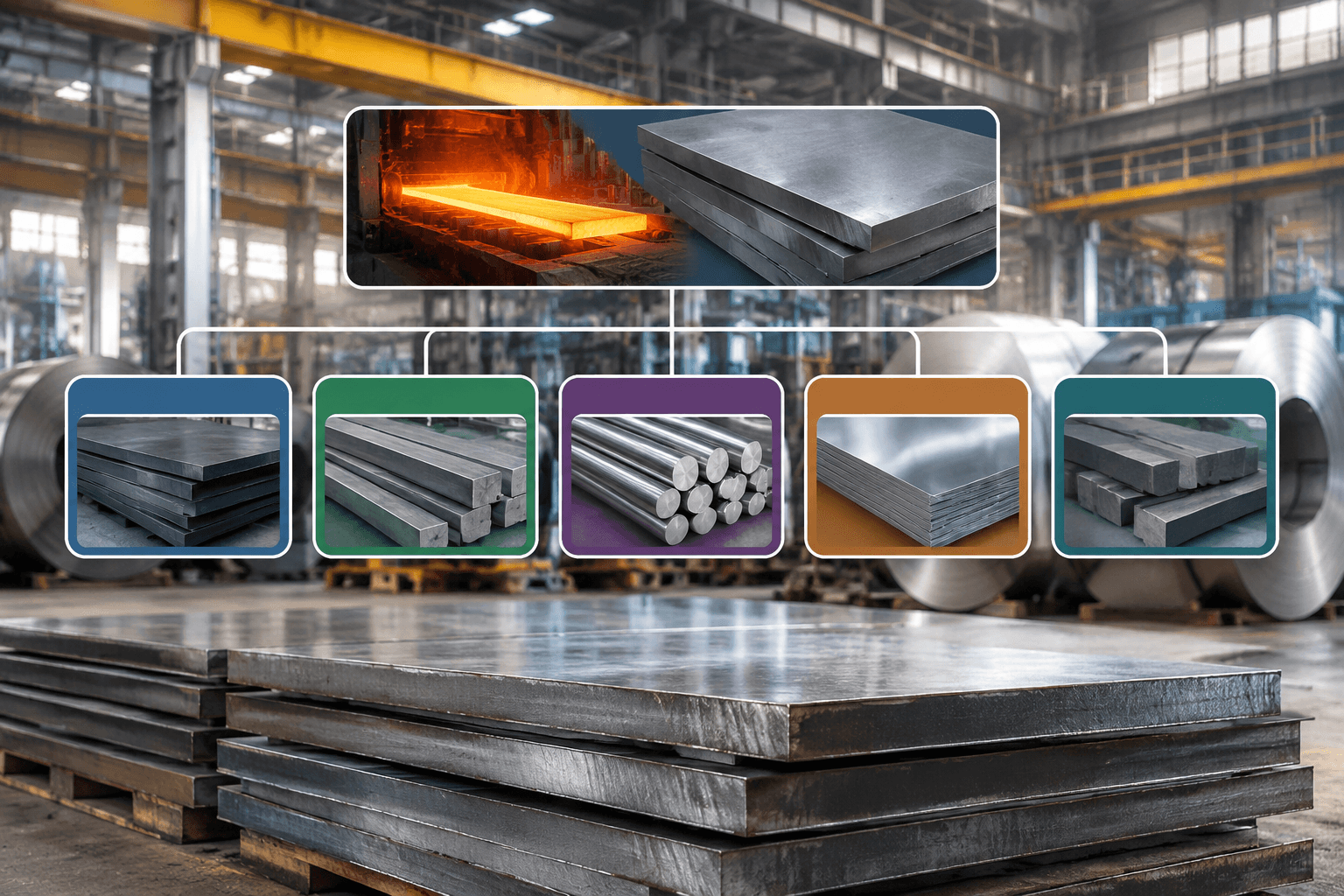
Alloy steel is a broad group of steels, not one material with a predictable set of properties. Alloying elements are added or controlled to influence characteristics such as hardenability, strength, toughness, wear resistance, corrosion behavior, or performance at elevated temperature. However, the word alloy alone does not establish how a steel will perform. Meaningful comparisons require the grade, applicable standard, heat-treatment condition, product form, section size, and service environment.
The category includes numerous low-alloy, high-alloy, stainless, tool, bearing, spring, and engineering steel families. These groups can overlap, and the boundaries are not defined by one alloy-percentage threshold that applies across every standard or designation system. The most useful first step is therefore to identify the relevant steel category before comparing individual grades.
Where Alloy Steel Fits Within the Steel Classification Map
Steel is primarily an iron-based material in which carbon and other elements influence its structure and performance. Broad labels such as carbon steel, low-alloy steel, high-alloy steel, stainless steel, and tool steel describe different classification perspectives. Some refer mainly to composition, while others also reflect intended performance, heat treatment, or application.
Carbon steel generally relies on carbon as the principal deliberate strengthening element, although manganese, silicon, and residual elements may also be present. It is not chemically pure iron and carbon. The practical distinction is that it is not primarily identified by substantial additions of elements such as chromium, nickel, or molybdenum for specialized performance.
Low-alloy steel typically contains deliberate alloy additions at levels intended to improve properties such as hardenability, strength, toughness, wear resistance, or temperature performance while retaining a broadly steel-like processing route. Chromium-molybdenum and nickel-chromium-molybdenum engineering steels are common examples. The numerical boundary between low- and high-alloy steel varies with the standard, technical reference, and classification purpose.
High-alloy steel contains a greater proportion of one or more alloying elements under the applicable classification system. Stainless steels and many tool steels fall within the wider high-alloy field, but those names communicate more specific material functions. High-alloy does not automatically mean stainless, and it does not identify a universal level of strength, hardness, or corrosion resistance.
Stainless steel is a corrosion-resistant alloy-steel category defined through the requirements of the relevant standard. Its behavior depends on composition, metallurgical structure, surface condition, fabrication history, and exposure environment. Stainless does not mean rustproof under every condition.
Tool steel is grouped primarily around performance in cutting, forming, molding, impact, or other tooling service. Tool steels commonly use combinations of carbon, chromium, molybdenum, vanadium, tungsten, or other elements, together with controlled heat treatment. Their defining feature is not simply a high alloy content but their intended tooling performance.
These categories should be treated as a map rather than a rigid ladder. A stainless grade may also be high-alloy, and a tool steel is also an alloy steel. A low-alloy engineering steel, by contrast, is not normally described as stainless merely because it contains some chromium.
What Common Alloying Elements Can Change
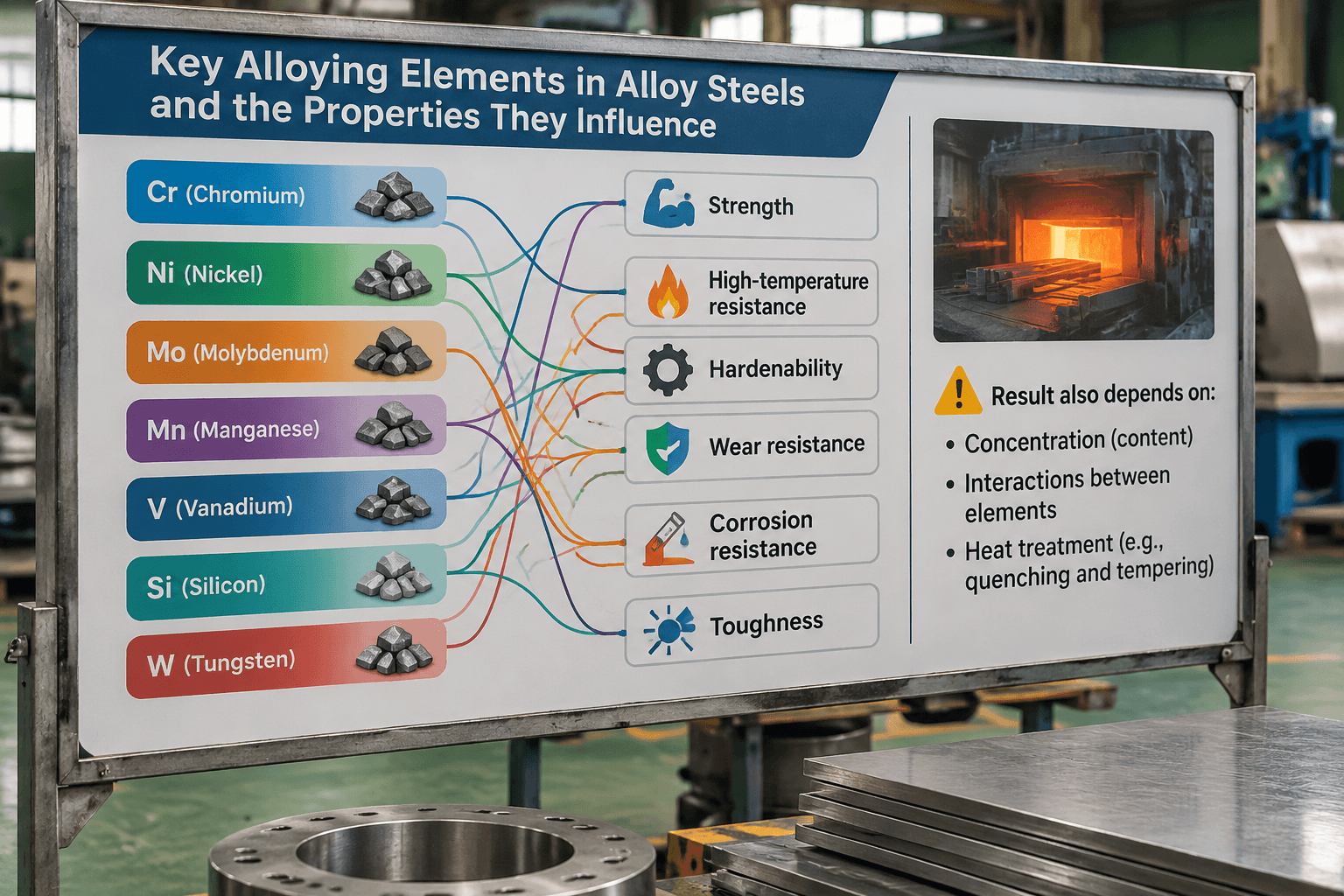
Alloying elements influence steel through their concentrations, interactions with other elements, response to heating and cooling, and effects on the resulting microstructure. No single element guarantees a finished property. For example, chromium can contribute to hardenability, wear behavior, oxidation resistance, or corrosion resistance, but the outcome depends on the complete composition and processing condition.
| Element | Characteristics it can influence | Important qualification |
|---|---|---|
| Carbon | Hardness potential, strength, wear resistance, carbide formation, and heat-treatment response | Increasing carbon can reduce ductility, toughness, or weldability in some grades and conditions. Carbon content alone does not determine final hardness. |
| Chromium | Hardenability, wear resistance, carbide formation, oxidation behavior, and corrosion resistance | Small or moderate chromium additions do not automatically make steel stainless or suitable for a corrosive environment. |
| Nickel | Toughness, strength, hardenability, corrosion behavior, and stability of certain metallurgical structures | Its effect depends on the wider alloy system and condition; nickel content alone does not establish impact performance. |
| Molybdenum | Hardenability, resistance to softening, elevated-temperature performance, and resistance to some forms of corrosion | The benefit varies with concentration, companion elements, heat treatment, and service temperature. |
| Manganese | Hardenability, strength, deoxidation, and control of sulfur-related effects during steelmaking | Manganese is present in many carbon and alloy steels, so its presence alone does not assign a steel to a specialized alloy family. |
| Silicon | Deoxidation, strength, elastic behavior in some spring steels, and oxidation performance in selected systems | Higher levels can affect forming, coating, or other processing behavior depending on the grade and product. |
| Vanadium | Grain refinement, precipitation strengthening, carbide formation, wear resistance, and resistance to softening | Results depend on thermal history and whether the vanadium is present in the form needed to produce the intended microstructure. |
| Tungsten | Hard-carbide formation, wear resistance, and retention of hardness in selected tool-steel applications | It is most meaningful as part of a designed tool-steel system rather than as an isolated indicator of performance. |
| Boron | Hardenability at carefully controlled addition levels | Its effectiveness is sensitive to steelmaking control, interactions with other elements, and heat treatment. More boron does not necessarily produce a better result. |
Several terms in this table are related but not interchangeable. Hardenability describes the ability to develop hardness through a section under a defined heat-treatment route; it is not the same as measured hardness. Strength concerns resistance to applied stress, while toughness concerns the ability to absorb energy before fracture. Ductility describes the capacity for plastic deformation, and wear resistance depends on the wear mechanism as well as hardness and microstructure.
Representative Alloy-Steel Families and Grade Examples
There is no short master list that captures every alloy steel. The following families and designations are representative examples used to illustrate how the field is organized. A grade name should always be read within its stated designation system; similar-looking names from different systems are not automatically equivalent.
| Representative family | Example designations | Typical material focus | Application context |
|---|---|---|---|
| Chromium-molybdenum engineering steels | SAE/AISI 4130 and 4140 | Heat-treatable strength, hardenability, and a balance of mechanical properties | Shafts, structural components, pressure-related products, gears, and machinery parts, subject to grade and condition |
| Nickel-chromium-molybdenum steels | SAE/AISI 4340 | Through-section hardenability and combinations of strength and toughness after appropriate processing | Highly loaded shafts, gears, fasteners, and structural parts where section size and impact demands matter |
| Bearing steels | SAE/AISI 52100 | Hardness potential, rolling-contact wear resistance, and controlled cleanliness and microstructure | Bearing races, rolling elements, and other contact-fatigue applications after suitable heat treatment |
| Spring steels | SAE/AISI 5160 and silicon-manganese spring-steel families | Elastic response, fatigue resistance, strength, and toughness in the specified condition | Springs, clips, suspension-related parts, and resilient components |
| Hot-work tool steels | AISI H13 | Resistance to softening, thermal cycling, wear, and heat-related cracking mechanisms | Hot-forming dies, extrusion tooling, and other tooling exposed to repeated heating |
| Cold-work tool steels | AISI D2 | Wear resistance, hardness, dimensional considerations, and resistance to deformation | Cutting, blanking, forming, and wear tooling where toughness requirements must also be evaluated |
| Stainless alloy steels | EN X5CrNi18-10 / 1.4301 and commonly associated grade names within other systems | Corrosion resistance combined with formability, toughness, or other structure-dependent characteristics | Equipment, enclosures, process components, and exposed parts selected for a defined environment |
These examples identify families, not guaranteed performance packages. A grade supplied as hot rolled, annealed, normalized, quenched and tempered, solution treated, cold worked, or otherwise processed may have substantially different properties. Product form also matters: plate, sheet, bar, tube, forging, casting, and wire may be governed by different requirements even when they share a related grade identity.
How to Read X5CrNi18-10 and Other Steel Designations
Steel designations do not follow one worldwide decoding method. EN symbolic names may communicate aspects of composition, while SAE/AISI, UNS, ASTM, JIS, and other systems use their own numbering or specification structures. A rule from one system should not be used to decode a grade from another.
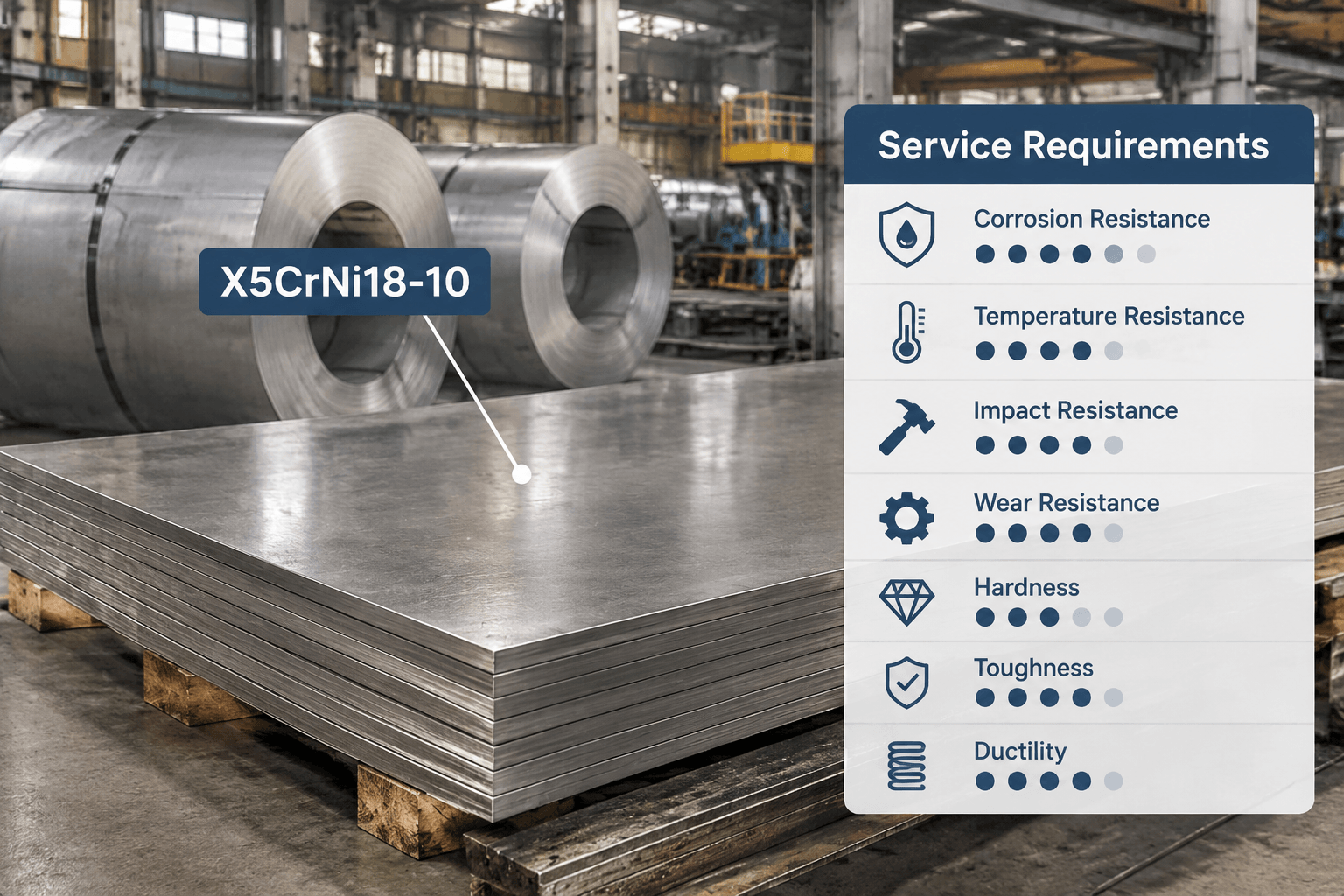
Annotated example: X5CrNi18-10
- X identifies the steel as high-alloy under the applicable EN symbolic naming approach.
- 5 indicates an approximate carbon level expressed through the naming convention in hundredths of a percent.
- CrNi identifies chromium and nickel as the principal named alloying elements.
- 18-10 indicates their approximate nominal percentages in the same sequence: chromium followed by nickel.
X5CrNi18-10 is associated with EN material number 1.4301 in the relevant designation framework. This identity is often discussed alongside familiar austenitic stainless grade names from other systems, but cross-system correspondence should be checked against the applicable product standard rather than assumed to be exact for every product or requirement.
The designation provides a useful composition signal, but it does not state every allowable element, mechanical property, delivery condition, surface requirement, dimensional tolerance, or corrosion limit. Those details belong in the governing standard, product specification, inspection document, and service assessment.
Composition, Heat Treatment, Product Form, and Service Work Together
Composition establishes the range of microstructures and responses a steel may be capable of developing. Heat treatment then controls transformations, carbide behavior, grain structure, hardness distribution, residual stress, and other features. The same nominal grade can therefore behave differently when delivered in different conditions.
Section size affects heating and cooling rates. A condition achieved in a small test piece may not represent the center of a much thicker component. Product-making routes can also introduce differences in grain flow, segregation, surface condition, directional properties, or available tolerances. This is why an isolated strength or hardness value should not be applied without confirming the grade, condition, product form, section dimensions, standard, and test basis.
Service conditions complete the picture. Corrosive media, temperature, load direction, cyclic stress, impact, contact pressure, abrasion, lubrication, surface finish, and joining history can all change which alloy-steel family is appropriate. Selection should begin with the failure modes that must be prevented, not with a search for the alloy steel described as universally strongest.
From Service Requirement to Alloy-Steel Category: A First-Pass Map
This matrix helps narrow the field, but it does not replace grade-level engineering validation.
| Service requirement | Properties to evaluate | Families that may warrant review | Questions that prevent a false match |
|---|---|---|---|
| Corrosive exposure | Resistance to the specific medium, temperature, concentration, deposits, and surface condition | Stainless steels or other corrosion-resistant alloy systems | What chemicals, moisture, chlorides, cleaning agents, temperatures, and contact materials are present? |
| Elevated-temperature service | Strength retention, oxidation behavior, thermal-fatigue resistance, creep where relevant, and resistance to softening | Chromium-molybdenum steels, heat-resistant stainless families, or hot-work tool steels | Is exposure continuous or cyclic, and is the critical limit strength, scaling, distortion, or thermal cracking? |
| Impact or shock loading | Toughness, ductility, notch sensitivity, strength, and behavior at the service temperature | Nickel-containing engineering steels and quenched-and-tempered low-alloy families | What is the lowest service temperature, section size, loading rate, and stress concentration? |
| Abrasive or contact wear | Hardness, carbide structure, toughness, contact stress, and compatibility with lubrication | Bearing, tool, or wear-resistant alloy-steel families | Is the mechanism abrasion, adhesion, rolling contact, impact wear, or a combination? |
| Cutting or drilling | Edge stability, wear resistance, hardness retention, toughness, and resistance to chipping | Cold-work, hot-work, high-speed, or other application-specific tool steels | What material is being cut, at what temperature and speed, and which failure mode limits tool life? |
| Resistance to permanent deformation | Yield behavior, hardness, section stability, fatigue resistance, and toughness | Heat-treatable low-alloy engineering steels, spring steels, or tool steels | Is the load static, cyclic, compressive, bending, torsional, or impact-driven? |
| Forming with retained ductility | Ductility, strain hardening, bend behavior, anisotropy, surface condition, and post-form properties | Suitable low-alloy sheet grades or formable stainless families | What product form, thickness, bend severity, forming direction, and final property level are required? |
Trade-offs are unavoidable. Higher hardness can improve resistance to some wear mechanisms but may increase sensitivity to cracking. Higher strength does not necessarily mean higher toughness. Greater ductility can support forming or energy absorption but does not by itself provide wear resistance. The required balance should be defined around the component and its credible failure modes.
These questions are especially relevant to automotive and transportation components exposed to cyclic loading, impact, wear, or demanding structural conditions. They also apply to material-handling and logistics equipment where load-bearing parts may need to resist wear or permanent deformation. These application contexts still require grade- and condition-specific evaluation.
Information Needed for a Material Review
Before evaluating whether an alloy-steel category is appropriate, organize the information that controls the decision:
- The current material designation or grade, including the designation system
- The applicable material and product standard
- The required delivery or heat-treatment condition
- The product form, approximate dimensions, and critical section sizes
- The service temperature, environment, loading, wear mechanism, and expected life
- The critical balance among corrosion resistance, hardness, strength, toughness, and ductility
This information supports a focused material and manufacturability review without assuming that all alloy steels can be processed or substituted in the same way.
Where RFQ Assumptions Create Cost and Production Risk
Many sheet metal fabrication problems begin before production starts. If drawings, tolerances, finish expectations, material grades, or assembly requirements are unclear, suppliers may quote based on different assumptions. That can make prices difficult to compare and may lead to rework, cosmetic rejection, assembly misalignment, or production delays later.
For OEM buyers, the goal is not simply to request the lowest price. The goal is to make sure each supplier is quoting the same manufacturing reality. Before confirming an order, clarify which dimensions are fit-critical, which surfaces are cosmetic, whether prototypes must match batch-production conditions, and how finished parts will be inspected.
Frequently Asked Questions
What alloy steels details should buyers define before requesting a quote?
Buyers should define the functional requirement, drawing notes, critical dimensions, material or process expectations, and any inspection points related to alloy steels. This helps suppliers quote the same manufacturing scope instead of making different assumptions.
How can RFQ details affect cost, fit, or lead time?
RFQ details can change tooling, forming, welding, finishing, inspection, or rework requirements. If buyers do not clarify it early, two supplier quotes may look comparable while covering different production risks.
Why should drawing requirements be reviewed before prototype approval?
drawing requirements may look acceptable on a single sample but become harder to control during batch production. Buyers should confirm whether the prototype reflects the same process, finish, and inspection conditions expected for production.
What inspection points matter most for alloy steels projects?
Important inspection points usually include fit-critical dimensions, holes or mating areas, cosmetic surfaces, finish build-up, welded or formed features, and any dimensions that affect downstream assembly. These points should appear in the RFQ or drawing notes.
How can buyers reduce prototype approval risk before batch production?
Buyers can reduce risk by clarifying drawings, locking key material and finish assumptions, defining inspection timing, approving a representative sample, and confirming which dimensions or surfaces require tighter process control.
How can Yishang help review alloy steels requirements?
Yishang can review drawings, RFQ notes, material requirements, tolerance expectations, finish details, samples, and assembly needs to identify unclear assumptions before quoting or batch production.