
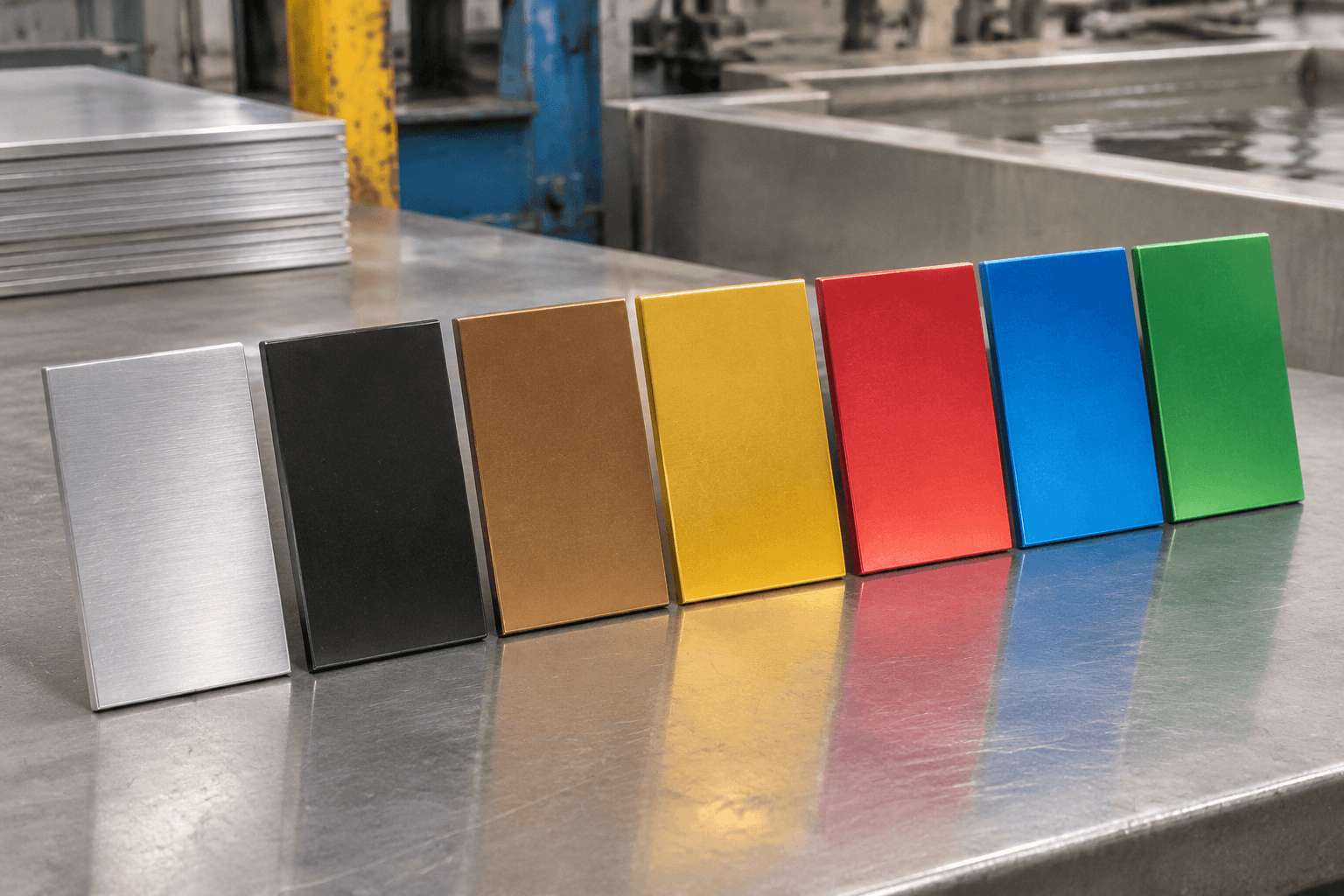
Aluminium anodizing colours commonly include natural silver, black, bronze, gold, red, blue, green, and many other decorative shades. The visible result is not determined by a colour name or dye alone: aluminium alloy, surface condition, oxide structure, colouring method, sealing, and viewing conditions all influence the final appearance.
An aluminium anodizing colours chart should therefore be treated as a representative selection tool, not a guarantee. For reliable approval, compare processed samples made from the intended material and finish under controlled lighting, then use measured colour differences where appropriate.
Available Colours and How They Are Produced
Anodizing forms a controlled aluminium oxide layer on the part surface. In decorative sulfuric-acid anodizing, this layer initially contains microscopic pores. Depending on the required appearance, the oxide may remain substantially natural, absorb a dye, receive electrolytically deposited material, or develop colour during oxide formation. Sealing subsequently closes or stabilizes the pores.
| Colour route | How the appearance develops | Typical colour families | Selection considerations |
|---|---|---|---|
| Clear or natural anodizing | The oxide remains uncoloured, so the underlying aluminium and surface preparation dominate the appearance. | Silver, clear, satin silver, grey-silver | It is not optically transparent. Alloying elements, coating thickness, etching, polishing, and grain structure can make the finish brighter, greyer, or more matte. |
| Dyed anodizing | Organic or inorganic dye enters the porous oxide before sealing. | Black, red, blue, green, gold, yellow, violet, orange, and mixed shades | The available shade and durability depend on the dye system, oxide quality, concentration, temperature, immersion time, sealing, and exposure requirements. |
| Electrolytic colouring | After anodizing, alternating current deposits metallic material near the base of the pores. | Champagne, light bronze, medium bronze, dark bronze, brown, and black | Commonly used for stable bronze-to-black families. Shade is controlled through the oxide, electrolyte, electrical cycle, and deposition conditions. |
| Integral colouring | Colour forms while the anodic oxide is being produced in a specially controlled electrolyte. | Amber, bronze, brown, grey, and black families | It is a distinct process route rather than ordinary clear anodizing followed by dye. Alloy response and line-specific chemistry remain important. |
These families do not represent universal shades. One supplier’s “gold” may be yellow-gold, champagne, brass-like, or brown-gold, while black can appear neutral, blue-black, purple-black, or warm brown under different conditions.
Why Identically Specified Parts Can Look Different
Alloy composition and temper
Different aluminium alloys contain different amounts and forms of magnesium, silicon, copper, manganese, iron, zinc, and other constituents. These elements can alter the natural tone, brightness, oxide development, and dye response. Even nominally similar alloys may show variation when material comes from different mills, heats, extrusion lots, or sheet batches.
Temper and previous thermal processing can also change the microstructure. A machined component cut from plate may therefore look different from a formed sheet part or extrusion, even if all three receive the same nominal colour process. Keeping visible components within a controlled alloy, temper, and material source reduces one major cause of mismatch.
Grain structure and production history
Rolling direction, extrusion flow lines, die condition, cooling, stretching, and heat treatment can produce directional grain patterns. Anodizing does not cover these structures like paint; it converts the existing surface. Consequently, adjacent components can reflect light differently when their grain directions or manufacturing routes are not aligned.
This is particularly relevant to custom aluminium extrusion components. Extrusions intended for appearance-controlled assemblies should be assessed by production lot, visible face, grain direction, and pretreatment—not by alloy designation alone.
Surface preparation and defects
Mechanical polishing can create a reflective finish, brushing produces directional lines, and blasting creates a diffuse matte texture. Chemical cleaning, etching, and desmutting further influence gloss and colour depth. These operations must be controlled consistently because the same dye can look lighter on a reflective surface and softer or darker on a matte one.
Scratches, dents, tool paths, polishing waves, embedded contamination, weld zones, heat-affected areas, and inconsistent sanding can remain visible after anodizing. Weld filler and the parent metal may anodize to different tones. Anodizing should not be specified as a method for hiding substrate defects.
Process Variables That Control Shade and Uniformity
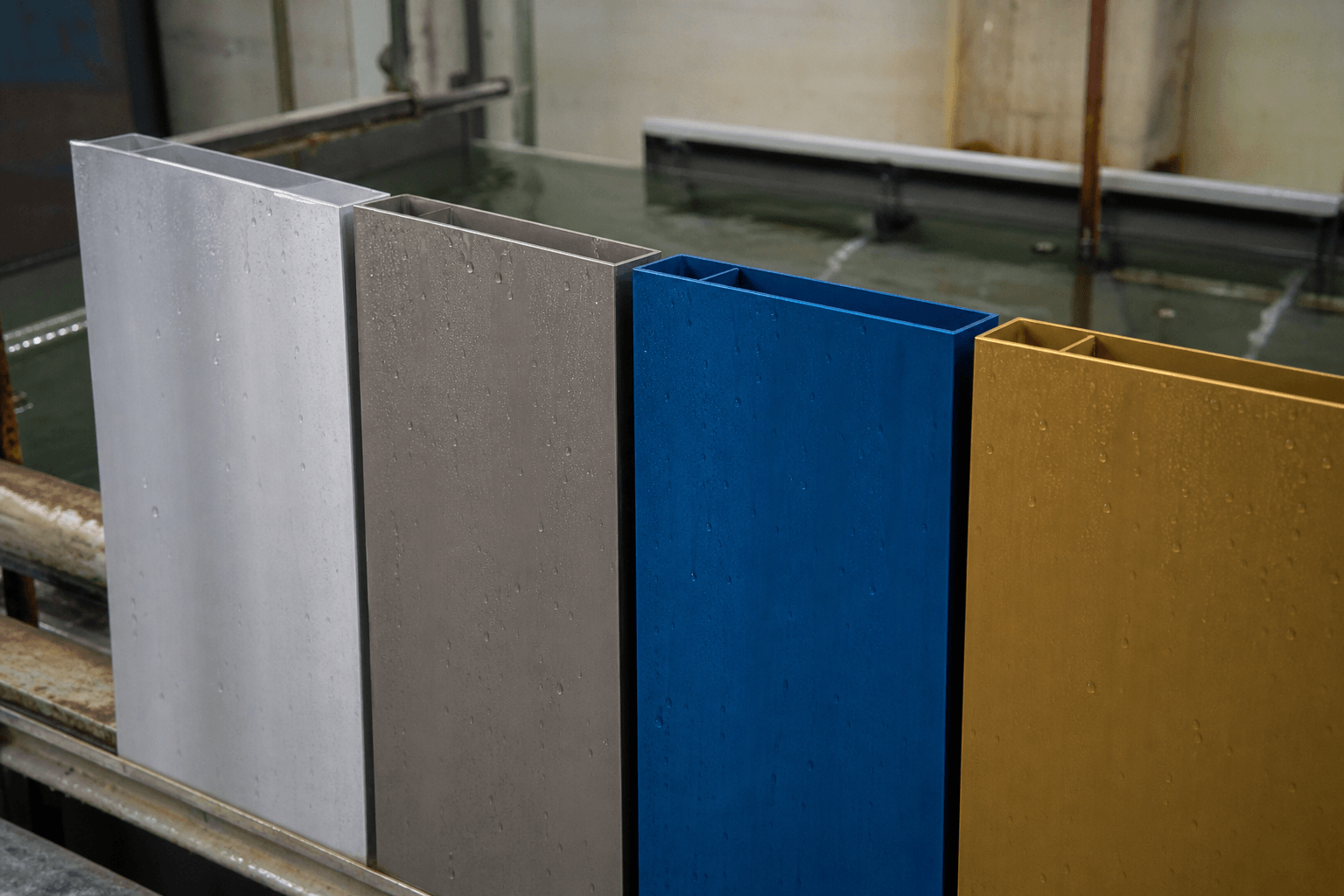
Decorative colour depends on a connected process system. Changing one variable may alter oxide growth, pore size, dye uptake, reflectivity, or sealing response, so isolated settings should not be copied between anodizing lines without trials.
| Variable | Possible effect on colour | What requires control |
|---|---|---|
| Oxide-layer thickness | Changes natural tone, optical response, and the volume of porous oxide available for colouring. Insufficient or uneven oxide can produce weak or inconsistent dye uptake. | Thickness target appropriate to the process, application, alloy, colour route, and exposure. |
| Current density and voltage | Affect oxide growth and uniformity. Poor electrical contact or uneven current distribution can create light areas, edge differences, or rack-related variation. | Part area calculations, contact quality, rack design, electrical ramp, load geometry, and rectifier calibration. |
| Bath temperature and anodizing time | Influence the balance between oxide formation and chemical dissolution. Temperature gradients may change pore structure and colour response across a load. | Temperature stability near the work, cooling capacity, load size, immersion time, and agitation. |
| Solution chemistry | Acid concentration, dissolved aluminium, impurities, and water quality affect oxide formation and consistency. | Scheduled analysis, filtration, replenishment, contamination control, and documented bath limits. |
| Agitation and part orientation | Poor solution movement can allow local heating, trapped gas, or uneven mass transfer, leading to streaks or patchy regions. | Solution circulation, air agitation where appropriate, spacing, drainage, and avoidance of trapped pockets. |
| Dye concentration, pH, and temperature | Influence uptake rate, saturation, hue, and reproducibility. A bath can shift as dye is consumed or contaminated. | Dye-specific technical instructions, bath analysis, calibrated pH and temperature measurement, and controlled additions. |
| Dye immersion and rinsing | Time affects colour depth, while acid carryover or inadequate rinsing may cause uneven uptake or contamination. | Transfer time, rinse quality, rinse agitation, immersion timing, and consistent loading. |
| Sealing | Can alter the final shade and gloss while stabilizing the coloured oxide. Inconsistent sealing may contribute to colour shift, bleeding, staining, or poor durability. | Sealer type, water quality, concentration, pH, temperature, time, contamination, and post-seal handling. |
Stable production also depends on filtration, preventive equipment maintenance, calibrated instruments, bath-analysis frequency, operator procedures, and environmental control. Statistical process control can reveal gradual movement before it becomes an obvious visual mismatch.
Defining and Approving an Acceptable Colour
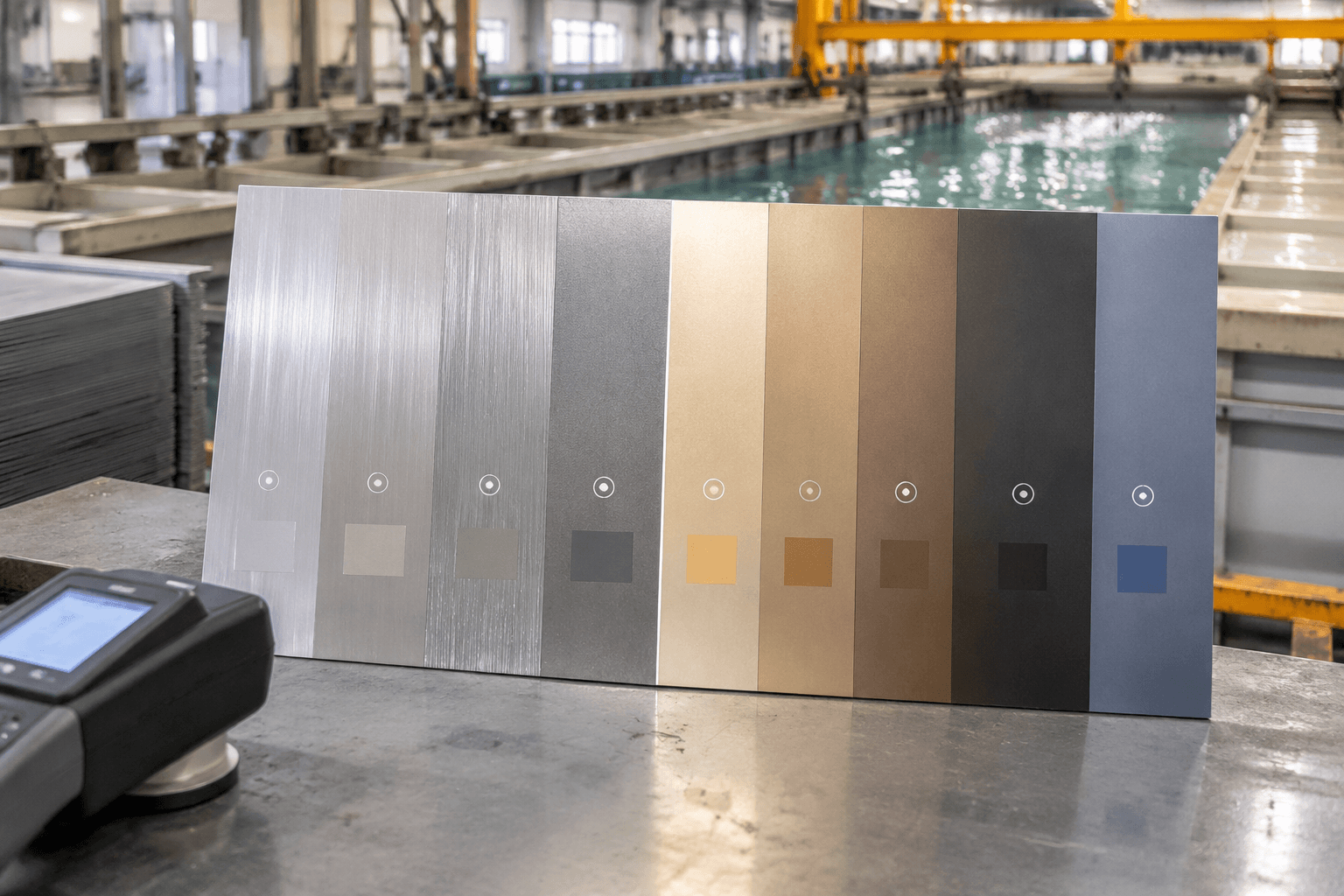
A colour name, photograph, rendering, or screen image is not a sufficient production standard. Screens emit light, whereas anodized aluminium reflects it. Camera exposure, white balance, image compression, monitor calibration, surrounding colours, and room lighting can all change the apparent shade.
- Prepare representative samples. Use the intended alloy, temper, production route, surface texture, pretreatment, oxide process, colouring method, and sealing system. A flat laboratory coupon may not represent a curved, brushed, machined, or welded production part.
- Define the viewing setup. Record the illuminant or light source, viewing angle, distance, sample orientation, background, and whether the assessment includes directional grain or gloss. Rotate brushed samples consistently because orientation can change perceived brightness.
- Approve physical limits. Where appearance is critical, use an approved production sample or agreed light and dark boundary samples. Protect and identify these references so ageing, handling, and contamination do not quietly change the standard.
- Measure colour differences. A spectrophotometer can report L* for lightness, a* along the red–green axis, and b* along the yellow–blue axis. Delta E summarizes measured difference, but the formula, instrument geometry, illuminant, aperture, and inclusion or exclusion of specular reflection must be agreed.
- Sample the production spread. Check more than one convenient part. Sampling may need to cover rack positions, load edges and centres, separate extrusion lengths, cavities, material lots, and multiple production batches.
Instrument readings and visual judgement are complementary, not interchangeable. Two textured surfaces can produce similar numerical colour readings yet look different because of gloss or directionality. Conversely, a small measured difference may be visually noticeable on large adjacent panels. This matters in appearance-controlled automotive and transportation metal components and in lighting fixtures and equipment, where colour, reflectivity, and texture interact.
Anodized Colour Variation: Symptom, Likely Source, and What to Check
| Observed symptom | Possible source | Investigation direction |
|---|---|---|
| Entire batch is lighter or darker | Oxide thickness, dye condition, immersion time, bath temperature, material lot, or measurement setup | Compare process records, thickness results, retained samples, bath analysis, and alloy traceability before adjusting colour. |
| Streaks following the metal direction | Extrusion grain, rolling pattern, polishing, brushing, etching, or material segregation | Inspect untreated material and compare streak direction with extrusion or rolling history. |
| Random blotches or cloudy areas | Cleaning residue, contamination, uneven etching, trapped gas, poor rinsing, local overheating, or dye circulation | Review pretreatment cleanliness, rack orientation, agitation, temperature mapping, and rinse condition. |
| Edges differ from broad surfaces | Current-density distribution, geometry, oxide variation, aggressive finishing, or light reflection | Measure representative locations and inspect rack layout, edge condition, and viewing angle. |
| Visible rack or contact marks | Necessary electrical contact, loose contact, unsuitable rack location, or current interruption | Confirm that contact points are placed on non-visible or permitted surfaces and remain secure throughout processing. |
| Black appears grey, brown, blue, or purple | Low colour saturation, alloy tone, thin or unsuitable oxide, dye imbalance, sealing shift, or lighting | Compare under controlled illumination and review oxide, dye, sealing, and substrate records rather than adding dye automatically. |
| Colour fades or rubs after processing | Incomplete sealing, unsuitable dye for exposure, chemical attack, heat, ultraviolet exposure, or handling contamination | Review dye selection, sealing control, service environment, cleaning chemicals, and storage conditions. |
| Separate batches do not match | Different material lots, pretreatment condition, bath age, rack loading, dye state, sealing, or inspection conditions | Compare retained samples and complete traceability across material, preparation, anodizing, colouring, sealing, and inspection. |
Review the Colour Definition Before Production
For a custom OEM or ODM metal product, colour control should begin before material purchasing and surface finishing.
For a technical review, provide the part drawing or representative photographs, aluminium alloy and temper, required surface texture or pretreatment, target physical colour sample or approved reference part, expected quantity, and identification of appearance-critical surfaces. This information helps determine whether the material, surface preparation, colour route, and approval method are defined clearly enough for production planning.
Frequently Asked Questions
Can the colour of already-anodized aluminium be changed?
Normally, a significant colour change requires removal of the existing anodic layer followed by surface preparation, re-anodizing, recolouring, and sealing. Stripping removes material and may affect dimensions, edges, texture, or appearance, so feasibility should be reviewed against part tolerances and visible-surface requirements.
Why does black anodized aluminium sometimes look grey, brown, blue, or purple?
Black appearance depends on dye saturation or electrolytic deposition, oxide structure, alloy tone, surface texture, sealing, and lighting. A glossy black part may also reflect surrounding colours strongly. Investigation should separate a true colour-process shift from differences in gloss, grain, geometry, and viewing conditions.
Does a thicker anodized layer always produce a darker colour?
No. Oxide thickness can influence natural tone and dye capacity, but colour depth also depends on pore structure, dye chemistry, concentration, temperature, time, pretreatment, and sealing. Excess thickness does not automatically correct weak dye uptake and may create other dimensional or appearance concerns.
What information is needed to match an existing anodized component?
Start with a protected physical reference part, alloy and temper, material form, surface preparation, colouring method if known, gloss or texture requirement, viewing conditions, and acceptable variation. Photographs or colour names can support communication, but they should not replace a representative sample and an agreed inspection method.