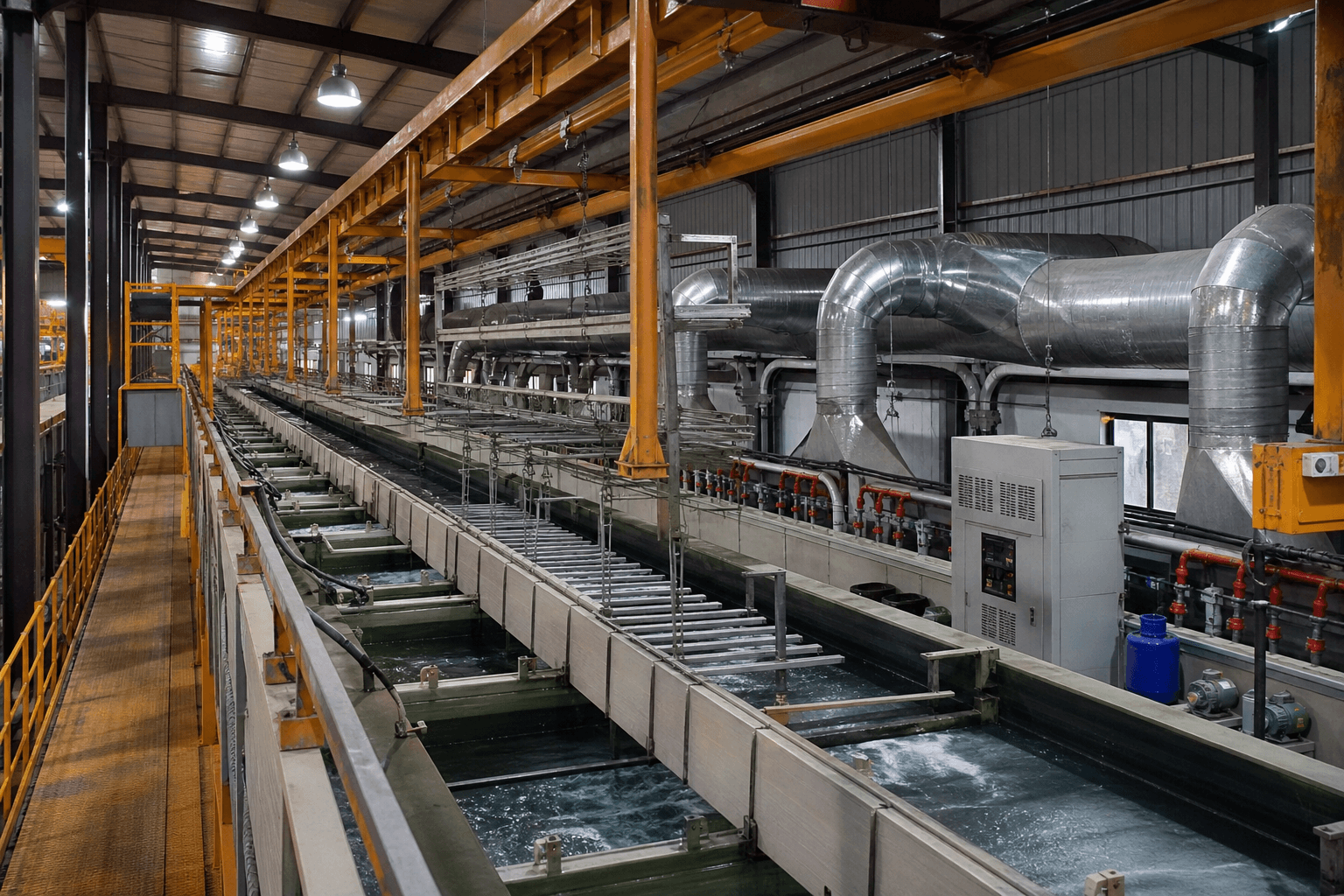
An aluminium anodizing plant is an integrated production system that prepares aluminium parts, forms a controlled oxide layer electrochemically, optionally colours it, seals it, and manages rinsing, drying, inspection, and waste treatment. The plant is more than the anodizing tank: it includes the full tank train, rectifier, utilities, ventilation, material handling, process controls, water treatment, and wastewater infrastructure.
A suitable line must match the alloy, part envelope, total surface area, finish requirement, production mix, and local environmental obligations. A plant designed around small decorative components may not have the tank clearance, electrical capacity, cooling load, handling system, or colour controls needed for large industrial parts.
From Loading to Inspection: The Complete Production Flow
Although the exact sequence depends on alloy, surface condition, finish specification, and plant chemistry, an industrial line generally follows the product path below. Multiple rinse stages are often positioned between chemical baths to limit drag-in and cross-contamination.
Product flow: Part inspection → racking and electrical contact → cleaning → rinsing → etching or another surface-preparation step when required → rinsing → desmutting when required → rinsing → anodizing → rinsing → optional electrolytic colouring or dyeing → rinsing → sealing → rinsing → drying → unloading and inspection
Supporting flow: Water supply and treatment → rinse management → segregated chemical waste streams → neutralisation or other required treatment → compliant discharge, recovery, or off-site disposal
Cleaning removes oils and shop contamination. Etching can create a more uniform matte appearance, but it also changes the surface and may reveal differences caused by extrusion, machining, welding, or handling. Desmutting removes residues that remain after alkaline treatment, particularly when alloying constituents do not dissolve at the same rate as aluminium.
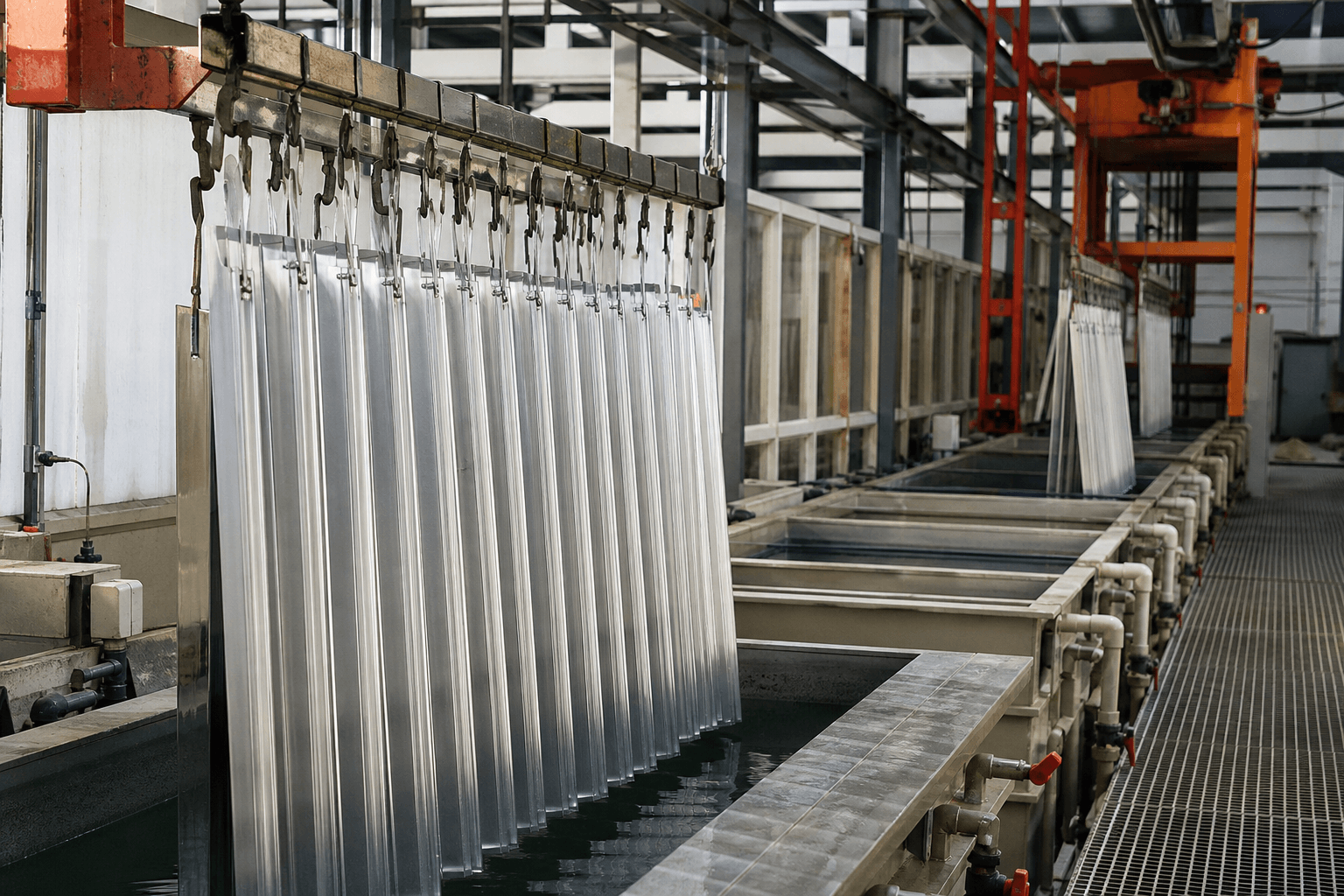
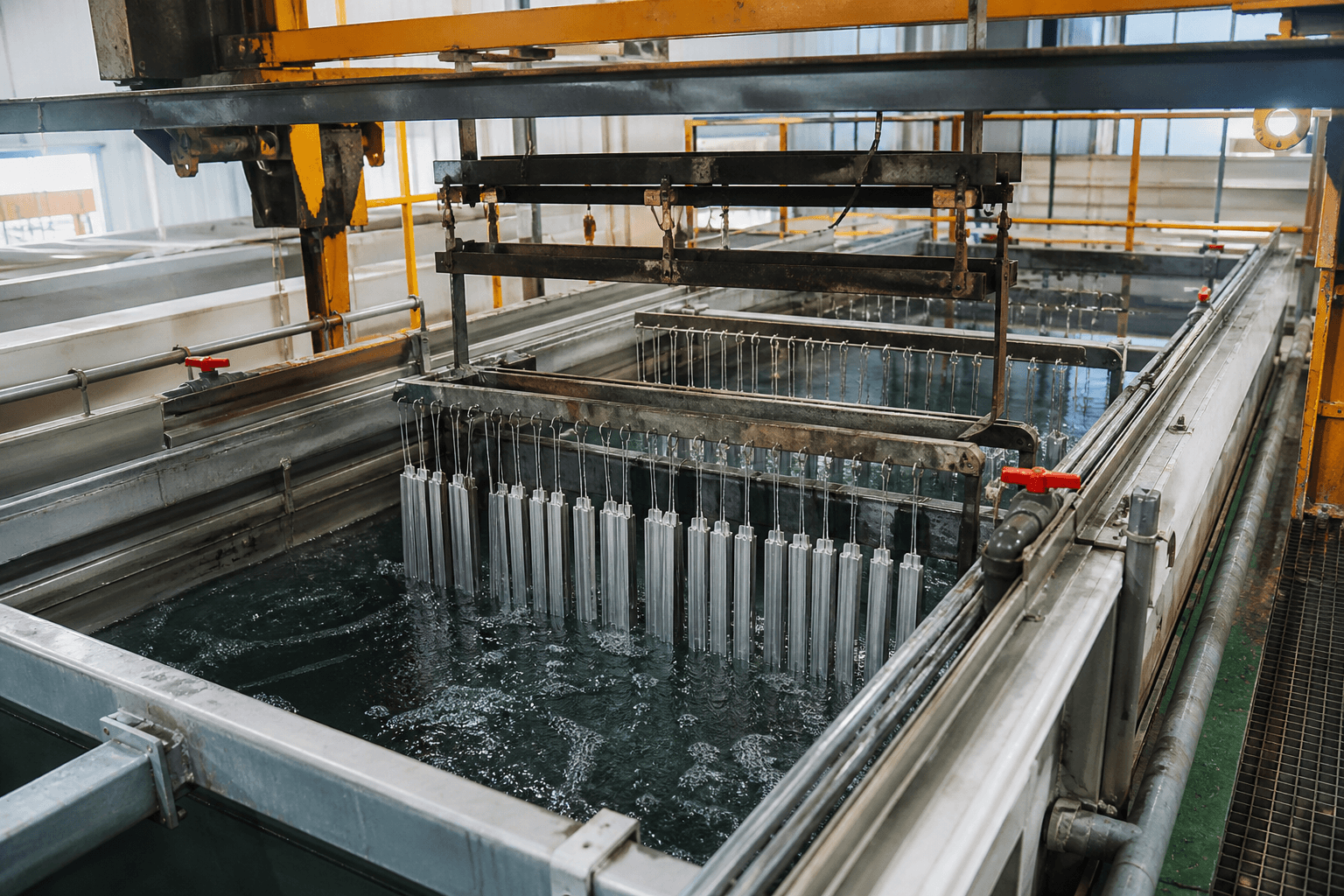
In the anodizing bath, the workpiece acts as the anode and becomes part of the electrical circuit. The oxide forms from the aluminium surface rather than being deposited like paint. Colouring is optional and may require dedicated baths and tighter appearance controls. Sealing closes or modifies the porous oxide structure to support the specified performance. Drying must avoid stains, retained solution, and handling damage.
Major process families are not interchangeable. Chromic-acid, sulfuric-acid, hard-anodizing, and plasma electrolytic oxidation processes can require different chemistries, power supplies, cooling capacity, tanks, ventilation, safety measures, and inspection methods. Plant configuration should therefore begin with the required process and specification, not simply the word “anodizing.”
Which Equipment and Utilities Does the Line Need?
Equipment selection must consider both chemical compatibility and operating conditions. Tank, pipe, pump, heater, seal, fixture, and exhaust materials should be selected for the particular solution concentration and temperature rather than assumed to be universally suitable.
| Plant function | Typical equipment | Engineering questions |
|---|---|---|
| Wet processing | Cleaning, etching, desmutting, anodizing, colouring, sealing, and rinse tanks | What working volume, freeboard, part clearance, and chemical-compatible construction are required? |
| Electrical conversion | Rectifier, busbars, cathodes, racks, contacts, cables, and electrical protection | Can the system maintain the required current distribution across the loaded surface area? |
| Temperature management | Heaters, cooling coils or heat exchangers, chillers, sensors, and circulation loops | How much heat enters from the electrical cycle, pumps, ambient conditions, and incoming loads? |
| Bath uniformity | Solution circulation, agitation, filtration, and suitable pumps | Will flow reach recessed areas without causing unacceptable local variation or excessive foaming? |
| Fume control | Tank hoods, local exhaust, ducting, mist control, and make-up air | Are capture rates, materials, worker exposure controls, and discharge requirements suitable for local rules? |
| Part movement | Manual hoists, overhead transporters, programmed cranes, racks, drip stations, and load/unload areas | Can the system control immersion, dwell, transfer time, drainage, and safe load movement? |
| Water and waste | Water treatment, rinse controls, holding tanks, dosing systems, monitoring, and sludge handling | Which waste streams require segregation, treatment, recovery, documentation, or external disposal? |
| Process management | Control panels, alarms, recipes, data logging, laboratory equipment, and inspection stations | Which parameters need automated control, operator confirmation, and lot-level records? |
Layout matters as much as individual equipment. Wet stages need safe access and containment, while chemical storage, laboratories, electrical equipment, and loading areas may require separation. Maintenance access around pumps, filters, heat exchangers, and exhaust ducting should be planned before tank positions become fixed.
How Plant Capacity Is Calculated
Tank length alone does not define capacity. The limiting factor may be usable rack area, part spacing, rectifier output, heat removal, rinse performance, hoist availability, or the slowest process stage.
A practical capacity calculation starts with these relationships:
- Part envelope: Confirm the maximum length, width, height, orientation, and required clearance from the tank walls, liquid level, cathodes, coils, and adjacent parts.
- Surface area per load: Calculate all exposed surfaces, including edges, holes, and internal features where applicable. Multiply by the number of parts on a rack.
- Rack density: Determine spacing for solution movement, electrical uniformity, drainage, and acceptable contact locations. Maximum physical packing is rarely the maximum reliable process load.
- Electrical demand: Apply the approved current-density basis to the actual anodized area, then verify rectifier, busbar, contact, and cooling capacity.
- Cycle time: Include loading, preparation, each rinse, anodizing, colouring, sealing, transfer, drainage, unloading, inspection, changeover, and planned maintenance.
- Operating pattern: Account for shifts, product mix, colour changes, re-racking, bath analysis, downtime, and rejected or reworked loads.
A non-numerical sizing workflow is: group parts by process route; establish the rack layout for each family; calculate exposed area per load; identify the electrical and thermal demand; map dwell and transfer times; find the bottleneck stage; then apply realistic shift availability. Repeating this for low-volume large parts and high-volume small parts prevents an average product from hiding the true constraint.
Parallel tanks can reduce bottlenecks, but only if handling, rectifier allocation, rinsing, and downstream sealing capacity can support them. Automated transport can improve timing consistency, although automation cannot correct poor rack contact, unsuitable alloy selection, or inadequate drainage.
Control Points Behind Consistent Coating and Colour
Repeatability depends on controlling the incoming surface and the process history, not just measuring the finished coating.
| Control stage | Items to monitor | Risk if uncontrolled |
|---|---|---|
| Incoming part | Alloy and condition, surface finish, welds, machining marks, contamination, and lot identity | Streaks, mottling, shade differences, or inconsistent oxide formation |
| Preparation baths | Concentration, temperature, time, dissolved aluminium, contamination, and rinse quality | Over-etching, retained smut, dimensional change, or uneven appearance |
| Anodizing cycle | Bath chemistry, temperature, agitation, current density, voltage response, time, contact quality, and load area | Thickness variation, burning, weak areas, or inconsistent pore structure |
| Colouring | Dye or electrolyte condition, pH where applicable, temperature, immersion time, prior oxide condition, and rinse carryover | Lot-to-lot or within-rack colour variation |
| Sealing | Bath condition, temperature, time, contamination, water quality, and loading | Failure to achieve the specified sealing or appearance outcome |
| Final inspection | Coating thickness, visual criteria, colour measurement when specified, sealing-quality test, dimensions, contact marks, and damage | Parts passing visual checks while missing functional or dimensional requirements |
Colour approval should define the viewing method, lighting, reference sample or numerical colour limits, gloss or texture expectations, and acceptable variation between parts and lots. Dye colour is not automatically permanent or identical from batch to batch; alloy, oxide structure, dye condition, sealing, UV exposure, and service environment all matter.
Traceability can link the production lot to the alloy, rack position, bath-analysis status, electrical recipe, operator or automated cycle, colouring bath, sealing conditions, and inspection results. Alarm limits and recipe control are useful, but periodic laboratory checks and preventive maintenance remain necessary.
Is the Plant Suitable for Your Aluminium Part?
Suitability is a combined part, process, and end-use decision. Review the following issues before assigning a part to a line.
| Part or requirement | Plant/process review |
|---|---|
| Alloy and manufacturing route | Confirm expected appearance and performance for the specific alloy and condition. Aluminium extrusion components may show die lines or metallurgical variation, while die-cast housings and structures can respond differently because of alloy composition, porosity, and casting condition. |
| Blind holes, cavities, and tubes | Provide drainage and venting where practical. Trapped solution can contaminate later baths, stain parts, create safety risks, or interfere with sealing and drying. |
| Rack contact restrictions | Identify permitted contact marks and electrically reliable locations. Small or hidden contact areas may not carry the required current. |
| Threads, fits, and critical dimensions | State dimensions before and after processing, masking needs, and inspection method. Oxide growth and preparatory material removal can affect fits; the effect depends on process, target coating, alloy, and geometry. |
| Welded or assembled parts | Check filler alloy, crevices, mixed metals, trapped chemicals, and whether components should be anodized before assembly. |
| Service exposure | Define abrasion, corrosion, chemicals, UV, cleaning, thermal cycling, and cosmetic priorities. Anodizing improves selected properties but does not make a surface immune to scratching, fading, corrosion, cracking, or maintenance. |
Plant Sizing and Part-Suitability Input Worksheet
- Drawing revision, alloy, temper or material condition, and upstream manufacturing route
- Maximum part envelope, orientation, individual weight, and total exposed surface area
- Batch quantity, annual volume, product mix, shift pattern, and throughput target
- Required process family, finish, colour, texture, and approved appearance criteria
- Permitted rack-contact locations, masked areas, blind features, and drainage concerns
- Critical dimensions, threads, fits, and required pre- and post-process inspection
- Service environment and priorities for corrosion, wear, appearance, adhesion, or thermal cycling
- Available electrical power, water quality, heating, cooling, ventilation, floor space, and handling capacity
- Applicable chemical storage, worker protection, wastewater, discharge, and reporting obligations
Frequently Asked Questions
What does the 720 rule estimate?
The 720 rule is a conventional calculation relating current density, anodizing time, and target coating thickness for aluminium under assumed current efficiency. A common form estimates time in minutes as 720 multiplied by desired thickness in mils, divided by current density in amperes per square foot. It is not a complete plant-sizing method: actual results depend on process chemistry, alloy, temperature, current efficiency, rack contact, geometry, agitation, and bath condition. The approved specification and measured results should govern production.
What determines aluminium anodizing plant cost or outsourced unit cost?
Plant investment is driven by tank size and quantity, process family, rectifier capacity, heating and cooling, automation, ventilation, water treatment, wastewater systems, building work, laboratory needs, and local compliance. Outsourced unit cost depends on part size, surface area, racking difficulty, batch quantity, colour, masking, inspection, specification, packaging, and minimum lot charges. A price without these inputs is not a reliable comparison.
Can aluminium be anodized with a home kit?
Small-scale anodizing is technically possible, but it involves corrosive chemicals, electrical power, fumes, temperature control, rinsing, chemical storage, and regulated waste. A controlled industrial line adds engineered ventilation, compatible tanks, repeatable electrical control, water management, bath analysis, traceability, inspection, and worker-protection procedures. DIY content should not be treated as a substitute for site-specific safety and environmental requirements.
How do maximum part size and rectifier capacity limit a plant?
A part must fit within the usable working envelope, not merely inside the tank. Clearance is needed around cathodes, coils, walls, racks, and nearby components. The rack must also provide secure contact and drainage. Even when a load physically fits, its total surface area may exceed the rectifier, busbar, contact, agitation, or cooling capacity. Maximum part dimensions and maximum load area should therefore be evaluated separately.