
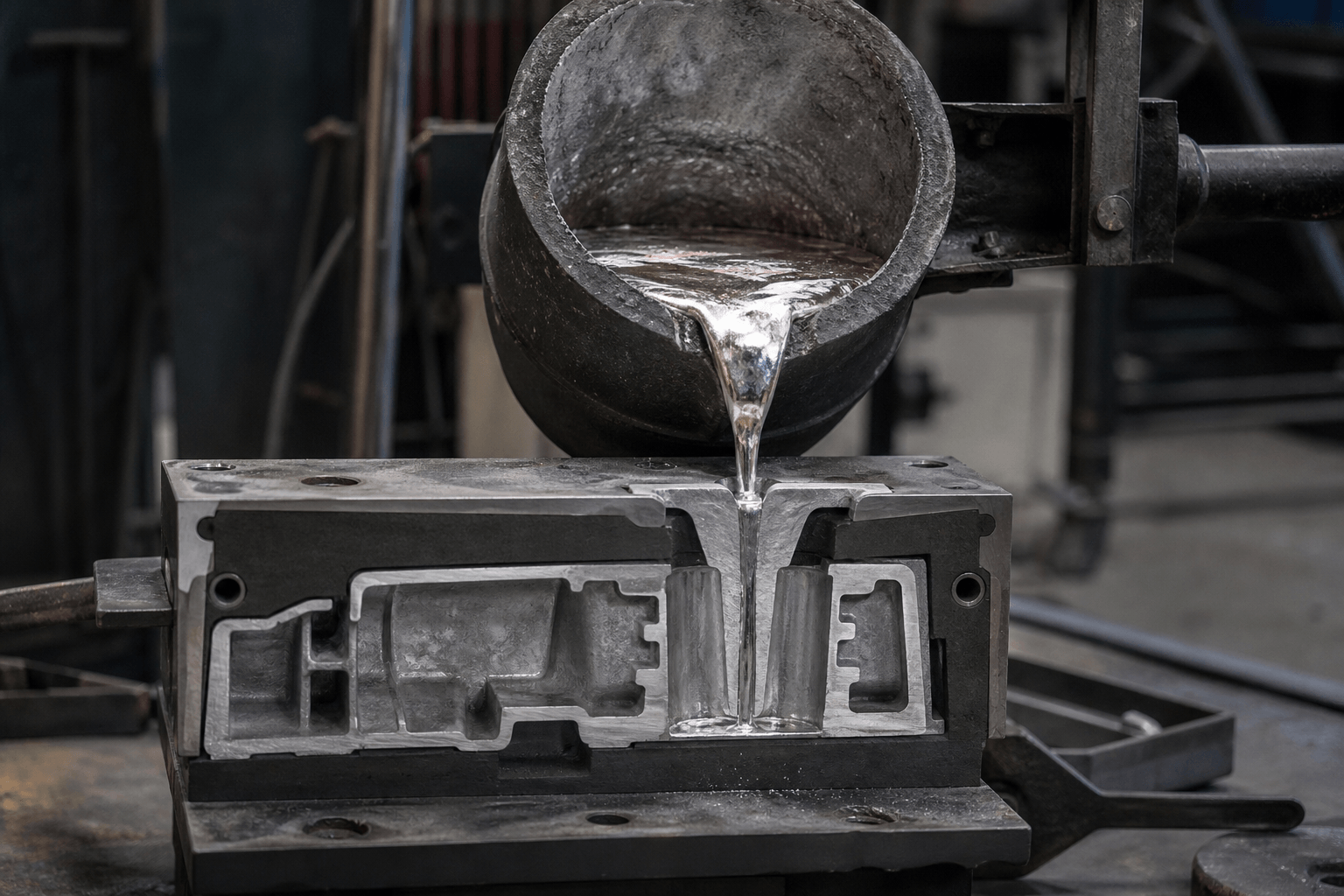
Aluminium casting is the process of pouring or injecting molten aluminium alloy into a shaped mould or die, allowing it to solidify, and removing the resulting component. The aluminium casting process generally moves from alloy and mould preparation through melting, filling, solidification, removal, trimming, optional secondary operations, and inspection.
The exact route depends on the mould material, filling mechanism, component geometry, production quantity, selected casting alloy, surface expectations, and quality requirements. Sand casting, gravity die casting, high-pressure die casting, and low-pressure die casting are four commonly compared methods, but they are not the only ways to cast aluminium.
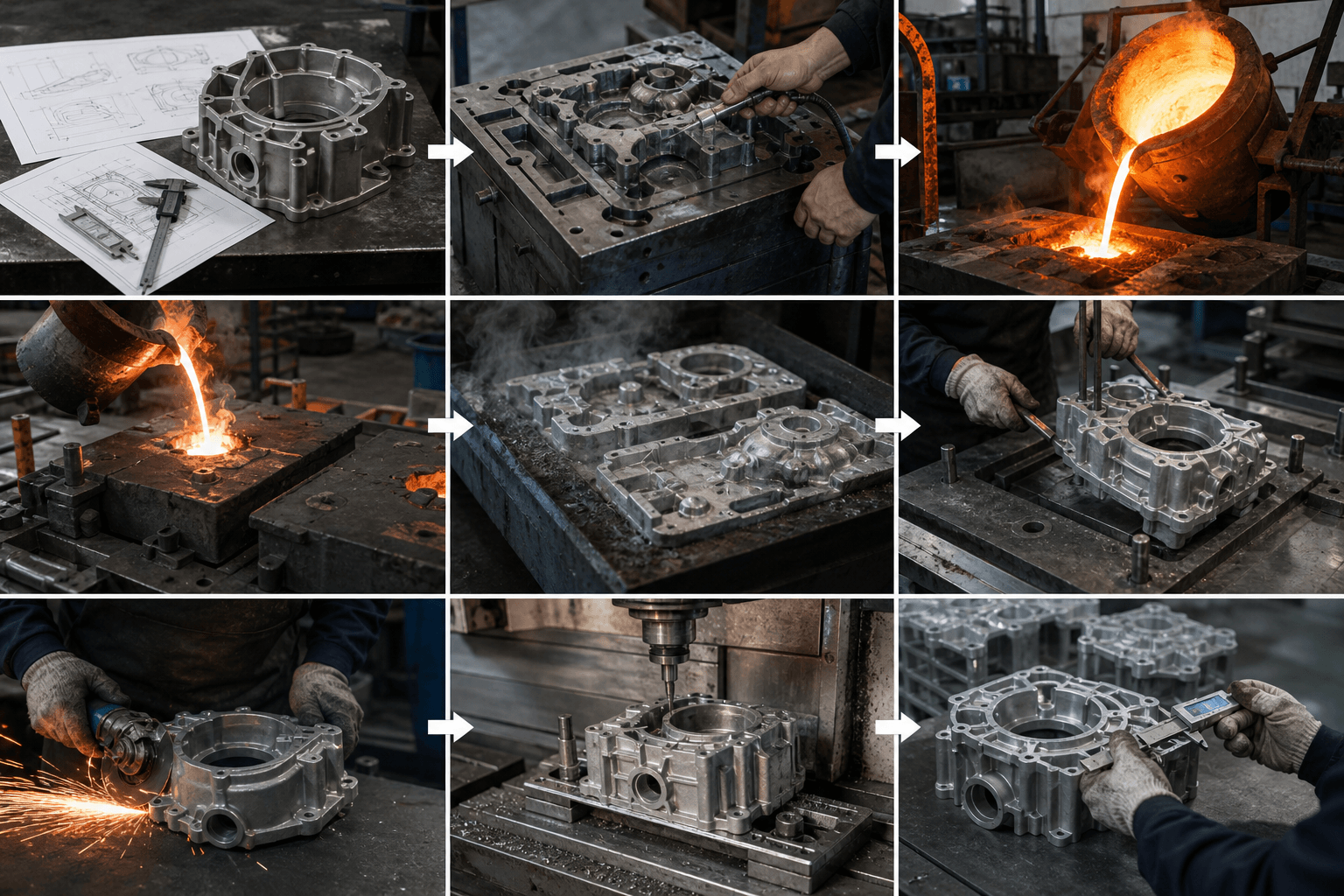
Aluminium Casting Process Step by Step
Although equipment and controls differ by method, most foundry workflows contain the following stages. Decisions made early in the sequence affect solidification, defect risk, machining requirements, and final assembly fit.
Requirements and alloy selection → mould or die preparation → melting and treatment → mould filling → solidification → part removal → trimming and cleaning → secondary operations → inspection
- Define the component requirements. The review begins with geometry, annual and batch quantities, service loads, corrosion exposure, cosmetic areas, critical dimensions, pressure-tight regions, and downstream assembly interfaces. These inputs help determine whether casting is appropriate and which method should be evaluated.
- Select a casting alloy. The alloy must suit the filling and solidification behaviour of the chosen process while meeting strength, corrosion, heat-treatment, finishing, and service requirements. A familiar wrought grade should not be substituted directly for a casting alloy without engineering review.
- Prepare the mould, die, and cores. A mould forms the external shape. Cores may create holes or internal cavities that cannot be formed by the main mould surfaces. Preparation can include applying coatings or release media, positioning cores, closing the mould, and checking gating, vents, risers, parting surfaces, or temperature controls as applicable.
- Melt and condition the metal. Aluminium alloy is melted and managed to limit contamination and unwanted gas pickup. Composition, melt cleanliness, holding conditions, and treatment practices influence fluidity, inclusions, porosity, and mechanical properties.
- Fill the cavity. Metal may enter under gravity, controlled low pressure, or high pressure. The gating system and filling conditions should deliver metal without excessive turbulence, premature freezing, or air entrapment.
- Allow the casting to solidify. Heat leaves the metal through the mould or die. Section thickness, wall transitions, feeding paths, local hot spots, chills, risers, and alloy shrinkage all affect how solidification progresses.
- Remove and trim the part. A sand mould is broken away, while a permanent die opens and may use ejectors. Gates, runners, risers, flash, and other process material are then removed.
- Complete secondary operations. Depending on the specification, the casting may require cleaning, heat treatment, surface finishing, leak sealing, machining, or assembly. Machining is a separate post-casting operation used where cast surfaces cannot provide the required datum, thread, bore, sealing face, or fit.
- Inspect against defined criteria. Inspection can include visual and dimensional checks, material verification, leak testing, nondestructive examination, or destructive testing. The plan should reflect component function rather than applying every test to every casting.
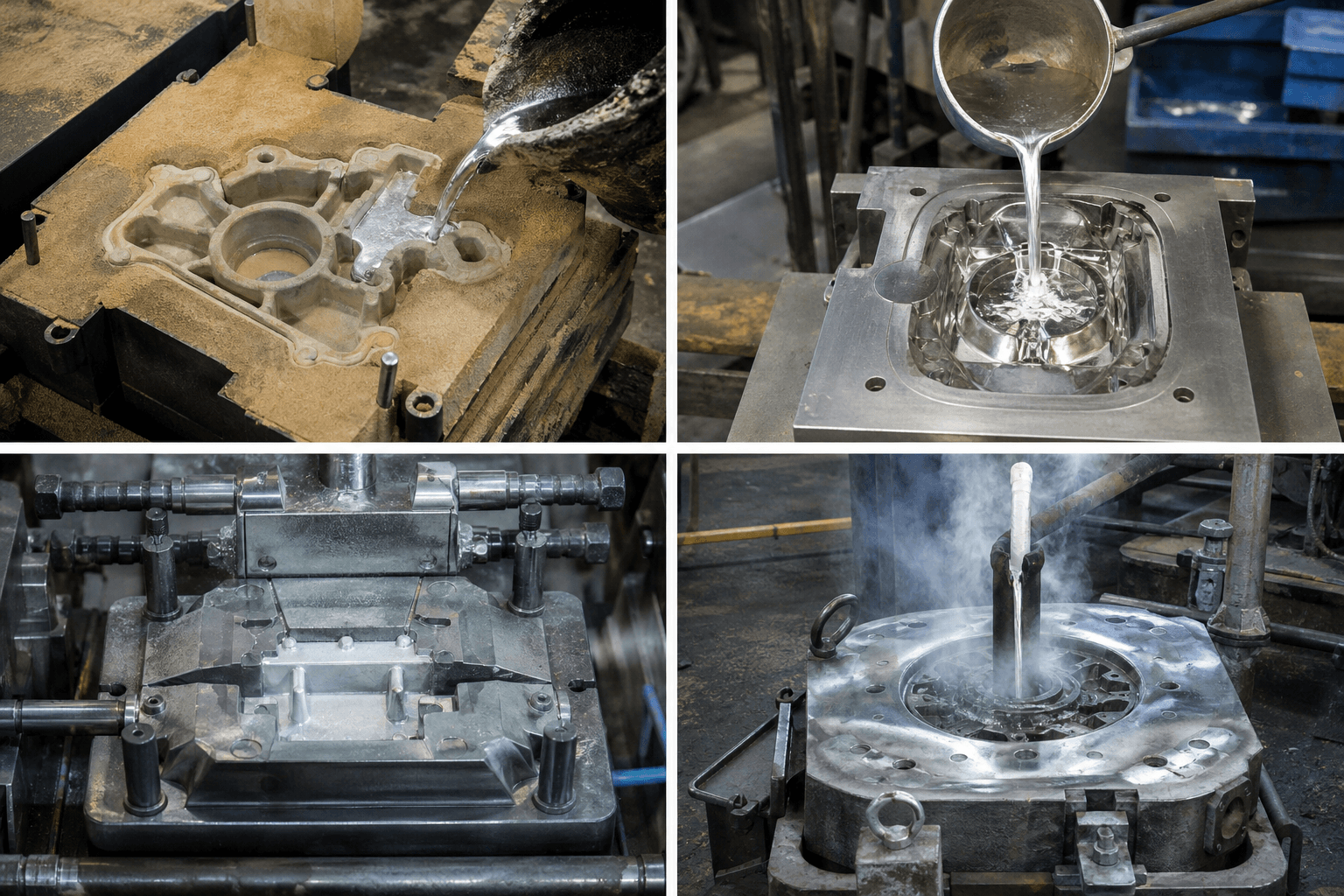
Sand vs Gravity Die vs High-Pressure Die vs Low-Pressure Die Casting
The four methods differ mainly in mould construction and how molten metal enters the cavity. Their relative suitability cannot be reduced to one universal ranking because alloy, size, geometry, tooling design, quality level, and foundry controls change the outcome.
Sand casting
Sand casting uses an expendable mould formed around a pattern. It can accommodate large parts, substantial section changes, and complex internal spaces formed by sand cores. Tooling commitment is often lower than for permanent-die methods, making it useful for prototypes, low quantities, or designs likely to change. The trade-offs may include rougher as-cast surfaces, more finishing, and less dimensional repeatability than a well-controlled permanent-die route.
Gravity die casting
Gravity die casting pours molten aluminium into a reusable metal die without using high injection pressure to fill the cavity. The metal die can provide better surface replication and batch consistency than sand moulds, although the result depends on die design, filling, venting, alloy, and thermal control. Draft, parting lines, core strategy, and removal from the die remain important constraints.
High-pressure die casting
High-pressure die casting drives metal rapidly into a steel die under pressure. It is commonly considered for repeat production of detailed components with relatively thin sections and integrated features. Tooling and process development require greater commitment, but cycle rate and repeatability can support higher quantities. Rapid filling may also trap air if die design, venting, vacuum provisions, and process controls are inadequate. Buyers considering housings or structural parts can review custom die casting applications.
Low-pressure die casting
Low-pressure die casting uses controlled gas pressure to move molten metal, often upward from a furnace into a metal die. The controlled filling direction can reduce turbulence and support feeding during solidification. It is frequently evaluated for parts where soundness and controlled metal flow are priorities, but tooling, cycle time, geometry, and production economics still require part-specific assessment.
| Factor | Sand casting | Gravity die casting | High-pressure die casting | Low-pressure die casting |
|---|---|---|---|---|
| Mould | Expendable sand mould | Reusable metal die | Reusable metal die | Reusable metal die |
| Filling | Gravity pouring | Gravity pouring | High-pressure injection | Controlled low-pressure filling |
| Tooling commitment | Usually lower, subject to pattern and core complexity | Higher permanent-tool commitment | Substantial die and process-development commitment | Substantial die and delivery-system commitment |
| Production fit | Often prototypes, low volume, large or changing parts | Often repeat low-to-medium or medium-volume work | Often higher repeat volumes | Often repeat production with controlled filling needs |
| Typical trade-off | Flexible geometry versus more variable finish and dimensions | Consistency versus die-access and removal constraints | Rate and detail versus tooling cost and air-entrapment control | Controlled flow versus cycle and equipment considerations |
These are selection tendencies, not fixed capability limits. A supplier must review the actual drawing, alloy, quality specification, and projected demand.
How to Select a Casting Method for a Specific Part
Begin with the requirements that cannot change, then compare total delivered cost rather than casting price alone.
- Quantity and repeat demand: A lower-tooling process may suit a prototype or short run. Permanent tooling can become more economical when stable repeat demand distributes its cost across more parts.
- Part size and geometry: Review overall envelope, internal cavities, undercuts, ribs, bosses, wall transitions, and access for cores or moving die elements. A shape that can be moulded is not automatically easy to remove, feed, vent, trim, or inspect.
- Wall design: Relatively uniform sections and gradual transitions generally support more predictable filling and solidification. Heavy isolated masses can form hot spots, while abrupt thin regions may freeze before filling is complete.
- Surface and dimensional requirements: Identify cosmetic faces, sealing areas, datums, bearing locations, and assembly interfaces. Some requirements may be achieved as cast; others should receive machining allowance and be finished afterward.
- Tooling budget, lead time, and total cost: Tool design and manufacture, process development, validation, design stability, maintenance, and expected tool use all affect the schedule and business case. Compare total delivered cost—including tooling, casting, machining, finishing, inspection, and anticipated scrap risk—rather than relying on unit casting price alone.
For example, a hypothetical large prototype housing with cored passages may favour sand casting because design flexibility matters more than rapid cycling. A stable, high-quantity enclosure with detailed external features may justify high-pressure die casting. A component requiring controlled upward filling might lead the team to examine low-pressure casting. These are starting points for review, not automatic selections.
Casting should also be compared with alternative manufacturing routes. If a component has a constant cross-section, an aluminium extrusion finished for assembly may reduce the need for a fully shaped casting. Fabrication or machining may be more practical when quantities, geometry, material properties, or design-change frequency do not support casting tooling.
Alloy and Design Inputs Needed Before Evaluation
Casting alloys are formulated and selected for process behaviour as well as service performance. Fluidity affects the ability to fill detailed or thin regions. Solidification shrinkage affects feeding and cavity risk. Strength, ductility, corrosion resistance, heat-treatment response, finishing compatibility, and pressure tightness may also be relevant.
The casting method can restrict the practical alloy choices. An alloy suitable for one process may not deliver the same filling behaviour, heat-treatment response, or final properties in another. Buyers should state the required material specification when known; otherwise, they should provide service loads, environment, operating conditions, finish, regulatory constraints, and required properties so that an alloy can be proposed for approval.
Useful design information includes:
- Draft direction and surfaces that must release from the mould or die;
- Parting-line preferences and acceptable witness marks;
- Fillets and gradual section transitions to support flow and reduce stress concentration;
- Core requirements for internal passages, holes, and inaccessible cavities;
- Permitted ejector, gate, overflow, riser, and trim locations;
- Machining stock, datums, threads, sealing faces, and tolerance zones;
- Cosmetic surfaces and areas where porosity exposure after machining is unacceptable.
A 3D model communicates nominal geometry, but a controlled drawing is still valuable for dimensions, tolerances, material, finish, inspection, and acceptance notes.
Defect Risks and Function-Based Inspection
Inspection does not replace process control. Mould preparation, melt quality, filling, venting, feeding, cooling, trimming, and handling should first be managed to prevent defects. Inspection then provides evidence against agreed requirements.
| Potential issue | Typical mechanism | Prevention focus | Relevant inspection options |
|---|---|---|---|
| Gas porosity | Dissolved gas or entrapped air | Melt handling, controlled filling, venting, and vacuum where applicable | Radiography or sectioning when internal soundness is critical; leak testing for pressure boundaries |
| Shrinkage cavities | Inadequate feeding as metal contracts | Risers, feeding paths, section balance, chills, and thermal control | Radiography, ultrasonic methods where suitable, or destructive validation |
| Cold shut or misrun | Metal fronts fail to fuse or the cavity does not fill | Flow path, metal and mould conditions, gating, venting, and wall design | Visual examination, dimensional checks, and targeted sectioning |
| Inclusions | Oxides, sand, refractory material, or contamination enters the casting | Melt cleanliness, handling, filtration, and mould integrity | Visual, radiographic, metallographic, or other specified examination |
| Hot tearing or distortion | Restrained contraction or uneven cooling | Geometry, fillets, mould restraint, ejection timing, and cooling balance | Visual and dimensional inspection, fixtures, or scanning |
| Surface defects | Mould damage, poor release, erosion, laps, or handling | Mould condition, coatings, filling, ejection, trimming, and handling | Visual examination against defined cosmetic criteria |
Visual inspection can identify external conditions, but it cannot by itself confirm internal soundness. Critical dimensions may require gauges, coordinate measurement, scanning, or dedicated fixtures. Pressure-containing components may require a specified leak test. The drawing should define acceptance criteria, sampling, test method, and documentation rather than relying on the general instruction “inspect casting.”
Request an initial process review. For a B2B OEM or ODM discussion, provide the part drawing or 3D model, expected quantity and repeat demand, required alloy or service conditions, critical dimensions, cosmetic surfaces, inspection requirements, and any casting method already under consideration. This allows the proposed route, design assumptions, and downstream operations to be reviewed before formal pricing.
Frequently Asked Questions
How difficult is it to cast aluminium?
Difficulty depends on the alloy, component size, wall transitions, cavity complexity, mould or die design, filling method, cosmetic requirements, tolerances, and internal-quality criteria. A simple, well-fed shape can be relatively straightforward, while a thin, pressure-tight component with isolated heavy sections and critical machined surfaces may demand extensive process development.
What are the disadvantages of cast aluminium?
Potential disadvantages include tooling investment, design constraints for filling and removal, porosity or shrinkage risk, variable as-cast properties, and the need for trimming or machining. Compared with wrought aluminium, a casting may provide different strength and ductility. Compared with fabrication, design changes may be more expensive after permanent tooling is completed. The practical comparison depends on alloy, process, quantity, and function.
What are the four commonly compared types of aluminium casting?
They are sand casting, gravity die casting, high-pressure die casting, and low-pressure die casting. They are not the only available methods. Investment casting and other specialised processes may also be suitable, but they fall outside this four-method comparison.
What grade of aluminium is used for casting?
Multiple casting-alloy families are available; there is no single grade for every component. Selection must consider fluidity, shrinkage, required strength and ductility, corrosion exposure, heat treatment, finishing, pressure tightness, and compatibility with the chosen casting method. Wrought and casting alloy designations should not be treated as directly interchangeable without engineering review.