
Introduction
When buyers compare bronze vs copper, they are rarely asking a purely academic materials question.
They are usually trying to solve a practical sourcing problem:
Which metal will give us the better balance of performance, machinability, joining behavior, durability, and cost in real production?
That is why this comparison matters so much in OEM and industrial procurement. The choice does not only affect part performance. It also affects tooling wear, cycle time, finishing stability, service life, and long-term warranty exposure.
Copper and bronze may look related on paper because bronze is built on a copper base. In production, though, they behave differently enough that choosing the wrong one can create avoidable cost or performance problems.
This article explains those differences from a manufacturer’s viewpoint. Instead of repeating textbook definitions, it focuses on what buyers actually need to know when selecting material for bulk orders, engineered parts, and multi-stage fabrication projects.
Bronze and Copper: Composition, Origins, and What It Means for Procurement
Copper and bronze are closely related, but they are not interchangeable.
Copper is a near-pure metal valued mainly for its electrical and thermal conductivity. Bronze is a family of copper-based alloys designed to improve properties such as wear resistance, hardness, and corrosion performance.
That difference matters immediately in procurement because alloy chemistry affects not just performance in service, but also what happens during machining, forming, welding, polishing, and long-term use.
| Metal Type | Common Grades | Composition | Practical Characteristics |
| Copper | C11000, C10100 | ~99.9% Cu | Very high conductivity, soft, ductile, easy to deform |
| Bronze | C51000, C95400 | Cu + Sn + other alloying elements | Stronger, harder, better wear and corrosion resistance |
For buyers, the main takeaway is simple: copper is usually chosen for conductivity, while bronze is usually chosen for mechanical and environmental performance.
Strength and Wear Resistance
This is one of the clearest dividing lines between the two materials.
Copper is relatively soft. That makes it useful in conductive applications and easier to form, but less suited to parts that see repeated friction, pressure, or moving contact.
Bronze performs much better in those conditions because alloying improves hardness and load-bearing stability.
| Property Example | Copper (C11000) | Phosphor Bronze (C51000) |
| Tensile Strength | ~210 MPa | ~500 MPa |
| Brinell Hardness | ~35 HB | ~110–150 HB |
That difference changes the sourcing logic immediately.
If the part will experience:
sliding contact
repetitive movement
vibration
pressure loading
wear against another component
then bronze is often the more reliable engineering choice.
This is why bronze shows up so often in bushings, gear inserts, wear strips, sliding parts, marine components, and mechanically stressed assemblies.
Electrical and Thermal Conductivity
If conductivity is the main job of the part, copper usually wins without much debate.
Copper remains the reference material for electrical transfer because it reaches about 100% IACS, while bronze drops far below that depending on alloy family.
| Property | Copper | Bronze |
| Electrical Conductivity | ~100% IACS | ~15–30% IACS |
| Thermal Conductivity | ~390–400 W/m·K | ~60–120 W/m·K |
| Arc Resistance | Lower | Higher |
That means:
copper is usually preferred for terminals, connectors, busbars, and heat-transfer-heavy applications
bronze becomes more attractive when electrical performance can be lower but mechanical stability and arc resistance matter more
For buyers, this is where the decision becomes application-driven rather than value-judgment driven. Copper is not “better” overall. It is better when conductivity is the priority.
Corrosion Resistance
Bronze often gains an advantage when the service environment is aggressive.
Saltwater, industrial moisture, and chemically active environments tend to favor bronze because many bronze alloys hold up better under long-term exposure than pure copper.
Copper naturally develops a patina, which can be visually attractive and sometimes acceptable in decorative or architectural use. But in harsher chloride-rich environments, bronze is often the safer long-term choice.
This is why buyers often choose bronze for:
marine fittings
pump parts
valves
offshore or outdoor hardware
water-related industrial components
Where exposure conditions are mild and conductivity matters more, copper may still be the smarter choice.
Fabrication and Machining
Material selection should never stop at service performance. Buyers also need to consider how the material behaves in production.
Copper is soft and highly conductive, which changes how it behaves during machining and joining. Bronze is typically harder and may create different tooling demands, but often gives better dimensional stability in wear-critical parts.
For machining-heavy projects, the right material choice can affect:
cutting speed
tool life
burr behavior
finish consistency
secondary polishing requirements
In many bronze applications, a good final result may still require controlled post-machining finishing if appearance matters.
Joining, Welding, and Assembly Fit
Joining behavior is another practical differentiator.
Copper is more difficult to weld cleanly because it pulls heat away rapidly. That high thermal conductivity can make process control harder and increase risk of distortion or incomplete fusion if parameters are not adjusted properly.
Bronze—especially silicon bronze in certain joining contexts—can be easier to manage in TIG or MIG processes.
For buyers, this matters because a material that joins more predictably often means:
lower reject rates
better assembly repeatability
reduced rework
more stable throughput in production
Visual Appearance and Oxidation
Appearance may not be the first decision factor in industrial buying, but it still matters in branded products, exposed assemblies, and architectural hardware.
In simple terms:
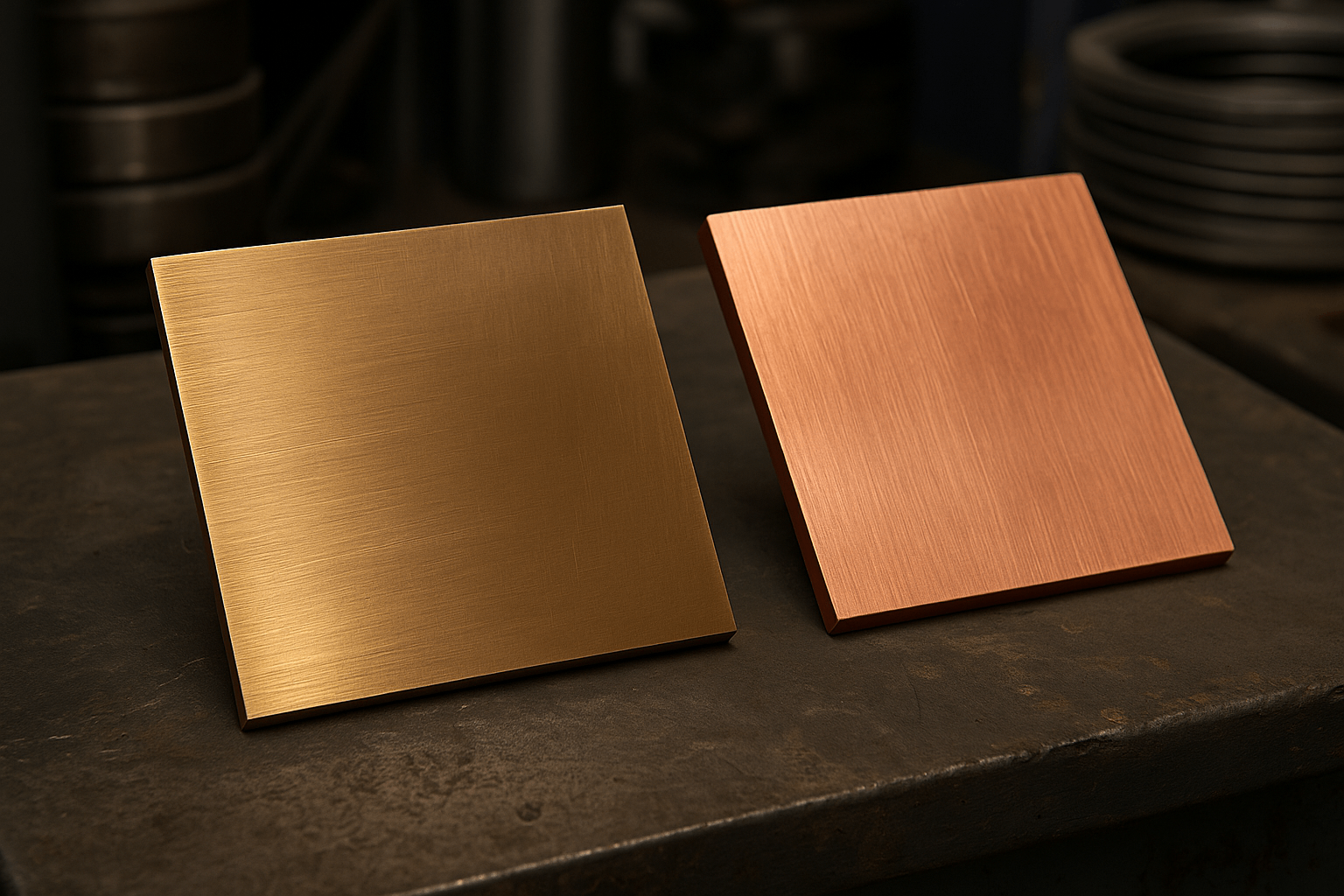
copper usually appears more reddish-orange
bronze tends to appear darker, warmer, or more brown-gold depending on alloy and finish
brass typically reads more yellow-gold than either one
Their oxidation behavior also differs, which affects long-term appearance expectations.
For exposed products, buyers should decide early whether the goal is:
natural aging and patina
stable maintained appearance
decorative surface with protective coating
Applications and Use Cases
The easiest way to choose between bronze and copper is often to look at what the part must actually do.
Where Bronze Excels
Bronze is often the stronger choice for:
marine fasteners and valves
bushings and gear-related wear parts
heat-exposed machine components
industrial hardware exposed to repeated friction or vibration
outdoor utility housings and mechanical inserts
Where Copper Leads
Copper remains the more natural choice for:
electrical terminals
conductive connectors
busbars and current-carrying components
plumbing or HVAC connections
applications where conductivity dominates the design logic
For hybrid assemblies, mixed-metal design may also make sense if the function is split between conductivity and mechanical durability.
Pricing and ROI for Bulk Orders
A common sourcing mistake is to compare bronze and copper only by raw material price.
That misses the larger business question: which material gives the better total return once machining, wear life, replacement frequency, and assembly performance are considered?
In many cases:
copper has the lower entry cost when conductivity is the main requirement
bronze has the higher initial price, but may reduce replacement frequency and service cost in wear-heavy applications
| Cost Factor | Copper | Bronze |
| Material Price | Lower | Higher |
| Tooling Wear | Usually lower | Moderate to higher depending on alloy |
| Replacement Cycle | Shorter in wear-heavy use | Often longer |
| Long-Term Ownership Cost | Moderate | Can be lower over time in the right application |
That is why bronze sometimes wins even when it costs more per kilogram.
Availability, MOQ, and Format Options
For bulk buyers, availability matters almost as much as technical fit.
Common industrial sourcing formats include:
sheets
rods
tubes
bars
machined inserts or bonded assemblies
When buyers compare suppliers, they should look beyond stock claims and verify:
grade availability
MOQ flexibility
export packaging readiness
quality-control traceability
ability to support assemblies, not just raw stock
At YISHANG, we support bronze and copper fabrication across multiple formats and can also assist with integrated component production where machining, assembly, and logistics coordination need to be handled together.
Conclusion
Choosing between bronze and copper is not about picking the “better” metal in general.
It is about matching the material to the real job.
If the part lives or dies by electrical or thermal conductivity, copper is usually the stronger choice.
If the part must survive wear, friction, vibration, pressure, or corrosive service, bronze often delivers the better long-term result.
If the project includes machining, joining, finishing, or multi-stage assembly, production behavior should be considered just as seriously as datasheet values.
That is where strong sourcing decisions are made.
At YISHANG, we help OEM and industrial buyers compare materials through the lens of manufacturability, service life, and total project value—not just raw specification sheets.
If you are reviewing a bronze or copper program for an upcoming bulk order, the next step is not only to compare prices. It is to compare how well each material fits the actual working conditions of the part.