
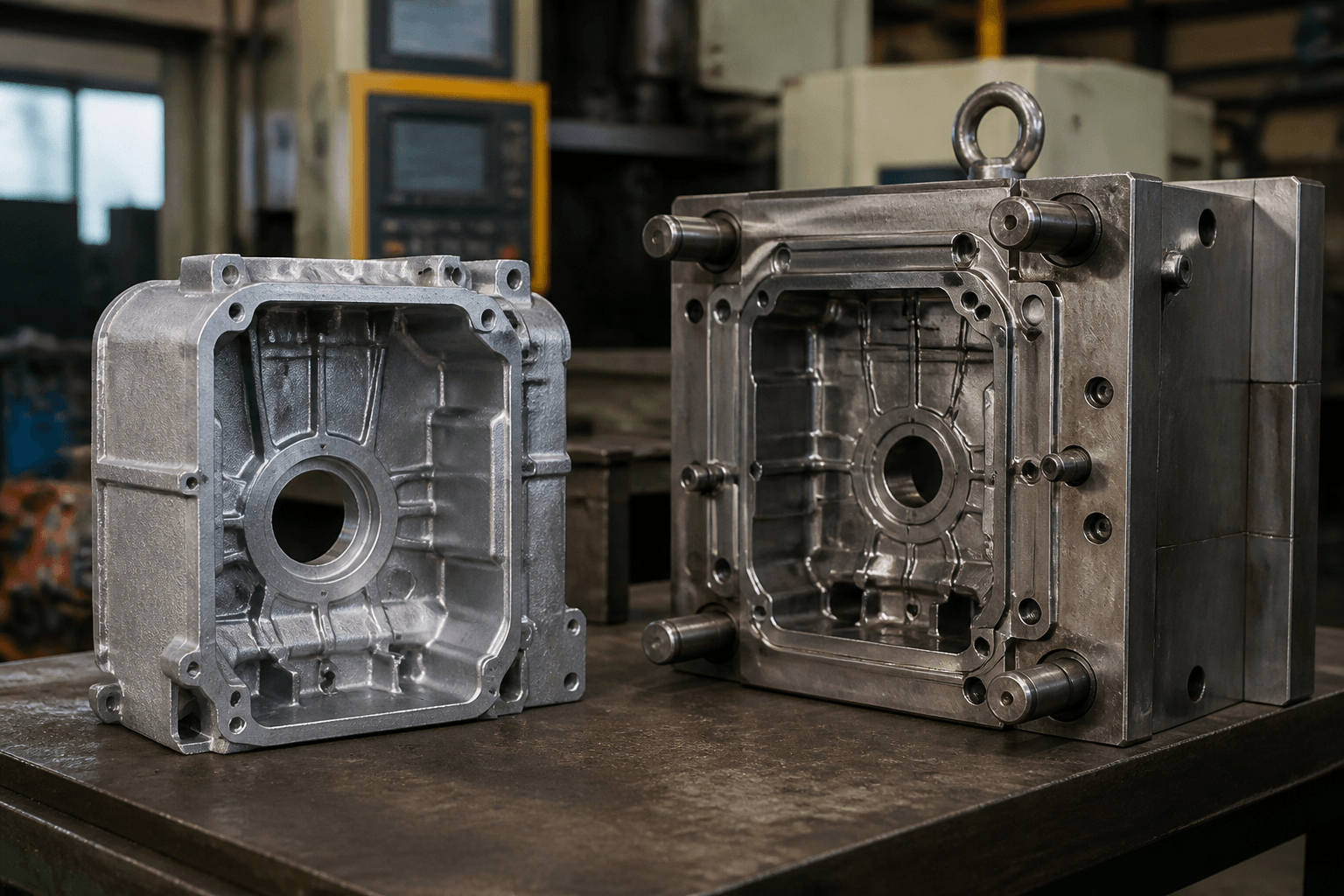
“Advance Die Cast” is not a recognized manufacturing-process category. The exact phrase may refer to a company name, while some searchers may actually mean “advanced die casting,” an informal description of modern die-casting methods, engineering, tooling, automation, or secondary operations.
This article does not imply any affiliation between Yishang and a business named Advance Die Cast. It explains the underlying die-casting process and the information engineers need when assessing a component redesign.
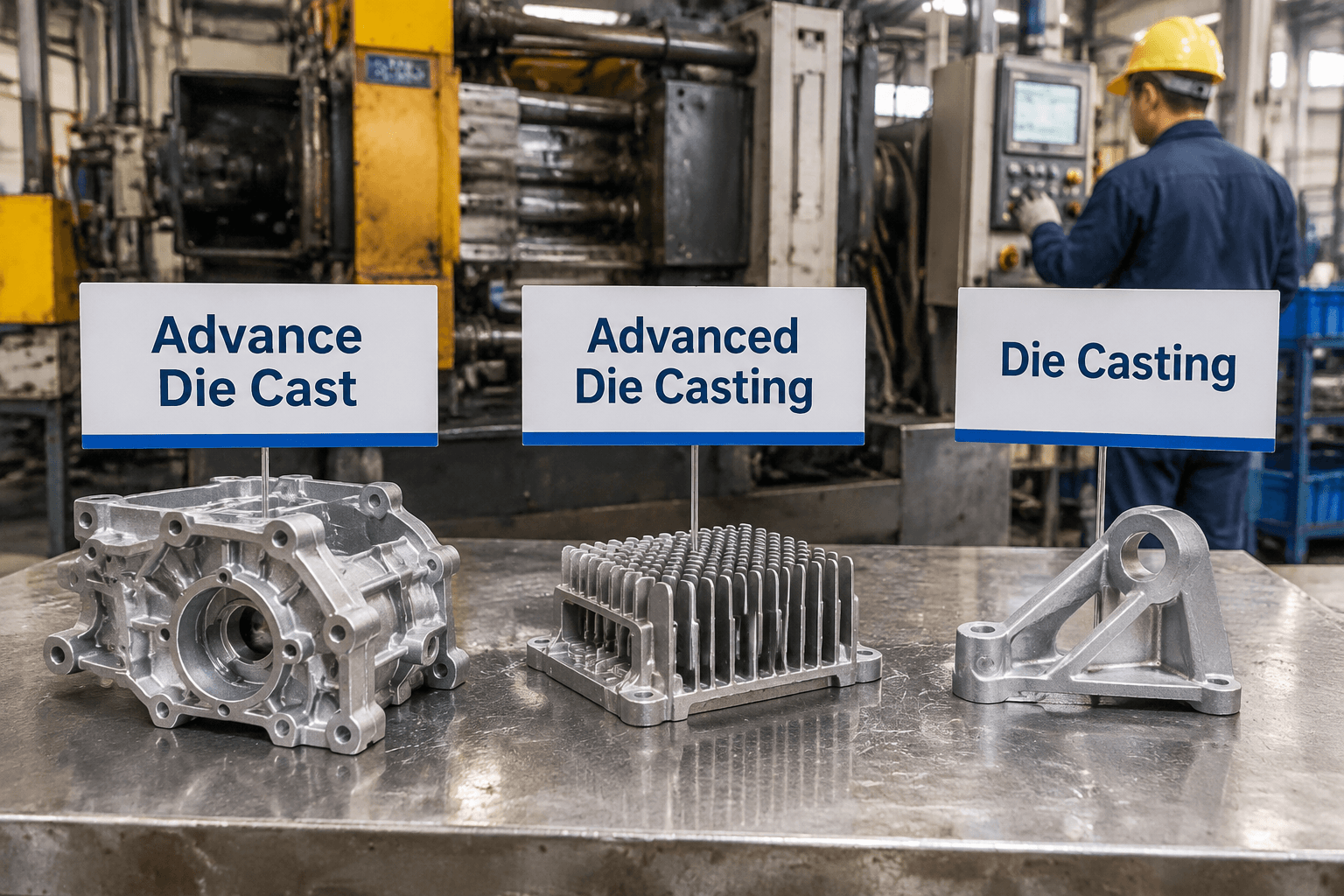
Advance Die Cast, Advanced Die Casting, or Die Casting?
The wording matters because these phrases do not have the same meaning. A buyer searching the exact capitalized phrase may be trying to locate a specific supplier. An engineer using lowercase words may instead be looking for information about process improvements, complex castings, or advanced tooling.
| Search term | Likely meaning | What to review next |
|---|---|---|
| Advance Die Cast | Potentially a proper company or brand name | Confirm the intended company through its official information before evaluating capabilities or requesting contact details. |
| Advanced die casting | An informal technical phrase | Identify the specific subject, such as tooling design, process monitoring, thin-wall geometry, automation, machining, or finishing. |
| Die casting | An established metal-forming process | Review alloy selection, part geometry, tooling requirements, production volume, tolerances, and secondary operations. |
“Advanced” does not automatically identify a separate casting process. In most technical discussions, the base process remains die casting; the advanced element may be the die design, simulation, process control, automation, integrated features, or production strategy.
How High-Pressure Die Casting Forms a Component
High-pressure die casting forms repeatable metal components by injecting molten alloy into a reusable steel die. The die contains the negative geometry of the intended part, together with the necessary flow paths, vents, parting surfaces, cores, and ejection features.
- Die preparation: The die closes, and process controls prepare it for the next cycle.
- Metal injection: Molten alloy enters the die cavity under pressure and fills the component geometry.
- Solidification: The metal cools while constrained by the die, allowing the part to retain its intended shape.
- Ejection: The die opens, and ejector mechanisms release the casting.
- Trimming and secondary work: Runners, gates, flash, or overflow material are removed. Machining, surface treatment, inspection, or assembly may follow.
This is different from CNC machining, which creates geometry by removing material from bar, plate, extrusion, or another workpiece. It is also distinct from sheet metal fabrication, where sheet or coil is cut, bent, stamped, welded, and assembled. A casting may still require drilled, tapped, reamed, or milled features when those details cannot be produced reliably or economically in the die.
Readers evaluating industrial housings and structural parts can learn about custom die casting applications while keeping these process boundaries clear.
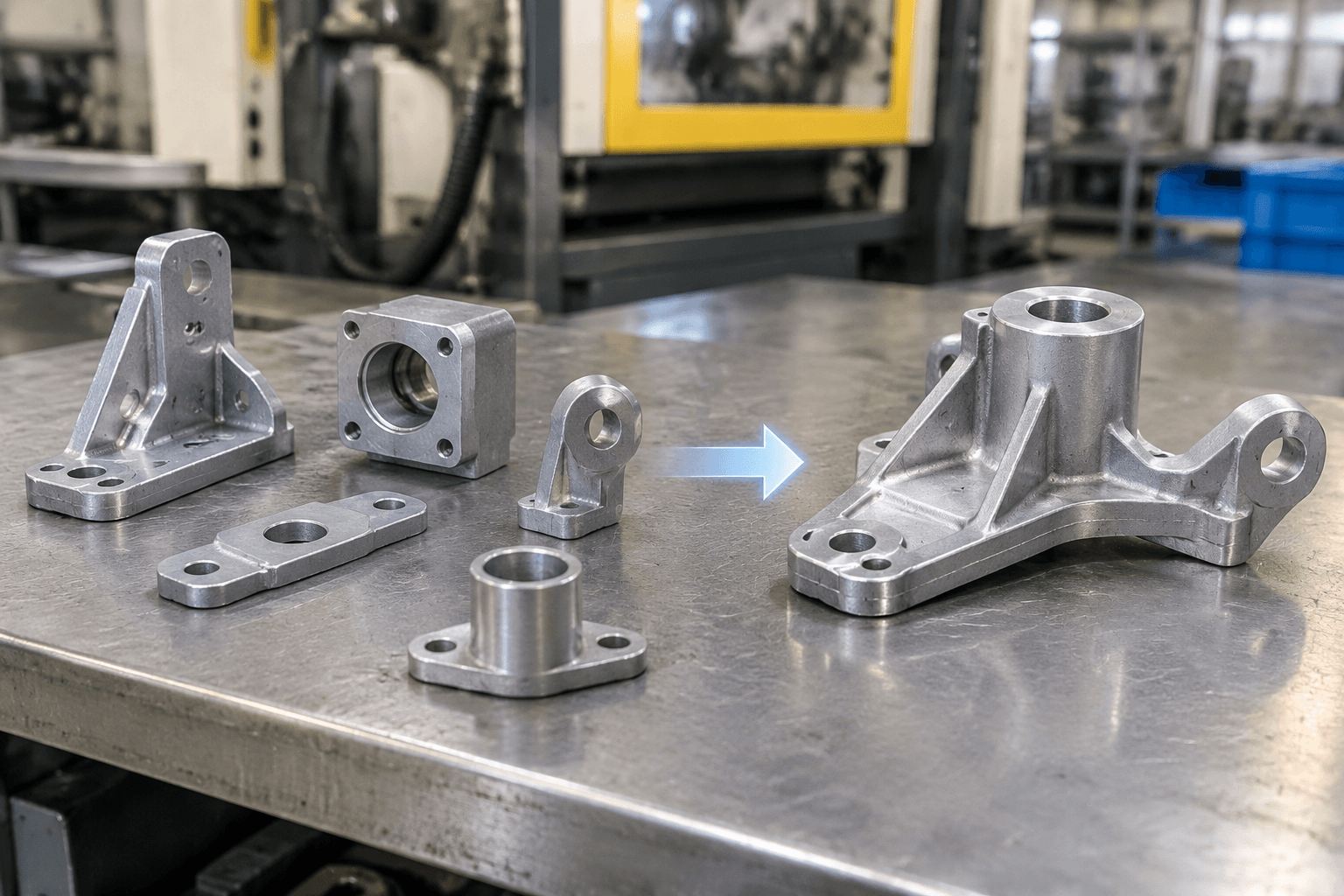
When a Multi-Part Design May Become One Casting
A practical reason to consider die casting is the opportunity to integrate features that were previously distributed across several components. A hypothetical assembly might contain a machined base, separate mounting brackets, threaded inserts, a stamped cover interface, and fasteners. A die-cast redesign could potentially form some bosses, ribs, locating features, mounting points, cable paths, or enclosure details in one body.
That possibility does not mean every assembly should be converted. The engineering team must compare the proposed casting with the existing manufacturing route and consider:
- whether the geometry can fill, solidify, and eject without unacceptable defects or distortion;
- whether draft, parting lines, gate locations, and ejector marks are compatible with functional surfaces;
- whether integrated features remain accessible for machining, coating, inspection, and assembly;
- whether production demand supports the required tooling investment;
- whether design changes are likely after the die is released; and
- whether separate components provide serviceability, material, thermal, or structural advantages that should be retained.
Extrusions, for example, are often appropriate for long components with a consistent cross-section. Die casting may be considered when a shorter component needs more three-dimensional detail, but the decision depends on geometry and volume.
Stampings and fabricated sheet metal assemblies also remain useful when the design is based on relatively uniform material thickness, folded geometry, accessible welds, or lower tooling commitment. Die casting should therefore be treated as a redesign option, not an automatic replacement for machining, extrusion, stamping, welding, or assembly.
Zinc or Aluminum: What Changes in the Design Decision?
Zinc and aluminum die-casting alloys influence component weight, wall geometry, strength priorities, corrosion strategy, finishing, tool design, and production conditions. The correct selection cannot be made from the material name alone; the final alloy must be matched to the part specification and operating environment.
| Decision factor | Zinc alloy considerations | Aluminum alloy considerations |
|---|---|---|
| Weight | Zinc has higher density, so component mass must be checked where weight is important. | Aluminum’s lower density can be useful for weight-sensitive housings and structural components. |
| Geometry | Zinc alloys are often considered for detailed features and relatively compact parts, subject to casting review. | Aluminum is widely considered for larger housings and structural forms, but fill paths and wall transitions still require careful design. |
| Mechanical priorities | Material behavior may suit components requiring detail, rigidity, or durable small features, depending on the selected alloy. | Aluminum alloys may support favorable strength-to-weight and thermal requirements, depending on alloy, geometry, and service conditions. |
| Surface and finish | Plating, coating, cosmetic appearance, and corrosion exposure should be specified before alloy approval. | Coating, conversion treatment, paint, machining exposure, and cosmetic requirements can influence alloy and process planning. |
| Production review | Part size, tooling layout, cycle conditions, feature detail, and secondary operations affect suitability. | Part size, thermal behavior, porosity risk, machining, sealing surfaces, and finishing requirements require project-specific review. |
Finish requirements should be discussed early. A decorative surface, sealed enclosure, painted transportation component, machined gasket face, or conductive contact area can lead to different alloy and process decisions. Cosmetic zones should also be identified on the drawing rather than left to interpretation.
What to Provide for a Die-Casting Feasibility Review
A useful die-casting review requires more than a sample image and a request for a unit price. The supplier needs enough engineering and production information to determine whether the process fits the component.
- Drawing and model: Provide a dimensioned drawing and, where available, a 3D CAD model. Identify the revision and applicable units.
- Material requirements: State the specified alloy or describe the functional priorities if the material remains open for recommendation.
- Production demand: Include expected annual volume, anticipated program life, batch pattern, and any ramp-up assumptions.
- Critical dimensions: Mark fit, sealing, bearing, alignment, thread, flatness, positional, and assembly-critical characteristics.
- Surface requirements: Define cosmetic areas, coating or plating expectations, texture, color, corrosion exposure, masking, and contact surfaces.
- Secondary operations: Identify drilling, tapping, reaming, milling, insert installation, deburring, cleaning, finishing, or assembly requirements.
- Validation: Explain prototype, sample approval, dimensional reporting, functional testing, inspection, traceability, and production-approval expectations.
- Tooling terms: Clarify ownership, maintenance responsibilities, revision control, expected storage, and the process for future engineering changes.
For a component-level process-fit review, provide the drawing or 3D model, target alloy or functional requirements, expected production volume, critical tolerances, finish, and assembly details. The objective should be to establish whether die casting is appropriate before assuming the process will deliver a better commercial or technical result.
Frequently Asked Questions
Is Advance Die Cast a company or a manufacturing process?
The exact phrase may be a company-name search. It is not a recognized process category. If you are researching manufacturing methods, the intended terms are more likely “die casting” or the informal phrase “advanced die casting.”
Is advanced die casting different from conventional high-pressure die casting?
Not necessarily. “Advanced die casting” is commonly used as a broad description rather than a formal process name. It may refer to improved tooling, simulation, monitoring, automation, alloy control, integrated features, or secondary operations applied to a conventional casting process.
Can die casting replace a multi-part machined or stamped assembly?
Sometimes. Bosses, ribs, mounting points, and enclosure details may be consolidated, but tooling cost, production volume, draft, wall transitions, machining access, finishing, inspection, and serviceability must be reviewed before conversion.
What files and specifications are needed to evaluate a custom die-cast component?
Provide a dimensioned drawing, a 3D model if available, material or functional requirements, expected volumes, critical tolerances, finish specifications, assembly interfaces, secondary operations, and validation expectations. These details allow a supplier to review feasibility before preparing a meaningful quotation.