
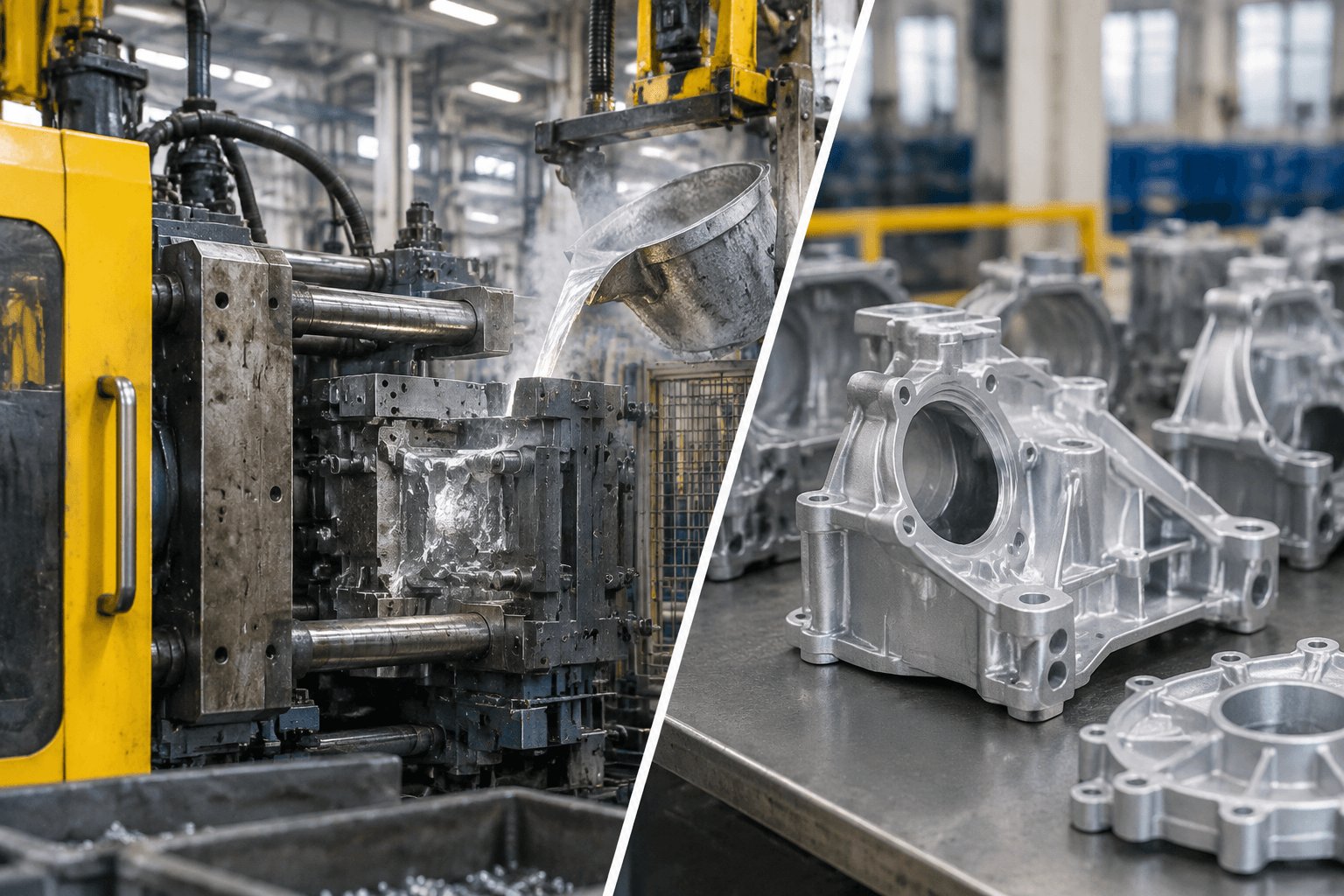
“Advance die casting” is not a standardized manufacturing process name. The phrase usually means either a search for a company or brand with a similar name, or a search for information about advanced die casting equipment and production capability.
If you are looking for a specific business, verify its exact legal name, location, and official website. If you are researching the manufacturing concept, “advanced” normally describes the configuration, automation, control, and supporting systems of a die-casting operation—not a separate casting method.
Does “Advance Die Casting” Refer to a Company or a Manufacturing Concept?
The wording is ambiguous because “Advance Die Casting” can look like a company name, while “advanced die casting” reads as a description of manufacturing capability. Search terms such as “Advance Die Casting locations” or “Advance Die Casting jobs” are likely navigational. They suggest that the user wants information about a particular employer, facility, or business.
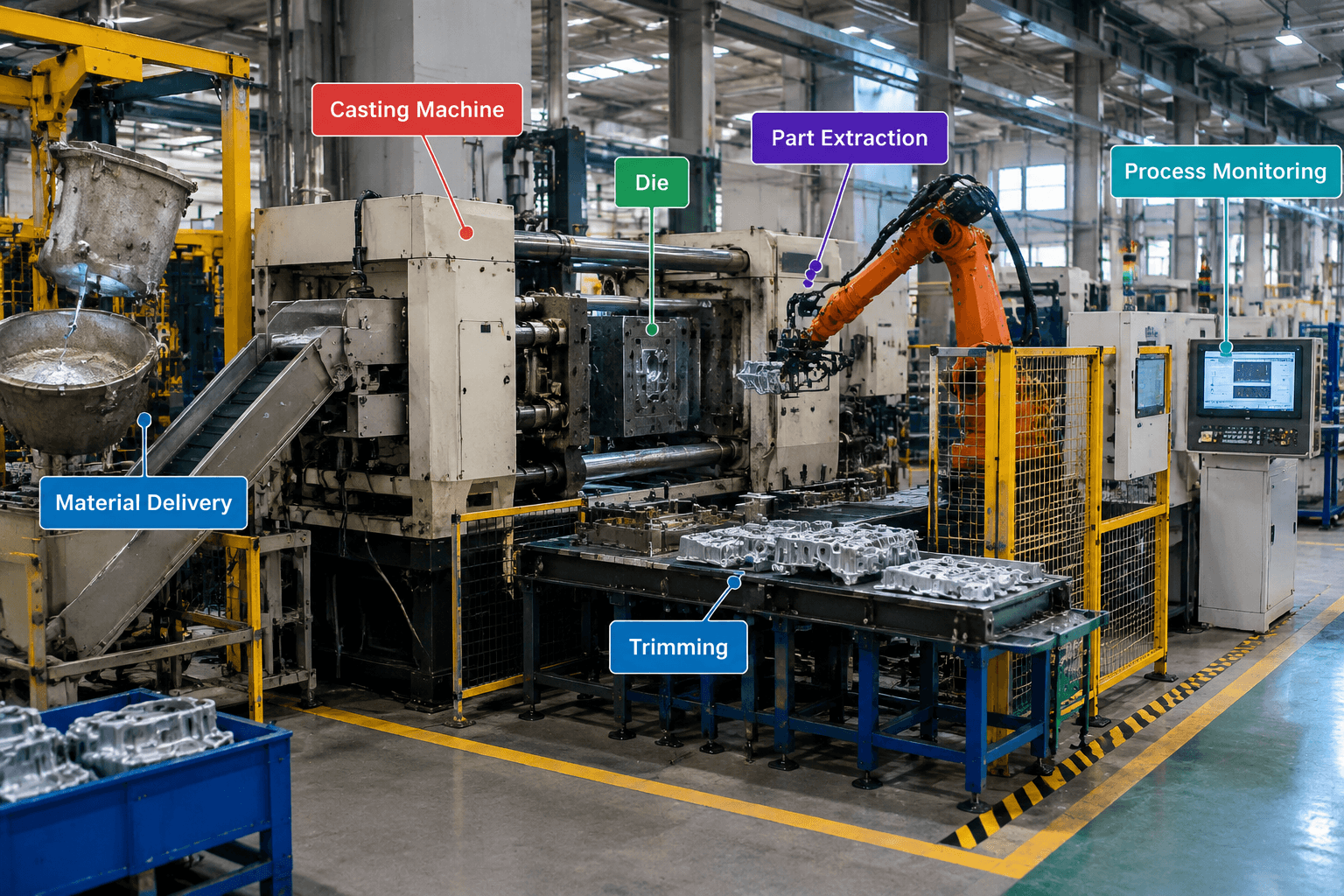
By contrast, an engineer searching for advanced die casting may want to understand how modern casting cells differ in automation, process monitoring, material handling, trimming, and quality control. In this context, the word advanced is relative. It does not define a universally recognized process category or guarantee that a supplier is suitable for a particular component.
This distinction matters because company-specific claims require primary evidence. A website, equipment list, facility record, certification document, or direct technical response may help verify those claims. Search-result summaries and promotional comparisons are not enough to establish machine availability, quality performance, capacity, or service level.
What Makes a Die-Casting Setup More Advanced?
Die-casting operations can use manual, semi-automated, or highly automated production cells. The appropriate configuration depends on the casting design, tooling, alloy specification, production pattern, downstream requirements, and acceptable level of process variation.
Capability is better understood as a group of connected production functions:
- Casting-machine configuration: The machine must be compatible with the selected casting process, die design, component envelope, material system, and required production conditions. A machine being large or recently installed does not by itself prove suitability.
- Shot and cycle control: Relevant controls may monitor or manage process variables during filling, pressure application, solidification, and ejection. The useful question is which variables are controlled, recorded, and reviewed for the proposed part.
- Thermal management: Die temperature, cooling arrangements, lubrication, and cycle stability can affect filling behavior, solidification, dimensional consistency, and surface condition. Requirements vary with geometry and material.
- Material delivery and handling: Manual transfer, automated dosing, part extraction, conveyors, and robotic handling can influence consistency and labor content. Their value depends on how reliably they support the approved process.
- Trimming and post-casting flow: Gates, runners, flash, and other process-related material may need controlled removal. Trimming can be performed through different manual or automated arrangements based on the casting and tool design.
- Monitoring and traceability: A production cell may collect process data, identify alarms, or connect results to batches. Buyers should ask which records are retained and how exceptions are handled rather than assuming that a screen or sensor guarantees quality.
Automation can reduce manual variation and support repeatable handling, but it is not a substitute for appropriate tooling, process development, maintenance, operator competence, and inspection planning.
What a Capability Claim Tells You—and What Still Needs Verification
Supplier descriptions often emphasize machine count, automation, quality, capacity, or location. These claims can help begin a technical discussion, but each leaves important questions unanswered.
| Capability claim | What it may indicate | What still needs verification |
|---|---|---|
| Number of die-casting machines | Installed equipment and potential scheduling flexibility | Machine types, compatible part range, operational status, current loading, maintenance condition, and availability for the project |
| Manual and automated cells | Different production configurations for different jobs | Which configuration would run the proposed component and how critical parameters are controlled |
| High production capacity | Potential ability to support recurring demand | Available rather than installed capacity, tooling readiness, shift pattern, batch strategy, and contingency planning |
| Advanced quality control | Some level of inspection or process monitoring | Inspection plan, equipment used, sampling frequency, acceptance criteria, records, calibration controls, and response to nonconforming output |
| Multiple locations | A broader operating footprint | Which facility performs casting, tooling, machining, finishing, assembly, and inspection for the specific project |
Machine count alone cannot establish part suitability or available capacity. Ten compatible, maintained machines with a defined process plan may be more relevant than a larger installed fleet that is committed to other programs or unsuitable for the proposed die.
The same caution applies to supplier rankings. Without consistent evidence and comparable criteria, a statement that one company is the “best” is promotional rather than technically useful. A defensible comparison should relate each supplier’s documented capability to the same drawing, material requirement, volume pattern, downstream scope, and inspection expectations.
How to Match a Die-Casting Operation to Your Part
A production setup should be evaluated against the component rather than against a generic description of the factory. The following information helps a supplier determine whether casting is appropriate and what process development may be required.
- Material or alloy requirement
- State the specified material, applicable condition, and any restrictions. Material selection affects casting behavior, mechanical requirements, corrosion considerations, finishing compatibility, and recycling or compliance expectations.
- Geometry and die-related features
- Provide a 3D model and controlled drawing where available. Wall transitions, ribs, bosses, draft, undercuts, parting-line location, ejection features, and thick-to-thin sections can influence die design and filling behavior.
- Critical dimensions and interfaces
- Identify dimensions that control sealing, alignment, bearing locations, fastener positions, mating surfaces, or assembly fit. Do not rely on a general drawing tolerance when only several features are function-critical.
- Demand and ordering pattern
- Annual demand is only part of capacity planning. Expected batch quantities, release frequency, ramp-up profile, inventory strategy, and demand variability also affect tooling, automation, staffing, and scheduling decisions.
- Surface and cosmetic requirements
- Mark visible surfaces, prohibited defect zones, texture expectations, coating requirements, and areas where ejector marks or parting-line evidence may be restricted.
- Inspection and documentation
- Define the features to inspect, the finished condition in which they are measured, required records, sampling expectations, and any approval process. Inspection should follow functional risk rather than simply checking easily accessible dimensions.
When Do Machining, Finishing, and Assembly Enter the Workflow?
Die casting does not automatically include machining, finishing, assembly, or comprehensive inspection. These operations become relevant when the finished-part specification requires them.
Secondary CNC machining may be necessary when a feature cannot be formed accurately or practically in the die, when a sealing or bearing surface needs a controlled finish, or when holes and interfaces must be established after casting.
Finishing should be considered when the component needs a particular appearance, corrosion behavior, coating system, conductivity condition, or surface preparation. The material, surface condition, masking needs, and dimensional effects of the finish should be reviewed together.
Assembly becomes part of the scope when cast components must receive fasteners, inserts, seals, fabricated brackets, covers, or other parts. Fit criteria, torque requirements, joining methods, and inspection responsibilities should be defined before production planning.
Inspection may occur after casting, machining, finishing, assembly, or at several stages. The correct inspection point depends on which operation creates or can alter the critical characteristic.
For an early technical review, send the part drawing or 3D model, material requirement, expected order volume and batch pattern, critical dimensions, surface requirements, and assembly interfaces. The first discussion should confirm whether die casting is suitable, which features require secondary operations, and what project-specific capability evidence is still needed before production or quotation assumptions are made. Buyers can also review Yishang’s custom die-casting information for housings and structural components.
Frequently Asked Questions
Is “advance die casting” different from “advanced die casting”?
“Advance die casting” is commonly an ambiguous search phrase rather than a defined process. It may refer to a business name or be a wording variation of “advanced die casting,” which informally describes modern equipment, automation, control, or production systems.
Does a larger number of die-casting machines mean greater available capacity?
Not necessarily. Machine count describes installed equipment, while available capacity depends on compatibility, operating condition, current commitments, tooling, staffing, maintenance, batch pattern, and scheduling.
When does a die-cast component require secondary CNC machining?
Machining may be required for critical holes, threads, sealing faces, bearing locations, tight assembly interfaces, or other features that cannot be completed adequately in the die. The need should be determined from the drawing and functional requirements.
What information is needed to assess a die-casting part from a drawing?
Provide the drawing and 3D model, material requirement, expected volume and batch pattern, critical dimensions, cosmetic zones, finishing requirements, assembly interfaces, inspection expectations, and any required documentation. These details allow capability claims to be tested against the actual component.