
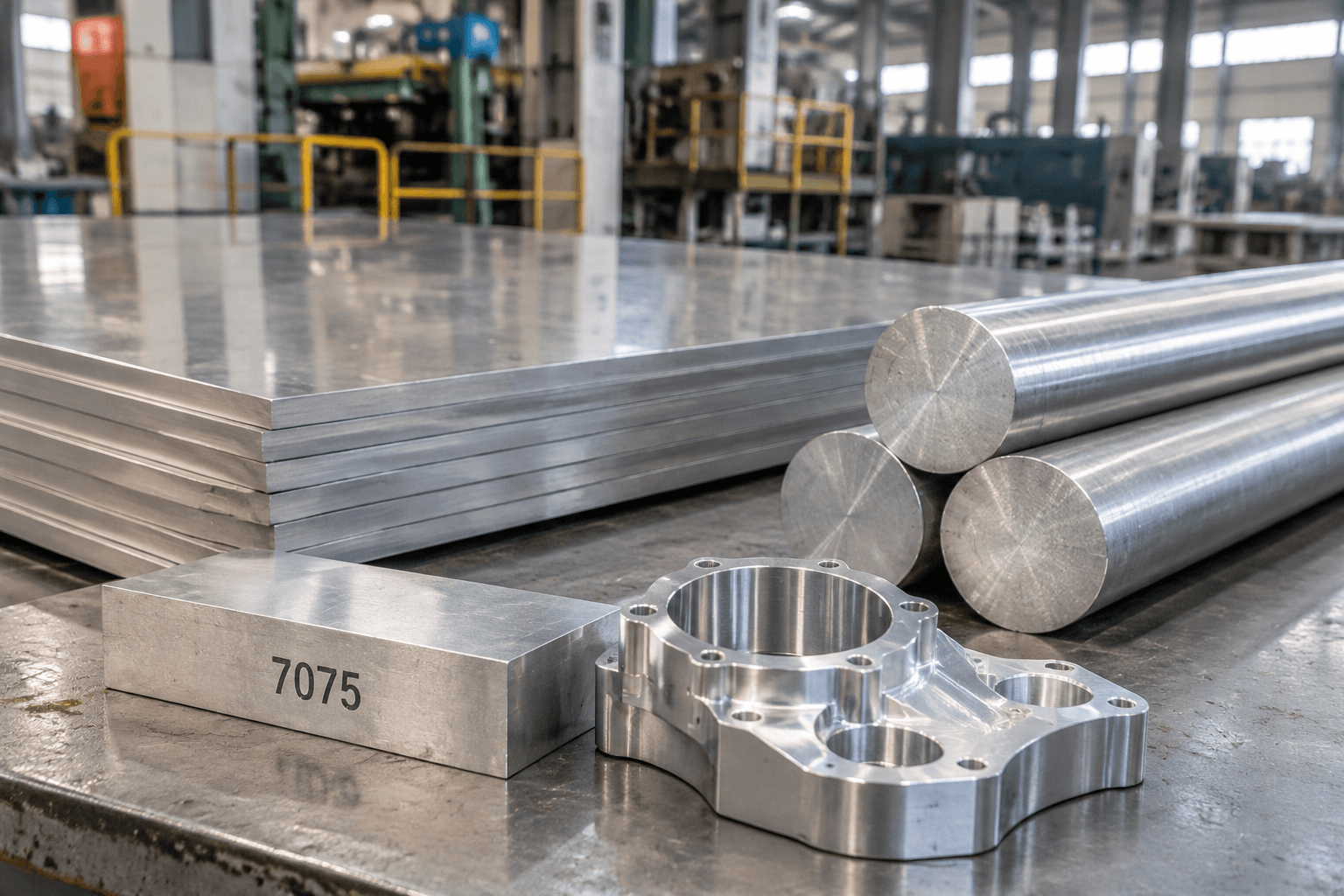
Al alloy 7075 is a high-strength, heat-treatable wrought aluminum alloy whose principal alloying elements are zinc, magnesium, and copper. It is often selected for highly loaded, weight-sensitive parts, but the correct choice depends on temper, product form, thickness, grain orientation, corrosion exposure, forming, and joining requirements.
7075 is not a casting grade or a substitute for die-cast aluminum. It is supplied as wrought products such as plate, sheet, bar, extrusions, tube, forgings, and rings. A complete material callout must therefore state more than “7075 aluminum”: it should identify the temper and product form, along with the governing material specification and any inspection or documentation requirements.
What Defines 7075 Aluminum?
In the wrought aluminum designation system, the first digit places 7075 in the 7xxx series, where zinc is the main alloying element. Registered composition limits for 7075 include approximately 5.1–6.1% zinc, 2.1–2.9% magnesium, 1.2–2.0% copper, and 0.18–0.28% chromium by weight. Silicon, iron, manganese, titanium, and other elements are controlled at lower maximum levels, with aluminum making up the balance. ([voestalpine.com](https://www.voestalpine.com/highperformancemetals/usa/app/uploads/sites/294/2026/04/alloy7075techsheet.pdf?utm_source=openai))
Zinc and magnesium support precipitation hardening, which gives heat-treated 7075 its high strength. Copper contributes to strength but also affects corrosion behavior. Chromium and the controlled minor elements help regulate microstructure and processing response. These elements work as an alloy system; the performance cannot be attributed to zinc alone.
The temper suffix describes the processing condition that develops the final properties. For example, T6 identifies a solution-heat-treated and artificially aged condition, while T651 adds a stress-relieving operation appropriate to particular wrought product forms. T73 and T7351 are overaged conditions that trade some peak strength for improved resistance to stress-corrosion cracking. Temper designations are not interchangeable: the Aluminum Association notes that each designation represents defined processing parameters and minimum properties. ([aluminum.org](https://www.aluminum.org/sites/default/files/2021-11/PS19107ANSIInterpretationQuestionResponseTemperDesignations.pdf?utm_source=openai))
Properties That Need Temper and Product Context
Published values for 7075 vary with temper, thickness, test direction, product form, and whether the number is a typical result or a specified minimum. The following figures illustrate that variation; they should not replace the values in the applicable drawing specification or mill certificate.
| Property | Representative data | How to interpret it |
|---|---|---|
| Tensile strength | T6 sheet: about 510–538 MPa minimum; T651 plate: about 462–538 MPa minimum across listed thicknesses; T7351 plate: about 421–476 MPa minimum | Strength generally changes with temper and section thickness. These published ranges apply to defined sheet or plate thicknesses and test orientations. |
| Yield strength | T6 sheet: about 434–476 MPa minimum; T651 plate: about 372–462 MPa minimum; T7351 plate: about 331–393 MPa minimum | T7351 normally sacrifices some yield strength to improve stress-corrosion performance. |
| Density | Approximately 2.81–2.82 g/cm³ | Density varies little by temper, but the finished part mass still depends on geometry and tolerances. |
| Elastic modulus | Approximately 71–72 GPa | 7075 can be much stronger than 6061 without being proportionally stiffer. Deflection may still govern a design. |
| Thermal behavior | Thermal conductivity commonly reported around 130–160 W/m·K; thermal expansion around 23.4 × 10⁻⁶/°C over 20–100°C | Thermal properties vary with condition and should be confirmed for temperature-sensitive assemblies. |
| Fatigue | One producer reports a typical reversed-stress endurance value of about 158 MPa at 5 × 10⁸ cycles for selected T651 and T7351 test conditions | Fatigue performance depends heavily on surface finish, geometry, stress concentration, environment, and load spectrum. This is not a universal design limit. |
The mechanical ranges above are published for specific sheet and plate conditions, while the physical values are representative producer data. ([voestalpine.com](https://www.voestalpine.com/highperformancemetals/usa/app/uploads/sites/294/2026/04/alloy7075techsheet.pdf?utm_source=openai))
7075 generally machines well in hardened tempers, producing parts with high strength and good dimensional definition when the process is controlled. However, removing large amounts of material from plate can release residual stress and cause movement. Balanced machining, suitable stock allowance, stable workholding, appropriate cutting tools, chip evacuation, and intermediate dimensional checks may be needed for thin walls or asymmetric parts.
Corrosion requires more caution. Bare 7075 does not offer the all-around corrosion behavior associated with many 6xxx-series alloys. T6 and T651 conditions can also be vulnerable to stress-corrosion cracking when sustained tensile stress, an unfavorable grain orientation, and a corrosive environment occur together. Protective finishes, sealed interfaces, drainage, galvanic isolation, and a more corrosion-resistant temper may be necessary. ([online.kaiseraluminum.com](https://online.kaiseraluminum.com/depot/PublicProductInformation/Document/1017/Kaiser_Aluminum_7075_Sheet_Coil_and_Plate.pdf?utm_source=openai))
How Common 7075 Tempers Change the Decision
| Temper family | Processing and selection meaning | Main trade-off |
|---|---|---|
| O | Annealed and comparatively soft. Relevant where substantial forming or later heat treatment is planned. | Improved formability, but much lower strength than aged conditions. |
| W | Solution heat treated in an unstable condition before natural or artificial aging is completed. | Properties change with time; procurement, forming, and subsequent heat treatment need tight control. |
| T6 | Solution heat treated and artificially aged toward high strength. | High strength, but lower resistance to stress-corrosion cracking than overaged T7 conditions. |
| T651 | A T6-type condition with stress relief by stretching for applicable products, commonly plate. | Better dimensional stability than material without stress relief, but machining distortion is not eliminated. |
| T73 or T7351 | Overaged for improved stress-corrosion resistance; T7351 also includes stress relief by stretching for applicable products. | Improved environmental durability in critical orientations at the cost of some strength. |
| T76 or T7651 | An overaged condition commonly positioned between T6 and T73 objectives, with emphasis on exfoliation-corrosion resistance. | Selection requires the governing product specification because properties and availability depend on form and section. |
The final digits can differ among plate, sheet, extruded profiles, bar, tube, or forgings because the stress-relief method and product processing are different. A drawing should not casually replace T651 plate with T6511 extrusion, even when the basic alloy number is identical. ([aluminum.org](https://www.aluminum.org/sites/default/files/2021-11/PS19107ANSIInterpretationQuestionResponseTemperDesignations.pdf?utm_source=openai))
Where 7075 Is Appropriate—and Where It Becomes Difficult
7075 is commonly associated with aircraft fittings, gears, shafts, structural plate components, highly loaded machine parts, and other applications where reducing mass while retaining high strength is valuable. It may also be considered for selected transportation, automation, sporting, tooling, and equipment components. These categories describe established uses, not automatic approval for a particular part. ([aerospacemetals.com](https://www.aerospacemetals.com/wp-content/uploads/2023/06/Aluminum-7075-T73-7075-T735x.pdf?utm_source=openai))
A practical example is a machined bracket carrying concentrated loads. If the design is strength-governed and the bracket can be cut from qualified T651 or T7351 plate, 7075 may permit a smaller section than a medium-strength alloy. If deflection controls the design, however, the benefit may be limited because aluminum alloys have broadly similar elastic modulus values. The engineer must also review bearing stress, fatigue, fastener loads, grain direction, edge distance, and corrosion protection.
For transportation equipment, low mass can be valuable, but environmental exposure, repair methods, joining strategy, inspection access, and cost remain part of the decision.
7075 is more difficult when the design depends on extensive cold forming or conventional fusion welding. Forming hardened 7075 can require generous bend radii and careful orientation, and some shapes may need to be formed in a softer condition before controlled heat treatment. Springback and cracking risk vary with thickness, bend direction, radius, and temper.
Conventional arc or gas welding is generally a poor default for 7075. Heat-affected zones can lose the original heat-treated properties, and cracking or corrosion concerns may arise. Resistance welding may be possible in qualified applications, but mechanical fastening, bonding, or redesigning the joint around another alloy is often considered. Any welded load-bearing design requires a validated welding procedure and post-weld engineering assessment rather than an assumption that the parent-metal properties remain intact. ([online.kaiseraluminum.com](https://online.kaiseraluminum.com/depot/PublicProductInformation/Document/1017/Kaiser_Aluminum_7075_Sheet_Coil_and_Plate.pdf?utm_source=openai))
Machining and protective finishing are more compatible with the alloy. Anodizing and other conversion or coating systems can improve surface protection, but appearance may vary with alloy chemistry, heat treatment, surface preparation, and process controls. Dimensions must account for coating buildup where fits, threads, bearing seats, or electrical contact areas are critical.
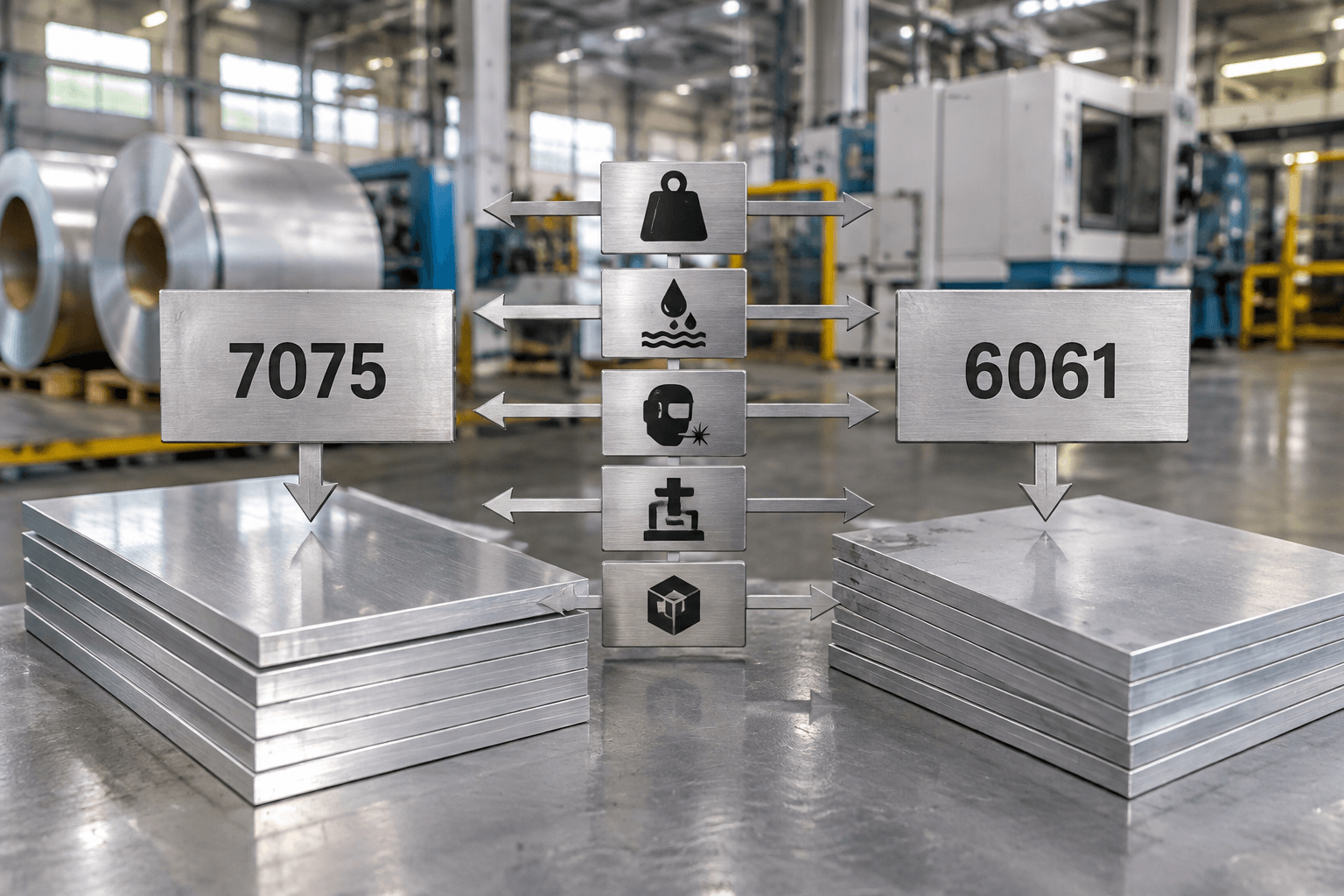
7075 Versus 6061 and Other Alternatives
| Selection factor | 7075 | 6061 or another alternative |
|---|---|---|
| Strength | Substantially higher in commonly compared aged conditions, provided equivalent forms and valid specifications are used. | 6061-T6 has lower strength but may already satisfy the load case. 7050, 7175, 7475, or 2024 may be compared for specialized strength, toughness, or corrosion requirements. |
| Stiffness | Elastic modulus is only modestly different from other aluminum alloys. | Changing from 6061 to 7075 may not solve a deflection problem without changing geometry. |
| Corrosion | Requires greater attention to temper, stress direction, interfaces, and protection. | 6061 generally provides better all-around corrosion resistance; 5xxx alloys may be preferable in demanding marine exposure. |
| Welding and forming | Usually less suitable for welded structures and severe forming, especially in high-strength tempers. | 6061 is commonly chosen for welded structures. Softer or non-heat-treatable alloys can be better for formed sheet-metal parts. |
| Machining | Generally machines well, but residual-stress management matters for heavily machined plate. | 6061 also machines effectively and may offer a simpler cost, supply, and joining route. |
| Product form | Available in several wrought forms, but a specific profile, temper, size, or governing specification must be confirmed. | 6061 is widely associated with extrusions. If a design requires a profile, confirm alloy and temper feasibility through the custom aluminum extrusion component route before freezing the drawing. |
Producer data for comparable T6/T651 test conditions illustrate the strength difference: typical 6061 values are around 310 MPa ultimate and 276 MPa yield, while representative 7075-T651 values can be significantly higher. These figures are not a universal comparison because form, thickness, specification, and statistical basis may differ. 6061 remains the better choice when weldability, corrosion resistance, forming, extrusion availability, or sufficient rather than maximum strength drives the design. ([online.kaiseraluminum.com](https://online.kaiseraluminum.com/depot/PublicProductInformation/Document/1025/Kaiser_Aluminum_6061_Rod_and_Bar.pdf?utm_source=openai))
A complete purchase specification should identify the alloy and exact temper; wrought product form; dimensions and tolerances; grain direction where relevant; applicable material specification and revision; surface condition; required finish; prohibited substitutions; and any heat-treatment, stress-relief, or machining requirements. Buyers should also define whether they need a mill test certificate, heat or lot traceability, chemical-composition results, mechanical-property records, inspection reports, coating records, or positive material identification.
7075 Selection Matrix: Temper, Environment, Joining, and Product Form
| Design situation | Directionally appropriate response | Items requiring confirmation |
|---|---|---|
| Maximum strength, machined from plate, controlled environment | Evaluate T651 against the actual thickness and loading direction. | Specification minima, residual stress, machining sequence, finish, fatigue details, and grain orientation. |
| Sustained load with moisture or corrosive exposure | Evaluate T7351 or another corrosion-resistant alloy/temper rather than selecting T651 from strength alone. | Stress-corrosion requirements, coating system, drainage, galvanic couples, short-transverse stress, and inspection plan. |
| Complex bent sheet component | Review softer forming conditions or a more formable alloy. | Bend radius, thickness, bend-to-grain direction, heat-treatment route, springback, and crack acceptance criteria. |
| Welded frame or enclosure | Compare 6061, 5xxx sheet, or a mechanically fastened redesign. | Joint process, heat-affected-zone properties, corrosion protection, distortion, and required post-weld strength. |
| Custom extruded profile | Confirm that the cross-section, temper, quantity, and specification are producible before relying on 7075. | Extrusion feasibility, minimum section features, straightness, quench response, temper suffix, and machining allowance. |
| Safety-critical or fatigue-critical component | Use application-specific engineering substantiation rather than general material tables. | Design allowables, load spectrum, fracture and fatigue requirements, nondestructive inspection, traceability, and regulatory approval. |
Request a material-and-process review before production planning. Send the part drawing or 3D model, required alloy and temper if specified, product form, critical dimensions, service loads, environment, joining method, finish requirements, and required material or inspection records. Yishang can review these inputs for material-condition or manufacturing-route conflicts before quotation and production planning, without assuming that 7075 is the correct choice for every high-strength component.
Frequently Asked Questions
What is 7075 aluminum alloy commonly used for?
7075 is used for highly loaded, weight-sensitive wrought components such as aircraft fittings, structural plate parts, gears, shafts, machine components, and selected transportation or sporting products. Suitability depends on temper, product form, environment, fatigue loading, joining, and applicable engineering requirements.
Is 7075 stronger than 6061, and does that make it the better choice?
7075 in comparable aged conditions is generally much stronger than 6061, but it is not automatically better. 6061 may be preferable for welded assemblies, corrosion exposure, extensive forming, common extruded profiles, or parts whose loads do not justify the higher-strength alloy. Stiffness can also remain similar even when tensile strength differs greatly.
What are the main disadvantages of 7075 aluminum?
The main limitations are lower general corrosion resistance than many 6xxx alloys, stress-corrosion susceptibility in certain tempers and orientations, restricted cold formability in hardened conditions, poor suitability for conventional fusion welding, and possible distortion when large volumes are machined from residual-stress-bearing stock.
Can 7075 aluminum be welded, formed, anodized, or machined?
It normally machines well and can be anodized or otherwise protected, subject to finish and dimensional requirements. Forming depends strongly on temper, thickness, radius, and grain direction. Conventional fusion welding is generally not preferred because cracking and loss of heat-treated properties must be addressed through qualified engineering and process validation.