
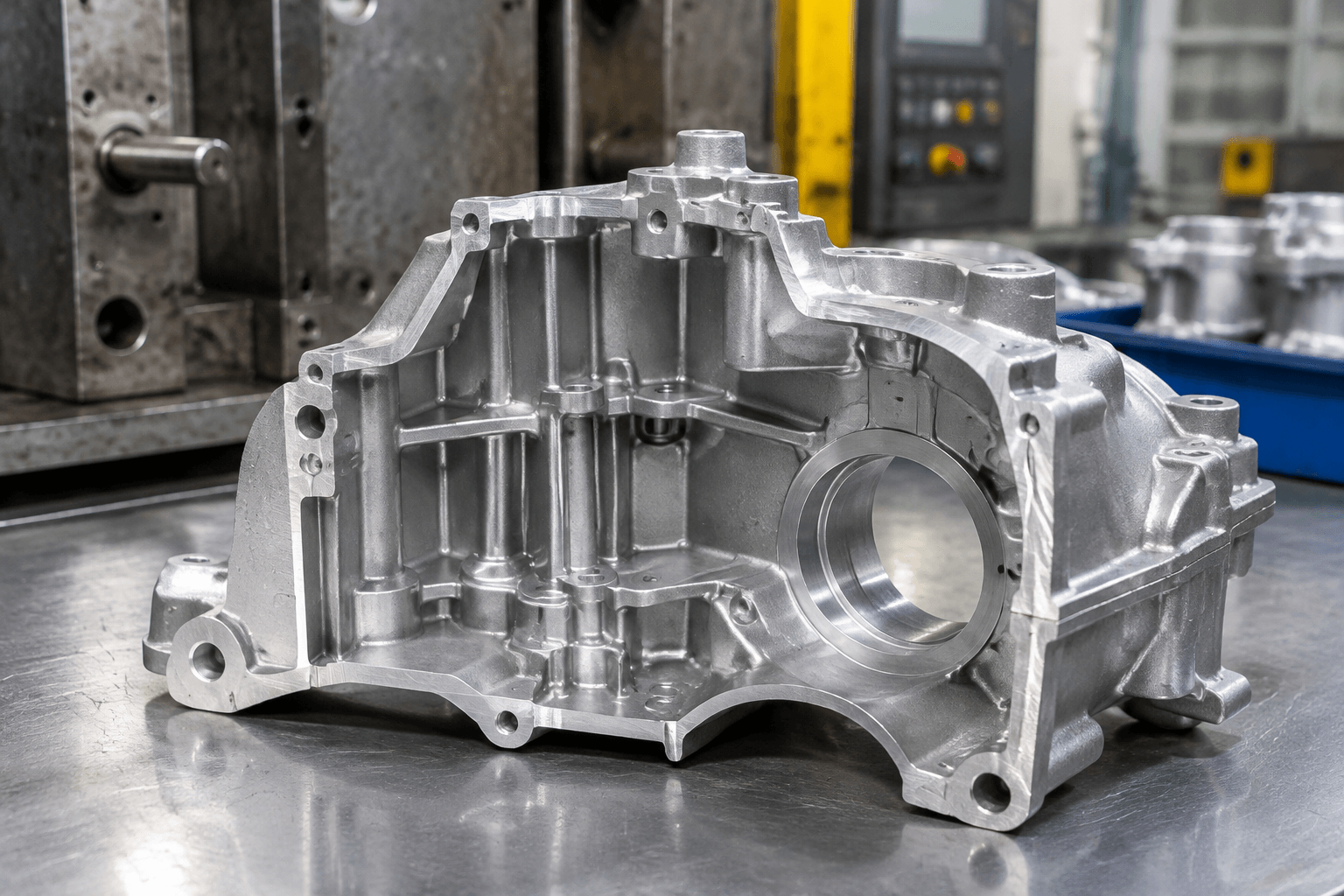
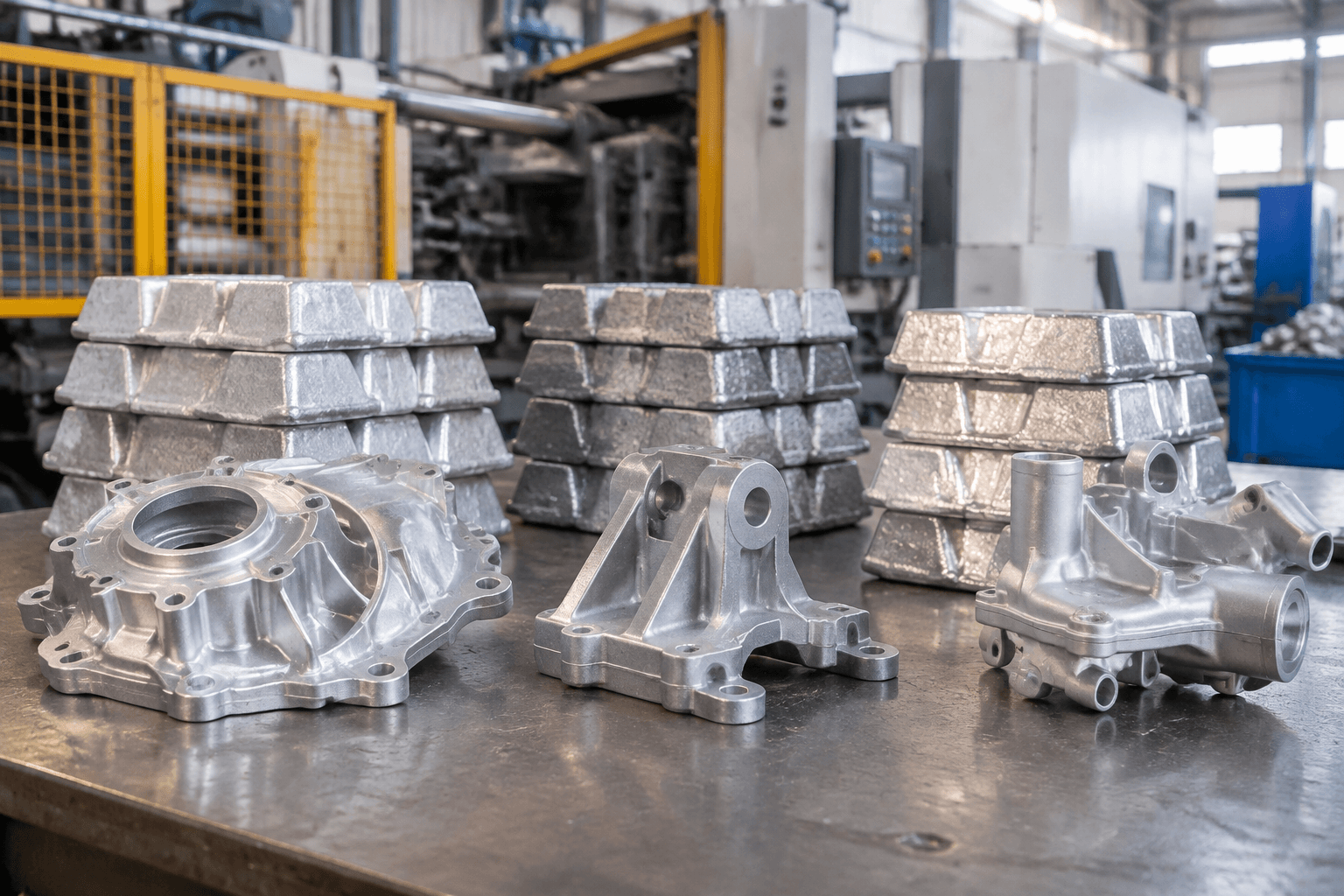
Alloy die casting is a production process that injects molten metal alloy into a reusable steel die under pressure to form complex, repeatable components. It is not limited to aluminum: aluminum, zinc, and magnesium alloy families offer different balances of weight, castability, strength, heat transfer, corrosion response, surface appearance, and finishing compatibility.
A responsible material and process decision therefore depends on the component geometry, service environment, critical surfaces, secondary machining, finish requirements, and acceptance criteria—not the alloy name alone.
What Happens During Alloy Die Casting?
In this article, alloy die casting refers specifically to high-pressure die casting, rather than gravity die casting or other metal-casting routes. The process uses hardened steel tooling containing the component cavity, feed system, parting surfaces, ejector arrangement, and other features needed to fill and release the casting.
Steel tooling supports repeatable production of components that may combine walls, ribs, bosses, mounting pads, flanges, thermal fins, cable openings, and appearance surfaces. However, the die cannot independently correct an unsuitable wall transition, inaccessible machining feature, unrealistic cosmetic requirement, or poorly defined sealing surface. These issues must be reviewed before tooling decisions are finalized.
- Alloy preparation: The specified metal is melted and controlled according to the selected alloy and casting process.
- Die preparation: The die is closed and prepared for filling. Process conditions depend on the alloy, component geometry, die design, and required surface condition.
- Injection: Molten alloy enters the steel cavity under pressure, filling the main geometry and detailed features.
- Solidification: The metal cools inside the die. Wall distribution, thermal balance, gates, overflows, and venting influence how the casting fills and solidifies.
- Ejection: The die opens and ejector pins release the casting. Their positions can leave visible marks and must be coordinated with functional and cosmetic zones.
- Trimming and cleaning: Runners, overflows, flash, and gate vestiges are removed to the required condition.
- Secondary operations: Critical holes, threads, bearing locations, sealing faces, or datums may be CNC machined. Finishing, assembly, leak testing, and inspection follow when required by the drawing.
This sequence explains why alloy selection and die design cannot be separated. The alloy influences flow, solidification, mechanical behavior, corrosion response, machining, and finishing, while the tool determines how the chosen material reaches the required geometry.
How Aluminum, Zinc, and Magnesium Alloys Differ
The three principal die-casting alloy families should be compared by application priorities rather than by a single ranking. Properties vary within each family, so the final review must use the specified grade, composition limits, condition, and applicable material specification.
| Decision area | Aluminum alloys | Zinc alloys | Magnesium alloys |
|---|---|---|---|
| Weight | Lower density than zinc and widely used where moderate weight reduction is important | Highest density of the three families, which may be acceptable for compact components | Lowest density of the three, supporting aggressive weight-reduction objectives |
| Castability and detail | Well suited to complex housings and structural forms, subject to alloy and geometry review | Often selected for fine detail, compact features, and good as-cast surface definition | Can fill complex lightweight forms, but design and process control remain alloy-specific |
| Mechanical priorities | Commonly balances stiffness, strength, weight, and dimensional function | Useful where compact geometry, detail, and local mechanical performance matter more than low mass | Offers a high strength-to-weight opportunity, with loads and service conditions requiring careful review |
| Thermal considerations | Frequently considered for housings, heat paths, and finned components | Usually chosen for reasons other than maximum heat dissipation | May serve lightweight thermal enclosures, but performance must be checked against the selected grade |
| Corrosion and environment | Depends on alloy chemistry, exposure, galvanic interfaces, surface condition, and finish | Requires consideration of environment, coating system, and contact with other metals | Often needs particularly deliberate corrosion and galvanic protection planning |
| Finishing | Coating, conversion treatment, painting, or other finishes must suit the alloy and casting surface | Can support decorative and protective finishes when surface preparation and acceptance criteria are defined | Finish selection must address alloy reactivity, pretreatment, exposure, and assembly interfaces |
Regional names are useful cross-reference points, not automatic substitutions. Aluminum discussions may refer to systems such as JIS ADC designations, North American Aluminum Association or ASTM-related names, and European EN AC designations. Zinc may be described through Zamak or regional specification systems, while magnesium alloys may use designations such as AZ-series names.
A nominally similar designation does not prove identical chemistry, impurity limits, mechanical properties, test methods, or casting performance. Procurement documents should identify the governing specification, grade, revision where relevant, and any required material documentation rather than relying on a supplier’s informal equivalence statement.
Is the Component a Good Candidate for Die Casting?
Alloy die casting becomes attractive when a component benefits from integrated geometry and repeatable production from dedicated tooling. A housing that combines mounting bosses, ribs, connector openings, shielding walls, thermal fins, and external styling may eliminate several separate parts and assembly steps. That advantage is meaningful only if the integrated design can fill, eject, machine, finish, and pass inspection consistently.
Screen the part through the following questions:
- Geometry: Can wall sections remain reasonably consistent, with manageable transitions instead of isolated heavy masses beside thin regions?
- Loads: Are load direction, bolt forces, vibration, impact, stiffness, and fatigue expectations defined well enough to review ribs, bosses, and local section thickness?
- Weight: Is mass reduction a primary requirement, or would a denser alloy be acceptable in exchange for fine detail or compact geometry?
- Environment: Will the component face moisture, road salts, chemicals, outdoor weather, elevated temperature, or contact with dissimilar metals?
- Function: Does the part transfer heat, provide electrical grounding or shielding, hold bearings, support threads, or contain fluid or gas?
- Appearance: Which surfaces are cosmetic, what defects are unacceptable, and will the surface be painted, plated, coated, polished, or left as cast?
- Production pattern: Is expected demand stable enough to justify dedicated tooling? There is no universal break-even quantity because tooling complexity, part size, secondary operations, and alternative processes vary.
Alternative production routes should remain in the discussion. Billet machining may suit lower demand, frequent revisions, or parts dominated by precision surfaces. Sheet metal fabrication may be preferable for folded enclosures, large panels, welded frames, or designs likely to change. Extrusion can be efficient for constant cross-sections, while sand or gravity casting may suit different size, tooling, volume, or structural priorities. Injection molding is relevant when polymer properties satisfy the thermal, mechanical, grounding, and environmental requirements.
For examples of casting-oriented housings and structural components, buyers can explore custom die-casting production for housings and structural parts.
Which Features Need Casting, Machining, or Finishing Review?
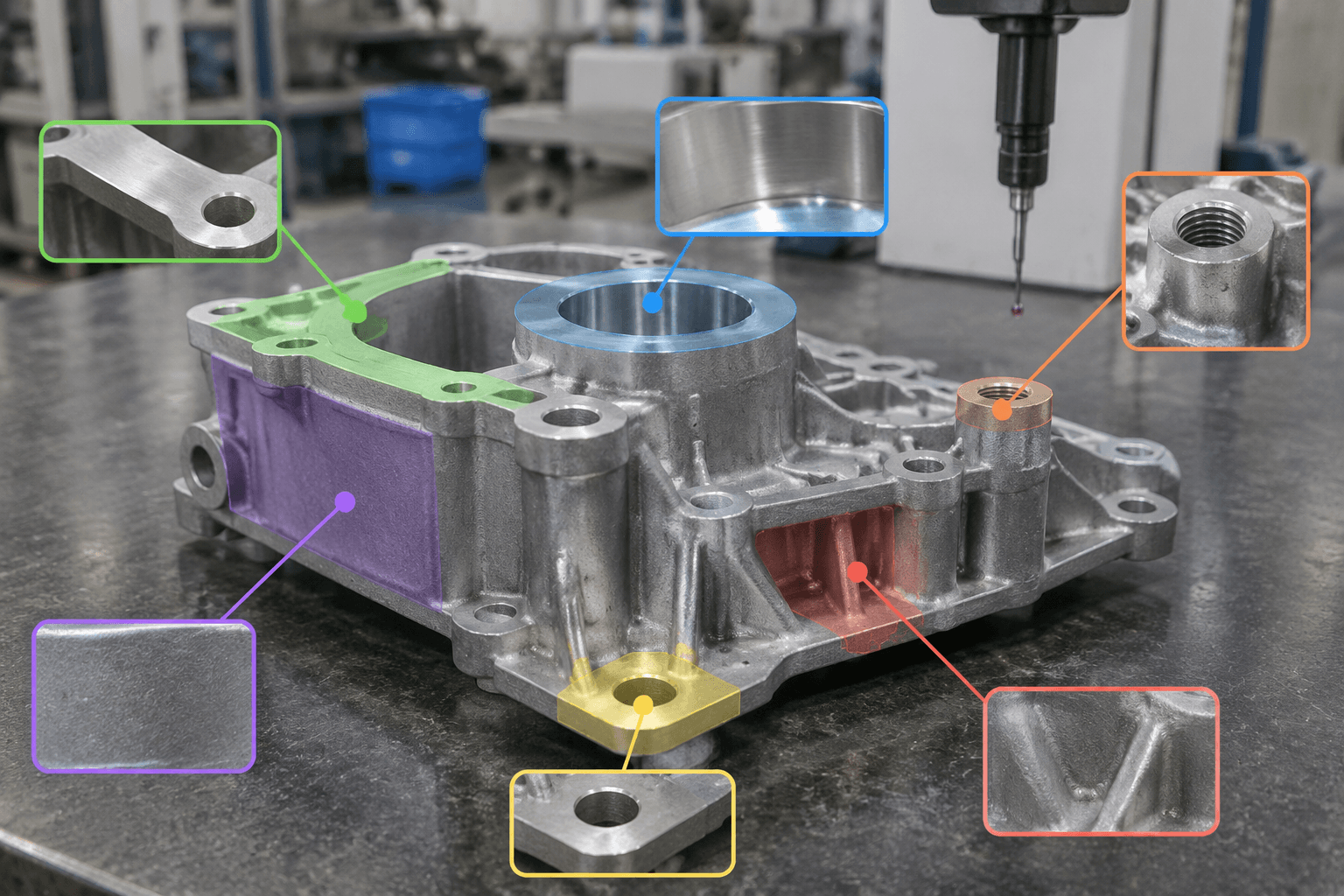
A die-cast component normally contains three categories of surfaces: features that can remain as cast, features that need controlled trimming or finishing, and functional areas that require CNC machining. Treating every surface as machined adds unnecessary cost, while assuming every feature can remain as cast can create fit, sealing, and alignment problems.
| Feature | Design review priority | Possible downstream requirement |
|---|---|---|
| Wall transitions | Avoid abrupt changes that create uneven filling, cooling, shrinkage, or concentrated internal defects | Geometry revision may be more effective than adding inspection later |
| Draft | Provide release geometry in the direction the die opens, considering surface texture and feature depth | Insufficient draft can affect ejection and surface condition |
| Ribs and bosses | Review stiffness, load paths, local mass, bolt forces, tool access, and surrounding wall sections | Bores, threads, or mounting faces may need machining |
| Parting line | Place it away from critical sealing, bearing, or appearance areas where practical | Flash trimming and local dimensional control may be required |
| Gate vestige | Define an acceptable location and post-trim condition | Trimming, grinding, or localized finishing may be specified |
| Ejector marks | Keep them away from critical datums, sealing paths, and protected cosmetic zones | Acceptance limits should be stated if marks remain visible |
| Bearing seats and precision bores | Establish alignment, datum structure, fit, and accessible cutting direction | CNC boring, reaming, or related machining may be needed |
| Sealing faces | Define flatness, surface condition, seal type, pressure medium, and porosity sensitivity | Machining, leak testing, impregnation review, or other controls may apply |
| Machining stock | Provide enough material for cleanup without creating unnecessarily heavy sections | Allowance must reflect casting variation, datum strategy, and required final geometry |
Finishing decisions also belong in the early design review. Coating adhesion can be affected by alloy chemistry, release residues, oxidation, porosity, surface contamination, and pretreatment. A cosmetic requirement such as a smooth painted exterior does not automatically apply to hidden internal faces. Mark appearance zones on the drawing and define whether gate traces, ejector marks, flow patterns, polishing variation, or exposed machining are acceptable.
Outdoor lighting illustrates this interaction: a housing may need thermal transfer, corrosion protection, gasket sealing, mounting strength, and a controlled visible finish at the same time. The lighting equipment manufacturing overview provides additional application context without replacing part-specific alloy and finish validation.
Match the Requirement to the Alloy and Review Priority
This screening matrix helps organize discussions before detailed material approval. It indicates where each requirement directs engineering attention; it does not select a grade or guarantee performance.
| Primary requirement | Initial alloy direction | Design or validation focus |
|---|---|---|
| Lowest practical component mass | Compare magnesium and aluminum families first | Loads, stiffness, corrosion protection, joining, and total installed weight |
| Fine detail in a compact component | Include zinc in the comparison | Feature filling, local sections, ejection, finish, and acceptable mass |
| Heat dissipation through a housing or fins | Aluminum is a common starting point | Selected alloy conductivity, fin geometry, fill path, thermal interfaces, and coating effects |
| Pressure or fluid containment | No family should be approved by name alone | Porosity-sensitive zones, wall transitions, machining exposure, sealing design, medium, pressure, and leak criteria |
| Decorative external appearance | Compare alloy and finish as one system | Cosmetic zones, surface preparation, gate and ejector locations, coating acceptance, and handling |
| Machined bearings, threads, or datums | Evaluate the specified grade’s machinability | Datum scheme, machining stock, tool access, distortion, internal defects, and inspection method |
| Outdoor or chemically exposed service | Review all candidates against actual exposure | Corrosion mechanism, galvanic contacts, coating damage, drainage, crevices, and maintenance |
Where several priorities conflict, rank them. For example, the lightest alloy is not automatically the best choice if the component also requires a demanding decorative coating, aggressive corrosion exposure, heavily loaded threads, and a tightly controlled sealing face. The preferred solution may involve an alloy change, local geometry revision, inserts, machining, a different finish, or another manufacturing route.
How Should Quality and Inspection Requirements Be Defined?
Porosity is a central die-casting concern because gas entrapment and solidification behavior can create internal voids. Its significance depends on location and function. An internal indication in a noncritical rib may have different consequences from porosity exposed by machining across a gasket path, bearing seat, threaded hole, or pressurized wall.
Pressure-tightness is possible, but it must be engineered and verified. The drawing or quality plan should identify the contained medium, operating and test conditions, leak limit, test method, connection arrangement, test stage, and sampling expectation. A statement such as “no leakage” is incomplete unless the measurement method and acceptance condition are defined.
| Requirement | Possible evaluation approach | Information to define |
|---|---|---|
| Critical dimensions | Calipers, gauges, CMM, fixtures, or other suitable dimensional methods | Datums, tolerances, measurement condition, frequency, and reporting |
| Sealing and bearing surfaces | Dimensional and surface inspection, supplemented by functional checks where required | Flatness, position, fit, surface condition, and protected handling |
| Pressure-tightness | Air, gas, liquid, pressure-decay, or other specified leak-testing methods | Medium, pressure, duration, leak limit, temperature, and sampling |
| Internal defects | Sectioning, radiographic methods, computed tomography, or other agreed techniques | Inspection zones, defect classification, acceptance criteria, and sampling |
| Material identity | Supplier documentation, chemistry verification, or agreed material testing | Alloy specification, revision, documentation, and traceability level |
| Appearance and finish | Visual standards, approved samples, coating measurements, or adhesion tests when specified | Cosmetic zones, viewing conditions, color, texture, allowable marks, and test criteria |
Inspection scope should reflect failure consequences. A decorative cover, a structural mounting component, and a pressure-containing housing do not require identical evidence. Sampling, documentation, traceability, and test frequency should be agreed from drawing requirements and application risk rather than assumed from the process name.
For an initial technical feasibility review, send the part drawing or 3D model, intended alloy or required functional properties, expected annual demand or production pattern, and identified critical dimensions, sealing areas, cosmetic zones, and finish requirements. The initial discussion can then address casting suitability, unresolved alloy questions, critical features, secondary machining, finishing, and inspection expectations before a quotation is requested.
Frequently Asked Questions
Is alloy die casting the same as aluminum die casting?
No. Aluminum die casting is one category within alloy die casting. Zinc and magnesium alloys are also widely considered for die-cast components, and each family has different implications for density, detail, mechanical behavior, heat transfer, corrosion protection, machining, and finishing.
Can a die-cast component be pressure-tight despite porosity risk?
Yes, pressure-tight components can be produced, but pressure-tightness should never be assumed from the alloy or process alone. Geometry, gating, venting, process conditions, machining exposure, sealing design, contained medium, leak limit, and test method must be reviewed together.
Which die-cast surfaces usually need CNC machining?
Machining is commonly considered for precision bores, bearing seats, tapped holes, dowel locations, sealing faces, mounting datums, and other features that require controlled size, position, flatness, fit, or surface condition. Noncritical walls, ribs, and exterior forms may remain as cast when their requirements permit.
Can regional alloy designations be treated as direct equivalents?
Not without verification. Similar designations from JIS, ASTM-related, Aluminum Association, EN, or other systems may differ in chemistry limits, impurities, mechanical-property requirements, test methods, or available casting conditions. Confirm the governing specification and required documentation before approving a substitution.