
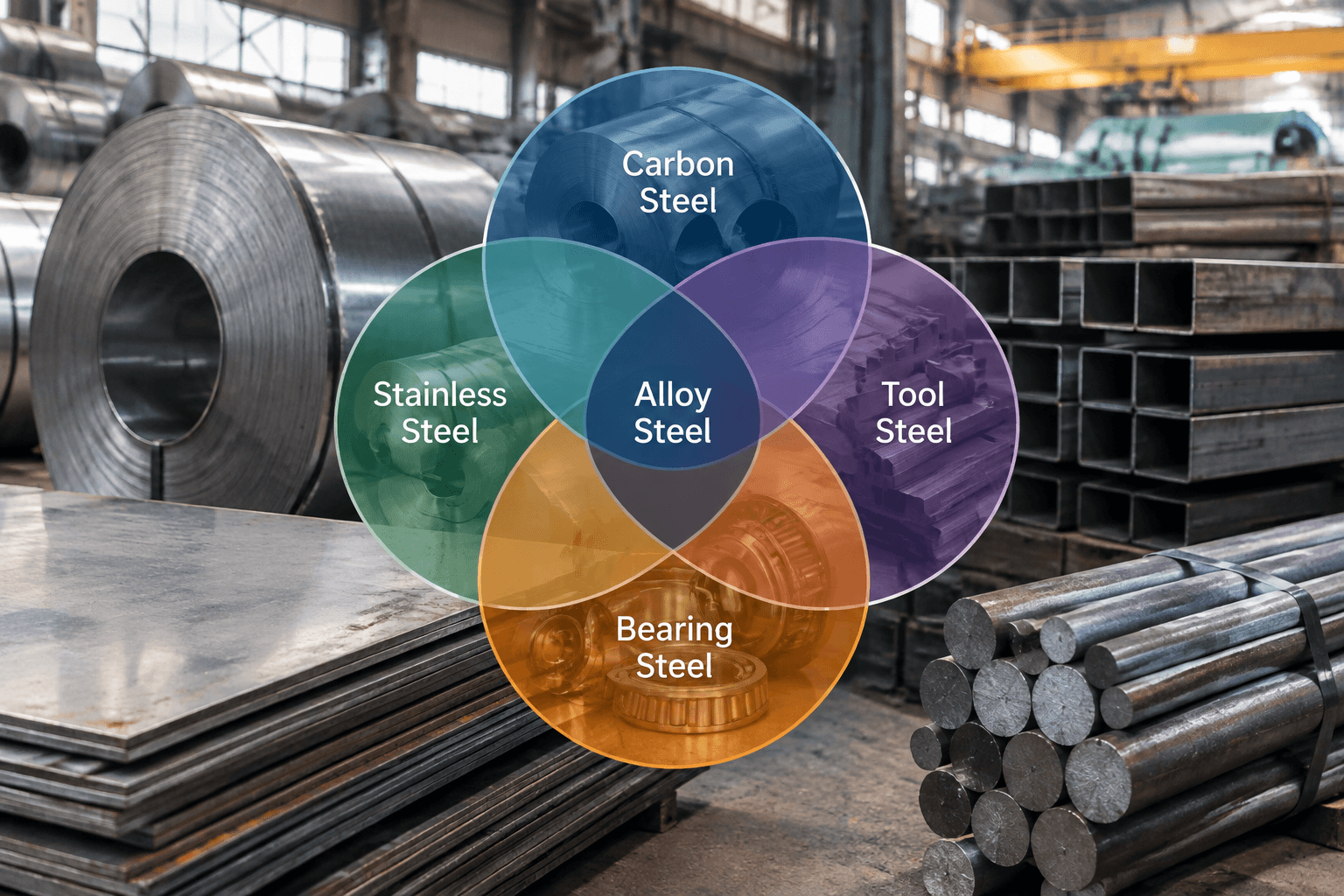
Alloy grades of steel are standardized identifiers that describe a material’s chemical family, but a grade number alone is not a complete performance specification. Grades such as 4140, 4150, 4340, 52100, and 9310 must be evaluated together with the governing specification, product form, dimensions, processing history, and heat-treatment condition. ([saemobilus.sae.org](https://saemobilus.sae.org/standards/j404_199102-chemical-compositions-sae-alloy-steels?utm_source=openai))
This distinction matters because two components labeled with the same nominal grade can arrive in different conditions and respond differently during machining, forming, welding, heat treatment, finishing, or service. The useful question is therefore not simply “Which alloy steel is best?” but “Which grade, condition, and product specification fit the part’s actual requirements?”
What an Alloy Steel Grade Actually Tells You
Steel is fundamentally an iron-and-carbon alloy. In commercial material classification, alloy steel usually refers to steels whose controlled alloying additions are used to obtain particular hardenability, strength, toughness, wear, fatigue, temperature, or processing characteristics. This category is not a universal quality ranking: an alloy steel is not automatically better or stronger than a carbon steel or stainless steel for every application. ([worldsteel.org](https://worldsteel.org/about-steel/glossary/?utm_source=openai))
The boundaries between steel categories also require care. Stainless steel is distinguished primarily by the chromium level that supports corrosion resistance, while tool steels are grouped around tooling applications and specialized working properties. Bearing steels are associated with rolling or sliding contact requirements. A grade such as 52100 may therefore be described both as alloy steel and bearing steel, depending on the classification context. Tool and bearing categories can overlap broader chemistry-based classifications rather than sitting completely outside them. ([store.astm.org](https://store.astm.org/products-services/standards-and-publications/standards/steel-standards.html?utm_source=openai))
Traditional SAE-style numbers organize many carbon and alloy steels by chemical family. Four- and five-digit designations provide a convenient identity, but they do not fully encode product quality, cleanliness, mechanical properties, dimensional tolerances, surface condition, or delivery state. Modern designation systems also recognize that one short number cannot represent every chemistry modification, hardenability requirement, or processing requirement. ([saemobilus.sae.org](https://saemobilus.sae.org/standards/j402_202403-new-steel-designation-system-wrought-rolled-steel?utm_source=openai))
Where Common Alloy Steel Grades Fit
The following map shows broad design intent rather than guaranteed properties. The exact behavior of each grade remains conditional on its specification, section size, product form, and treatment.
| Grade or family | Broad classification | Typical selection focus | Important qualification |
|---|---|---|---|
| 41xx, including 4140 and 4150 | Chromium-molybdenum alloy steel family | Components requiring a balance of strength, hardenability, toughness, and manufacturability | 4140 and 4150 are separate grades. A shared family prefix does not make them interchangeable. |
| 43xx, including 4340 | Nickel-chromium-molybdenum alloy steel family | Parts where toughness and response through heavier sections may be important | Required properties must be connected to a defined condition and section size. |
| 52xxx, including 52100 | High-carbon chromium alloy steel commonly associated with bearings | Wear, contact fatigue, hardness response, and surface integrity | Bearing quality, cleanliness, processing route, and heat treatment may be as important as the grade name. |
| 93xx, including 9310 | Nickel-chromium-molybdenum carburizing steel family | Parts designed around a hardened case with a different core requirement | Case requirements, core requirements, product quality, and treatment route must be specified separately. |
Official material specifications demonstrate why the family map is only a starting point. The same nominal grade may be covered in separate specifications for bars, forgings, tubing, sheet, strip, plate, or specialized quality levels. For example, published specifications exist for 4140 in both bar and flat-product forms, while 52100 and 9310 specifications distinguish product forms and application-related quality requirements. ([saemobilus.sae.org](https://saemobilus.sae.org/standards/ams6267k-steel-bars-forgings-mechanical-tubing-forging-stock-12cr-325ni-012mo-007-013c-9310-electroslag-remelted-consumable-electrode-vacuum-remelted?utm_source=openai))
Why the Same Grade Can Behave Differently
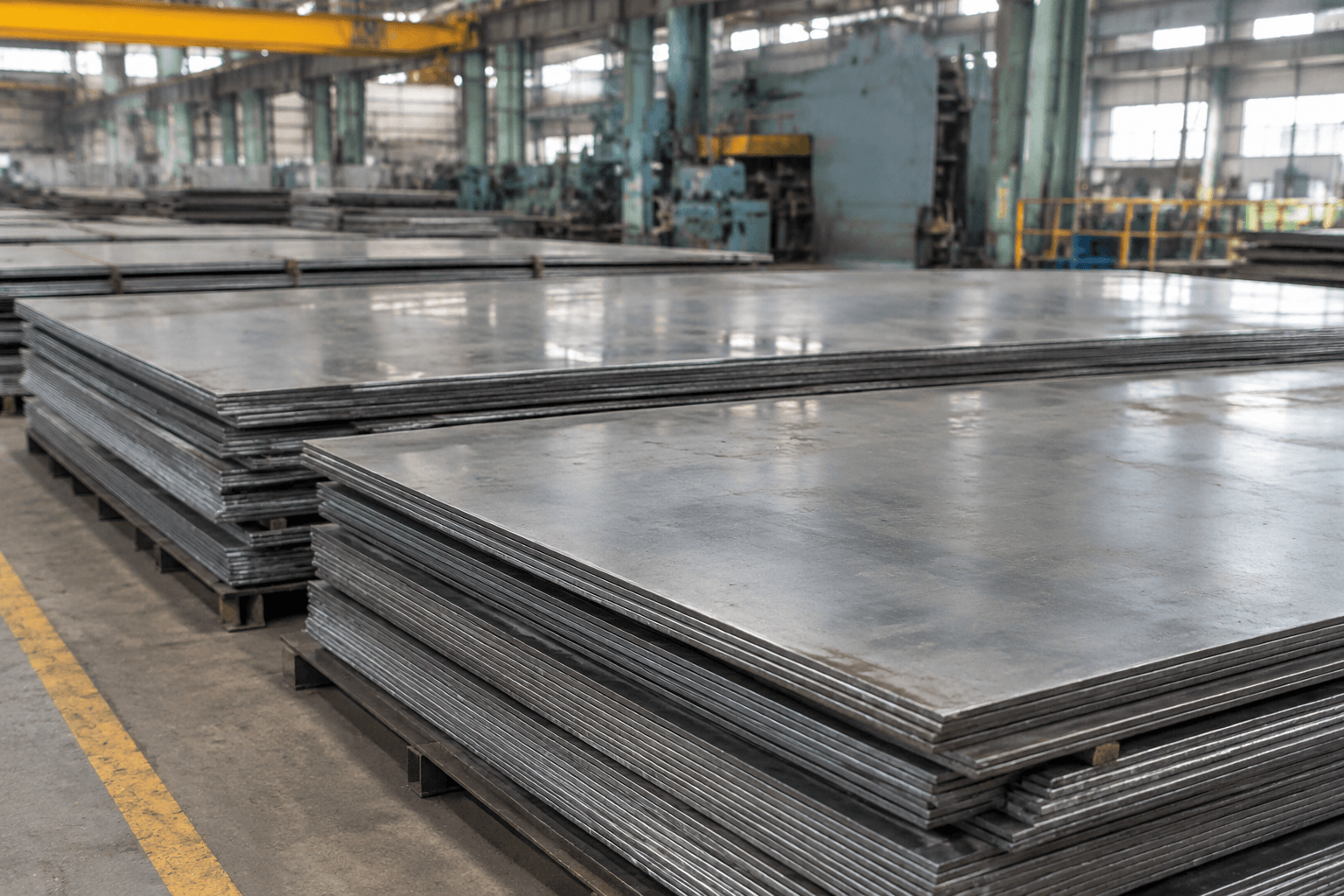
Heat-treatment condition changes the material state. Annealed material may be supplied to support machining or forming, while normalized, quenched-and-tempered, or case-hardened material is intended to create a different property balance. These descriptions cannot be treated as synonyms. Even within one named condition, the applicable specification and required test results determine what the purchaser is actually receiving.
Section size changes heat-treatment response. A thin feature and a heavy cross-section do not necessarily cool or transform in the same way. Geometry also affects distortion risk: an asymmetric part, a deep bore, or a large difference between wall sections may respond differently from a simple test specimen. This is one reason mechanical-property requirements should identify where and how compliance will be evaluated.
Product form carries its own requirements. Hot-wrought bar, cold-finished bar, plate, tubing, and forging stock may be supplied under different specifications. Those specifications can address chemistry, dimensions, testing, processing, surface quality, and supplementary purchaser requirements. A grade listed for bar should not automatically be assumed to have identical requirements when ordered as sheet or tube. ([saemobilus.sae.org](https://saemobilus.sae.org/standards/j404_199102-chemical-compositions-sae-alloy-steels?utm_source=openai))
Processing history adds another layer. Forging, cold finishing, machining, welding, heat treatment, grinding, plating, and coating can influence residual stress, surface integrity, dimensions, or inspection needs. Grade selection should account for the complete manufacturing route rather than focusing only on the finished component’s headline property.
Define Requirements Before Selecting a Grade
Begin with the component’s failure risks and manufacturing route. A shaft carrying cyclic torque, a wear insert, a case-hardened gear, and a fabricated bracket do not present the same selection problem even if each could be described broadly as a high-strength steel part.
- Describe the load: Identify static, impact, cyclic, rolling-contact, bending, torsional, or combined loading. State whether toughness, fatigue resistance, wear behavior, or stiffness is the controlling concern.
- Define the environment: Record service temperature, moisture, chemicals, lubrication, abrasive contact, and expected coating maintenance. Do not assume a conventional alloy steel provides stainless-like corrosion resistance.
- Review geometry: Include maximum section thickness, wall transitions, holes, threads, joining locations, and distortion-sensitive features. Evaluate whether the geometry affects heat-treatment response, final dimensions, surface requirements, or the feasibility of the planned manufacturing route.
- Map the manufacturing route: Identify which operations occur before and after heat treatment, and note any machining, forming, joining, grinding, finishing, or assembly steps that could affect material condition, distortion, surface integrity, or verification requirements.
- Set verification requirements: Specify critical dimensions, mechanical-property evidence, heat-treatment records, material certificates, surface inspection, hardness testing, or traceability only where the application requires them.
- Check sourcing constraints: Confirm that the required grade, form, dimensions, condition, and documentation can be sourced consistently for both prototypes and production. Availability should be verified rather than assumed from a generic steel grade chart.
In applications such as automotive and transportation equipment, fatigue, joining, geometry, and repeatability may drive the discussion. For material handling and logistics equipment, load paths, wear exposure, impact, and fabricated assembly requirements may receive greater attention. These are requirement examples, not automatic grade recommendations.
Match the Requirement to a Steel Family
This shortlist matrix helps organize an early material review. It does not replace engineering validation or the applicable material specification.
| Primary requirement | Family worth investigating | Questions to resolve before nomination |
|---|---|---|
| General strength and toughness after treatment | 41xx or other through-hardening alloy steel families | What condition, section size, welding route, machining stage, and final properties are required? |
| Toughness in more demanding or heavier components | 43xx or another suitable high-hardenability family | Are properties required at the surface, core, or a specified test location? |
| Rolling contact or concentrated wear | 52100 or another bearing-oriented steel | What cleanliness, dimensional stability, surface finish, lubrication, and contact-fatigue requirements apply? |
| Hard wear-resistant surface with a different core condition | 9310 or another carburizing steel family | What case profile, core performance, post-treatment machining, grinding, and distortion controls are needed? |
| Fabricated or welded component | A grade selected around the approved joining and property requirements | Can the planned grade and condition be welded under a qualified procedure without compromising the required result? |
| Corrosive service | Stainless steel, protected alloy steel, or another corrosion strategy | Is corrosion resistance required from the base material, a coating system, or both? |
The matrix deliberately avoids naming a universal “best” grade. A simpler carbon steel with an appropriate design or coating may be more suitable in one application, while a stainless, tool, bearing, or alloy steel may be justified in another.
Write a Material Callout That Production Can Follow
A consistent callout separates each requirement instead of expecting the grade number to carry the whole specification. A practical structure is:
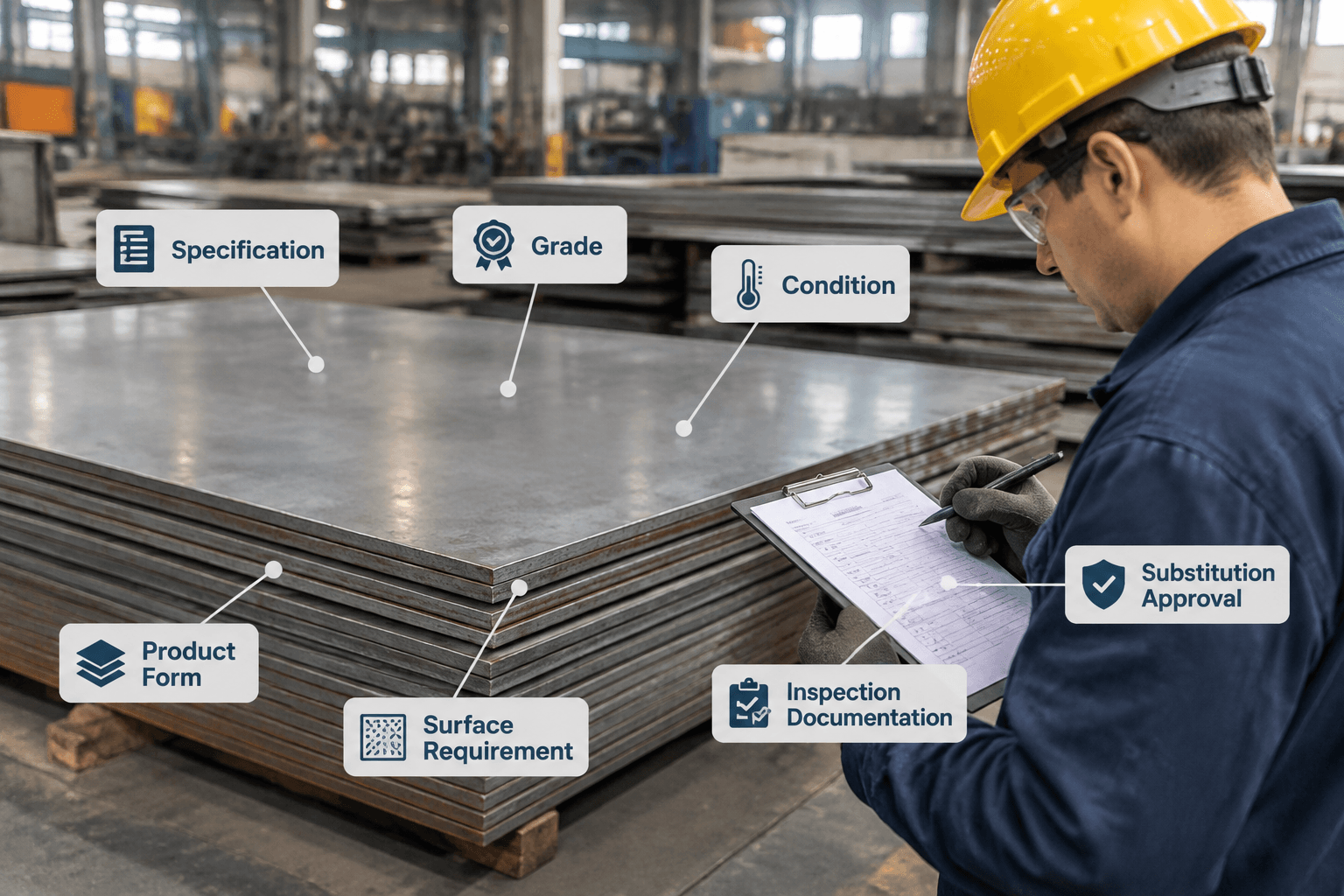
Material: [governing material specification] + [grade] +
+ [delivery or heat-treatment condition] + [required mechanical or hardness criteria] + [surface condition or finish] + [inspection and documentation] + [substitution rule].
Governing specification: Identifies the controlling technical document and its revision policy. Grade: Defines the chemistry designation within that system. Product form and size: State whether the purchase is bar, plate, sheet, tube, forging, or another form, including dimensions relevant to treatment response.
Condition and required properties: State the delivery condition and any properties that must be achieved in the final part. Clarify whether requirements apply before or after machining, welding, heat treatment, coating, or grinding. Surface and inspection: Add finish, decarburization, defect-control, traceability, certificate, or test-report requirements when functionally necessary.
Substitutions: Do not write “equivalent grade acceptable” without defining the approval method. International designations that appear similar may differ in composition limits, product requirements, testing, or availability. Require documented engineering or purchaser approval before substitution.
General steel specifications commonly distinguish purchase-order requirements, individual material specifications, product forms, analyses, mechanical tests, and supplementary requirements. This hierarchy illustrates why “4140 steel” by itself may be too ambiguous for controlled production. ([store.astm.org](https://store.astm.org/a0029_a0029m-11a.html?utm_source=openai))
Frequently Asked Questions
Does heat treatment change the properties of the same alloy steel grade?
Yes. Annealing, normalizing, quenching and tempering, and case-hardening routes create different material conditions. Final behavior also depends on part dimensions, treatment controls, and subsequent operations. The grade and heat-treatment condition should therefore appear as separate requirements.
Can one alloy steel grade replace another with similar properties?
Not automatically. Similar published properties do not prove equivalent chemistry limits, hardenability, cleanliness, heat-treatment response, product requirements, weldability, or dimensional behavior. Any substitution should be checked against the governing specifications and approved by the responsible engineer or purchaser.
How does alloy steel differ from stainless steel when strength and corrosion both matter?
Conventional alloy steels may be selected around strength, toughness, wear, or treatment response, while stainless steels are defined around chromium-supported corrosion resistance. Either category can include many property levels. Selection should consider the actual environment, required mechanical performance, fabrication route, coating strategy, and maintenance plan. ([worldstainless.org](https://worldstainless.org/about-stainless/properties/stainless-steel-standards/?utm_source=openai))
What details should accompany an alloy steel grade on a drawing?
Include the governing specification, grade, product form, dimensions, delivery or final condition, required properties, surface requirements, inspection documents, traceability expectations, and substitution restrictions. Also clarify which requirements apply to raw material and which must be verified on the finished component.