
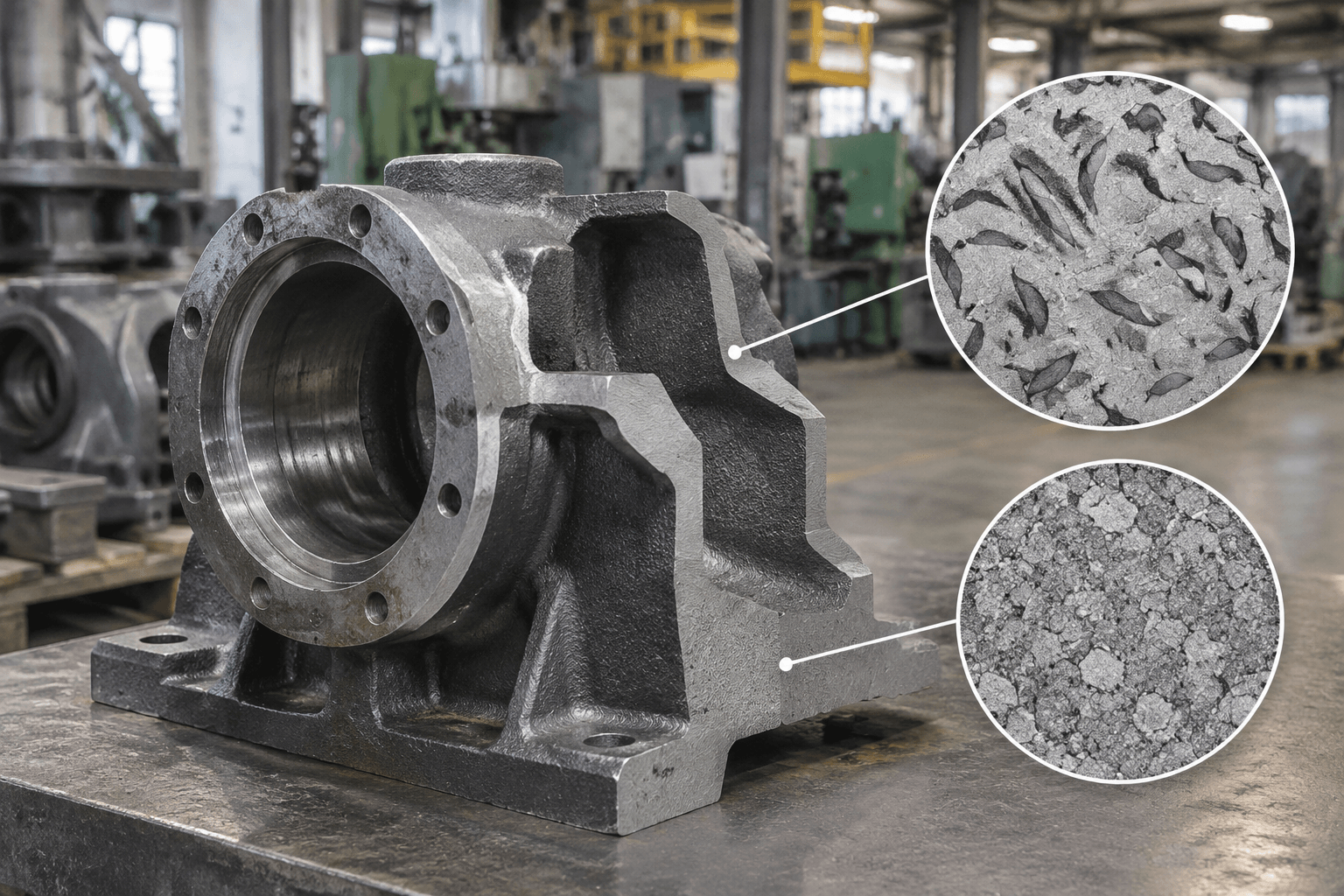
Alloyed cast iron is cast iron intentionally modified with elements such as chromium, nickel, molybdenum, silicon, copper, or manganese to develop a required response to wear, heat, corrosion, hardening, or other service demands. It is not a separate graphite family: an alloyed iron may still be gray, ductile, compacted-graphite, white, or another recognized cast iron type.
Chemistry alone does not predict performance. Engineers must also consider graphite morphology, metal matrix, carbide content, heat-treatment condition, casting section thickness, and cooling history. ASM describes chemical composition, cooling rate, and heat treatment as major influences on cast iron structure, while ISO treats graphite classification and matrix classification as distinct metallurgical descriptions. ([dl.asminternational.org](https://dl.asminternational.org/handbooks/edited-volume/52/chapter-abstract/636753/Classification-and-Basic-Types-of-Cast-Iron-1?redirectedFrom=fulltext&utm_source=openai))
What Makes a Cast Iron “Alloyed”?
Cast irons are iron-carbon materials commonly distinguished from steels by their higher carbon content, generally above approximately 2%. Their casting behavior and properties are strongly influenced by how carbon appears in the solidified structure—as graphite, iron carbide, or a combination of constituents. The commercial cast iron families include gray, ductile or nodular, compacted-graphite, white, and malleable iron. These names mainly describe graphite form, fracture behavior, or production route rather than whether the iron is alloyed. ([dl.asminternational.org](https://dl.asminternational.org/technical-books/monograph/94/chapter-abstract/2105910/Cast-Irons?redirectedFrom=fulltext&utm_source=openai))
For example, ductile iron is defined by substantially spheroidal graphite. That definition does not automatically mean it contains a significant chromium, nickel, or molybdenum addition. Conversely, abrasion-resistant white iron may contain substantial alloy additions while retaining carbon mainly in hard carbide structures. ASTM and ISO therefore maintain separate specifications for gray, ductile, compacted-graphite, austenitic, and abrasion-resistant irons. ([store.astm.org](https://store.astm.org/products-services/standards-and-publications/standards/cast-iron-standards.html?utm_source=openai))
Use four separate questions when identifying the material:
- Alloy content: Which elements have been intentionally added, and in what grade-controlled amounts?
- Graphite morphology: Is graphite flake, spheroidal, compacted, temper carbon, or largely absent?
- Matrix and carbides: Is the surrounding structure ferritic, pearlitic, martensitic, austenitic, ausferritic, or carbide-rich?
- Condition: Is the casting supplied as-cast, annealed, normalized, quenched and tempered, austempered, or in another specified condition?
Cast steel is a different material family. It generally contains less carbon, does not rely on graphite morphology for classification, and is often considered when impact toughness, ductility, or weldability is more important than the casting and damping characteristics associated with cast iron. Cast steel is not automatically superior: its suitability still depends on grade, heat treatment, section design, inspection, and service loading. Cast steel is often selected for ductility and toughness, but weldability still depends on grade chemistry, section thickness, heat treatment, joint design, and a qualified procedure. ([sfsa.org](https://www.sfsa.org/wp-content/uploads/2021/10/WhitePaper-Welding.pdf?x94350=&utm_source=openai))
What the Main Alloying Elements Change
Alloy additions work through interactions rather than isolated ingredient effects. An element may encourage graphite or carbides, change transformation rates during cooling, stabilize a matrix phase, or affect oxidation and corrosion behavior. The outcome depends on total chemistry, inoculation, section size, cooling rate, and heat treatment.
| Element | Typical directional effect | Specification caution |
|---|---|---|
| Chromium | Promotes carbides and can increase hardness, abrasion resistance, hardenability, and oxidation resistance in suitable high-alloy grades. | Excess carbide formation can reduce machinability and toughness. The required amount must be tied to a recognized grade and service condition. |
| Nickel | Can promote graphitization, improve hardenability without the same carbide-forming tendency as chromium, stabilize austenite, and support corrosion or thermal performance in designated alloy families. | Benefits are environment- and grade-specific. Nickel content alone does not establish corrosion resistance. |
| Molybdenum | Generally delays transformation, increases hardenability, and can support elevated-temperature strength or wear-resistant martensitic matrices. | It may contribute to carbide formation and section-dependent hardness. Heat treatment often determines whether the intended matrix develops. |
| Silicon | Strongly encourages graphitization and influences ferrite formation. Higher-silicon grades may be selected for particular oxidation, heat, or corrosion environments. | Its effect on strength, embrittlement risk, graphite formation, and oxidation behavior depends on concentration and grade. |
| Copper | Often encourages pearlite and can increase strength or hardness while supporting hardenability in some irons. | Copper does not replace control of graphite shape, cooling rate, or heat treatment. |
| Manganese | Combines with sulfur and can promote pearlite, hardenability, and carbide retention. | Balance with sulfur, silicon, and cooling conditions matters; excessive retained carbides can impair machining and ductility. |
ASM identifies silicon, aluminum, nickel, cobalt, and copper as graphite-promoting elements, while chromium, molybdenum, manganese, vanadium, tin, and sulfur tend to promote cementite formation to different degrees. These are directional metallurgical tendencies, not universal recipes. ([dl.asminternational.org](https://dl.asminternational.org/technical-books/monograph/94/chapter-abstract/2105910/Cast-Irons?redirectedFrom=fulltext&utm_source=openai))
Recognized high-alloy families demonstrate why grade context matters. ASTM lists separate specifications for abrasion-resistant irons, high-silicon corrosion-resistant irons, austenitic gray iron, austenitic ductile iron, and high-silicon-molybdenum ferritic iron. High-alloy white irons also include nickel-chromium, chromium-molybdenum, and high-chromium groups intended mainly for abrasive service. ([store.astm.org](https://store.astm.org/products-services/standards-and-publications/standards/cast-iron-standards.html?utm_source=openai))
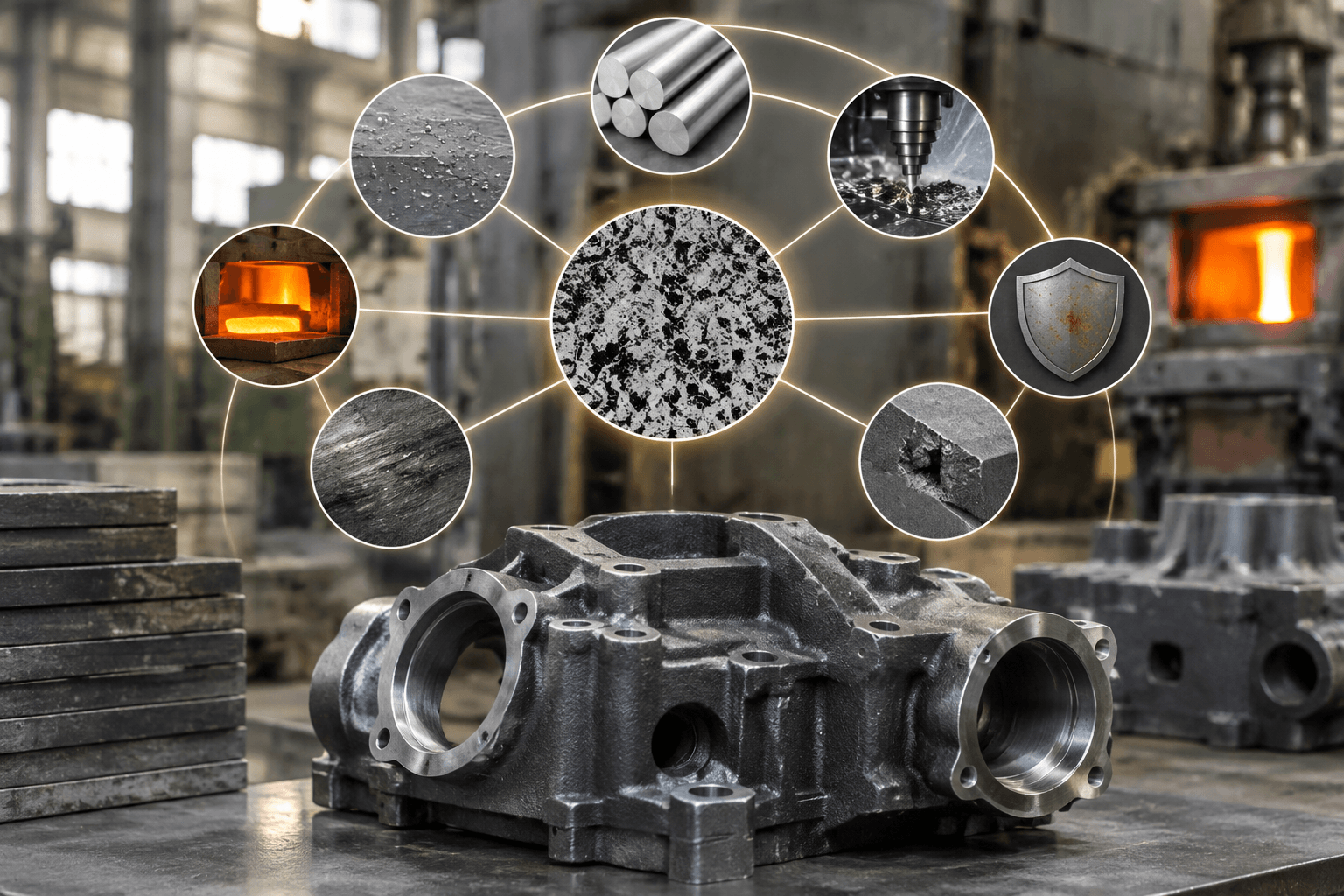
Why Similar Chemistry Can Produce Different Castings
Chemistry + melt treatment → solidification and cooling rate → graphite and carbide formation → matrix after cooling or heat treatment → hardness, wear, toughness, machinability, and thermal behavior
A thin rib loses heat faster than a heavy hub. Even within one casting, this difference can change graphite size, carbide content, matrix transformation, hardness, residual stress, and machining response. A separately cast test bar may therefore not duplicate every local property in the production component. ASTM specifications for ductile and compacted-graphite irons explicitly caution that a precise relationship cannot always be established between test specimens and every location in a casting. ([store.astm.org](https://store.astm.org/a0536-26a.html?utm_source=openai))
Faster cooling can suppress graphitization and retain more carbide, especially when carbide-promoting elements are present. This may improve abrasive wear resistance but can also increase brittleness and cutting-tool wear. Slower cooling in a heavy section may produce a different graphite distribution or softer matrix unless the chemistry and heat-treatment route account for the section size.
Graphite shape creates another performance axis. Flake graphite in gray iron supports damping and machinability but acts differently under tensile and impact loading than spheroidal graphite in ductile iron. Compacted graphite provides an intermediate morphology, while white iron obtains much of its wear behavior from carbide-rich structures rather than free graphite. ASTM A247 and ISO 945-1 classify graphite by form, distribution, and size, but both caution that graphite appearance alone does not prove suitability for an application. ([store.astm.org](https://store.astm.org/standards/a247?utm_source=openai))
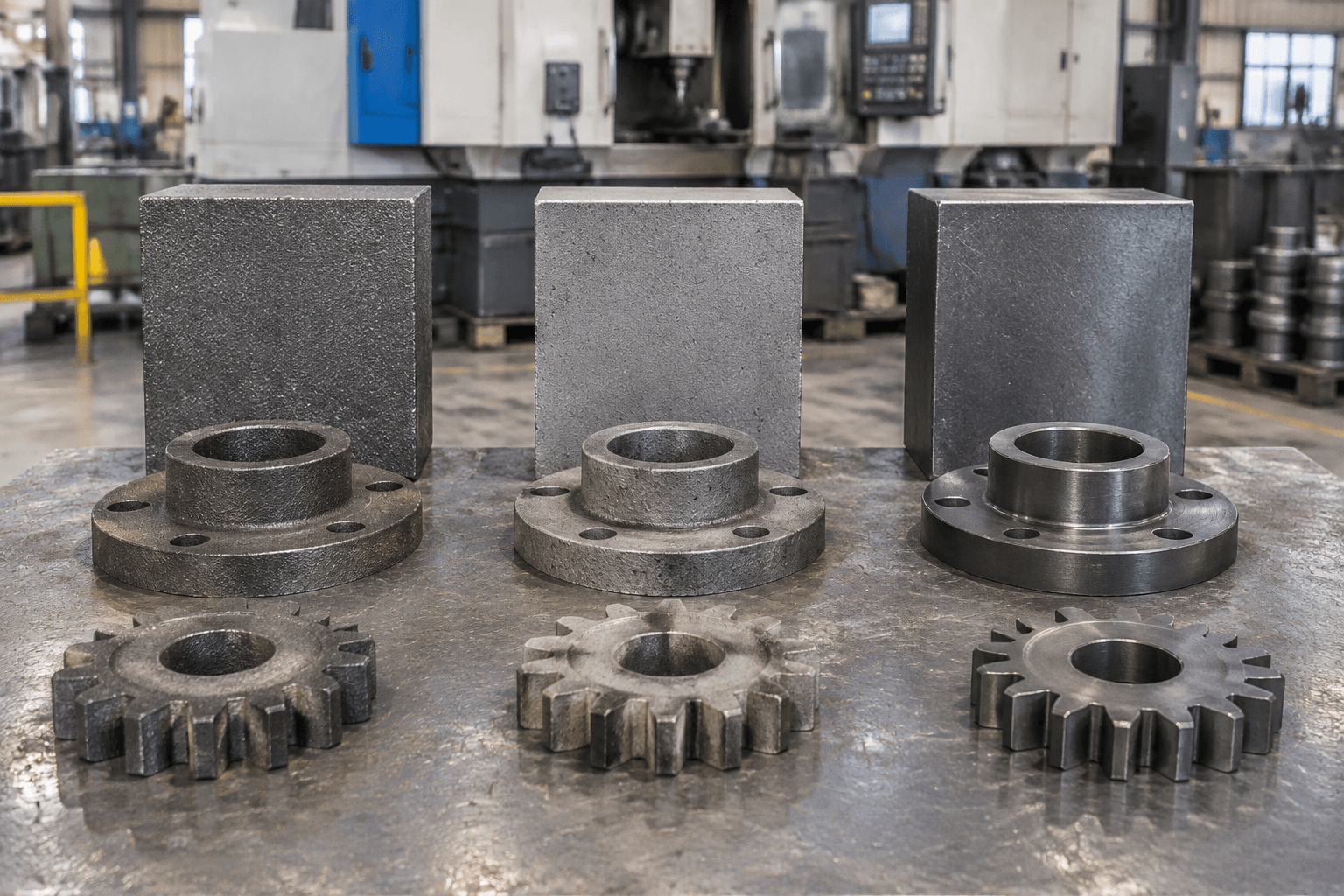
Heat treatment can change the matrix without changing the graphite family. Annealing may increase ferrite and machinability; normalizing may encourage a stronger pearlitic matrix; quenching and tempering can develop hardened structures; and austempering produces an ausferritic matrix in suitable ductile irons. High-alloy white irons may undergo austenitizing, quenching, tempering, stress relieving, or annealing according to the required balance of abrasion resistance and machinability. ([store.astm.org](https://store.astm.org/a0536-26a.html?utm_source=openai))
Alloyed Cast Iron, Unalloyed Cast Iron, or Cast Steel?
The correct choice begins with the dominant failure risk, not a general ranking of material quality.
| Design or service demand | Alloyed cast iron | Unalloyed cast iron | Cast steel |
|---|---|---|---|
| Severe abrasion | Consider a recognized carbide-rich, abrasion-resistant grade where impact is controlled. | May be adequate for moderate sliding wear, depending on matrix and hardness. | Consider when abrasion occurs together with substantial impact or structural loading. |
| Impact and shock | Possible with an appropriate alloyed ductile grade, but chemistry and matrix must be verified. | An unalloyed ductile iron grade may be suitable; unalloyed gray or white iron usually requires greater caution. | Often favored when high toughness and deformation before fracture dominate. |
| Fatigue loading | Potentially useful where alloying and heat treatment support the required matrix. | Unalloyed ductile or compacted-graphite grades may meet many cyclic-loading needs when the specified matrix and section condition support them. | Consider for demanding tensile fatigue, impact-fatigue, or welded structures. |
| Sustained elevated temperature | Special silicon-, molybdenum-, nickel-, or chromium-containing grades may be appropriate. | Suitable only within the limits of the specified grade and section condition. | Heat-resistant cast steel may be preferred for severe temperature, stress, or weldability requirements. |
| Corrosive exposure | Use only a grade documented for the actual chemical environment. | Usually requires environmental assessment and possibly a protective finish. | Carbon cast steel can also corrode; stainless or other corrosion-resistant cast alloys may be needed. |
| Machining priority | Alloying and carbides may increase tool wear, although some graphitic alloyed grades remain machinable. | An unalloyed gray iron grade may be attractive where machinability and vibration damping matter. | Machinability varies with strength, alloy content, heat treatment, and workpiece rigidity. |
| Joining to a fabricated assembly | Prefer mechanical fastening or a deliberately qualified joining design unless the grade supports another method. | Welding gray or ductile iron is generally more restrictive than welding steel. | Usually offers the clearest route when production welding is a central requirement. |
For a hypothetical material-handling component exposed to abrasive bulk material, a high-alloy white iron insert might provide the wear surface while a fabricated steel frame carries impact and structural loads. In transportation equipment, a ductile or alloyed iron housing may interface with machined shafts, fasteners, brackets, and fabricated enclosures. These mixed-material designs require attention to mounting stiffness, galvanic and environmental exposure, thermal expansion, service access, and replaceable wear interfaces. Related contexts include fabricated structures for material-handling equipment and metal components and assemblies for transportation equipment.
How to Write an Auditable Material Specification
A purchase description such as “alloy cast iron” is not sufficient. The drawing, material specification, and purchase order should establish the following fields:
- Recognized designation: State the grade and issuing standard, such as the applicable ASTM or ISO specification. Confirm the required edition rather than assuming an old drawing references the current document.
- Material family: Identify gray, ductile, compacted-graphite, white, malleable, austenitic, or another defined cast iron type.
- Supply condition: Specify as-cast or the required annealing, normalizing, quenching and tempering, austempering, stress relief, or other treatment.
- Chemistry: Include mandatory limits only where required by the grade or application. Do not create a custom chemistry without metallurgical review.
- Mechanical requirements: Define tensile, yield, elongation, impact, or other properties where relevant, including the test-piece location and sampling method.
- Hardness: State the method, acceptable range, measurement locations, and whether requirements apply before or after machining.
- Microstructure: Define graphite form, nodularity or distribution, matrix, carbide limits, or other criteria using an appropriate referenced method.
- Inspection: Identify dimensional inspection, surface acceptance, chemical analysis, hardness mapping, metallography, pressure testing, or nondestructive examination required by the design risk.
- Traceability: State heat, lot, test-certificate, marking, and document-retention expectations.
ASTM A536 illustrates this layered approach: the base grade includes tensile requirements and associated heat-treatment conditions, while hardness, chemistry, microstructure, pressure tightness, radiographic soundness, magnetic-particle inspection, dimensions, and surface finish may be added when the contract requires them. ([store.astm.org](https://store.astm.org/a0536-26a.html?utm_source=openai))
Do not treat two national or international designations as direct equivalents based only on similar grade names. Compare chemistry, graphite requirements, matrix or heat treatment, test-bar type, section sensitivity, minimum mechanical properties, hardness, supplementary inspection, and acceptance rules. ISO designation guidance aims to communicate material attributes clearly, but cross-references still require engineering review. ([iso.org](https://www.iso.org/obp/ui?_escaped_fragment_=iso%3Astd%3Aiso%3A16112%3Aed-2%3Av1%3Aen&utm_source=openai))
Review the complete component interface before releasing the specification. If a cast part connects to a sheet metal enclosure, welded frame, bracket, guard, or other fabricated assembly, Yishang can discuss the fabricated-metal side of the design without implying that it produces the casting itself. Share the part drawing, current material designation and standard, service temperature and environment, loading and wear conditions, hardness target, inspection requirements, and assembly interfaces.
Frequently Asked Questions
Is alloyed cast iron the same as ductile or nodular iron?
No. “Alloyed” describes intentional chemical additions, while “ductile” or “nodular” describes substantially spheroidal graphite. A ductile iron can be conventionally composed or intentionally alloyed for hardenability, temperature resistance, corrosion behavior, or another grade-specific purpose. ([store.astm.org](https://store.astm.org/a0536-26a.html?utm_source=openai))
Which alloying elements improve wear or elevated-temperature performance?
Chromium, molybdenum, nickel, and silicon are common in specialized wear- or heat-resistant families, but they perform different functions. Chromium frequently supports carbide formation and oxidation resistance; molybdenum affects hardenability and hot-strength behavior; nickel can stabilize austenite and influence toughness or corrosion response; and silicon can support graphitization and the behavior of certain heat-resistant grades. Selection must follow a recognized grade rather than an element-only rule.
Can alloyed cast iron rust, and when is a coating required?
Yes. The word “alloyed” does not mean stainless or corrosion-immune. A coating or other protection should be evaluated when the selected grade lacks documented resistance to the actual moisture, salt, chemical, condensation, or outdoor exposure. Specify the environment, operating and coating-cure temperatures, required service life, surface preparation, and any machined or mating surfaces that must remain uncoated.
Can grades from different cast iron standards be treated as equivalents?
Not automatically. A valid comparison must review chemical limits, graphite and matrix requirements, heat treatment, mechanical properties, test specimen design, section thickness, hardness, and inspection provisions. Cross-standard tables are useful starting points, not authorization for substitution. ([iso.org](https://www.iso.org/obp/ui?_escaped_fragment_=iso%3Astd%3Aiso%3A16112%3Aed-2%3Av1%3Aen&utm_source=openai))