Why Aluminium Fuel Tanks Are More Than Just Welded Containers
For overseas wholesale buyers sourcing aluminium fuel tanks, the purchase is rarely just about initial pricing. What matters more is long-term procurement reliability—how consistently the tanks perform, integrate into automated assembly lines, and meet safety and environmental compliance standards across geographies.
Aluminium fuel tanks are not inert storage boxes. They are structural components operating under real-world stress: vibration, thermal expansion, dynamic loads, and corrosive exposure. When even one parameter in fabrication deviates—weld inconsistency, flange warpage, port misalignment—the failure risk multiplies across thousands of units.
Strategic sourcing managers are shifting from spec-based decisions to process-based evaluation: how the tank is fabricated, how dimensional tolerances are controlled, and how predictable performance is across batch-scale production.
What Actually Determines Fuel Tank Lifecycle
Material Selection Isn’t Just a Datasheet Decision
While 5052 and 5083 aluminium alloys dominate this sector due to corrosion resistance and formability, real-world performance hinges on how they behave during forming, TIG welding, post-weld heat dissipation, and surface prep.
For instance, bending against grain direction can introduce early fatigue, even if appearance passes QC. Improper oxide cleaning before welding often leads to porosity—tolerable in static parts, but a failure point in high-vibration applications like heavy machinery or transport fleets.
Leading OEMs now request mill certs, hardness values, and bend test results to verify that supplied tanks meet fatigue standards—not just chemical composition.
Design Fatigue, Not Just Capacity
Field failures frequently stem from overlooked stress zones—brackets, welded ports, mounting flanges—rather than the tank shell itself. Over 60% of fatigue cracks initiate at these interfaces, according to transport equipment testing reports.
That’s why engineered manufacturers like YISHANG integrate features like baffle placement, radius optimization, and port collar reinforcement during CAD design. Buyers focusing only on volume risk unexpected service failures and hidden costs.
Hidden Risks: When Minor Deviations Create Major Failures
Factory Pass ≠ Real-World Reliability
Many tanks pass visual inspection or simple pressure tests—yet crack in the field under dynamic stress. Errors like 0.2 mm bracket shift or inconsistent weld penetration escape traditional QC.
At YISHANG, we digitally record argon gas rates, current levels, and filler usage per batch. Weld logs tie each tank to its process data. This traceability reduces systemic risk and supports audit documentation.
Buyers can request batch reports to verify consistency across 500+ unit runs—essential for critical fleets and OEM partnerships.
Case in Point: Minor Tolerance, Major Loss
A European buyer once rejected 160 units due to a 0.6° port flange skew—visually minor but critical in robotic assembly. Result: 3-week delay, €90,000 loss, urgent remanufacturing. The misalignment was within generic QC range but incompatible with automated line specs.
This illustrates the procurement gap between “passable” and “production-ready.” Buyers should always validate tolerance claims against their own assembly tolerances.
Interface Accuracy: The Hidden Metric in Procurement Risk
Why Ports and Brackets Deserve More Scrutiny Than Shells
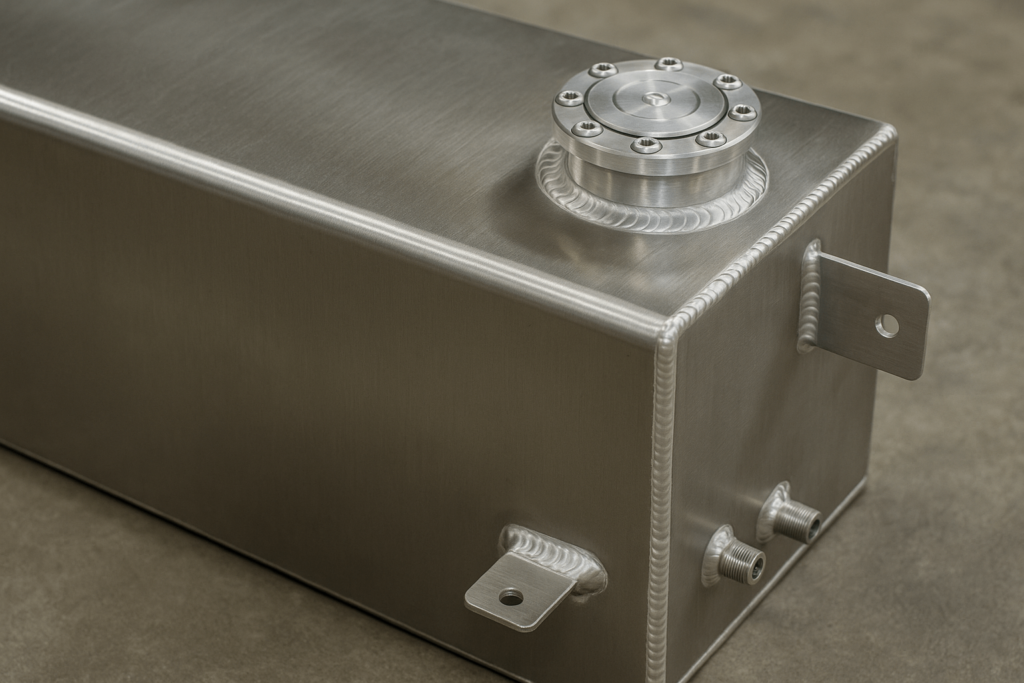
The tank shell often receives the most attention, but it’s the interfaces—fuel inlets, return ports, brackets—that determine real-world fitment. Even a 0.15 mm deviation can trigger sealing failures or vibration stress under engine cycles.
Buyers with automated lines or multi-port tanks should request full interface tolerance maps—not just outline drawings.
Predictable Tolerance Through Engineering Controls
YISHANG uses laser and jig-based validation to keep OD/ID concentricity within ±0.02 mm. Pre-simulation of heat distortion allows us to compensate proactively, avoiding thermal warpage before it happens.
This ensures precise fitment to your 3D CAD specs—no flange reshaping or forced alignment on-site, which directly improves throughput and reduces assembly error rates.
Quality Assurance: From Documentation to Predictability
B2B Buyers Need Systems, Not Surprises
Technical buyers demand more than pass/fail checks. YISHANG provides:
- Certified WPS/PQR welding procedures
- Batch-based dimensional inspection reports
- 100% leak testing with logs per tank
- Serialized traceability, ready for ISO or EN audits
These systems reduce procurement risk, support documentation requirements, and build trust with QA and compliance teams.
Controlling Dimensional Drift at Scale
Maintaining ±0.02 mm across 5,000+ tanks isn’t possible without systemized control. We employ:
- Periodic laser templating every 25 units
- Fixture recalibration every 50 units
- First-article validation + pre-series run signoff
This limits batch variance to <2%, allowing lean inventory strategies, seamless integration with JIT assembly, and improved cost control downstream.
Calculating True Cost Beyond Price Per Unit
Indirect Losses Are Procurement’s Blind Spots
Cutting $10 off unit price might introduce:
- Higher field return rates
- Assembly line fit issues
- Logistics bottlenecks
- Legal or compliance exposure
| Criteria | Low-Cost Supplier | Engineered Vendor (YISHANG) |
|---|---|---|
| Unit Cost | ✔ Lower | ✔ Competitive |
| Full Leak Test | ✘ Spot-checked | ✔ 100% logged |
| Traceability | ✘ Minimal | ✔ Batch-level, serialised |
| Port Tolerance | ✘ ±0.5 mm | ✔ ≤ ±0.02 mm |
| Pre-shipment QA Docs | ✘ None | ✔ Supplied with each lot |
ROI Comes from Repeatable Quality
Experienced buyers benchmark vendors on dimensional variance, not just unit quotes. Repeatability saves:
- Dock-to-stock handling time
- End-customer complaint rates
- Inter-department coordination cost
YISHANG’s documented QA protocols deliver that repeatable assurance—ensuring every tank performs identically across multiple batches and production dates.
Questions That Filter Real Fabricators from Resellers
When sourcing aluminium fuel tank suppliers, ask:
- How do you position ports ±0.02 mm reliably?
- Are your weld logs accessible for each batch?
- What’s your failure rate over 1,000-unit runs?
- How do you simulate or control heat warpage?
- Is surface coating in-house or subcontracted?
- Do you offer dimensional validation reports?
These shift conversations from “how cheap” to “how controlled.”
FAQs That Buyers Actually Search
Q: Best aluminium alloy for marine-grade fuel tanks?
A: 5083 with epoxy primer coating or anodization. Avoid 6061 unless certified for weld fatigue.
Q: Are all tanks leak tested before delivery?
A: At YISHANG, yes. Each tank undergoes hydrostatic or helium decay testing. Logs are available upon request.
Q: Can TIG welds handle field vibration?
A: Only if gas shielding, oxide removal, and travel speed are tightly controlled. We follow ASME and EN-certified protocols with parameter tracking per batch.
Q: How are tanks packaged for export?
A: Foam-in-place, anti-static wrap, humidity control, and ISTA-certified crate designs. Export packaging is tailored per transport route (sea or air).
Final Word: Procurement Confidence Starts with Fabrication Discipline
Aluminium fuel tank sourcing isn’t just about specs—it’s about process traceability, repeatable tolerance, and supplier transparency.
YISHANG builds every tank to meet not just the blueprint, but your operational tolerance: robotic arms, torque specs, flange flatness, dock-to-line efficiency.