
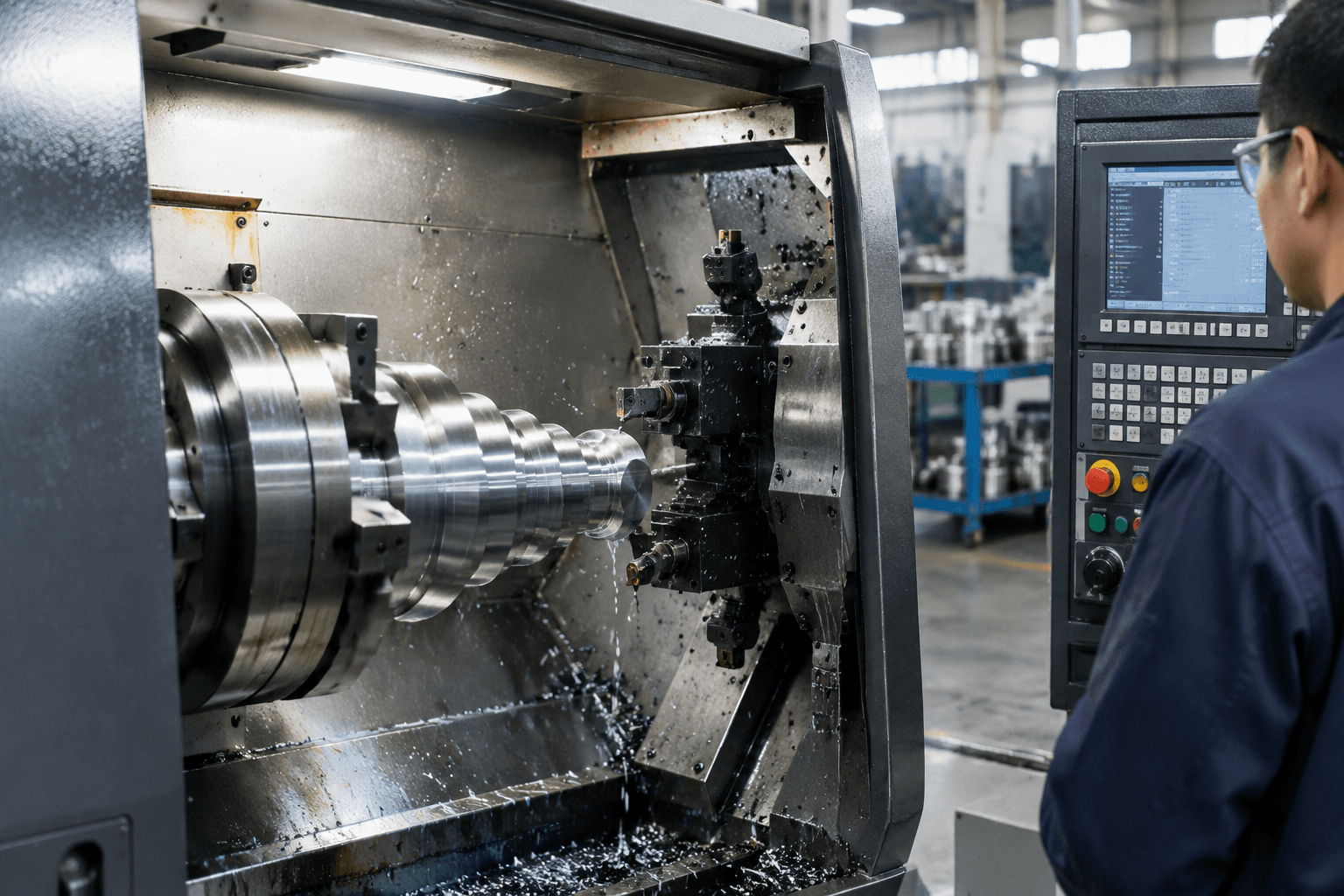
A CNC lathe machine is used to produce parts whose main features are arranged around a central axis. The machine rotates a bar, tube, or prepared workpiece while computer-controlled tools remove material to create outside diameters, end faces, holes, grooves, threads, and other rotational features.
A CNC lathe is therefore most useful for shafts, pins, bushings, sleeves, spacers, threaded studs, connectors, nozzles, and similar components. It is a subtractive machining process for bar, tube, or other prepared stock, suited to rotational geometry rather than primarily flat or formed parts.
Where a CNC Lathe Fits in Manufacturing
The central application of CNC turning is the controlled production of cylindrical or partly cylindrical components. A programmed tool path replaces most manual tool movement, allowing the same sequence to be repeated when the material, workholding, tooling, and inspection plan remain suitable.
- External turning: Reduces the outside diameter of round stock and creates steps, shoulders, tapers, or other external profiles.
- Internal features: Produces drilled or bored holes, counterbores, internal diameters, and internal shoulders.
- Threaded and locating features: Creates external or internal threads, grooves, chamfers, and surfaces used for assembly or positioning.
- Repeat component production: Supports batches of parts that require the same programmed operations and documented inspection method.
This process is not limited to simple round pins. A component may begin with a rotational form and later receive cross-holes, flats, slots, or milled features. Those additions may require live tooling, a Y-axis configuration, a second machine, or another secondary operation.
Common CNC Lathe Applications by Part Type
Applications of CNC lathe machines can be understood more clearly by looking at the components used in industrial equipment. The examples below are general component categories, not claims about a particular customer project.
- Power transmission: Shafts, pins, sleeves, spacers, hubs, and coupling components often start as rotational parts. Keyways or cross-holes may need milling after turning.
- Fluid and process equipment: Threaded adapters, valve-related bodies, bushings, nozzles, and sealing sleeves can require accurate external and internal features. The final design must account for material, sealing surfaces, and inspection requirements.
- Automation and fixtures: Standoffs, locating pins, guide components, sensor housings, and replaceable wear parts are common examples where concentric features matter.
- Electrical and hardware products: Connectors, threaded inserts, terminals, cable-related hardware, and cylindrical housings may be produced by turning when their main geometry is axisymmetric.
- Maintenance and replacement parts: Bushings, shafts, threaded plugs, and sleeves can be manufactured from a drawing or sample after the material, dimensions, and functional interfaces have been confirmed.
In each application, the important question is not simply whether the part is round. The drawing should show which surfaces locate, rotate, seal, carry a load, receive a thread, or mate with another component. Those details determine the operations, workholding, inspection points, and possible secondary processes.
Mapping CNC Lathe Operations to Part Features
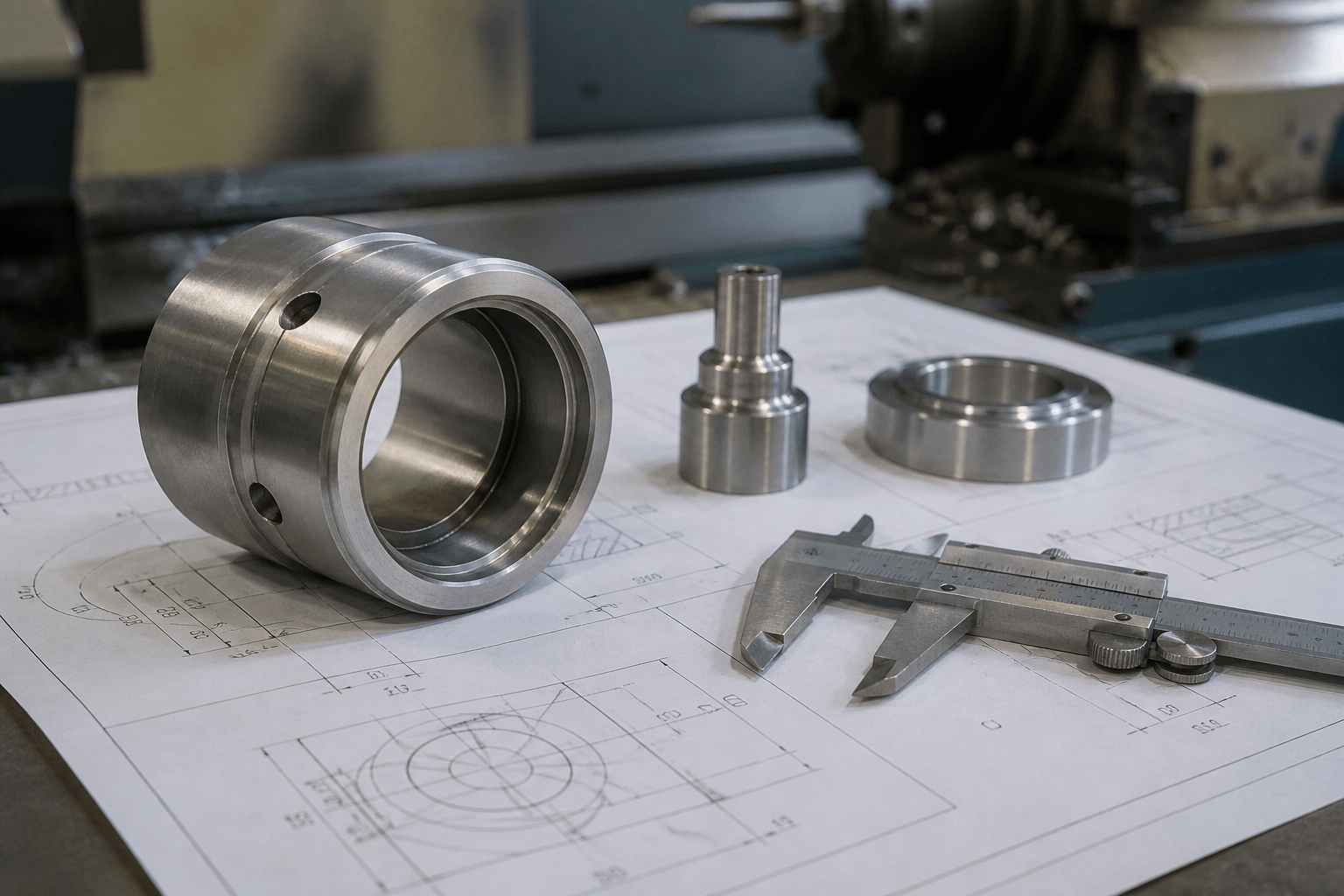
A CNC lathe works by coordinating workpiece rotation with programmed tool movement. The turret can hold multiple tools, while cutting conditions such as feed rate and depth of cut are selected for the material, geometry, and required finish. Typical operations include:
- Turning: Removes material from an outside diameter to create a straight, stepped, tapered, rough, or finished surface.
- Facing: Cuts across the end of the workpiece to establish a flat face or a reference datum.
- Boring: Enlarges or finishes an existing hole and can control an internal diameter or shoulder.
- Drilling: Produces an axial hole using a suitable drill and setup. Hole depth, chip evacuation, and workholding need review.
- Threading: Forms internal or external threads according to the drawing and the selected tool path.
- Grooving: Cuts narrow recesses for retaining rings, seals, chip relief, or other functional details.
- Parting: Separates a finished component from bar stock or divides a workpiece during the process.
- Live-tool or Y-axis work: Supports suitable off-center drilling, milling, or slotting when the machine has the required configuration.
A possible process sequence is to face the stock, rough and finish the outside diameter, drill or bore the internal feature, add threads or grooves, and then part the component. The actual order changes with the drawing, the required datum structure, access for tools, and whether the part must be reversed for a second setup.
Selecting the Right Machine Configuration
Machine selection should follow the part geometry rather than the word CNC alone. A basic lathe may be sufficient for a rotational component, while a more integrated turning center can reduce handling when the part also needs drilling or milling. The available turret, live tooling, Y-axis movement, spindle arrangement, and workholding method must be confirmed for the specific machine.
| Option | Good fit for | Selection check |
|---|---|---|
| Standard CNC lathe | Parts dominated by outside diameters, faces, axial holes, grooves, and threads. | Confirm that all required features are reachable with the available tools and workholding. |
| CNC turning center | Rotational parts that also require drilling, tapping, or milling when the machine is equipped for those operations. | Verify the actual live-tool, turret, spindle, and axis configuration instead of assuming every turning center has the same functions. |
| CNC mill | Prismatic parts, flat faces, multiple off-center features, and geometry that is not primarily rotational. | A cylindrical shaft may still require turning before or after milling, depending on the design. |
| Swiss-type machine | Long, slender, or relatively small rotational components that benefit from support close to the cutting area. | This is a specialized process choice; confirm the part geometry, material supply, and required operations. |
| Manual lathe | One-off work, simple repairs, or situations where operator-controlled movement is acceptable. | Consider operator time and consistency when the project involves repeated parts or several programmed features. |
What to Check Before Choosing CNC Turning
Before selecting CNC turning for a project, review the drawing as a manufacturing plan rather than only as a list of dimensions. The following points can change the machine choice, setup method, cost, and inspection approach.
- Geometry: Identify whether the primary form is rotational. Cross-holes, flats, slots, angled features, and off-center details may require live tooling or a secondary operation.
- Diameter and length: Review the stock size, finished dimensions, length-to-diameter relationship, and any unsupported length. Slender parts can require additional support and careful control of cutting conditions.
- Material: CNC lathes may process categories such as aluminum, carbon steel, stainless steel, specialty alloys, plastics, and some non-metal components. Each material affects tool selection, heat, chip control, burr formation, and surface finish.
- Tolerance and finish: Specify critical dimensions and surface requirements by feature. The appropriate process and inspection plan depend on the material, diameter, length, geometry, and drawing requirements; a universal capability number should not be assumed.
- Quantity: Programming, setup, tooling, and fixturing can be a significant part of a short-run project. For repeated production, the same factors should be balanced against cycle time, inspection, and consistent workholding.
- Workholding: A jaw chuck, screw chuck, or job-specific fixture affects tool access, datum location, concentricity, and the risk of distortion. Parts with multiple critical surfaces may need more than one setup.
- Secondary operations and inspection: Deburring, milling, heat treatment, coating, assembly, or additional inspection may be required after turning. These steps should be included in the process plan rather than treated as an afterthought.
CNC turning is usually a strong candidate when the part is mainly axisymmetric and the required features can be reached securely. It becomes less suitable when the design is primarily flat, heavily off-center, or dependent on complex multi-face milling. A design review can identify that boundary before tooling and programming begin.
Frequently Asked Questions
Which part features are best suited to a CNC lathe?
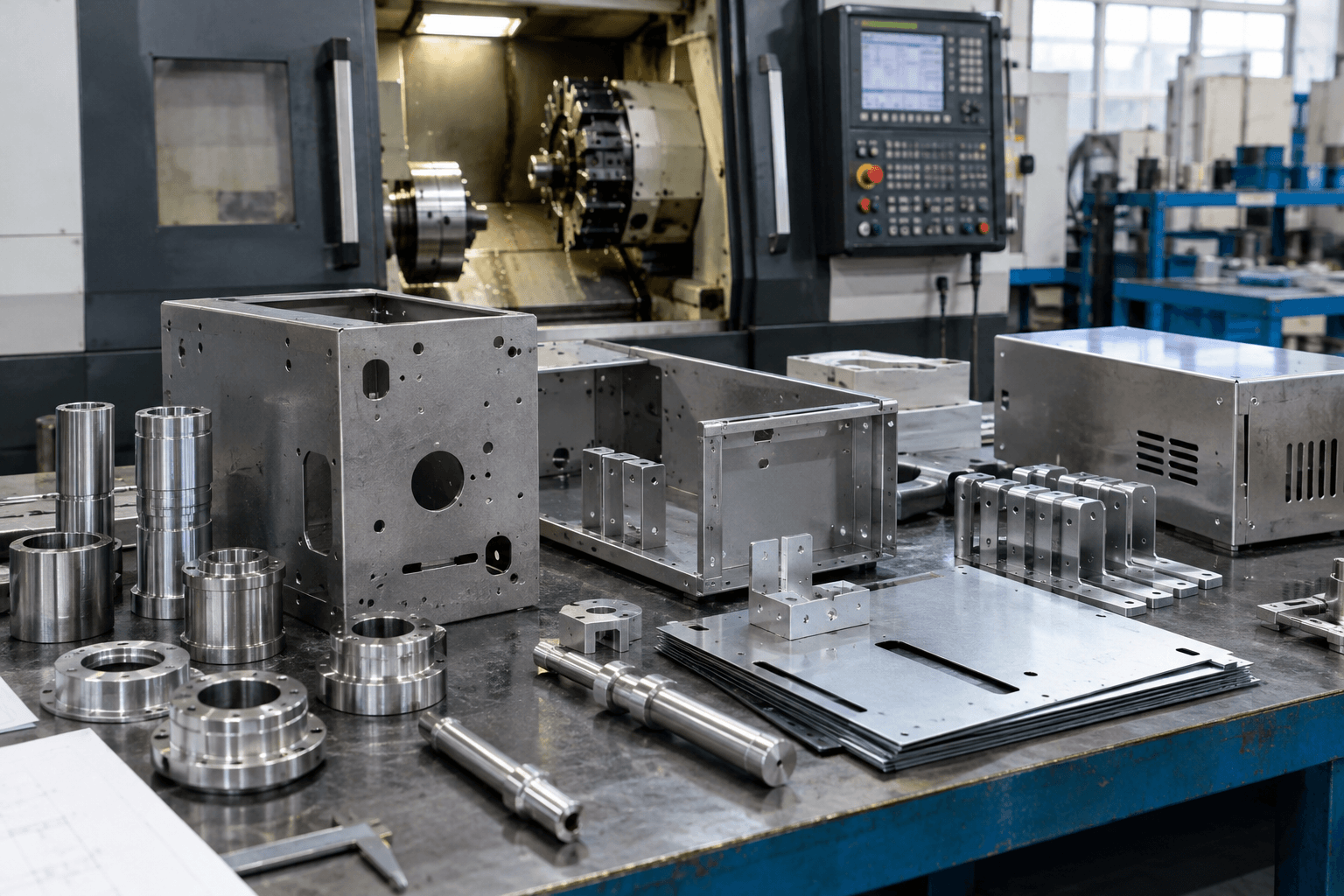
A CNC lathe is best suited to outside diameters, end faces, axial holes, internal diameters, grooves, and threads arranged around a central axis. These features are common on shafts, bushings, sleeves, pins, and threaded fittings; off-center or flat features may require live tooling or another operation.
What can be made with a CNC lathe machine?
Typical products include cylindrical housings, spacers, nozzles, connectors, studs, shafts, valve-related bodies, and replacement bushings. Parts with off-center holes or milled flats may need live tooling, a Y-axis machine, or a secondary operation.
When should a CNC lathe be chosen instead of a CNC mill?
Choose a CNC lathe when the part is primarily cylindrical and its important features follow a central axis. A CNC mill is generally more appropriate for prismatic parts, broad flat surfaces, and geometry with several off-center or multi-face features.
What are the downsides of using a CNC lathe?
Setup, programming, tooling, and workholding can make a CNC lathe inefficient for some one-off or very simple parts. It is also not ideal for every flat or off-center geometry. Material behavior, tool access, inspection, and secondary operations must be reviewed before production.