
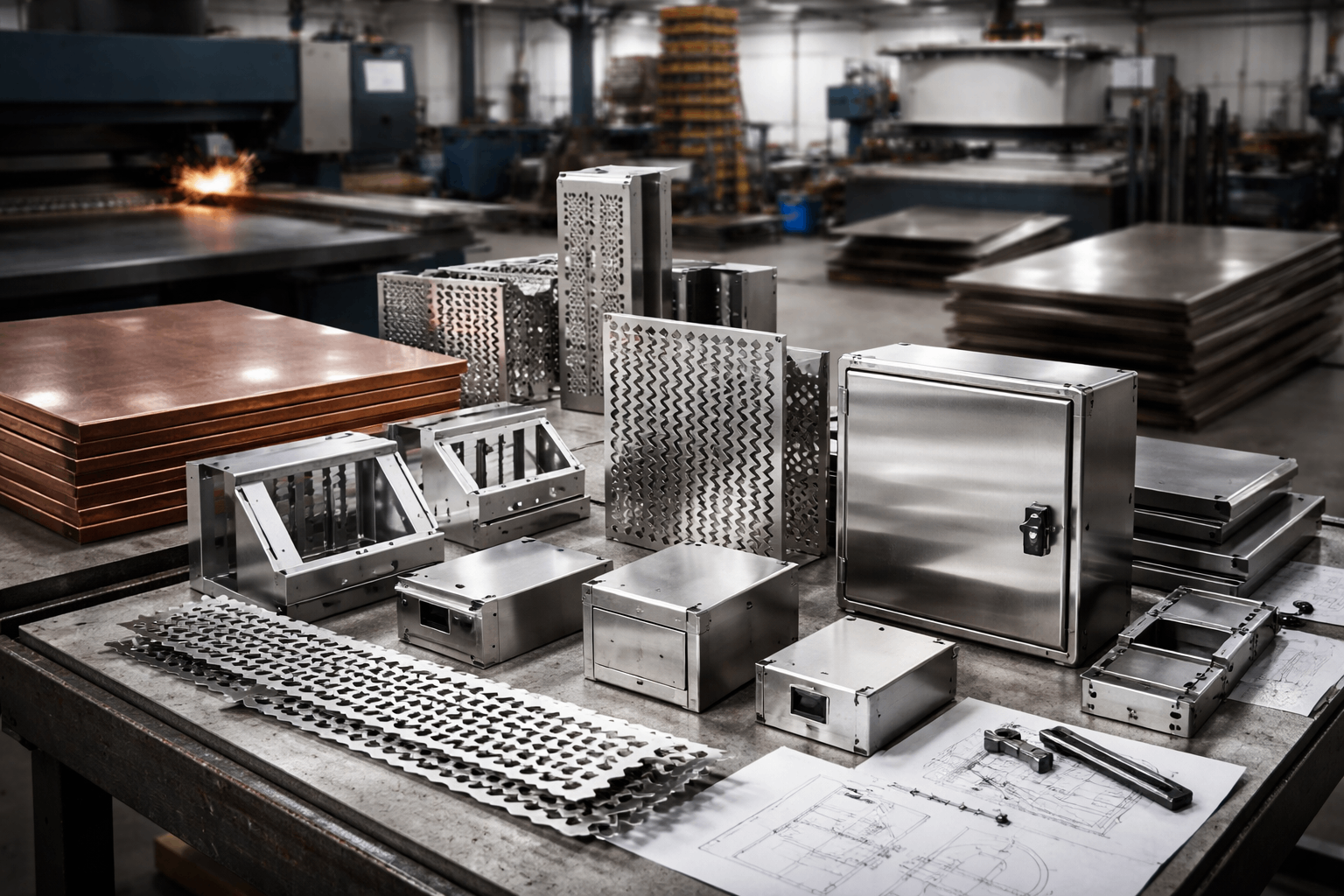
Architectural metal fabrication in China is often presented as a simple sourcing task. A buyer sends drawings, requests pricing, compares lead times, and waits for a sample. For overseas wholesale buyers, however, that is only the visible part of the decision.
What usually determines whether the project becomes easy or costly is not the first quotation, but what happens after it. Buyers need to know whether the supplier can keep the product stable from sample approval to batch production, from one shipment to the next, and from one reorder cycle to the next. In practice, that means evaluating more than fabrication capacity. It means evaluating drawing interpretation, finish consistency, tolerance control, packaging discipline, and communication quality.
That is why architectural metal fabrication needs to be reviewed differently. In this category, a part can be technically correct and still create commercial problems if it causes installation delays, visible inconsistency, or repeat claims after delivery. For B2B buyers, the issue is not whether a factory can make one acceptable part. The real issue is whether it can support a product program reliably.
Why Architectural Metal Fabrication Requires a Different Buying Logic
For wholesale buyers, architectural metal fabrication is different from general sheet metal fabrication because the product is judged on several levels at once. It must meet the drawing, but it must also support the installation condition, match the expected finish, and remain consistent across repeat orders. That makes the buying logic more demanding than in many ordinary industrial sourcing situations.
This is especially true when the parts are visible, installed in customer-facing environments, or supplied as part of a repeat program. Metal cabinets, frames, trims, enclosures, brackets, panel-based assemblies, and other architectural metal products are rarely judged only by whether they physically fit. Buyers also need edge condition, weld appearance, coating quality, and surface consistency to remain under control. A part that is dimensionally acceptable but visually unstable can still damage the value of the order.
The same logic extends to functional metal housings that sit inside building-related or infrastructure-related projects. Products such as electrical enclosures, electrical meter boxes, NEMA-style junction boxes, push-button housings, and control station enclosures may seem closer to industrial supply than to decorative architectural metal. Yet buyers often evaluate these products through the same commercial lens: will the specification remain stable, will the materials stay consistent, and will the product arrive in a condition that supports resale, installation, or project delivery?
For that reason, long-term sourcing decisions are rarely made on process names alone. Laser cutting, bending, welding, and CNC machining are necessary capabilities, but they only become meaningful when the supplier can turn them into a stable production system. The first step, then, is to stop viewing architectural metal fabrication as a process list and start viewing it as a controlled delivery task.
The Gap Between a Good Drawing and a Good Production Result
Once that buying logic is clear, the next question becomes more practical: why do some projects still go wrong even when the drawing looks complete? One major reason is that a good drawing does not automatically produce a good production result. In custom metal fabrication, there is always a translation step between design intent and factory execution.
A design team may focus on appearance, visual rhythm, proportions, and how the product fits the space. A fabrication team has to think about bend allowance, weld access, grain direction, fixture setup, coating sequence, and inspection points. Both viewpoints are valid, but they are not identical. If the translation between them is weak, the buyer may receive a quotation that looks competitive while hiding important differences in finish handling, tolerance assumptions, inspection standards, or packaging protection.
This is one reason two suppliers can quote the same architectural metal parts at very different levels. On paper, the part description may appear identical. In practice, one supplier may be building in tighter finish control and more protective handling, while another may be assuming a lower control standard. For buyers, this is not a minor technical detail. It directly affects how comparable the quotations really are.
The same issue becomes more visible when a project moves from prototype to batch production. A sample can be made with extra time and extra manual attention. That does not always mean the same result can be maintained during volume production. For wholesale buyers, this matters because the commercial value of the project usually depends on repeat orders, not on one perfect sample.
This is where manufacturability becomes a practical procurement concept rather than only an engineering term. A part is manufacturable not only when it can be made once, but when it can be made repeatedly with stable lead time, controlled finish, and acceptable quality yield. Understanding that point helps buyers judge the next question more clearly: why China can be strong in this category when the right production system is in place.
Why China Remains Strong in Architectural Metal Fabrication
Architectural metal fabrication in China is often reduced to a price discussion. Price matters, but experienced buyers usually see the stronger advantage elsewhere. In many cases, the real value comes from production integration.
A typical order may require cutting, forming, welding, machining, surface treatment, assembly, inspection, and export packing. When those steps are coordinated well, the buyer gains more than a competitive piece price. The buyer gains faster drawing feedback, fewer handoff errors, and more stable control over the finished product. For projects that need repeatability, those benefits often matter more than a small price gap.
This is one reason China remains competitive in both architectural metal fabrication and broader sheet metal fabrication programs. Buyers are often not looking for isolated process vendors. They are looking for a metal fabrication company in China that can manage the full flow from raw material selection to finished shipment with fewer points of breakdown.
Material flexibility also contributes to that strength. Depending on the application, a product may be made from steel sheet metal, stainless steel sheet, galvanized sheet metal, aluminum, copper sheet metal, or, in more specialized cases, titanium sheet metal. The right choice depends on corrosion exposure, finish expectations, structural requirements, downstream treatment, and budget target.
For wholesale sourcing, this flexibility matters because it improves quotation quality. A supplier that can explain when a carbon steel enclosure is sufficient, when a galvanized steel enclosure is the safer choice, or when a stainless steel enclosure offers better lifecycle value is easier to evaluate than one that simply pushes a default material. In short, China becomes highly competitive when the buyer needs custom dimensions, batch consistency, process coordination, and export readiness in the same program.
What Wholesale Buyers Usually Care About Most
Once buyers move past the broad question of location, their attention usually becomes very specific. They are not reading supplier blogs for textbook definitions. They are scanning for signals that show whether the supplier understands the same risks they face in purchasing, inventory, and customer delivery.
The first signal is repeatability. Can the same product be supplied again with the same finish, fit, packaging standard, and general quality level? For buyers handling architectural metal products, architectural metal parts, or custom housings over multiple purchase cycles, this matters far more than many factory sites admit. If the second order does not match the first, the cost appears later through claims, stock separation, relabeling, customer complaints, or slower sell-through.
The second signal is quoting discipline at RFQ stage. Buyers usually notice quickly whether the supplier asks the right questions during RFQ review. A strong supplier does not stop at “send your drawing” or “send your inquiry.” It clarifies visible surfaces, installation-critical dimensions, finish expectations, packaging requirements, and whether the approved sample should represent normal production rather than a special one-off effort.
The third signal is communication that helps decision-making. Broad phrases such as “high-quality architectural metal,” “a wide range of products,” or “get instant quote” may attract attention, but they do not help a professional buyer qualify a supplier. What helps more is a supplier that can discuss lead time risk, finish consistency, packaging design, material trade-offs, and inspection logic in clear commercial terms.
This is also where specific examples become more persuasive than generic capability claims. A buyer reviewing options for an electrical enclosure program, a solar battery enclosure, or a bracket-and-frame assembly will usually care more about repeat-order control and packaging protection than about a long list of equipment names. In many B2B supply chains, one replacement shipment can cost more than the margin on the affected parts once freight, delay, warehouse handling, and customer communication are included. That is why experienced buyers tend to look for prevention rather than promises.
What Actually Drives a Smooth Order
These buying priorities lead to a more operational question: what actually makes an order smooth in day-to-day execution? In architectural metal fabrication, four factors usually decide whether the order stays controlled or becomes difficult: finish, tolerance, material selection, and packaging.
Finish control comes first because it affects both appearance and claim risk. Brushed stainless steel sheet, powder-coated aluminum, and decorative steel sheet metal components can all look acceptable as individual pieces while still showing inconsistency across a shipment. Grain direction, gloss variation, edge treatment, and weld blending all influence whether the final installation feels uniform or patchy.
Tolerance strategy comes next. A part can pass measurement and still create assembly trouble if the drawing tolerance does not match the installation condition. This happens regularly with frames, cabinets, panel systems, and bracket-based assemblies. Good suppliers understand that some dimensions are mainly manufacturing references, while others determine whether the product will fit reliably on site.
Material and finish matching is the third factor.
- Stainless steel enclosure applications are not evaluated in the same way as a galvanized steel enclosure or a powder-coated carbon steel enclosure.
- Stainless steel 304 is often a practical option for many indoor or moderate-exposure uses.
- Stainless steel 316 may be better where corrosion pressure is higher.
- Mild steel with powder coating can offer strong cost-performance when edge coverage and coating thickness are controlled.
- Aluminum is often ideal for weight-sensitive designs, although it may need stronger handling protection because cosmetic damage shows more easily.
Packaging is the fourth factor, and it is often underestimated. Export packaging is part of quality control, not an afterthought. Protective films, separators, corner guards, pallet stability, moisture control, and part identification all matter. For wholesale buyers handling larger shipments, packaging affects not only product protection but also warehouse efficiency and claim prevention.
Typical Material Choices and Buying Considerations
| Material option | Common use | Buyer focus |
|---|---|---|
| Stainless steel 304 | Cabinets, frames, visible enclosures | appearance consistency and corrosion resistance |
| Stainless steel 316 | Higher-exposure environments | longer service life and finish control |
| Mild steel + powder coating | Cost-sensitive assemblies | coating durability and edge protection |
| Galvanized sheet metal | Utility-oriented structures | corrosion control and price balance |
| Aluminum | Lightweight frames and housings | weight, handling, and surface protection |
Taken together, these four factors explain why some projects stay controlled from the start while others become reactive. They also point toward a deeper issue that buyers often overlook until later in the process: predictability.
Why Predictability Matters More Than a Good Sample
A common sourcing mistake is to assume that a good sample proves a good supplier. It proves something useful, but not enough. A sample often receives extra care. Batch production follows a different logic and depends on process stability, operator control, inspection discipline, material consistency, and variation management.
For wholesale buyers, predictability affects much more than quality. It affects reorder timing, inventory confidence, customer commitments, and the amount of safety stock needed to protect against claims. A supplier with more stable output can reduce operating stress even if its quoted price is not the lowest.
This is why experienced sourcing teams look beyond “instant quote” language. They want evidence that the supplier can reproduce the same standard under normal production conditions. Defined inspection points, realistic lead times, finish references, packaging plans, and stable communication after order confirmation all matter more than a polished sample alone.
The commercial value of predictability is often underestimated. One unstable batch can create more cost than a year of careful supplier management can save. In that sense, production consistency is not only a quality issue. It is also a margin issue. That is exactly where the supplier’s operating approach begins to matter.
How a Wholesale-Focused Supplier Supports the Process
For wholesale buyers, the best suppliers do more than fabricate architectural metal parts according to a file. The goal is to make the order easier to manage from quotation through shipment.
That starts with drawing review. Before pricing is finalized, important points usually need to be confirmed, such as visible surfaces, key dimensions, expected finish, packing method, and whether the part belongs to a repeat-order program. This helps reduce assumption gaps that often lead to later problems.
It also continues through production planning. In custom sheet metal fabrication and architectural metal fabrication, stable results depend on process coordination rather than isolated operations. Laser cutting, bending, welding, machining, surface treatment, assembly, and inspection all need to support the same product target.
In practice, that means focusing on the concerns that matter most to wholesale buyers: repeatability, export packing, response speed, and realistic communication around manufacturability. This is not about making broad promises. It is about giving buyers a clearer basis for decision-making and smoother order management.
Choosing a Supplier With the Right Commercial Fit
At that stage, the buying decision becomes easier to frame. A reliable supplier is not always the one with the longest capability page. In many cases, it is the one that reduces uncertainty.
For wholesale buyers, that usually means choosing a partner that can explain how the part will be made, how quality will be checked, how packaging will protect the goods, and how future repeat orders will be controlled. Those points are more valuable than broad claims because they connect directly to procurement risk.
Architectural metal fabrication in China continues to offer strong opportunities for buyers who value repeatability, specification control, and balanced cost-performance. When the supplier understands both manufacturing detail and purchasing behavior, the order becomes easier to manage and easier to scale.
If you are evaluating a custom architectural metal or sheet metal fabrication program, YISHANG can review your drawings, discuss material and finish options, and quote from a production-based perspective. When you are ready, send your inquiry and the discussion can begin from your actual application rather than from assumptions.