
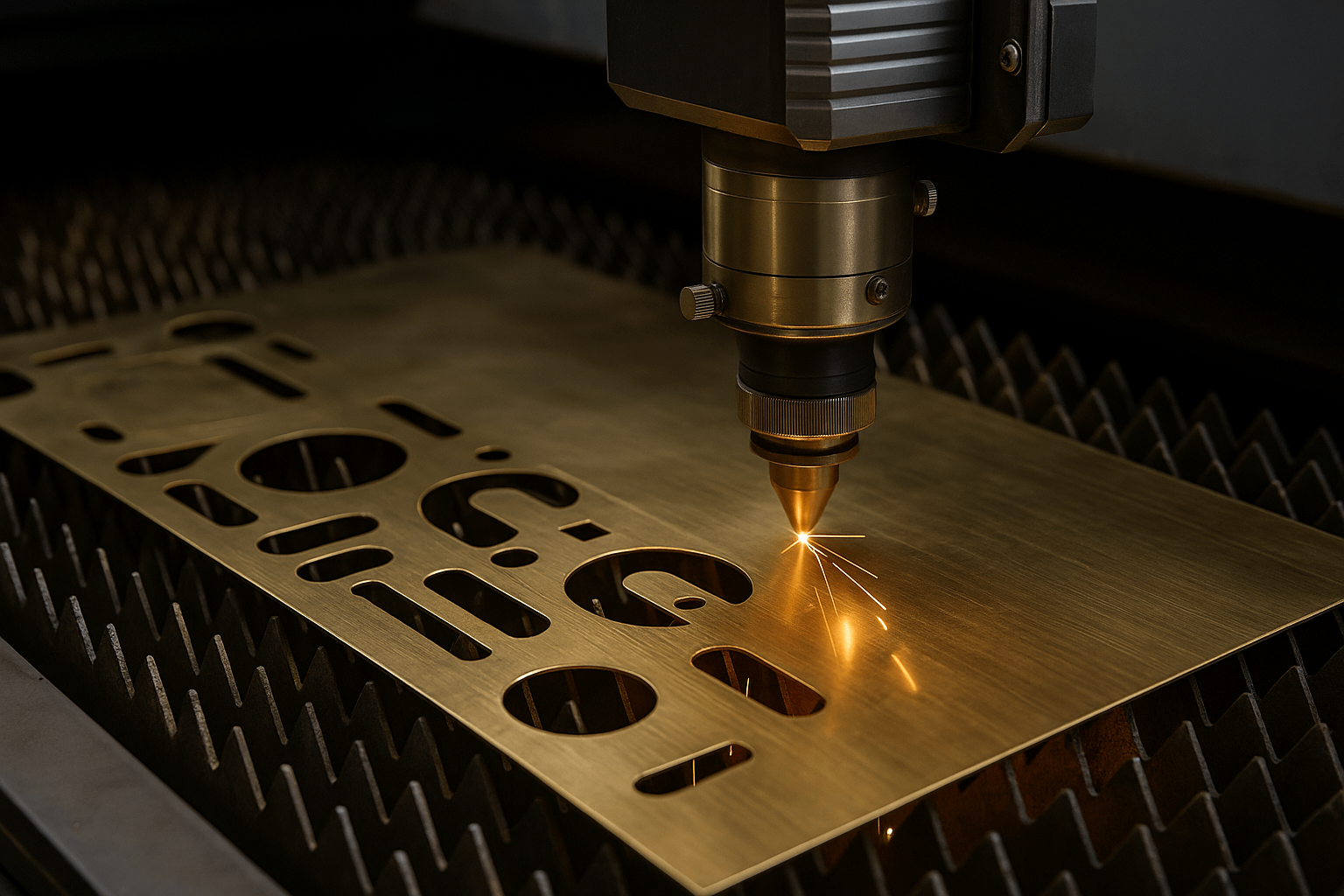
Introduction: The Hidden Challenge in a Golden Alloy
Brass is widely used because it combines machinability, conductivity, corrosion resistance, and a premium finished appearance in one material family. But for engineers and procurement teams, brass performance does not depend on the alloy alone. It also depends on whether the cutting method fits the part geometry, tolerance level, thickness, and production volume.
The wrong cutting choice can increase waste, slow delivery, damage edge quality, or create unnecessary downstream finishing cost. The right choice improves consistency, throughput, and total project control.
That is why brass cutting should be treated as an engineering and sourcing decision, not just a workshop operation.
Part 1: Why Start with Brass? Understanding the Engineer’s Alloy
Before comparing cutting methods, buyers need to understand why brass is chosen in the first place. Brass is not just a decorative metal. It is often selected because it offers a practical engineering combination of good machinability, stable conductivity, corrosion resistance, and usable strength.
More Than a Metal: The Unique “Combination Advantage” of Brass
What makes brass valuable is not one single property, but the way several useful properties exist together. In many components, buyers need conductivity, dimensional precision, corrosion resistance, and efficient processing in the same part. Brass often meets that mix better than a simpler material substitute.
Decoding the Brass Family: C360 vs. C260 and Beyond
Not all brass grades behave the same way in manufacturing.
- C360 free-cutting brass is widely preferred for machining because it supports faster cutting and lower tool wear.
- C260 cartridge brass is better known for formability, but it is less attractive for heavy machining.
- C464 naval brass is more suitable where corrosion resistance matters more, especially in tougher service environments.
For buyers, alloy choice should always be reviewed together with the cutting route, not as a separate decision.
Part 2: The Brass Cutting Playbook: A Method-by-Method Breakdown
Once the alloy is chosen, the next question is how to process it efficiently and accurately.
CNC Machining: The Sculptor’s Chisel
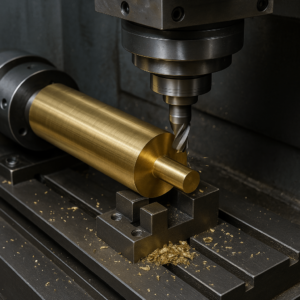
CNC machining is usually the strongest option when the brass part includes threads, pockets, tight tolerances, 3D geometry, or detailed mechanical features.
For buyers, CNC is often the best fit for fittings, precision components, turned parts, and parts where dimensional accuracy matters more than raw cutting speed.
Fiber Laser Cutting: The Speed of Light
Fiber laser cutting is often chosen for flat brass sheet parts, decorative profiles, faceplates, and medium-volume 2D production where speed and repeatability matter.
For procurement teams, the main value is fast profile cutting with consistent geometry, but the process still requires correct machine setup because brass is reflective and not every laser system handles it equally well.
Abrasive Waterjet Cutting: The Power of Erosion
Abrasive waterjet cutting is especially useful when the project requires no heat-affected zone, thicker material processing, or minimal thermal distortion.
Buyers often choose waterjet when the part is thicker, when the brass must retain its base material condition, or when edge heating is unacceptable.
Other Key Processes: Stamping & Sawing
For simpler geometries and higher volumes, stamping or sawing may still be practical. These methods are usually more process-specific and are best evaluated according to volume, geometry simplicity, and required secondary operations.
Part 3: The Decision Engine: CNC vs. Laser vs. Waterjet for Your Project
The right brass cutting method depends on balancing four real project priorities: precision, geometry, speed, and cost.
The Engineer’s Quadlemma: Precision, Geometry, Speed, and Cost
No single method wins every time. CNC is usually stronger for detailed 3D parts. Fiber laser is often more efficient for thinner 2D sheet profiles. Waterjet is more useful where thickness and thermal control matter most.
Head-to-Head Comparison Matrix
A practical buyer comparison looks like this:
| Criterion | CNC Machining | Fiber Laser Cutting | Abrasive Waterjet Cutting |
| Typical strength | Best for precision features and 3D geometry | Best for fast 2D profiles | Best for thick sections and no-heat cutting |
| Heat affected zone | None | Minimal | None |
| Thickness flexibility | Strong for machined parts | More limited | Very strong |
| Production speed | Moderate | Fast | Slower |
| Per-part cost logic | Good for precise functional parts | Good for repeated flat parts | Higher but justified for special cases |
For buyers, the most important question is not which method sounds most advanced, but which one matches the actual part design and business target.
Real-World Scenarios
High-volume threaded fittings usually favor CNC machining on free-cutting brass. Decorative grilles or faceplates often suit laser cutting. Thick marine plates or heat-sensitive parts are more likely to justify waterjet. Prototypes depend on whether geometry complexity or thickness drives the decision.
Part 4: DFM Cheatsheet: Optimizing for Manufacturability
Good brass cutting results depend heavily on DFM discipline.
Universal Rules
Keep tolerances realistic, design for stable workholding, and avoid unnecessary complexity that adds cost without improving function.
Method-Specific Tips
For CNC, avoid impossible internal corners and over-complicated wall conditions. For laser and waterjet, consider kerf, slot sizing, and how thin details may behave after cutting.
Part 5: Beyond the Cut: Finishing, Quality & Supplier Vetting
Cutting is only one stage of a successful brass project. Buyers should also evaluate what happens after cutting.
Post-Cut Techniques
Deburring, cleaning, polishing, plating, and other finishing steps can strongly affect the final usability and appearance of brass parts. For many projects, the cut quality and the finishing plan need to be evaluated together.
Choosing the Right Partner
A strong supplier should be able to explain not only how the brass is cut, but also how tolerances are controlled, how finishing is handled, and how quality is documented across batches.
Part 6: Brass Cutting FAQ
Melting Point
Brass generally melts within a range rather than at one exact number, and the exact interval depends on alloy composition.
Strength vs. Aluminum
In many applications, brass offers stronger wear and stiffness characteristics than aluminum, but the right comparison still depends on the specific part design and service condition.
Powder Coating
Yes, brass can be coated, but buyers should confirm whether coating is truly necessary or whether another finish better suits the part’s function and appearance.
Brass vs. Bronze
Brass and bronze are both copper-based alloys, but they differ in alloying elements and typical engineering use.
Electrical Conductivity
Brass provides useful conductivity, though it does not match pure copper.
Welding Brass
Welding is possible in some cases, but brazing or soldering is often preferred depending on the design.
Can brass be cut with fiber laser or waterjet?
Yes. Both are viable, but the best choice depends on thickness, heat sensitivity, geometry, and production priorities.
How to cut brass without burrs?
Good tooling, stable process control, and suitable feed conditions are more important than simply choosing one cutting label.
Brass sheet cutting service for enclosures?
Yes. Depending on design and volume, brass sheet components may be processed by laser, CNC, or other suitable fabrication methods.
Conclusion: Your Strategic Partner in Brass Fabrication
Choosing the right brass cutting process directly affects cost, lead time, finishing quality, dimensional reliability, and total project risk.
For procurement teams and engineers, the best outcome comes from matching alloy, geometry, thickness, and process route from the start rather than treating cutting as a generic workshop step.
At Yishang Metal Products Co., Ltd., we support OEM and wholesale customers with custom metal fabrication for brass and other industrial materials. With 26+ years of manufacturing experience, we support processes including laser cutting, bending, stamping, welding, CNC machining, surface treatment, assembly, packaging, inspection, and shipment.
📩 If you are evaluating brass cutting solutions for your next project, send us your drawings or requirements to discuss the most suitable manufacturing approach.