For overseas wholesale buyers, a useful technical article should do one thing well: help them judge whether a process fits the part, the specification, and the supply plan. That is especially important for components expected to work under pressure, abrasion, heat, or continuous duty, where structure and consistency matter more than appearance alone.
The centrifugal casting process is widely used for round or hollow metal parts such as sleeves, liners, rings, bushings, and tubes. Buyers usually do not search this topic out of curiosity. They are often comparing options, reviewing supplier capability, or trying to understand whether a recommended process will support the required material grade, tolerance, machining scope, and batch consistency.
This article explains how centrifugal casting works, the main process forms, the production sequence, the quality factors that matter most, and the situations where the process creates real value. The focus stays on practical sourcing and manufacturing decisions, not broad claims.
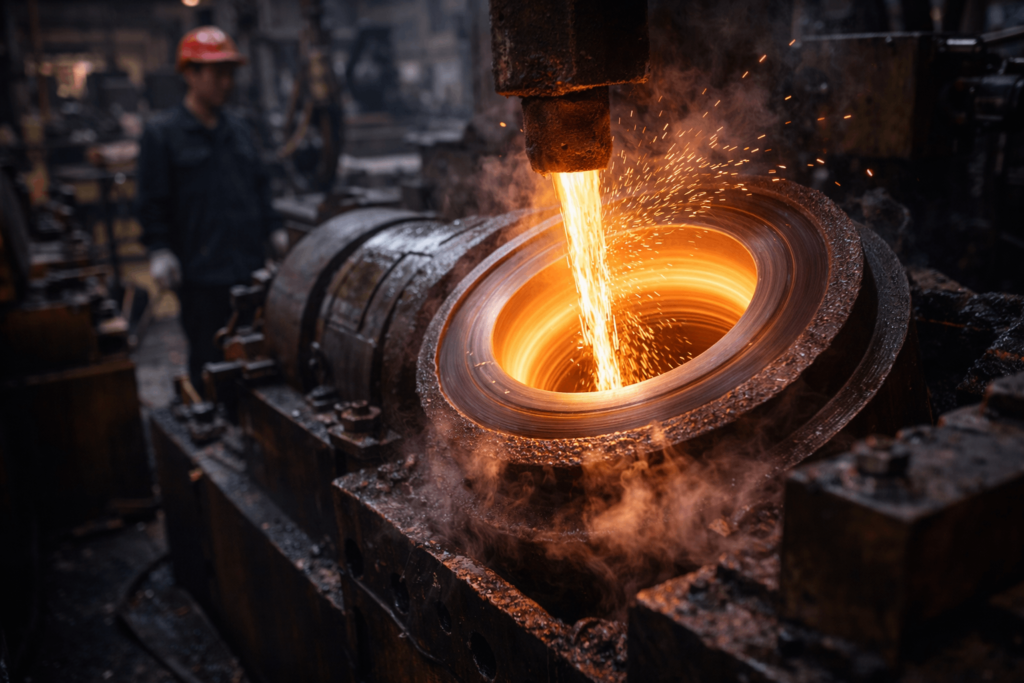
What Makes Centrifugal Casting Different
Centrifugal casting differs from conventional casting because the mold rotates while molten metal is poured into it. As the mold spins, the molten metal is forced toward the mold wall, where it forms a dense ring and begins to solidify. That movement changes both how the part takes shape and where certain defects are likely to appear.
In a static mold, filling and feeding rely mainly on gravity, gating, and riser design. In the centrifugal casting process, rotation becomes part of the quality mechanism. It affects metal compaction, wall formation, and the distribution of inclusions or lower-density phases within the part. This is one reason the process is strongly associated with hollow and rotationally symmetric components rather than highly irregular castings.
That difference matters because many centrifugal cast parts are used in working conditions where wall integrity is critical. A sleeve or liner is usually purchased for durability, dimensional stability, and service life. In those applications, the outer wall is often the functionally important area, so a process that improves structural soundness in that zone can bring a practical advantage.
For procurement teams, this distinction helps explain why centrifugal casting is selected for some parts and not for others. The process is most suitable when geometry, performance requirements, and finishing plans are aligned with its strengths.
How the Process Works in Production
The production cycle starts before pouring begins. Mold condition affects heat transfer, surface finish, release behavior, and wall quality. Rotational speed must be matched to the diameter, length, wall section, and alloy behavior of the part. These factors are not minor setup details. They help determine whether the metal forms a stable wall or produces uneven distribution during the casting cycle.
Once pouring starts, molten metal enters the rotating cavity and is driven outward toward the mold’s inner surface. In true centrifugal casting, this movement creates the bore naturally without a conventional core. That makes the method especially suitable for hollow cylindrical components, including sleeves, rings, tubes, and liners.
Solidification normally begins near the outer wall and progresses inward. This directional behavior is one of the most important features of the process. The outer region, which often becomes the main service wall of the finished component, tends to develop a denser structure. At the same time, lighter impurities, oxides, and some gas-related defects tend to move toward the inner diameter.
This is why bore machining is often built into the normal production plan. A realistic explanation of how it works is not that centrifugal casting removes every defect, but that it helps control where many defects are most likely to end up. For industrial parts, that can be beneficial because the inner zone is often machined anyway to meet tolerance, concentricity, and surface-finish requirements.
The process therefore links casting and finishing more closely than some buyers expect. The final result depends not only on the casting itself, but also on whether machining allowance, bore cleanup, and inspection points were planned correctly from the beginning.
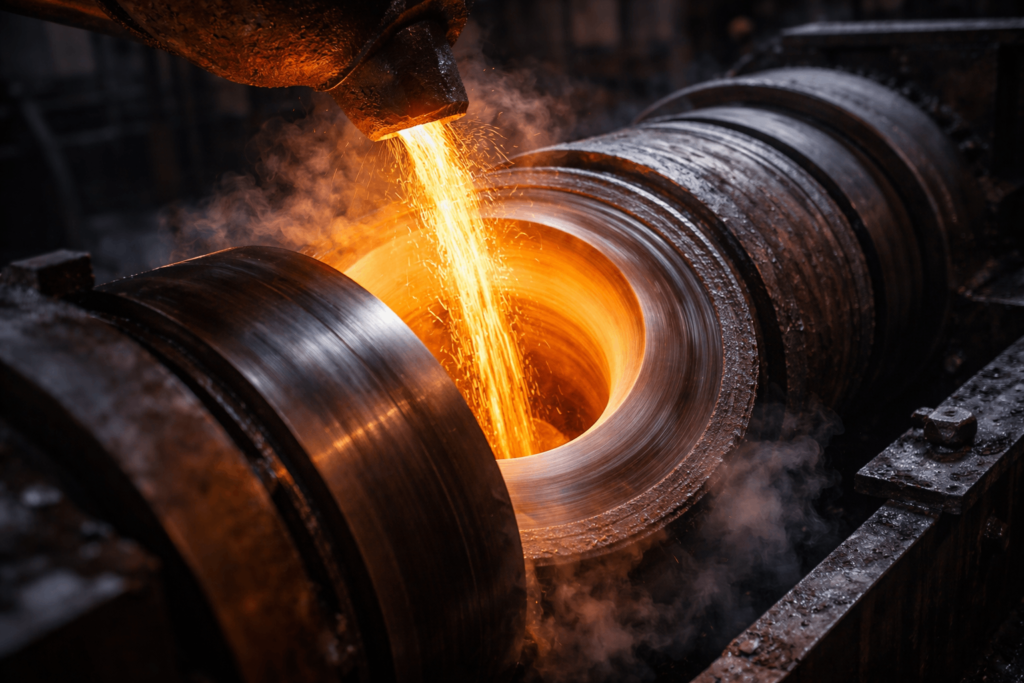
Main Types of Centrifugal Casting and Why They Matter
The main types of centrifugal casting influence geometry, tooling logic, and production efficiency. Buyers do not need every category in textbook detail, but they do benefit from understanding which form is being proposed and why.
Horizontal and Vertical Centrifugal Casting
Horizontal centrifugal casting is widely used for longer cylindrical parts such as tubes, liners, and shells. When part length is a major feature, horizontal rotation often provides a more practical setup because it supports wall formation along the axis and helps maintain consistency over a longer section.
Vertical centrifugal casting is more often used for shorter components such as rings, bushings, and compact sleeves. In these cases, the part is more diameter-driven than length-driven, so a vertical arrangement can be easier to control and better aligned with the final geometry.
For buyers, the key point is not that one orientation is universally better. The useful question is whether the chosen setup matches the actual shape, wall requirement, and finishing plan of the part.
True, Semi-Centrifugal, and Centrifuging
True centrifugal casting is used mainly for hollow cylindrical parts. The bore forms naturally during rotation, which makes the process suitable for pipes, rings, sleeves, and liners. This is the form most people refer to when they search for the true centrifugal casting process.
Semi-centrifugal casting is used for largely solid, axisymmetric components such as wheels or pulleys. Here, the goal is not to create a hollow center, but to improve feeding and density in a rotational part. Centrifuging, sometimes called centrifuged casting, is another variation in which metal is pushed into multiple mold cavities arranged around a central feed system.
These distinctions matter because they reflect different production objectives. One method creates hollow annular parts, another improves solid rotational parts, and another supports multi-cavity filling. For sourcing teams, that is more useful than classification for its own sake because it connects process language to product requirements and quotation logic.
The Production Sequence from Mold to Finished Part
Although the process is often summarized quickly, it is better understood as a sequence of controlled stages. Mold setup comes first. Surface preparation, coating, balance, and preheating all affect release behavior, cooling rate, and wall quality. A poorly prepared mold can reduce the benefit of rotation before the metal is even poured.
The second stage is pouring. Metal temperature, flow rate, and timing must be controlled so that the cavity fills smoothly. In a rotating system, unstable pouring can lead to wall inconsistency, turbulence, or local structural variation. That is why process discipline matters as much as machine capability.
Next comes solidification. Because freezing progresses from the outer wall inward, the process helps build a dense working wall while pushing many lower-density features toward the inner region. After cooling, the part is removed and prepared for post-processing. Depending on the specification, this may include bore machining, facing, straightening, heat treatment, dimensional inspection, and export packaging.
| Stage | What happens | Why it matters |
|---|---|---|
| Mold setup | Surface preparation, coating, balancing, preheating | Influences cooling behavior and wall formation |
| Pouring | Controlled delivery of molten metal | Affects filling stability and structure |
| Solidification | Freezing from outer wall inward | Supports dense service wall |
| Finishing | Machining, inspection, packaging | Determines final tolerance and shipment readiness |
For wholesale projects, the final stage deserves special attention. A part is not commercially ready when it leaves the mold. It is ready when dimensions, surface condition, documentation, and packaging match the purchase requirement. That is why experienced buyers usually review machining scope and inspection scope together with the casting route rather than after production begins.
What Determines Quality and Supply Reliability
A good casting process does not guarantee a good finished part by itself. Quality depends on how process variables, material behavior, and finishing allowances interact. Rotational speed is one of the most important factors. If it is too low, metal compaction may be insufficient. If it is too high, the process can become unstable for the alloy or section involved.
Pouring temperature is equally important because it affects fluidity, oxidation risk, and the timing of solidification. Mold condition also matters because it influences thermal behavior and surface development. The combined effect of these variables determines whether the structure is stable enough to support downstream machining and dimensional control.
Material selection adds another layer. Carbon steel, stainless steel, bronze, brass, and other engineering alloys are commonly used in centrifugal cast components, but they do not behave the same way during filling or freezing. Some buyers focus first on corrosion resistance or price, but from a process standpoint, fluidity, segregation tendency, and machinability are just as important.
This is why machining allowance should be planned as part of the casting strategy rather than treated as a secondary detail. The inner zone is often where cleanup is expected. If there is not enough stock, the part may fail to meet final specification. If there is too much, machining cost increases unnecessarily. Good process planning aims for a controlled balance between casting efficiency and finished tolerance.
For international buyers, quality also includes repeatability. A supplier may be able to make a good first batch, but long-term sourcing depends on whether material traceability, inspection records, lot control, and packaging standards can be maintained over repeat orders. In B2B projects, supply reliability is often valued as highly as the initial unit price.
Typical quality and procurement checks
| Check point | Why it matters |
|---|---|
| Material grade verification | Confirms alloy matches service requirement |
| Bore machining plan | Affects tolerance, cost, and lead time |
| Wall-thickness inspection | Supports fit and durability |
| Lot traceability | Reduces repeat-order risk |
| Packaging specification | Protects parts during export shipment |
These are the kinds of factors that shape a practical process discussion. In wholesale procurement, buyers usually respond better to clear control points and finishing logic than to broad capability claims, especially when one approved supplier may support multiple part numbers or a continuing distribution program.
Where Centrifugal Casting Creates Real Value
The strongest applications of centrifugal casting are the ones where geometry, service conditions, and production economics align. Typical centrifugal cast parts include sleeves, liners, bushings, rings, tubes, and wear components for pumps, industrial machinery, transport systems, oil and gas equipment, and heavy-duty assemblies.
The process creates value because it can improve wall integrity while reducing unnecessary material removal in the production of parts that would otherwise be machined from solid stock. For thick-wall cylindrical components, that difference can be commercially significant. In many industrial categories, raw material accounts for a major share of total part cost, so geometry-efficient production can improve cost control as well as material utilization.
The process is also useful when a buyer needs a practical balance between durability and manufacturability. A dense outer wall can support wear resistance and service life, while planned bore machining helps control the final surface and dimensions. That combination is one reason centrifugal cast parts remain relevant even when other casting methods are available.
At the same time, the process is not suitable for every drawing. If the part has highly irregular geometry, complex internal passages, or very low order volume, another route may be more practical. Saying so does not weaken the case for centrifugal casting. It makes the recommendation more credible.
For procurement teams, this is often the most useful way to evaluate the process: not as a universal answer, but as a strong option when the part is round, the wall is critical, the bore can be machined, and stable supply matters.
A quick comparison with alternative routes
For cylindrical industrial parts, buyers often compare centrifugal casting with sand casting or machining from solid stock rather than evaluating it in isolation. Sand casting usually offers more flexibility for irregular external geometry, but it may not provide the same structural advantage in round, hollow, or wall-critical parts. Machining from solid stock can deliver precise dimensions, but material waste can become costly when the part is a thick-wall ring, sleeve, or tube.
Centrifugal casting usually becomes more attractive when the component is axisymmetric, the outer wall is functionally important, and bore machining is already part of the production plan. In those situations, it can offer a practical middle ground between structural performance and material efficiency.
| Process route | Best fit | Main trade-off |
|---|---|---|
| Centrifugal casting | Hollow or annular parts with critical wall performance | Bore machining is often required |
| Sand casting | More irregular shapes and broader geometry flexibility | Lower structural advantage for round wall-critical parts |
| Machining from solid stock | Tight tolerance parts with simple supply planning | Higher raw material waste for hollow thick-wall shapes |
How Buyers Can Evaluate Process Fit Before RFQ
By the time a sourcing team reaches the RFQ stage, the most helpful question is no longer “what is centrifugal casting?” but whether it fits the project better than the alternatives. A practical evaluation usually starts with geometry. Is the part fundamentally round or annular? Is the key performance zone located in the wall rather than in complex external features? Will the inner diameter be machined anyway?
The next question is commercial. Does the order volume justify the tooling and process setup? Would machining from solid stock generate too much waste? Does the alloy requirement support the process window? In many cases, the answer depends on the interaction between quantity, material price, machining scope, and inspection level rather than on any single factor.
Buyers should also consider what evidence supports the supplier’s recommendation. Useful follow-up points include tolerance capability, concentricity control, expected machining scope, material certification, inspection records, and export packaging details. These are often the decision points that move a buyer from technical review to serious inquiry.
At this stage, the most useful content is content that supports faster and more accurate evaluation. In B2B buying, process-fit information reduces uncertainty before engineering time or purchasing time is committed.
If you are evaluating a hollow or cylindrical metal component for wholesale production, an early technical review can clarify material choice, machining scope, and inspection expectations before the RFQ moves too far. For projects that require process review before quotation, YISHANG can provide support based on part geometry and end-use requirements.
FAQs About Centrifugal Casting
Is centrifugal casting always better than other casting methods?
No. It is usually strongest for round or annular parts where wall integrity matters and bore machining is acceptable. For irregular shapes or very low-volume parts, another method may be a better fit.
Why is bore machining often included?
Because the inner region may contain more inclusions or lower-density material. Machining helps achieve the final tolerance, surface finish, and concentricity.
What do wholesale buyers usually ask first?
Most start with material grade, dimensional tolerance, machining scope, inspection records, lot consistency, and shipment requirements.
Which materials are common?
Carbon steel, stainless steel, bronze, brass, and other engineering alloys are common choices, depending on wear, corrosion, pressure, and cost requirements.
Is centrifugal casting better than sand casting for sleeves or bushings?
For many sleeves and bushings, centrifugal casting can offer better wall soundness and more efficient material use, especially when the part is round and the inner diameter will be machined anyway. Sand casting may still be suitable when the geometry is less regular or when production priorities are different.
When does machining from solid stock make more sense?
Machining from solid stock may be more practical when order volume is low, the part geometry is simple, and material waste does not heavily affect total cost. For thicker hollow parts, centrifugal casting often becomes more competitive as volume increases.
What documents do buyers often review before approving production?
Common checks include material certificates, dimensional inspection reports, lot traceability records, finishing scope confirmation, and packaging requirements for export shipment.