
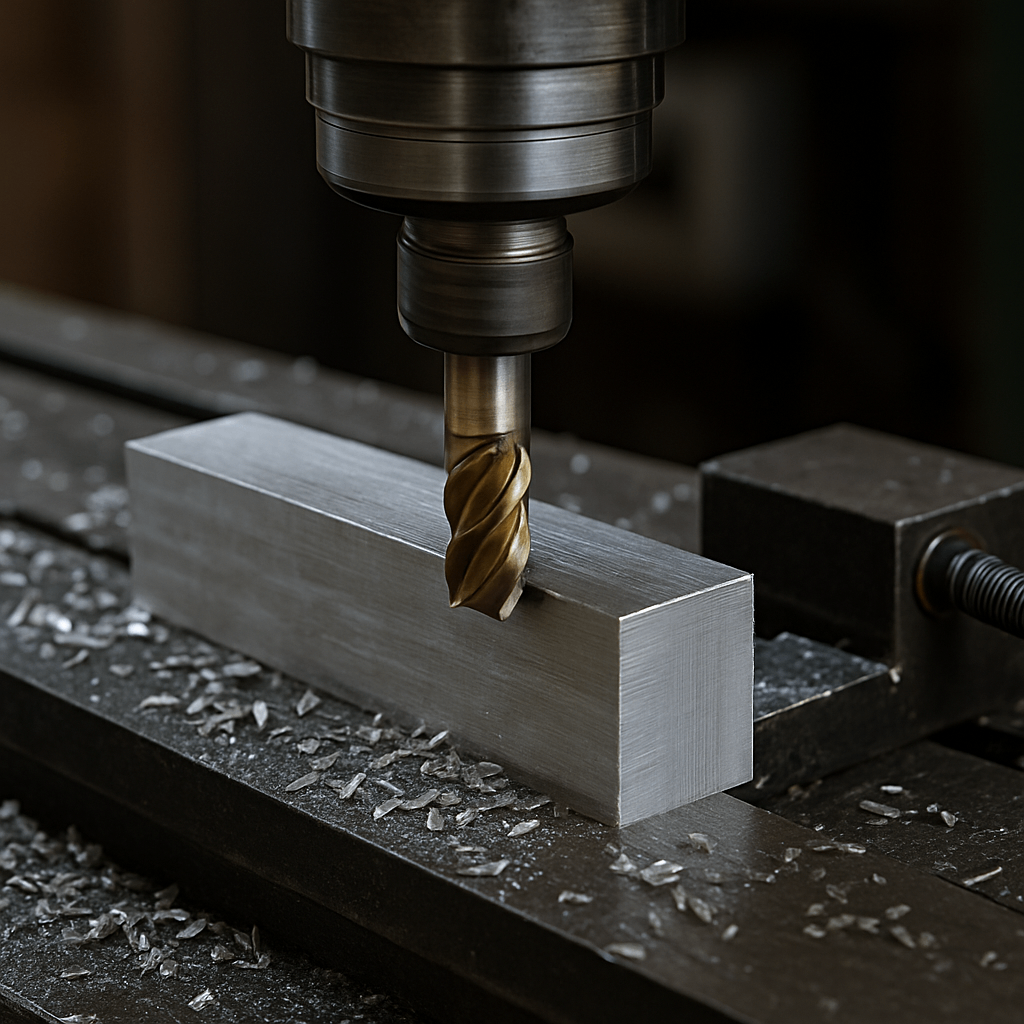
Milling Strategy Is a Procurement Decision—Not Just a Technical Choice
In international CNC sourcing, milling strategy is not just a programming detail. It affects cost consistency, surface quality, scrap rate, finishing compatibility, and batch-level predictability.
For buyers ordering enclosures, structural parts, brackets, display systems, or other precision metal components, the choice between climb milling and conventional milling can influence both the manufacturing result and the commercial outcome. That makes it a sourcing decision, not just a machining term.
Understanding the Technical and Sourcing Differences
1. Technical Overview: How They Work
In climb milling, the cutter rotates in the same direction as the feed. The chip starts thicker and becomes thinner. This usually reduces rubbing, lowers heat build-up, and can improve surface quality when machine rigidity and fixturing are strong enough.
In conventional milling, the cutter rotates against the feed direction. The chip starts thinner and ends thicker. This often creates more rubbing and heat, but it can still be useful in situations where machine backlash, material behaviour, or clamping stability make climb milling less suitable.
2. Why It Matters for Buyers
For procurement teams, the difference matters because machining method can affect tool wear, burr formation, edge quality, surface condition, throughput, and post-processing cost.
A buyer may never see the toolpath directly, but the consequences appear later in inspection, coating, assembly, and delivery reliability.
What Professional Buyers Must Prioritize
Batch-Level Consistency and Predictability
For repeat CNC orders, consistency matters as much as nominal accuracy. Even small differences in burr level, flatness, or edge condition can create extra sorting, rework, and delayed approval during mass production.
When the milling method is matched properly to the material and geometry, buyers usually see better repeatability across batches.
Controlling Quality Costs via Reduced Scrap
Scrap and rework are often where poor machining strategy becomes expensive. Tool chatter, unstable clamping, heat build-up, or weak edge quality may not seem serious on one part, but over a large batch they become measurable cost.
That is why buyers should care about whether the supplier is choosing the milling strategy based on part risk—not simply based on default machine setup.
Compatibility with Finishing Requirements
Surface condition after milling directly affects later steps such as anodizing, powder coating, painting, silk-screen printing, or cosmetic assembly.
A milling method that produces a cleaner base surface may reduce the need for extra polishing, sanding, or repair before finishing.
Industry-Specific Examples: Results from the Field
Advertising Frames (US Retail Brand)
In projects where visual finish and edge quality are important, milling strategy can directly affect polishing time and final appearance. For aluminum display and frame parts, better toolpath matching can reduce both cosmetic repair work and total finishing effort.
Medical Equipment Panels (EU OEM)
For flatter, tolerance-sensitive panels, method selection can influence dimensional stability and assembly efficiency. Where panel flatness and repeatability matter, a more controlled cutting strategy may support both QA performance and faster assembly.
Energy Grid Cabinets (AU Supplier)
For galvanized or more vibration-sensitive sheet-based parts, conventional milling may still be the better choice in some cases—especially when equipment condition, material response, or rigidity concerns make it more stable.
The lesson for buyers is simple: the best milling method depends on material, machine condition, geometry, tolerance, and end-use requirement, not on a universal rule.
Which Milling Method Is Right for Your CNC Project?
A practical buyer comparison looks like this:
| Attribute | Climb Milling | Conventional Milling |
| Tool wear | Usually lower | Usually higher |
| Surface finish | Smoother | Rougher |
| Heat build-up | Lower | Higher |
| Stability on thin parts | Often better with proper clamping | Sometimes safer on less rigid setups |
| Suitability for aluminum | Excellent in many cases | Possible, but more setup-sensitive |
| Risk on older machines | Higher if backlash exists | Often safer |
| Batch scrap risk | Often lower | More sensitive to chatter and burrs |
| Finishing readiness | Often needs less prep | May need more cleanup |
For buyers, the point is not to memorize the table. It is to ask suppliers how they selected the method for the actual part you are sourcing.
YISHANG: Milling Methods That Serve Your Procurement Priorities
At Yishang Metal Products Co., Ltd., we support OEM and wholesale buyers with machining strategies built around real sourcing priorities such as repeatability, finish readiness, tolerance stability, and scalable batch control.
With 26+ years of manufacturing experience, we support processes including laser cutting, bending, stamping, welding, CNC machining, surface treatment, assembly, packaging, inspection, and shipment. For CNC projects, method selection is matched to part geometry, material, fixturing condition, and downstream requirements rather than using a one-size-fits-all approach.
FAQ: Milling Strategy and CNC Sourcing Questions
Q1: Will climb milling work for thick carbon steel?
Sometimes, but not always. The right answer depends on machine rigidity, backlash condition, material behaviour, and fixture stability.
Q2: How does milling method affect total cost?
It affects tool life, scrap rate, finishing time, rework, inspection stability, and total throughput—not just machining cycle time.
Q3: Is method choice fixed by machine?
No. Programming, fixturing, part geometry, and process planning all influence the best choice.
Q4: Should method be included in my RFQ?
It is useful to request at least a process summary or machining approach for tolerance-sensitive or appearance-critical parts.
Q5: How does method choice affect lead time?
Poor method selection often creates burrs, chatter, rework, and delayed inspection, which can extend true delivery time.
Q6: Is climb milling always more expensive?
Not necessarily. In many projects, it can reduce total downstream cost by improving finish and lowering rework.
Q7: Does burr formation differ by method?
Yes. Burr behaviour can change significantly depending on cut direction, material, and tool condition.
Q8: Can milling method influence coating failures?
Yes. Surface inconsistency after machining can affect adhesion, cosmetic quality, and finishing performance.
Let’s Optimize Your Next CNC Project Together
For global buyers, milling strategy should support more than just part production. It should support stable QA, lower scrap, smoother finishing, and stronger delivery performance across the whole order.
At Yishang Metal Products Co., Ltd., we work with customers to align machining strategy with real RFQ priorities, part function, and supply-chain expectations.
📩 If you are evaluating CNC projects for enclosures, frames, panels, brackets, or other metal parts, send us your drawings or requirements to discuss the most suitable machining approach.