Overseas wholesale buyers don’t read manufacturing blogs the way hobbyists do. You’re usually scanning a page to answer a sourcing question fast: Will this supplier keep my metal parts consistent after first approval, when volume, time, and production pressure begin to matter?
That’s why a simple list of the components of a CNC machine rarely helps. Most professional buyers already know what a controller, bed, chuck, or spindle is. What you actually need is a decision lens: how cnc machine parts behave together as a system, how that behavior changes across long production runs, and what signals separate a stable process from a fragile one.
This article is written for procurement teams and manufacturing engineers who source machined metal products—brackets, housings, frames, enclosures, and precision interfaces—where the real cost is not the quote, but the variability: rework, sorting, line stoppages, and missed deliveries.
You’ll see practical buyer language (batch stability, assembly risk, corrective action), clear technical terms (datum shift, thermal growth, repeatability), and standards used as shared vocabulary—GD&T (ASME Y14.5 / ISO 1101), surface texture terminology (ISO 4287), and machine tool performance language (ISO 230).
A 30‑second framework buyers actually use
Most buyer searches start broad and then narrow quickly. At a glance, CNC machine parts fall into four functional groups that influence results very differently:
- Control components that repeat motion
- Motion components that translate commands into movement
- Structural components that resist force and heat
- Workholding components that create real‑world datums
Knowing what these components are is basic. Understanding how they interact over time is what determines whether production stays stable. The sections below follow that interaction path—so you can evaluate suppliers by outcomes, not brochures.
What Wholesale Buyers Really Mean When They Ask About CNC Machine Parts
When a buyer asks about cnc machine parts, it’s rarely curiosity about a single cnc component. In sourcing conversations, the term is shorthand for a broader concern: Can this factory deliver consistent parts across batches, schedules, and production cycles—without surprises?
A drawing defines intent, not reality. Two factories can follow the same print and still deliver different outcomes once production moves beyond sampling. The gap between intent and execution is where most long-term issues start: hole patterns that slowly shift, flatness that drifts, threads that gauge fine in week one but tighten later, or assemblies that suddenly need “extra hand fitting.”
From a procurement standpoint, the critical distinction is capability vs stability. Capability answers whether a part can be produced once. Stability answers whether it can be produced repeatedly under real operating conditions with predictable results. The second answer drives your total cost, because instability shows up as scrap, rework, expedited freight, and time lost in supplier negotiations.
How buyers search and scan
Wholesale buyers typically search in a “problem + intent” pattern:
They might start with broad queries like cnc machine parts suppliers or cnc milling parts supplier, then shift to intent-heavy queries such as batch-to-batch consistency, CNC machining repeatability, first article vs production issues, or why parts drift after approval.
When they land on a supplier site, they scan headings for outcomes: stability, inspection approach, fixture strategy, capability evidence, and how issues are handled. A page that only explains what parts exist in a machine rarely answers the buyer’s question.
That is why this article treats cnc machine parts as a system that produces outcomes. If you can understand the system behavior, you can compare suppliers more confidently—whether you’re sourcing domestically (for example, cnc parts USA) or overseas.
CNC Machine Parts Do Not Fail Suddenly — They Drift Gradually
Buyers often look for obvious warning signs: outdated machines, missing inspection tools, or vague capability claims. Those checks matter, but they don’t catch the most expensive failures—because many issues do not appear as sudden breakdowns.
In real production, cnc machine parts usually drift gradually as a system. Small mechanical wear, thermal changes, and fixture variation accumulate. At first the process stays “inside tolerance,” and everyone relaxes. Later the same process starts consuming tolerance in a different direction, and assemblies begin to fail even when individual features still pass.
A useful way to understand this is to view CNC behavior through four interacting domains:
- Control parts: controller logic, servo loops, compensation tables, feedback signals.
- Motion parts: motors, ball screws, linear guides, couplings, drive elements.
- Structural parts: the bed, column, frame—resisting cutting forces and managing thermal growth.
- Workholding parts: fixtures, chucks, vises, clamps—where datums are created in the real world.
None of these domains acts independently. A controller may repeat the same toolpath perfectly, while workholding creates a slightly different datum each cycle. A rigid frame may reduce deflection, while thermal expansion in a drive component changes position response during long runs.
Why drift matters to procurement
Drift is expensive because it hides early. It often appears as “noise” that increases inspection burden and creates disagreement about root cause. Buyers then face the real-world question: do you sort parts, accept deviation, redesign, switch suppliers, or stop the line?
The best suppliers don’t claim drift never happens. They show that drift is measurable, explainable, and recoverable—because they manage the CNC machining system, not just the machine.
Control Parts: Repeatability Is Not the Same as Accuracy
A common sourcing misunderstanding is assuming that advanced CNC control guarantees accuracy. In practice, CNC control systems are designed to guarantee repeatable motion, not absolute dimensional truth under all conditions.
Modern controllers execute toolpaths with high consistency. That’s why early samples can look excellent: offsets are fresh, the machine is cool, tools are sharp, and the process is slow enough for operators to intervene. But repeatable motion does not guarantee repeatable dimensions if the physical system changes during production.
For buyers, this matters because many quality issues get misattributed to programming or operator skill. In reality, thermal growth, fixture behavior, and tool wear are largely outside the controller’s direct influence.
What CNC control can manage, and what it cannot
| Aspect | Strongly influenced by control | Outside direct control |
|---|---|---|
| Toolpath execution (repeatability) | Yes | No |
| Multi-axis coordination | Yes | No |
| Compensation of stable, calibrated errors | Yes | No |
| Fixture seating repeatability | No | Yes |
| Thermal deformation under load | No | Yes |
Buyer-facing signals that control is being managed
If you want to reduce sourcing risk, ask for evidence that control behavior is managed as part of the process. Examples include: stable offset rules, documented warm-up routines, calibration records, and repeat measurements after the machine reaches thermal equilibrium.
This is also where shared standards language helps. GD&T clarifies functional intent. But the supplier must translate that intent into process controls that keep datums and critical features stable across time.
Motion Parts: How Small Mechanical Changes Become Dimensional Drift
Motion systems are where long-term variation often begins. The motion chain—motors, couplings, ball screws, linear guides, and encoders—translates commands into movement. Over time, that chain changes.
Unlike sudden failures, motion-related drift develops gradually. Lubrication shifts, temperature differences, and mechanical fatigue can alter axis response without triggering alarms. Parts may still pass inspection individually, yet show increasing variation in assembly.
This explains why two suppliers using similar cnc milling machine parts can deliver very different long-term results. One supplier actively manages motion stability with maintenance discipline and calibration. The other relies on nominal machine specs and reacts only after issues appear.
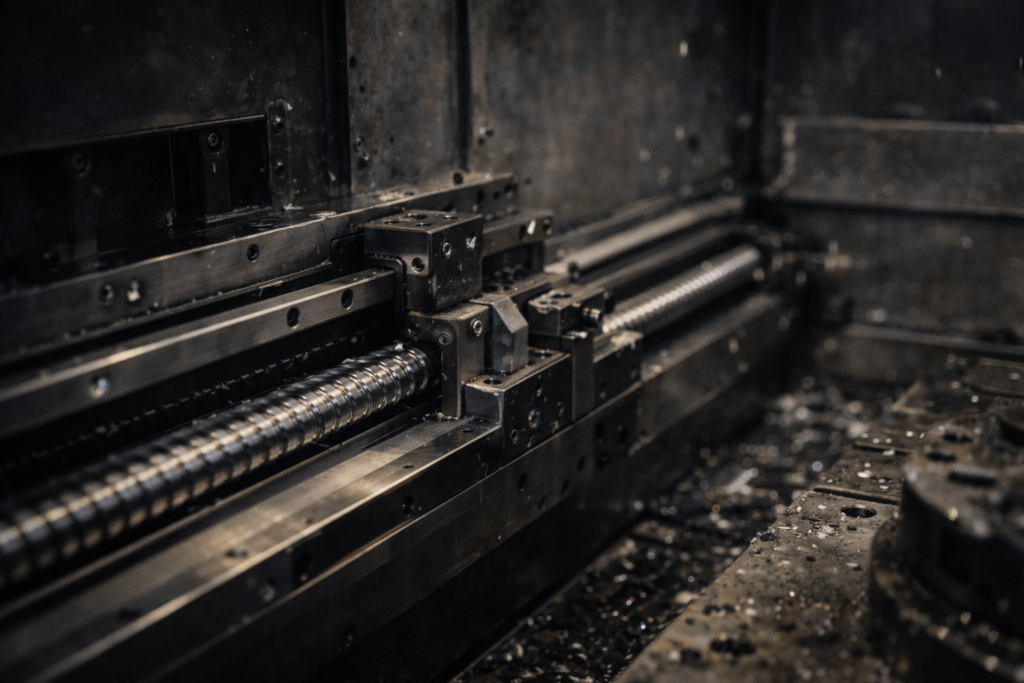
Buyers often see motion-related issues as functional symptoms:
A hole pattern slowly moves even though each hole size passes. A bore meets size tolerance but starts showing taper or out-of-round after longer runs. A milled pocket depth shifts after a tool change even though offsets “match.”
These can come from backlash under load, micro-slips in couplings, guide friction changes, encoder mounting sensitivity, or thermal expansion in drive components.
What to ask suppliers (without turning it into a checklist)
Instead of asking “Which brand is your machine?”, ask how the supplier sustains axis behavior: calibration intervals, warm-up practices, lubrication control, and how they verify positioning behavior after extended runtime.
If a supplier can explain these topics clearly, it usually indicates they understand motion stability as a production asset—not as an afterthought.
Structural Parts: The Hidden Foundation of Machining Consistency
Structural cnc machine parts form the physical foundation of machining. Their job is not to add features, but to resist variation.
A rigid structure minimizes deflection under cutting forces and helps maintain consistent geometry across features. Thermal stability further determines whether dimensions remain predictable during long production runs.
For sourcing teams, structural stability explains why some suppliers achieve consistent results even with modest control systems, while others struggle despite advanced electronics. Stability is a physical property. It can be improved through disciplined operation—warm-up routines, coolant management, controlled environments—but it cannot be “patched” by software.
Why structure matters more as parts get larger or thinner
When you machine thick, compact parts, deflection is often modest. But as parts get thinner, longer, or flatter, cutting forces create measurable bending and springback. A stable structure reduces variability, but process planning becomes equally important.
This is where experienced suppliers plan machining sequence to protect datums, control heat input, and avoid removing support material too early. Those decisions are often the difference between a stable batch and a batch that slowly drifts.
Workholding Parts: Where Consistency Is Most Often Lost
Among all cnc machine parts, workholding components often have the greatest impact on part-to-part consistency. They are also the least standardized across suppliers.
Fixtures, chucks, vises, and clamps define real-world datums. Any variation in seating, clamping force, or contact condition directly affects final dimensions.
This is the situation buyers frequently encounter: parts measure within tolerance individually, yet fail during assembly. When that happens, the root cause is often a shifting datum rather than poor machining. A part that seats slightly differently can still “pass” on key dimensions while causing a functional shift in the assembly.

Workholding behavior changes over time
Workholding variation grows during production. Contact surfaces wear. Soft jaws deform. Locator pins loosen. Chips imprint into fixture faces. The result is a slow drift that sampling does not reveal.
Reliable suppliers treat fixtures as controlled process assets: they validate seating, maintain contact faces, and replace wear items and cnc spare parts on schedule.
| Buyer-visible symptom | Likely workholding driver |
|---|---|
| Pattern misalignment while sizes pass | Datum reseating variation |
| Flatness changes after unclamping | Part distortion under clamp force |
| Surface finish varies in one zone | Vibration due to insufficient constraint |
| Rework spikes after long runs | Fixture wear or contamination |
Buyer Decision Box: How to Qualify CNC Machine Parts for Repeat Orders
Before moving into volume production, experienced buyers use a simple mental filter. Not a checklist—but a way to interpret what suppliers say and show.
First, look for time-based evidence. Ask what happens after the machine runs warm for several hours. A supplier who can show repeat measurements after thermal equilibrium understands stability better than one who only presents first-article results.
Second, listen for process ownership language. Suppliers focused on stability talk about fixtures as assets, tool life as a controlled variable, and measurement repeatability as part of the process—not as inspection overhead.
Third, evaluate response maturity. Drift will happen. The difference is whether the supplier can explain how it is detected, analyzed, and prevented from recurring.
If a supplier can communicate clearly across these three points, the risk profile is usually much lower—regardless of how impressive the machine list looks.
Why Sampling Rarely Reveals Long-Term Risk
Sampling is necessary, but it is not proof of production stability.
Short runs rarely expose thermal drift, fixture wear, or tool life effects. During sampling, machines are cool, fixtures are clean, and operators intervene frequently.
Once production begins, the environment changes. Heat accumulates, fixtures wear, chips interfere with seating, and tools degrade. What appeared stable during sampling may become unpredictable over time.
Practical sourcing approach
A useful way to qualify stability is to request evidence beyond a single first article. For example, ask for repeated measurements after sustained runtime, or ask how the supplier manages tool life on critical features.
If variation appears, you also want to know whether the supplier has a structured corrective action method. The existence of a clear 8D/CAPA approach is often a proxy for maturity—because stable suppliers don’t just fix a symptom; they prevent recurrence.
When CNC Machine Parts Are Not the Limiting Factor
Not all variation originates from cnc machine parts. In some cases, the part design becomes the dominant source of instability.
Thin walls, deep cavities, tight positional tolerances, and complex geometries amplify small variations. Over-specifying tolerances is a common procurement mistake.
A practical example is tightening tolerances “just to be safe,” then seeing lead time and rework rise. The process becomes fragile. The supplier compensates with more inspections, more tool changes, and more handling—each of which introduces new variation.
Experienced cnc machine parts suppliers identify these risks early. They may propose datum strategy improvements or tolerance rationalization to preserve function while improving manufacturability.
Predictability: The Metric That Matters Most to Wholesale Buyers
For high-volume sourcing, predictability matters more than peak accuracy. Predictable processes produce bounded variation, explainable trends, and recoverable deviations.
This is why mature manufacturers emphasize inspection repeatability, fixture discipline, and trend awareness. Quality metrics such as Cp, Cpk, and GR&R are tools to prove stability over time.
For buyers, predictable results translate into lower total cost. A small drift that pushes even a small fraction of parts into rework can erase savings from a lower unit price—especially when downstream labor is in higher-cost regions.
Predictability also reduces friction. When variation is bounded and documented, supplier communication becomes faster, and responsibility boundaries become clearer.
How Wholesale Buyers Should Interpret CNC Machine Parts Information
When reviewing supplier websites or technical content, buyers should look beyond surface descriptions and ask how a supplier manages system behavior over time.
A practical evaluation considers what type of variation the system introduces. Systematic errors may be compensated if stable. Random errors resist control. Drift errors require long-term stability management.
This lens also helps you interpret supplier claims. A supplier can have impressive equipment and still struggle if process discipline is weak. Another supplier can deliver stable results with standard equipment because they control workholding, tool life, measurement repeatability, and the availability of cnc spares.
If you are comparing regional options—whether cnc parts USA suppliers or overseas manufacturers—the question remains the same: can the supplier demonstrate predictable behavior under volume, not just attractive samples?
Practical FAQs (Search & PAA Focused)
What are the most important CNC machine parts for production consistency?
Consistency depends less on any single component and more on how control, motion, structure, and workholding interact over time—especially under heat and repetition.
Why do CNC parts pass inspection but fail during assembly?
This often indicates datum shift or workholding variation. Individual dimensions may pass while relative geometry drifts.
How should buyers compare CNC machine parts suppliers?
Beyond equipment lists, look for evidence of stability management: repeat measurements, fixture control, tool life rules, and documented corrective action.
Is sourcing CNC parts USA always more stable than overseas sourcing?
Not necessarily. Stability depends on process discipline, not geography. Buyers should evaluate evidence, not assumptions.
If you are qualifying cnc machine parts suppliers for repeat production, the strongest signal is not a machine list. It is whether the supplier can speak clearly about stability: how they manage heat effects, how they validate fixtures, how they control tool life, and how they respond when drift appears.
At YISHANG, we keep the sales pitch light and the technical discussion practical. If you are sourcing machined metal products for wholesale orders, we can review your drawings and identify stability risks that typically show up after sampling—before they become a cost problem.
Share your RFQ or drawings, and we’ll respond with a production-minded evaluation focused on predictability and batch consistency.