By the YISHANG Copper & Sheet Metal Engineering Team – 26+ Years in OEM / ODM Metal Manufacturing
Quick Answers for High‑Intent Searches
What type of metal is copper?
Copper is a non‑ferrous transition metal with a face‑centered cubic (FCC) crystal structure. It is soft, ductile, corrosion‑resistant, and one of the best conductors of electricity and heat used in modern engineering.
What is the boiling point for copper?
The boiling point for copper is 2,562°C (4,643°F) under standard atmospheric pressure.
In the rapidly evolving industrial landscape of 2025, copper is no longer simply a raw material. For purchasing managers, project engineers, and supply‑chain leaders, it has become a strategic resource that underpins global electrification, digital infrastructure expansion, EV charging networks, renewable energy systems, and new energy storage. In these industries, copper quietly sits at the core of almost every high‑value system.
At the same time, procurement teams face unprecedented volatility: price fluctuations, shipment delays, inconsistent quality from unknown suppliers, and constantly changing technical requirements. For companies operating across continents, the real challenge is not just securing copper—but securing the right type of copper, processed under stable, repeatable, and verifiable manufacturing conditions.
This guide is written specifically for overseas wholesale buyers, OEM/ODM brands, and engineering teams sourcing copper sheet metal parts, copper busbars, terminals, brackets, frames, cabinets and assemblies. It blends metallurgical knowledge with real factory practice and addresses the search intent behind “copper is what type of metal”, “boiling point for copper,” and related technical and procurement‑focused queries.
If you search terms like “what type of metal is copper,” “is copper ferrous or non‑ferrous,” “copper sheet metal fabrication,” “custom copper components OEM,” or “copper busbar manufacturer China,” this article is designed to match your intent with depth, accuracy, and practical value.
Key Physical Properties of Copper (Engineering Summary)
This property list helps buyers quickly confirm copper suitability for electrical, thermal, mechanical, and fabrication requirements.
- Type of metal: Non‑ferrous transition metal (Group 11)
- Boiling point of copper: 2,562°C (4,643°F)
- Melting point of copper: 1,084°C (1,984°F)
- Crystal structure: FCC (face‑centered cubic)
- Electrical conductivity: ~100% IACS (industry reference conductor)
- Thermal conductivity: Extremely high (excellent for heat dissipation)
- Density: ~8.96 g/cm³
- Magnetic properties: Non‑magnetic
- Corrosion resistance: Naturally forms a stable oxide layer; significantly more resistant than typical base metals
- Metal category: Considered a base metal in formal metallurgical classification, but behaves more corrosion‑resistant than typical base metals, which leads some engineers to refer to it as “relatively noble” in practical use contexts.
Common Applications of Copper (Helpful for Basic Search Intent)
Although this guide focuses on B2B manufacturing and OEM procurement, many readers searching “copper is what type of metal” also want to confirm how copper is used in real industries. Below is a concise, engineering‑accurate application overview.
Copper is widely used in:
- Electrical infrastructure: busbars, power distribution panels, grounding systems, switchgear
- Electronics: PCB terminals, connectors, RF components, EMI shielding
- Thermal systems: heat exchangers, cooling plates, heat pipes, HVAC hardware
- Automotive & EV: battery busbars, charging systems, high‑current connectors
- Construction: roofing, decorative architecture, plumbing systems
- Telecom & data centers: high‑efficiency conductors and thermal management modules
- Machinery & industrial equipment: electrical assemblies, hydraulic parts, functional brackets
These applications are the reason copper requires stricter process control than ordinary carbon steel or aluminum products.
1. Material Intelligence: Beyond the Commodity Price
Many first‑time buyers approach copper as if it were a simple commodity and judge suppliers only by price per kilogram. This often leads to mismatched conductivity, unstable forming quality, sample failures, or warping during assembly. In B2B production, material intelligence becomes a competitive advantage.
Copper is a non‑ferrous transition metal with an FCC crystal structure, which means:
- It does not rust like carbon steel.
- It is not attracted to magnets.
- It can be bent, drawn, punched, and formed with less cracking risk.
- It offers superior electrical and thermal conductivity.
Because of these characteristics, copper parts—especially electrical or thermal components—require higher manufacturing precision and more stable process control.
Understanding copper’s material type allows purchasers to correctly evaluate quotations, fabrication risks, and QC requirements. A supplier who treats copper “like steel” introduces hidden project risks that only appear during mass production.
2. Engineering Classification: Copper Is What Type of Metal?
Copper is classified as:
- A non‑ferrous metal (free of iron; no rust).
- A transition metal in Group 11 with silver and gold.
- A soft, ductile engineering metal optimized for formability.
- An FCC‑structured metal with multiple slip systems, allowing smooth plastic deformation.
For buyers, this classification affects real procurement decisions:
1. Copper is non‑ferrous (not ferrous)
This means copper requires different cutting, welding, surface treatment, and tolerance design compared with steel.
2. Copper is the benchmark material for electrical conductivity
Its IACS rating of ~100% makes it essential for EV power systems, battery assemblies, telecom, and industrial control.
3. Copper has strong natural corrosion resistance
It darkens but does not fail easily. For appearance‑critical parts, tin, nickel, or silver plating may be required.
4. Copper is highly formable but easily damaged
Thin‑wall copper parts deform if stored, packaged, or transported improperly.
In short, copper is a high‑conductivity non‑ferrous engineering metal, not a general commodity—and must be treated as such.
3. Copper Grades and the Purity Paradox: C11000 vs. C10100 and Beyond
Copper grades play a decisive role in electrical performance, manufacturability, and long‑term reliability. For overseas wholesale buyers, selecting the correct grade directly influences cost, lifespan, and assembly success. Most engineering failures we encounter during RFQ evaluations originate not from fabrication issues—but from incorrect copper grade selection.

C11000 (ETP Copper): The Global Standard for Electrical Applications
C11000, or Electrolytic Tough Pitch copper, is the most widely used grade in electrical systems. It offers:
- ~101% IACS conductivity
- Good formability and bend performance
- Suitable cost for large‑scale production
- Compatibility with laser cutting, CNC machining, and general fabrication
C11000 is ideal for:
- Electrical busbars
- Power distribution plates
- Switchgear components
- Battery connectors (non‑vacuum applications)
- Telecom grounding parts
However, it contains controlled oxygen. In high‑temperature hydrogen or vacuum environments, cuprous oxide may react, causing hydrogen embrittlement. Many overseas buyers discover cracking only after heat treatment or brazing—resulting in delays and scrap.
C10100 (Oxygen‑Free Electronic Copper)
C10100 is refined to extremely low oxygen levels (≤5 ppm). It resists hydrogen embrittlement and is suitable for high‑integrity operations. Advantages include:
- Ultra‑high purity
- Excellent conductivity
- Exceptional stability during brazing or high‑temperature exposure
C10100 is ideal for:
- Semiconductor vacuum assemblies
- EV battery modules requiring vacuum brazing
- High‑frequency RF components
- High‑reliability electrical terminals
The Purity Paradox: Why Buyers Often Over‑Specify Copper Grades
Many RFQs request OFE copper even when application conditions do not require it. This inflates:
- Material cost
- Lead times
- Scrap rate (due to softness)
Our engineering team routinely helps buyers determine whether ETP copper is sufficient based on:
- Ampere load
- Operating temperature
- Joining method (welding, mechanical fastening, brazing)
- Environmental exposure
Copper Alloys in Industrial Production
Beyond pure copper, many projects require alloys such as:
- Brass (C26000/C26800) – stronger, lower cost, good for decorative and structural components
- Bronze (tin bronze, phosphor bronze) – excellent wear resistance, used in springs and precision electrical parts
- Tellurium Copper (C14500) – improved machinability for CNC parts
- Beryllium Copper (C17200) – high strength, ideal for clips, contacts, and springs
Selecting the correct grade lowers cost, improves performance, and stabilizes mass production. YISHANG supports buyers with grade recommendations based on actual working conditions—not generic charts.
4. Thermodynamic Behavior & Manufacturing Limits in Real Projects
To support search intent from queries like “boiling point for copper” and “melting point of copper”, this section now cleanly integrates these values and explains their engineering impact.
Copper’s thermodynamic properties:
- Melting point: 1,084°C
- Boiling point: 2,562°C
- Thermal conductivity: extremely high
Because copper dissipates heat so quickly, welding and laser cutting require different parameters from steel. This is why inexperienced factories produce cold welds, distortion, or inconsistent batch quality.
5. Manufacturing Precision: Overcoming the “Red Metal” Challenges
Copper’s softness and thermal responsiveness create unique fabrication challenges. Unlike steel or aluminum, copper cannot be processed with one‑size‑fits‑all settings. Manufacturers must adapt tool selection, machining parameters, clamping, heat control, and inspection frequency to maintain accuracy.
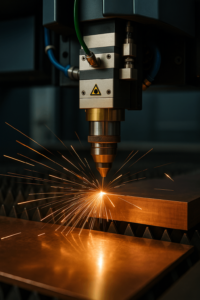
Laser Cutting for Copper
Copper’s high reflectivity makes older CO₂ systems unsuitable. At YISHANG, we use modern fiber lasers with optimized wavelengths to achieve clean cuts. We adjust:
- Assist gas: nitrogen for oxide‑free edges, oxygen for lower‑cost structural parts
- Power density and speed to prevent micro‑cracks
- Nozzle height to maintain kerf stability
For electrical components, oxidation control is essential. Nitrogen cutting ensures stable conductivity and clean surfaces for plating or brazing.
CNC Machining: Managing “Gummy” Chip Behavior
Copper tends to generate long, adhesive chips that damage tool edges. To maintain micro‑tolerances, we use:
- Polished carbide tools with low‑friction geometry
- High‑flow coolant to reduce heat and chip welding
- Optimized feed rates preventing tool chatter
- Deburring processes that protect electrical contact surfaces
This precision is critical for:
- RF shielding housings
- Thermal management plates
- High‑current connectors
- Ultra‑flat busbars
Bending & Forming: Preventing Surface Damage and Springback
Copper bends easily, but excessive pressure causes orange‑peel texture or surface marks. We ensure quality by:
- Selecting the correct temper (O or OS for deep bends)
- Using large punch radii to minimize stress
- Applying film protection to cosmetic surfaces
- Running simulations for complex geometries
Proper forming preserves functional performance and enhances product longevity.
6. YISHANG Quality Assurance: Verified, Tested, Certified
Copper components require stricter QA than steel or aluminum parts because electrical and thermal performance is highly sensitive to defects. At YISHANG, quality is integrated into every stage of production.
1. Material Verification & Traceability
Each incoming batch includes:
- Chemical composition analysis
- Grade confirmation (C11000, C10100, etc.)
- Conductivity validation (IACS testing when required)
- Thickness and flatness inspection
We maintain traceability from mill certificate to final shipment, ensuring consistent batch‑to‑batch performance.
2. In‑Process Inspection
Copper’s softness makes it prone to dents, bends, and deformation. Our inspection team monitors:
- Dimensional accuracy during forming
- Hole alignment and tolerances
- Edge quality after laser cutting
- Weld penetration depth
3. Advanced Dimensional Measurement
For precision copper parts, we use:
- CMM equipment
- Go/no‑go gauges
- Height and flatness sensors
Critical contact surfaces (e.g., busbars and terminals) undergo detailed flatness checks to prevent resistance increase.
4. Controlled Mass Production & Documentation
Once samples are approved, fabrication parameters are locked in controlled process sheets. Each batch follows the same routing, tools, and settings—reducing variability across thousands of units.
Our ISO 9001 system ensures documentation, repeatability, and transparent QC records that overseas buyers can rely on.
7. Logistics Strategy: Protecting Copper During Global Shipping
Copper is heavy, soft, and moisture‑sensitive. Without engineered packaging, it can develop dents, scratches, oxidation, or deformation during long‑distance transport.
Anti‑Corrosion Protection
We use:
- VCI (Volatile Corrosion Inhibitor) films
- Moisture‑barrier inner bags
- Desiccant packs calculated by volume and expected transit duration
This prevents oxidation during ocean freight, especially in humid routes.
Mechanical Protection
To prevent deformation, we apply:
- Foam or paper interleaving
- Hard corner protectors
- Reinforced cartons or plywood crates
- Anti‑static layers for electronic components
Shipment Optimization for Overseas Buyers
We assist buyers in selecting:
- FCL for high‑volume copper parts (reduces handling damage)
- LCL with reinforced palletization for mixed shipments
- Clear SKU labeling for warehouse efficiency
A well‑designed packaging system reduces claims, replacement costs, and delays—especially for cosmetic or high‑precision copper components.
8. 2025 Market Outlook: Strategic Procurement Insights
Global electrification and digital infrastructure are pushing copper demand to record levels. EV manufacturing, renewable energy projects, and AI‑driven data centers all require massive amounts of copper.
Key Market Trends for 2025
- Rising demand from EV platforms: EVs use up to 4× more copper than traditional vehicles.
- Grid upgrades and charging stations: High‑current busbars and connectors drive consumption.
- Energy storage systems: Copper plays a critical role in battery and inverter architecture.
- Data centers: AI and high‑density servers require advanced thermal and electrical copper components.
Buyer Strategies for Stability
To manage cost and ensure availability, overseas buyers should:
- Forecast beyond single shipments (quarterly or semi‑annual planning)
- Lock specifications early to prevent variation during mass production
- Maintain safety stock for critical electrical components
- Consider secondary or recycled copper where application allows
YISHANG assists with long‑term planning by offering stable production capacity, predictable lead times, and consistent quality—even when the copper market is volatile.
9. Why Partner with YISHANG for Copper Sheet Metal and Assemblies?
YISHANG has more than 26 years of experience manufacturing metal products for global OEM and ODM customers. Our expertise covers the full range of copper fabrication processes.
Full‑Process Fabrication Capabilities
We provide:
- Laser cutting, punching, bending
- Deep drawing and stamping
- CNC machining for precision copper parts
- TIG/MIG brazing and welding
- Surface treatments (plating, coating, passivation)
- Assembly and custom packaging
Industry Experience Across Sectors
Our copper components support industries such as:
- Automotive & EV
- Industrial electronics
- Telecom and data centers
- Medical equipment
- Vending and smart lockers
- Energy storage
Why Buyers Prefer YISHANG
- Export experience to 50+ countries
- ISO 9001–based quality system
- Stable production capacity and repeatability
- Engineering support for drawing review and DFM
- Ability to produce multi‑material assemblies (steel + copper)
We position ourselves as a technical manufacturing partner—not just a vendor—helping buyers reduce risk and achieve consistent product performance.
10. FAQ: Direct Answers Based on Real Search Queries
Q1: What type of metal is copper?
Copper is a non‑ferrous transition metal with an FCC crystal structure, high ductility, high conductivity, and strong corrosion resistance.
Q2: What is the boiling point for copper?
The boiling point for copper is 2,562°C (4,643°F).
Q3: What is the melting point of copper?
Copper melts at 1,084°C (1,984°F).
Q4: Is copper a base metal or noble metal?
Formally, copper is classified as a base metal, but it is significantly more corrosion‑resistant than typical base metals, leading some engineers to describe it as “relatively noble” in practical use.
Q5: Is copper ferrous or non‑ferrous?
Copper is non‑ferrous, meaning it does not contain iron and does not rust like steel.
Q6: What is copper used for?
Electrical systems, electronics, EV battery busbars, telecommunications, heat exchangers, industrial assemblies, and architectural applications.
Q7: Why is copper preferred over aluminum in busbars?
Because copper maintains higher conductivity, stability under load, and lower resistance over long‑term thermal cycling.
Q8: What copper grade should I choose for my project?
C11000 for general electrical use; C10100 for vacuum, hydrogen, or ultra‑high reliability environments.
If you are researching “copper is what type of metal” or preparing a new copperOEM project, the YISHANG engineering team can review your drawings, provide DFM suggestions, and support you from prototype to stable mass production.