Introduction: The Silent Cost—How Corrosion Quietly Erodes Your Bottom Line and Safety Margin
In the world of global manufacturing and procurement, success is measured by reliability, cost-efficiency, and the long-term performance of your products. Yet, a silent force is constantly at work, undermining these goals: corrosion.
This natural process is far more than a cosmetic nuisance. It is a hidden tax on profitability that can compromise structural integrity, trigger catastrophic failures, and erode your brand’s reputation. A landmark NACE International study estimated the global cost of corrosion at $2.5 trillion annually, or 3.4% of the world’s GDP.
For a wholesale buyer, these are not abstract numbers—they translate directly into the tangible risks of costly product recalls, significant warranty claims, and production downtime that can decimate profit margins.
However, within this challenge lies a profound opportunity. This blueprint provides a systematic framework for specifying and procuring failure-proof, corrosion-resistant sheet metal parts, turning a critical vulnerability into a powerful competitive advantage.
Chapter 1: Corrosion Diagnostics: Identifying the Four “Invisible Killers” of Sheet Metal
To effectively mitigate risk, one must first understand the threat. For procurement managers and engineers specifying metal components, this means being able to diagnose the primary forms of corrosion.
Corrosion is not a monolithic entity—it is an electrochemical process that manifests in distinct forms, each with its own mechanism and preferred point of attack.
1.1 Uniform Corrosion
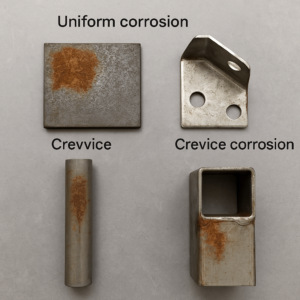
Also known as general corrosion, this is the most common and visually recognizable form of metal degradation. It is characterized by a relatively even and consistent loss of metal across the entire exposed surface.
While its predictability makes it less insidious than localized forms, if left unchecked, it will lead to a gradual thinning of the material, impacting the long-term durability of the product.
1.2 Galvanic Corrosion
This form of attack is a classic case of incompatible materials. Galvanic, or bimetallic, corrosion occurs when two electrochemically dissimilar metals are in direct electrical contact within a shared conductive electrolyte.
In this galvanic couple, the less noble metal becomes the anode and corrodes at an accelerated rate. This is a design-induced failure, commonly seen where steel fasteners are used on aluminum panels, and represents a significant reliability risk in multi-component assemblies.
1.3 Pitting Corrosion
Considered one of the most dangerous forms of corrosion from a product liability standpoint, pitting is a highly localized attack that results in small, deep holes or “pits” on the metal surface.
Its danger lies in its ability to perforate a sheet metal part and cause catastrophic structural failure with very little overall loss of metal, making it exceptionally difficult to detect during routine inspection. The presence of chloride ions is a primary catalyst for initiating this insidious attack.
1.4 Crevice Corrosion
This is a form of intense, localized corrosion that occurs within narrow, shielded gaps where a stagnant solution can exist. In sheet metal assemblies, this is commonly found in lap joints and under gaskets.
The trapped moisture creates an aggressive, acidic micro-environment that initiates rapid corrosion from within the joint, often hidden from view until significant damage has occurred.
Engineer’s Quick Diagnosis Matrix
| Corrosion TypeVisual SignsHigh-Risk Areas in AssembliesTrigger ConditionsPrimary Mitigation Strategy | ||||
|---|---|---|---|---|
| Uniform Corrosion | General dulling, etching, or consistent thinning of the material. | Large, openly exposed flat surfaces (e.g., body panels, enclosures). | Widespread exposure to a corrosive atmosphere or chemical. | Material Selection, Barrier Coatings (Paint, Powder Coat). |
| Galvanic Corrosion | Severe, localized corrosion on the less noble metal, right at the junction. | Fastener-to-panel joints, structural connections with mixed metals. | Electrical contact between dissimilar metals in an electrolyte. | Material Compatibility (Galvanic Series), Electrical Isolation. |
| Pitting Corrosion | Small, deep holes or pits, often covered by corrosion products. | Surfaces exposed to chloride ions (marine, de-icing salts). | Localized breakdown of a passive film, often catalyzed by chlorides. | Material Selection (e.g., Molybdenum-bearing alloys), Surface Finish. |
| Crevice Corrosion | Intense corrosion within a gap; often with rust stains weeping from the joint. | Lap joints, under washers and gaskets, threaded connections. | Stagnant moisture in a shielded area, leading to oxygen depletion. | Geometric Design (Eliminate Crevices), Sealing Joints. |
Chapter 2: The Core Anti-Corrosion Decision Matrix: The Trinity of Design, Material, and Protection
Effective corrosion prevention is not the result of a single choice but an integrated strategy. For a procurement professional, understanding this matrix is key to specifying components that deliver the lowest total cost of ownership, not just the lowest unit price.
The most resilient components are born from a holistic approach that balances three fundamental pillars: geometric design, material selection, and surface protection.
2.1 Pillar I: Design as Defense
The most elegant and cost-effective corrosion control method is to design out the conditions that allow it to begin. A design that inherently resists corrosion is less reliant on costly alloys or coatings and is fundamentally more reliable.
The core principle is to minimize the time a surface remains wet. This is achieved through critical design actions: optimize for drainage by avoiding horizontal surfaces where water can pool, and incorporate drain holes at the lowest points of any channel.
Equally important is the mission to eliminate crevices. Where structurally permissible, specifying continuous welds instead of intermittent or spot welds can completely remove the narrow gaps where crevice corrosion thrives.
2.2 Pillar II: Material as the Foundation
The choice of material establishes the inherent baseline of a component’s durability. This selection is a complex engineering trade-off involving corrosion performance, mechanical strength, weight, manufacturability, and cost.
The foundation of resistance for many high-performance alloys is a phenomenon known as passivation, where a thin, stable, and self-healing oxide layer forms on the surface, acting as a formidable barrier.
304 vs. 316 Stainless Steel
Among custom stainless steel sheet metal options, Grade 304 is a versatile industry workhorse, offering excellent resistance in many atmospheric environments.
However, its Achilles’ heel is its susceptibility to pitting in the presence of chlorides. This is where Grade 316, often called “marine grade” stainless steel, proves its superiority.
The key difference is the intentional addition of 2–3% molybdenum. This alloying element drastically enhances the stability of the passive film, providing significantly better resistance to chlorides and making it the essential choice for marine and chemical processing applications.
Aluminum Alloy Performance Tiers
Aluminum’s excellent corrosion resistance also comes from a tough, passive aluminum oxide film. However, its performance varies dramatically by alloy series.
For maximum inherent resistance, engineers turn to the 1xxx, 3xxx, and 5xxx series, which are workhorses for sheet metal parts for marine environments.
The 6xxx series (like the ubiquitous 6061) offers a balanced profile of good strength and corrosion resistance. In contrast, the high-strength 2xxx and 7xxx series, while indispensable for aerospace, have poor inherent corrosion resistance and almost always require a robust protective system like anodizing.
2.3 Pillar III: Protection as Armor
When inherent material resistance and design principles are insufficient, a protective coating system provides the final layer of defense.
True durability comes from a coating system mindset, where performance is dictated by the synergy of perfect surface preparation + the right primer + a high-performance topcoat. A vague specification can lead to inconsistent quality, so it’s vital to define the entire system.
Technology Comparison Table
| Protective System | Primary Protection Mechanism | Best Suited For | Key Advantages | Considerations |
|---|---|---|---|---|
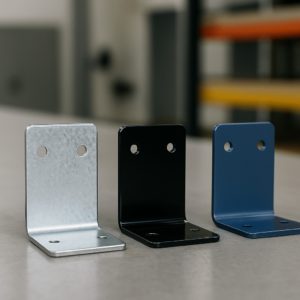
| Hot-Dip Galvanizing | Sacrificial & Barrier | Carbon Steel | Long-term performance, affordable, robust coverage for corrosion proof enclosure fabrication. | Can warp thin sheets; not ideal for tight tolerances. |
| Anodizing | Barrier | Aluminum | Excellent appearance and corrosion resistance; ideal for precision anti-corrosion manufacturing process. | Limited to certain alloys; brittle edges possible. |
| Powder Coating | Barrier | Steel, Aluminum | Attractive finish, strong adhesion, eco-friendly. | Surface prep critical to avoid failure. |
Chapter 3: Avoiding the Galvanic Trap: How to Design Against Dissimilar Metal Failures
Galvanic corrosion is not a material failure—it’s a design failure. The solution lies not only in choosing the right metals but also in smart assembly design. This chapter offers engineers and purchasers a practical, actionable guide to avoiding this easily preventable but common cause of field failures.
3.1 Consult the Galvanic Series—But Context Matters
The galvanic series ranks metals based on their nobility (tendency to resist oxidation) in a given electrolyte. While helpful, this list is electrolyte-specific—rankings in seawater don’t apply to indoor enclosures.
Tip: Always ask your supplier for a galvanic compatibility chart relevant to your operating environment.
3.2 Engineering the Joint: Isolation Is the Ultimate Weapon
Even if dissimilar metals are required, smart design can interrupt the galvanic path:
- Use non-conductive gaskets or isolator washers
- Employ plastic bushings
- Apply sealants or non-metallic barriers
- Use anodized or zinc-plated fasteners as sacrificial elements
These small changes can dramatically extend the service life of custom sheet metal assemblies.
Chapter 4: From Theory to Factory Floor: Manufacturing for Corrosion Resistance
Even the best design can fail if not manufactured properly. Partnering with an experienced ISO 9001 sheet metal supplier in China is essential.
4.1 Welding and Heat-Affected Zones (HAZ)
Welded areas are common failure points due to metallurgical changes or contamination.
- Use pickling/passivation after welding stainless steel
- Match filler metals to base material
- Prefer continuous welds for corrosion-critical zones
4.2 Surface Cleanliness and Pretreatment
Corrosion resistance starts before coatings are applied:
- Remove oil, dirt, and fingerprints
- Abrade or sandblast surfaces
- Rinse thoroughly before painting or anodizing
Poor pretreatment is the most common cause of premature coating failure in anti-corrosion manufacturing processes.

Chapter 5: Beyond the Basics – New Frontiers in Corrosion-Resistant Technologies
5.1 High-Entropy Alloys (HEAs)
HEAs combine multiple principal elements and have shown remarkable corrosion and temperature resistance—ideal for aerospace, chemical, and marine use. Though costly, they signal the next leap in corrosion-proof metal innovation.
5.2 Smart Coatings & Self-Healing Materials
Self-healing paints release inhibitors when scratched. They prolong coating life without reapplication, especially in coastal or industrial environments.
5.3 Green Chemistry
Due to environmental regulations, more companies are shifting to:
- Nano-ceramic conversion coatings
- Waterborne finishes
- Phosphate-free surface treatments
Chapter 6: Supplier Collaboration – DFM for Corrosion-Resistant Assemblies
Success depends on early Design for Manufacturability (DFM) collaboration.
6.1 Ask the Right Questions Early
- Will drainage work in assembled condition?
- Can this joint be welded and sealed reliably?
- Will tolerances shift after powder coating?
6.2 Coating Thickness vs. Fitment
Powder coatings can add 50–150μm thickness. Discuss hole size, clearance, and edge tolerances upfront with your supplier.
Our team at YISHANG, an ISO 9001-certified custom sheet metal supplier in China, collaborates closely with global OEM clients to apply these best practices in real-world assemblies.
Chapter 7: Corrosion Resistance in the Real World – 6 Must-Ask Questions in Your RFQ
Avoid costly surprises by addressing corrosion in your RFQ:
- What environmental class will this operate in (indoor, marine, industrial)?
- Are dissimilar metals involved in assembly?
- What surface prep steps will be performed?
- What coating system and film thickness will be applied?
- Will coatings pass a 500-hour ASTM B117 salt spray test?
- Can passivation, anodizing, or galvanizing be applied in-house?
Conclusion: Durable Designs Win the Long Game
Corrosion is silent but solvable. Custom stainless steel sheet metal parts can outperform expectations with the right combination of design, materials, protection, and manufacturing.
By proactively managing corrosion, you’ll reduce long-term costs, protect brand reputation, and increase product reliability.
Let’s discuss how we can build failure-proof components together.