
A Practical Guide for Bulk Sheet Metal Buyers
For overseas wholesale buyers, a punched sheet metal part is rarely just a drawing with holes, slots, and bends. It connects directly with pricing, tooling, sample approval, inspection, assembly, packing, and repeat orders.
A small design detail can change the entire purchasing experience. An unclear hole may delay a quotation. A slot placed too close to a bend may look fine in the sample but create problems in bulk production. A clearance hole that ignores powder coating thickness may become too tight during assembly.
That is where DFM for punch press operations becomes useful. It helps buyers and suppliers review the drawing before production starts, so both sides can correct potential risks while they still cost less to fix.
This guide shares five practical DFM tips for punch press operations in precision fabrication. It speaks to bulk buyers sourcing custom punched sheet metal parts and preparing RFQs for real production.
Why Punch Press DFM Should Be Reviewed Before RFQ
A Good Quote Starts with Clear Assumptions
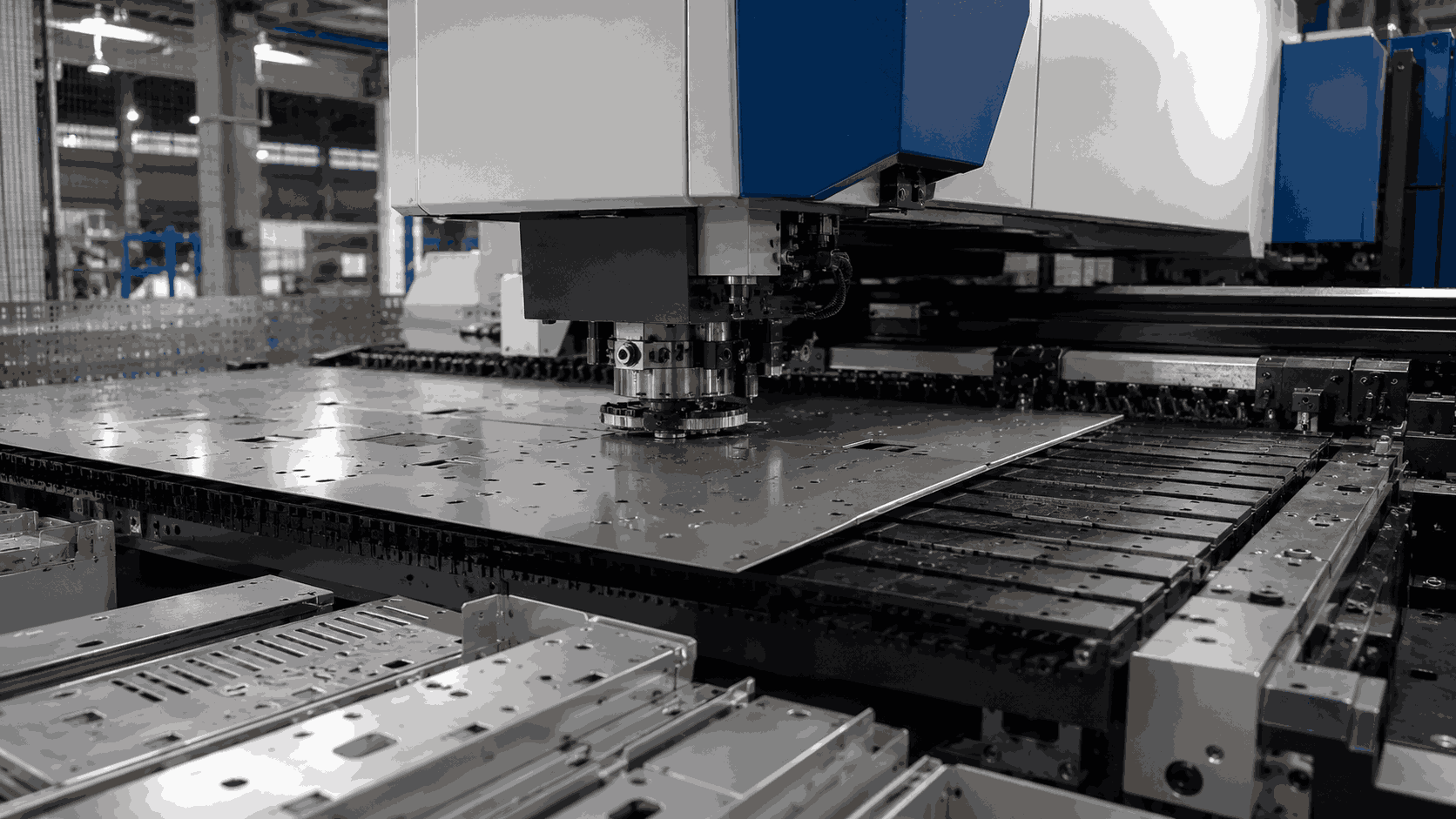
CNC punching works well for parts with repeated holes, slots, ventilation patterns, louvers, knockouts, and simple formed features. Once the supplier confirms tooling and setup, the process can support medium to high-volume sheet metal production with good speed and consistency.
However, a punch press does not follow CAD freedom alone. It relies on real punch tools, die clearance, machine tonnage, material thickness, bend areas, burr control, and the finishing steps that come after punching.
Buyers Need Comparable Quotations
This matters because a quotation only becomes useful when both sides understand the assumptions behind it. One supplier may quote based on standard punch tooling. Another may include custom tooling or secondary machining. A third may assume general tolerances where the buyer expects tighter inspection.
As a result, buyers may compare prices that do not represent the same production scope. A practical DFM review reduces this uncertainty. It tells the fabricator which features must stay fixed, which features can change, which dimensions affect assembly, and which surfaces or edges need special care.
| Buyer Concern | What DFM Helps Clarify | Procurement Value |
|---|---|---|
| Quotation accuracy | Tooling, process, and quantity assumptions | Fewer price changes after review |
| Sample approval | Critical holes, finishes, and tolerances | Fewer sample revisions |
| Bulk consistency | Feature spacing and material behavior | More stable repeat production |
| Assembly fit | Hardware holes, clearance holes, and burr side | Fewer installation problems |
| Inspection | Critical dimensions and acceptance criteria | Clearer quality control |
| Export delivery | Surface protection and packing needs | Lower risk of transit damage |
For a wholesale buyer, punch press DFM supports supplier evaluation, cost control, and order risk management. It also gives the supplier a clearer path from RFQ to sample and from sample to repeat production.
Tip 1: Check Tooling Fit Before Freezing the Geometry
CAD Freedom Is Not the Same as Tooling Reality
CAD gives designers freedom. A hole can take any diameter. A slot can take any width. A decorative opening can follow almost any shape.
A punch press works in a more practical way. It relies on physical tools, machine capacity, material behavior, and efficient setup. When a drawing fits that logic, CNC punching can become a cost-effective process. When it does not, the project may need custom tooling, laser cutting, or extra processing.
Standard Tooling Can Reduce RFQ Uncertainty
Standard punch tooling often works for round holes, rectangular slots, repeated ventilation patterns, louvers, countersinks, embosses, and simple forms. These features usually deliver good repeatability when the dimensions match available tools.
Problems appear when a non-critical feature requires a special tool. A narrow slot, unusual radius, sharp internal corner, or irregular decorative cutout may look harmless in CAD. However, it can increase tooling cost or extend the sample timeline.
Custom Tooling Can Still Make Sense
Custom tooling is not automatically a poor choice. For a large wholesale order, a dedicated punch tool may lower the unit cost and improve consistency over time. The key is to make that choice intentionally, based on order quantity and product function.
A metal ventilation panel gives a simple example. If the airflow slots match standard punch tooling, production may stay efficient and predictable. If the same panel uses free-form curved openings, laser cutting may work better unless the order volume justifies a special punch tool.
How Buyers Can Help the Supplier
Buyers can help the supplier by marking which features must remain fixed and which features allow adjustment. A slot used only for airflow may allow small changes. A cutout that must fit a branded component or mating part may need to stay exact.
| Design Situation | Helpful Buyer Question |
|---|---|
| Repeated holes or slots | Can standard punch tooling be used? |
| Irregular cutout | Would laser cutting be more practical? |
| High-volume order | Would custom tooling reduce long-term unit cost? |
| Adjustable feature | Can the supplier suggest a more manufacturable size? |
| Critical feature | Does the drawing explain why the shape must stay fixed? |
This kind of discussion makes quotations easier to compare. Buyers are no longer looking only at price. They also see what production method each supplier has assumed.
Tip 2: Review Material Thickness Together with Feature Spacing
Thickness Affects More Than Strength
Material thickness affects much more than part strength. In punch press fabrication, it influences punching force, minimum hole size, slot width, burr size, web strength, bend distortion, and tool wear.
A practical design starting point is that a punched hole usually works better when its diameter is not smaller than the material thickness. Very small holes in thick or hard metal can create tool stress and poor edge quality. Meanwhile, narrow slots need enough surrounding material to stay stable during punching and handling.
Feature Spacing Can Change the Final Part
Spacing should be reviewed together with thickness because holes, slots, and cutouts do not exist in isolation. Their distance from edges, bends, formed features, and other holes can affect whether the part stays flat and assembles correctly.
A slot may punch cleanly in a flat sheet. However, if it sits too close to the bend radius, the forming process may stretch the surrounding material and change the slot shape. The issue may not appear at the punching stage. Instead, it may show up later when the panel fails to align with a frame, cabinet, or mounting bracket.
Bend Relief Helps Control Forming Risk
A bend relief can help when a slot, cutout, or tab sits close to a formed area. It reduces tearing and stress concentration during bending. For buyers, this is not just a drafting detail. It can decide whether a sample issue becomes a repeat problem in bulk production.
Material behavior also matters. Stainless steel usually requires more punching force than mild steel. Aluminum may punch easily but can deform around delicate features. Galvanized steel may need more attention around punched edges to protect coating performance.
Small Corrections Become Large Costs in Bulk Orders
For bulk orders, small handling or forming issues can grow quickly. If a minor correction takes only 30 seconds per part, 1,000 pieces add more than 8 hours of extra work before the shipment even leaves the factory.
| Feature Relationship | Possible Risk | Practical Review Point |
|---|---|---|
| Small hole in thick sheet | Tool stress or rough edge | Compare hole size with material thickness |
| Slot near bend | Stretching or oval distortion | Move the slot or add bend relief |
| Dense perforation | Flatness loss | Review open area and web strength |
| Hardware hole near form | Installation access issue | Check tool and hardware access |
| Thin tab or narrow notch | Handling deformation | Increase width or adjust geometry |
A drawing should not only name the material grade. It should also show that the selected material thickness supports the punched features, formed areas, and expected batch quantity.
Tip 3: Make the Purpose of Every Hole Clear
Similar Holes Can Serve Different Jobs
A hole is not always just a hole. In punched sheet metal parts, different holes support different functions, and each function carries a different manufacturing risk.
Hardware holes hold PEM fasteners, rivet nuts, standoffs, hinges, latches, inserts, or other attached components. These holes depend on correct diameter, material thickness, edge condition, and installation access.
Clearance holes serve another purpose. They allow screws, bolts, shafts, pins, cables, or mating parts to pass through. Their main risk is interference, especially after powder coating, plating, or assembly tolerance stack-up.
Locating Holes Need Separate Attention
Locating holes control alignment. These holes may need tighter positional tolerance than general holes because they affect how the part fits into an assembly.
This distinction matters in real purchasing work because hardware and clearance holes may look similar in CAD. They fail differently in production. A hardware hole fails when the inserted component cannot seat or hold correctly. A clearance hole fails when another part cannot pass through or align smoothly.
Clear Hole Function Speeds Up RFQs
When a drawing does not explain hole function, the supplier has to ask more questions. That slows the RFQ. It may also lead to sample revisions if the supplier makes the wrong assumptions.
| Hole Type | Main Purpose | Buyer Risk If Unclear | What to Confirm |
|---|---|---|---|
| Hardware hole | Receives fasteners or inserts | Weak seating or loose hardware | Hardware model, hole size, access |
| Clearance hole | Allows another part to pass through | Interference after finishing | Clearance and coating allowance |
| Locating hole | Controls alignment | Assembly mismatch | Positional tolerance |
| Ventilation hole | Supports airflow or drainage | Distortion or weak webs | Open area and spacing |
| Cosmetic cutout | Supports appearance | Extra tooling or edge finishing | Whether the shape can change |
Downstream Processes Depend on Hole Purpose
Hole function also affects downstream production. A part that includes welding hardware, electromechanical assembly, powder coating, silk screening, or special packing needs clearer notes than a simple flat bracket.
For RFQ preparation, buyers can reduce back-and-forth communication by providing hardware specifications early. If the supplier will install the hardware, the drawing notes or quotation request should say so.
A production-ready drawing does not need excessive notes. It simply needs to make the important holes easy to understand.
Tip 4: Use Tolerances Where They Protect Function
Tight Tolerance Should Have a Reason
Tight tolerances can help when they protect function. In sheet metal punching tolerances, the important question is whether the dimension affects fit, safety, alignment, sealing, hardware installation, or final assembly.
Mounting hole patterns, locating holes, mating surfaces, and hardware installation points often deserve tighter control. Drainage holes, general ventilation patterns, non-critical slots, and cosmetic edges may not need the same level of precision.
Unclear Tolerances Make Quotations Hard to Compare
This difference affects quotation. If a drawing applies tight tolerances everywhere, the supplier may include more inspection time, slower setup, higher scrap allowance, or secondary machining. If another supplier assumes general tolerances, the two prices are not based on the same scope.
General standards such as ISO 2768 can help define baseline expectations for dimensions that are not individually specified. For assemblies that need tighter control, GD&T may define position, flatness, perpendicularity, or profile more clearly.
Tolerance Stack-Up Can Reduce Real Clearance
A punched mounting plate gives a simple example. The hole pattern may need accurate position control because it connects to a machine frame or metal cabinet. The outside edge may not need the same tight tolerance if it does not control fit.
Tolerance stack-up also deserves attention. A clearance hole may look large enough on its own. After coating thickness, fastener variation, mating part tolerance, and assembly movement are considered, the usable clearance may become smaller than expected.
| Dimension Type | Example | Better Tolerance Approach |
|---|---|---|
| Critical-to-function | Mounting holes, locating holes | Define clear positional tolerance |
| Assembly-related | Mating surfaces, hardware areas | Control where fit is affected |
| Finish-sensitive | Coated holes, visible surfaces | Add finish allowance or notes |
| Non-critical | Drainage holes, cosmetic edges | Avoid unnecessary tight control |
A capable supplier does not need every dimension to be loose. They need to know which dimensions matter most. That helps buyers protect performance without paying for precision that does not improve the product.
Tip 5: Look Beyond Punching to Finishing, Assembly, and Shipment
Later Processes Can Change Punched Features
A punched part is not complete when it leaves the punch press. It may still go through deburring, forming, welding, robotic welding, hardware installation, CNC machining, powder coating, silk screening, electromechanical assembly, inspection, packaging, and international shipping.
These steps matter because they can change how a punched feature performs. A hole that works before coating may become tight after finishing. A burr that is acceptable on one side may cause problems if it faces a cable path, gasket surface, sliding component, or user-contact edge.
Burr Direction and Finish Allowance Matter
Burr direction should be specified when it affects safety, appearance, sealing, wiring, or assembly. The drawing does not need excessive notes, but it should identify critical sides or surfaces.
Finish buildup is another common issue in bulk orders. Powder coating and plating add thickness. If buyers and suppliers do not review hardware and clearance holes with coating in mind, the part may require rework after finishing.
Orientation and Packaging Also Affect Quality
Part orientation also matters. A fully symmetrical part can be efficient. A nearly symmetrical part can be risky because workers may install it backward or upside down. Small details such as orientation notches, asymmetric hole spacing, locating tabs, and inside or outside surface notes can prevent assembly errors.
Packaging connects back to punch press DFM when the part includes louvers, thin tabs, protruding forms, sharp corners, brushed surfaces, or silk-screened graphics. For export orders, a part that passes factory inspection but arrives scratched or bent still becomes a quality complaint.
| Post-Punching Factor | Why It Matters to Buyers | Drawing or RFQ Note |
|---|---|---|
| Burr direction | Affects cables, gaskets, hands, and appearance | Identify critical side |
| Powder coating | May reduce clearance | Add finish allowance |
| Hardware installation | Depends on hole size and access | Provide hardware details |
| Part orientation | Prevents wrong assembly | Add notch or asymmetric feature |
| Export packaging | Protects formed or cosmetic areas | Mark sensitive surfaces |
This is not a broad list of fabrication capabilities. Each item affects how a punched part performs after it leaves the press. For buyers, that connection can prevent hidden costs.
Example: Turning a Risky Drawing into a Production-Ready RFQ
The Original Drawing Looks Complete
Consider a punched metal control panel for a bulk order. The drawing includes similar-looking holes, ventilation slots close to a bend, tight tolerances across most dimensions, powder coating after forming, and no burr-side note.
At a quick glance, the drawing may look complete. During DFM review, several questions appear. Which holes receive hardware? Which holes are only for clearance? Will coating reduce the clearance? Are the slots too close to the bend radius? Can workers install the part in the wrong direction? Which surface is cosmetic?
The Improved Drawing Becomes Clearer
The improved drawing is not necessarily longer. It is clearer. Hardware holes are separated from clearance holes. Coated holes receive allowance. Slots near the bend are moved or adjusted. Tight tolerances stay on mounting and locating holes, while non-critical features use practical tolerances.
A small orientation notch helps prevent wrong assembly. Burr direction is specified only where the edge may contact cables, hands, gaskets, or visible surfaces. Packaging notes are added for silk-screened or formed areas that may suffer damage during export shipping.
This kind of review helps both buyer and supplier. The quotation becomes more accurate, the sample is more likely to represent the bulk order, and inspection focuses on the features that affect performance.
For custom punched sheet metal parts, that is the value of DFM. It turns a drawing from CAD-complete into production-ready.
A Quick RFQ Check for Your Next Project
The RFQ Should Give the Supplier Enough Context
Before sending a drawing for quotation, buyers can check whether the supplier has enough information to evaluate the part correctly. This does not replace engineering review, but it can reduce unnecessary back-and-forth communication.
| RFQ Item | Why It Helps the Supplier Quote Accurately |
|---|---|
| Material grade and material thickness | Supports tooling, punching force, and forming review |
| Expected order quantity | Helps decide standard tooling or custom tooling |
| Surface finish | Allows coating, plating, or silk screening allowance |
| Hardware requirements | Clarifies installation and inspection needs |
| Critical dimensions | Prevents over-tolerancing and unclear inspection |
| Assembly use | Helps review clearance, fit, and orientation |
| Packaging expectations | Reduces damage risk during export shipping |
A complete RFQ does not need to be complicated. It needs to be clear. When the drawing, quantity, finish, hardware, tolerance, and packaging expectations are aligned, quotation becomes faster and production risk becomes lower.
YISHANG can review drawings for custom punched sheet metal parts before production. Share your material thickness, finish, hardware details, quantity, and inspection expectations to request a quote for your next project.
Closing Thoughts
These DFM tips for punch press operations work best when they support real purchasing decisions. For wholesale buyers, the value is not only a competitive unit price. It is clearer quoting, fewer sample revisions, more stable bulk production, and fewer assembly or delivery problems.
Good punch press DFM connects tooling, material thickness, hole function, feature spacing, tolerances, finishing, assembly, and packaging into one production-ready drawing. That connection helps buyers move from RFQ to sample approval, and from sample approval to repeat production with fewer surprises.