For OEM and wholesale buyers, an enclosure is not just a protective shell. It affects product reliability, assembly efficiency, shipping cost, field durability, and long-term customer satisfaction.
In practical sourcing, enclosure selection is often a balance between material choice, protection rating, standard availability, customization need, and total cost of ownership.
This guide explains how buyers can evaluate enclosure options more clearly, including metal vs plastic, NEMA vs IP ratings, and standard vs custom fabrication for different product and market requirements.
Why Enclosure Selection Is a Procurement Decision
Before comparing materials or ratings, buyers should first recognize that enclosure selection is not only a design issue. It is also a procurement decision that affects reliability, field performance, service cost, and customer confidence.
An under-specified enclosure may create downstream problems such as early field failure in outdoor or harsh environments, shielding issues in sensitive electronic equipment, higher maintenance or replacement cost, and product reputation damage caused by repeated enclosure-related failures.
For OEM and wholesale projects, the enclosure should be treated as an active part of product performance rather than only an outer shell. This is why enclosure sourcing should be reviewed through total cost of ownership, not only initial unit price.
Metal vs Plastic Enclosures: How to Choose
One of the first enclosure sourcing decisions is whether the project should use a metal enclosure or a plastic enclosure. The correct choice depends on environment, function, shielding need, appearance, weight, and cost target.
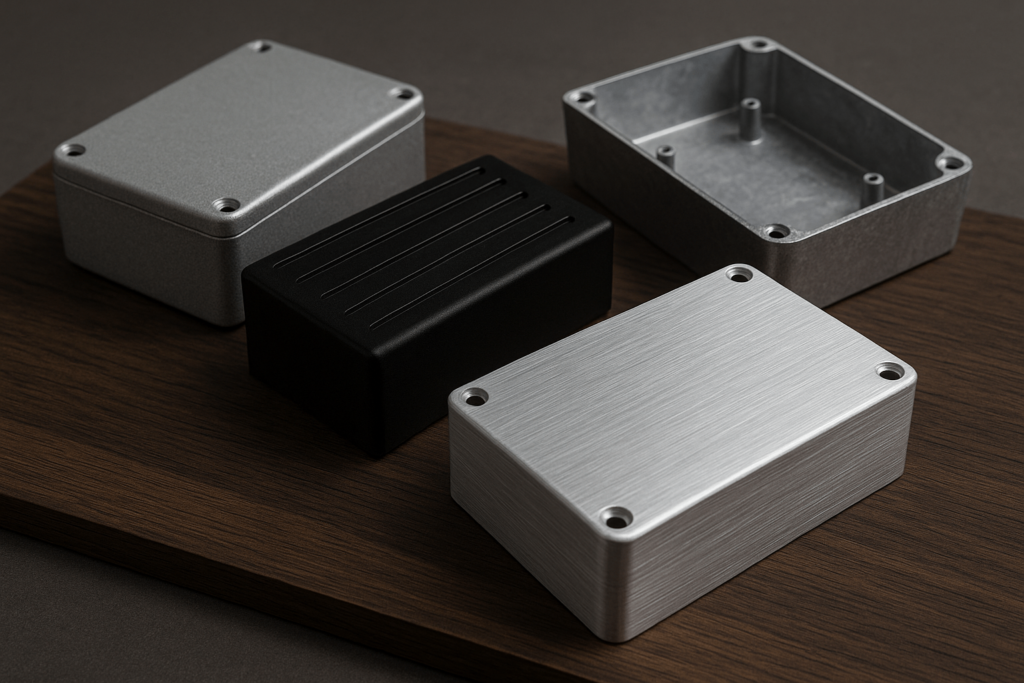
When Metal Enclosures Make More Sense
Metal enclosures are often preferred when the project needs:
- stronger impact resistance;
- better heat dissipation;
- EMI/RFI shielding;
- higher structural rigidity;
- heavier-duty industrial performance.
When Plastic Enclosures Make More Sense
Plastic enclosures are often preferred when the project needs:
- lighter weight;
- RF transparency for wireless products;
- lower cost in suitable environments;
- easier styling for indoor or light-duty applications.
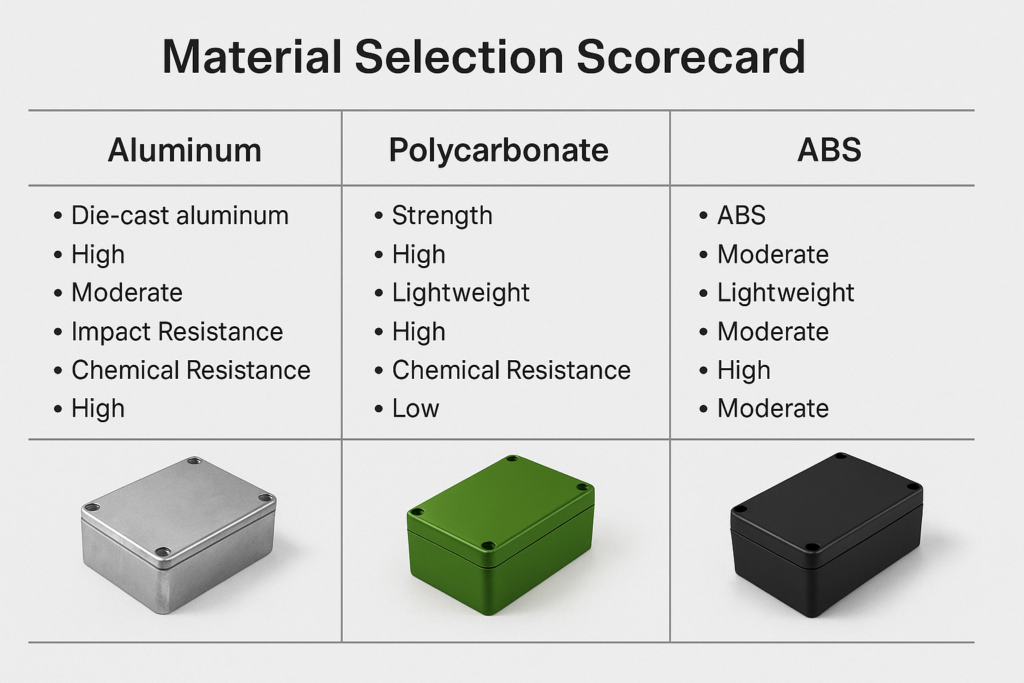
Polycarbonate vs ABS
- polycarbonate is often reviewed for outdoor or more demanding plastic enclosure use because of its stronger impact and UV performance;
- ABS is often more suitable for indoor, cost-sensitive, or general-purpose commercial applications.
Material Comparison Reference
| Performance Criterion | Metal Enclosure | Polycarbonate | ABS |
| EMI/RFI Shielding | Strong | None | None |
| Heat Dissipation | Better | Limited | Limited |
| Impact Resistance | Strong | Good | Moderate |
| UV Performance | Depends on finish/material | Good | Lower |
| RF Transparency | No | Yes | Yes |
| Relative Cost | Higher | Medium | Lower |
NEMA vs IP Ratings: What Buyers Should Compare
After choosing the material, buyers usually need to confirm the required protection level. In enclosure sourcing, NEMA and IP ratings are both important, but they are not identical systems.
How IP Ratings Are Used
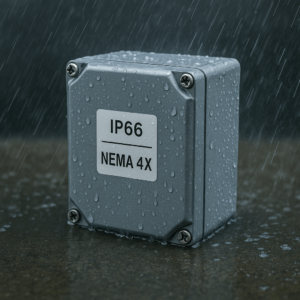
IP ratings are commonly used to describe protection against solid ingress and water ingress. For many international projects, IP ratings help buyers compare enclosure suitability across standard environmental conditions.
How NEMA Ratings Differ
NEMA ratings are often used more heavily in North American markets and may include requirements not directly covered by the IP system, such as broader environmental durability or corrosion-related considerations in some cases.
A Practical Sourcing Reminder
Buyers should not assume that an IP rating and a NEMA rating are always directly interchangeable. The required market, environment, and compliance context should be reviewed before finalizing the enclosure specification.
Why Modifications Matter
Any cutout, gland opening, switch opening, or custom modification can affect the original protection level of an enclosure if it is not handled correctly. This is one reason why modification capability and process control matter when sourcing pre-rated enclosures.
Standard Enclosures vs Custom Fabrication
After material and rating decisions, buyers often face another important choice: use a standard off-the-shelf enclosure or move to a custom enclosure solution.
When Standard Enclosures Make Sense
Standard enclosures are often a good choice for:
- rapid prototyping;
- low-volume projects;
- simple internal layouts;
- situations where fast availability matters more than optimization.
Where Standard Enclosures Reach Their Limits
Standard enclosure limitations often appear in:
- oversized box selection;
- inefficient use of internal space;
- added adapters or brackets for assembly;
- higher shipping volume than necessary;
- appearance or branding limitations.
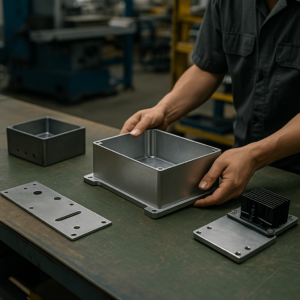
When Custom Fabrication Becomes the Better Choice
Custom enclosure fabrication becomes more attractive when the project needs:
- exact dimensional fit;
- integrated mounting features;
- better assembly efficiency;
- better control of external appearance;
- improved logistics efficiency in repeat production.
What Buyers Should Confirm Before RFQ
Before requesting a quote for an enclosure project, buyers should try to clarify:
- target environment and exposure risk;
- whether metal or plastic is more suitable;
- whether NEMA, IP, or both rating systems matter;
- whether the project is prototype, pilot run, or volume production;
- whether standard enclosure size creates assembly or shipping inefficiency;
- whether custom fabrication would improve fit, branding, or total cost of ownership.
A clearer RFQ usually leads to more accurate pricing, more realistic process recommendations, and fewer downstream changes.
FAQ
Which is better, a metal or plastic enclosure?
It depends on the application. Metal may be better for shielding, heat dissipation, and heavy-duty use, while plastic may be better for lighter weight, RF transparency, and lower-cost indoor applications.
Are NEMA and IP ratings the same?
No. They are related but not identical. Buyers should confirm which system is required by the target market and the actual application environment.
When should buyers move from a standard enclosure to a custom one?
Usually when standard sizing creates assembly inefficiency, oversized shipping volume, internal mounting compromises, or product appearance limitations in repeat production.
Can a modified enclosure still keep its original protection rating?
Only if the modification process is managed correctly and all relevant sealing and component details are controlled appropriately.
Custom Enclosure Support from YISHANG
YISHANG Metal Products Co., Ltd. is a metal products factory with more than 26 years of experience in custom metal manufacturing for wholesale and OEM/ODM projects.
We support custom enclosure fabrication for applications such as industrial control housings, vending machine enclosures, display systems, equipment cabinets, and other OEM metal enclosure projects.
Our manufacturing capabilities include sheet metal laser cutting, bending, deep drawing, stamping, welding, CNC machining, surface finishing, assembly, packaging, quality inspection, and shipment support.
We are certified to ISO 9001 and RoHS. For custom enclosure sourcing projects, we can support drawing review, material evaluation, sample development, and repeat bulk production.