Introduction: Welding Built for Industrial Demands
In the world of industrial metal product manufacturing, the ability to balance speed, strength, and adaptability in welding processes directly impacts cost, delivery time, and quality. Flux-Cored Arc Welding (FCAW) is one such process that offers advantages precisely aligned with the needs of global procurement managers.
At YISHANG, where our core clients are professional B2B buyers sourcing high-volume metal enclosures and custom fabricated metal parts, the importance of a reliable, versatile, and efficient welding process cannot be overstated. This article explores the FCAW process in-depth, including its advantages, variants, ideal use cases, and relevance to industries such as energy, automotive, and heavy equipment.
What is Flux-Cored Arc Welding (FCAW)?
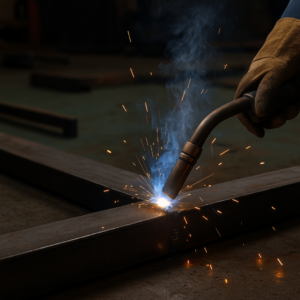
FCAW is a semi-automatic or automatic arc welding process that uses a tubular wire electrode filled with flux. This flux, which forms a protective shield around the weld pool, plays a critical role in shielding against atmospheric contamination and stabilizing the arc. Depending on whether an external shielding gas is used, FCAW is classified into two main categories: self-shielded (FCAW-S) and gas-shielded (FCAW-G).
Compared to processes like MIG or TIG, FCAW offers greater deposition rates and better penetration, especially in thicker materials — a key concern for heavy-duty metal fabrications such as carbon steel enclosures, structural brackets, and load-bearing frames.
Types of Flux-Cored Arc Welding and Their Industrial Relevance
Self-Shielded FCAW (FCAW-S)
This variant does not require external shielding gas, making it ideal for outdoor applications or field welding where wind could disperse protective gases. It’s widely used in structural steel fabrication, especially for remote job sites and construction projects where mobility is essential.
For B2B buyers sourcing components for telecom towers, traffic control enclosures, or pole-mount cabinets, FCAW-S ensures structural reliability without demanding an inert gas infrastructure.
Gas-Shielded FCAW (FCAW-G)
Using external shielding gas (typically CO₂ or a gas mix), FCAW-G offers smoother arc characteristics and less spatter. It is especially suitable for automated or semi-automated production lines where high deposition rates and clean weld profiles are essential — such as in automotive parts or large-scale HVAC cabinet manufacturing.
For purchasers managing product lines in high-throughput environments, this method supports consistent quality with reduced post-weld cleanup.
Key Technical Advantages for Metal Product Buyers
High Deposition Rates
FCAW can achieve deposition rates of up to 25 pounds per hour, significantly reducing production time — a vital metric for procurement managers balancing cost-per-unit with lead times.
Performance Across All Positions
The ability to weld in flat, horizontal, vertical, and overhead positions adds flexibility in design and fixture planning. This reduces the need for positioners and specialized jigs in the assembly phase.
Deep Penetration and Strong Welds
FCAW excels in welding thicker metals such as 3mm+ carbon steel, stainless steel, and galvanized materials. This makes it ideal for enclosures subjected to structural loads or harsh environmental conditions.
Material Compatibility: What Buyers Need to Know
Carbon Steel and Galvanized Steel
Carbon steel remains the most commonly welded material in enclosure production. FCAW is particularly effective on contaminated or rusted base materials, reducing the need for extensive pre-cleaning.
Galvanized steels, commonly used in outdoor-rated enclosures (e.g., NEMA 4X, NEMA 3R), are prone to porosity with some welding methods — but FCAW, when properly tuned, offers improved tolerance.
Stainless Steel
While less commonly used due to material cost, stainless steel enclosures (for pharmaceutical, food-grade, or marine environments) benefit from FCAW-G using specialized flux-core wires. It ensures welds retain corrosion resistance and structural performance.
Applications Across High-Demand Sectors
Electrical Enclosure Fabrication
From single-door to double-door, wall-mounted to pad-mounted, FCAW supports enclosure manufacturing for sectors like energy, telecom, and industrial automation. Its penetration depth and joint reliability support IP-rated assemblies.
Heavy Machinery and Automotive Components
FCAW is widely used in the fabrication of suspension mounts, frame structures, and bracket systems. For buyers in these sectors, weld integrity under vibration and dynamic load is a top priority — something FCAW delivers consistently.
Shipbuilding and Construction
With its portability (FCAW-S) and weather resistance, this process is essential for constructing on-site frames, supports, and equipment housing in oil & gas, maritime, and infrastructure projects.
Operational Considerations for Procurement Teams
Equipment and Setup Efficiency
FCAW-compatible machines are robust and widely available. Whether in-house or outsourced, this process allows suppliers to scale output without complex machinery or heavy inert gas dependency.
Cost-Efficiency and Cycle Time
Thanks to higher weld speeds and reduced cleanup requirements, FCAW improves throughput. For wholesale procurement contracts, this translates into predictable timelines and leaner per-unit welding costs.
Potential Limitations and Quality Control
Spatter and Slag Removal
Though reduced in gas-shielded FCAW, slag formation is part of the process. Manufacturers must maintain consistent post-weld cleaning and finishing — critical in precision parts like HMI enclosures or control cabinets.
Porosity and Undercuts
These defects can arise from incorrect voltage, wire feed speed, or improper travel angle. At YISHANG, our certified welding inspectors (CWI) apply strict inspection protocols, ensuring conformity to ISO9001 and IP66/IP67 structural sealing.
Why FCAW Supports Supply Chain Resilience
In global sourcing scenarios where lead time, repeatability, and environmental reliability are essential, FCAW strengthens supply chain resilience. For procurement teams sourcing from China or other offshore partners, understanding the manufacturer’s welding capabilities (especially FCAW proficiency) can preempt performance or durability issues downstream.
FCAW also allows for hybridization with other processes — combining root passes from GTAW with fill passes from FCAW can optimize both cost and quality.
Choosing the Right Supplier: What to Ask
When vetting a metal product manufacturer, consider:
- Can they handle FCAW across different materials and thicknesses?
- Do they provide weld quality certification (e.g., AWS D1.1, ISO 3834)?
- How is post-weld finishing handled — grinding, sanding, or powder coating?
- Is robotic or semi-automated FCAW available for high-volume parts?
YISHANG provides full-process traceability, from enclosure design and wire selection to welding, surface treatment, and packaging. Our capacity includes both batch prototyping and high-volume production.
Conclusion: Making Informed Decisions with FCAW
Flux-Cored Arc Welding offers a strategic combination of strength, versatility, and efficiency — making it one of the most procurement-aligned welding technologies in today’s competitive metal fabrication market.
For bulk buyers sourcing metal enclosures, control cabinets, or structural components, FCAW isn’t just a production method — it’s an assurance of reliability and speed.