Introduction: The Critical Component Defining Product Quality and Customer Satisfaction
For procurement managers and product developers in the grilling industry, evaluating a product line often centers on visible features like burner output or aesthetic design. However, the long-term performance of a grill and the ultimate satisfaction of the end-consumer are disproportionately dictated by a single, often underestimated, component: the cooking grate. This is more than a simple holding surface—it functions as a dynamic thermal engine.
Its material composition, mass, and engineering design are the primary determinants of heat transfer efficiency, flavor development, and, most critically for business, product longevity and brand reputation.
This document is a detailed technical analysis designed for industry professionals. It deconstructs the grill grate from a metallurgical and engineering perspective, moving beyond material lists to explore the science of thermal dynamics, common failure points, and the structural design features that separate a premium, durable product from one destined for early replacement.
This guide provides foundational insights to make strategic sourcing decisions that enhance brand value and performance consistency—whether you’re an OEM grill manufacturer , custom parts supplier, or bulk purchasing agent.
Section 1: The Foundational Science — Defining Performance Metrics for Sourcing
A comprehensive understanding of a grill grate’s function begins with the physics of heat and a clear definition of genuine cooking performance. Misconceptions in the consumer market often obscure the true quality benchmarks that should guide procurement decisions.
The Maillard Reaction vs. Carbonization: A Critical Distinction in Flavor Science
A common marketing trope is the aesthetic appeal of dark “grill marks.” From a food science perspective, however, these marks typically indicate carbonization—localized surface burning that imparts a bitter, acrid flavor.
In contrast, the Maillard reaction—a chemical interaction between amino acids and reducing sugars—creates a uniform, deep-brown crust and unlocks hundreds of flavor compounds. A grate’s ability to support this reaction is a key measure of its engineering quality.
Thus, the sourcing objective is not merely to brand food with lines but to ensure high, even surface heat across the entire cooking area.
The Physics of Performance: Two Pillars of Thermal Engineering
A grate’s effectiveness is governed by two core thermodynamic principles that stem directly from its material properties:
- Thermal Mass (The Power of Heat Retention): A material’s capacity to store thermal energy. Heavy-gauge cast iron acts like a thermal battery, absorbing significant heat and releasing it evenly, sustaining optimal searing temperatures when cold food is placed.
- Thermal Conductivity (The Finesse of Heat Distribution): The speed at which heat travels through a material. High conductivity—aluminum’s specialty—helps distribute heat uniformly across the grate surface, eliminating hot spots and improving consistency.
Section 2: A Metallurgical Analysis of Grate Materials for Commercial Application
Choosing the right grate material is the most influential factor in determining a grill’s performance, durability, and maintenance profile. Each option comes with engineering trade-offs that affect cost, lifespan, and end-user satisfaction.
Problem 1: Achieving Steakhouse-Grade Searing Performance
- The Solution: Raw Cast Iron.
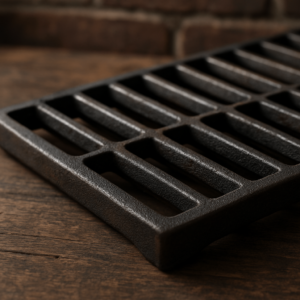
Raw cast iron is the benchmark for searing due to its dense molecular structure and exceptional thermal mass. This delivers powerful, sustained surface temperatures ideal for full Maillard reaction development.
Its ability to be seasoned—a process that creates a chemically bonded, non-stick oil layer—enhances both performance and longevity. Unlike synthetic coatings, this patina is integrated with the metal itself. However, without routine maintenance, cast iron is highly prone to oxidation and is best suited for experienced or instructed users looking for heavy-duty BBQ grill grates.
Problem 2: Ensuring Maximum Durability with Minimal User Maintenance
- The Solution: Heavy-Duty Stainless Steel.
For long-life and low-maintenance, 304-grade stainless steel is the preferred industry standard. Its nickel-chromium composition forms a passive, corrosion-resistant oxide layer.
In contrast, 430-grade stainless, with lower nickel content, is prone to rust and should not be used in premium-grade grill products. Furthermore, heavy-gauge (≥8mm) rod construction improves heat retention, narrowing the performance gap with cast iron without the maintenance burden.
Wire grates (3–5mm) lack sufficient mass for heat storage and are unsuitable for high-performance cooking. Specifying solid, thick 304-grade rods ensures both durability and end-user satisfaction, helping suppliers position their products as top-tier commercial BBQ replacement grates.
Problem 3: Mitigating Common Grill Design Flaws (Hot Spots & Flare-Ups)
- The Solution: Hard-Anodized Aluminum.
Aluminum excels in thermal conductivity, distributing heat quickly and evenly—ideal for grills with inconsistent burner layouts. Hard-anodized variants are reinforced with a bonded oxide layer, rendering the surface highly durable, non-reactive, and rust-proof.
When paired with a solid grease barrier design, these systems eliminate flare-ups, ensuring consistent performance. This makes them highly attractive in the aftermarket or upgrade segment, where solving user pain points adds competitive value for those sourcing laser-cut metal grill parts.
Problem 4: Avoiding Premature Product Failure and Customer Complaints
- The Truth About Porcelain-Enameled Grates.
Porcelain-enamel grates provide initial non-stick performance but introduce serious durability risks. The brittle enamel coating is prone to cracking under thermal stress or tool impact. Once chipped, moisture penetrates the core metal, accelerating rust beneath the coating.
This results in progressive flaking and material breakdown. Because repairs are impossible, porcelain-coated grates often lead to early replacement, warranty claims, and dissatisfied B2B clients. Procurement teams should carefully assess the intended market before approving this material.
| Feature | Raw Cast Iron | 304 Stainless Steel (Heavy Rod) | Hard-Anodized Aluminum | Porcelain-Enameled Cast Iron |
|---|---|---|---|---|
| Primary Alloy | Iron, >2% Carbon | Iron, Chromium, Nickel | Aluminum | Iron, >2% Carbon (Core) |
| Key Metric | High Thermal Mass | High Corrosion Resistance | High Thermal Conductivity | Non-Stick (Initial) |
| Performance | Excellent Searing | Good Searing, Reliable | Excellent Searing, Even Heat | Excellent Searing (when intact) |
| Durability | Very High (with maintenance) | Very High | Very High | Low to Medium |
| Common Failure Mode | Surface Rust (if neglected) | Pitting (in extreme conditions) | N/A (does not rust) | Chipping, Flaking, Rust Creep |
| End-User Maintenance | High (Requires Seasoning) | Low | Low | Medium (Requires Gentle Handling) |
| B2B Value Proposition | Ultimate Performance | Durability & Reliability | Problem-Solving & Innovation | Initial Convenience |
Section 3: Advanced Design Engineering for Superior Performance
The physical design of a grate significantly impacts its thermal behavior and the resulting flavor profile. Smart engineering choices can directly translate into competitive advantage.
Flavor vs. Control: The V-Groove vs. Round Rod Showdown
- Round Rods (The Flavor Chaser): These grates allow food drippings to vaporize on direct flame, enhancing smoky flavors. However, they’re prone to flare-ups, which may cause inconsistent cooking and burnt spots.
- V-Groove Grates (The Precision Cook): Featuring angled channels that divert grease away from flame, these grates virtually eliminate flare-ups. Though they may slightly reduce smoke flavor, they offer precision and safety—ideal for high-fat cooking in commercial or OEM applications.
The Reversible Grate Advantage: Two Surfaces, Twice the Versatility
Dual-sided grates offer two performance surfaces in one component. A peaked side maximizes sear marks for presentation, while a flatter surface promotes even browning for delicate foods. This feature adds value, especially for OEM grill parts suppliers targeting export or customization markets seeking wholesale BBQ grill accessories.
Section 4: Product Lifecycle and Sourcing Strategy
Understanding material lifecycles and maintenance needs is essential for wholesale procurement. Properly positioned, these insights strengthen product portfolios and after-sales strategies.
The Strategic Advantage: Aftermarket vs. OEM
OEM parts often replicate the original components without performance gains. Aftermarket grates—especially those made with upgraded 304 stainless or denser cast iron—offer both durability and user satisfaction improvements.
Wholesale customers searching for custom grill grate supplier or bulk stainless steel BBQ grates are increasingly turning to aftermarket partners that provide real-world performance upgrades rather than simple replacements.
End-User Maintenance: Impact on Product Longevity
Providing clear post-purchase guidance extends product life and builds trust:
- Cast Iron: Requires routine cleaning, drying, and oiling.
- Stainless Steel: Simply brush clean while hot.
- Porcelain-Enameled: Handle gently and avoid abrasive tools.
Identifying Material Failure: When to Replace
Encouraging timely replacement protects safety and brand image. Signs of failure include:
- Structural Rust
- Chipped Porcelain Coating
- Cracks or Warping
- Carbon Buildup
- Uneven Cooking
Conclusion: A Strategic Decision in Material Engineering and Brand Reputation
Grill grate selection is a key sourcing decision with long-term impact on product quality and brand integrity. Choosing materials like 304 stainless, heavy cast iron, or anodized aluminum positions your products as durable, high-performance, and worthy of professional or export use.
YISHANG, a seasoned metal fabrication manufacturer with over 26 years of OEM/ODM experience, supports custom grill accessory solutions tailored for bulk orders and international distributors.
For technical specifications or to request a quote for wholesale grill grates or custom OEM parts, contact YISHANG — your trusted grill grate manufacturing partner.