Introduction
For industrial buyers, the answer to how long it takes to powder coat rims is rarely the same as what consumer-facing search results suggest. A retail shop may promise one-day turnaround for a small local job, but export-grade powder coating for wholesale or repeat production usually follows a very different timeline.
In a controlled B2B workflow, powder coating rims typically takes 3–5 business days from receiving the wheels to final packing. The actual spray-and-cure stage is only part of the process. What drives the real timeline is everything around it: chemical stripping, rinsing, blasting, outgassing, coating application, part-metal-temperature control, cooling, inspection, batching, and packaging.
For distributors, importers, and OEM buyers, this is not just an operational detail. Lead time affects:
inventory planning
container scheduling
batch consistency
warranty risk
delivery reliability to downstream customers
This guide explains the full timeline from a B2B procurement perspective, so buyers can judge whether a quoted turnaround reflects a real industrial process or an unrealistic shortcut.
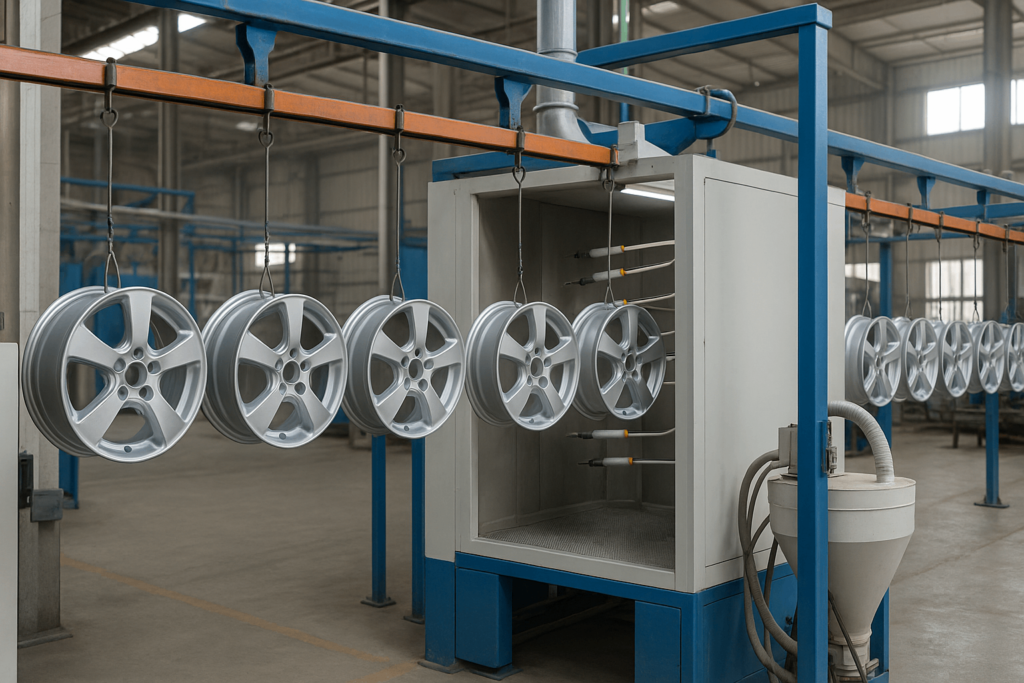
Lead Time Is Also a Quality Indicator
In B2B sourcing, lead time should not be viewed only as a scheduling issue. It is often a direct signal of how disciplined a supplier’s process really is.
A shop that promises extremely fast turnaround may still produce an acceptable-looking finish in the short term. But for wholesale buyers, the bigger question is whether that coating will remain stable after:
long-distance shipping
warehouse storage
seasonal climate changes
regular handling and field use
When a coating fails, the cost is rarely limited to rework. Buyers may also face returns, replacement claims, customer dissatisfaction, and avoidable damage to brand credibility.
That is why many industrial buyers treat 3–5 business days as a healthy sign of a controlled coating workflow rather than a delay. A reliable supplier should be able to explain the full sequence clearly, from stripping through to final packing.
Days 1–2: Surface Preparation Sets the Real Quality Baseline
The first one to two days are where long-term coating performance is largely determined. If preparation is rushed, even a good-looking final finish may fail early.
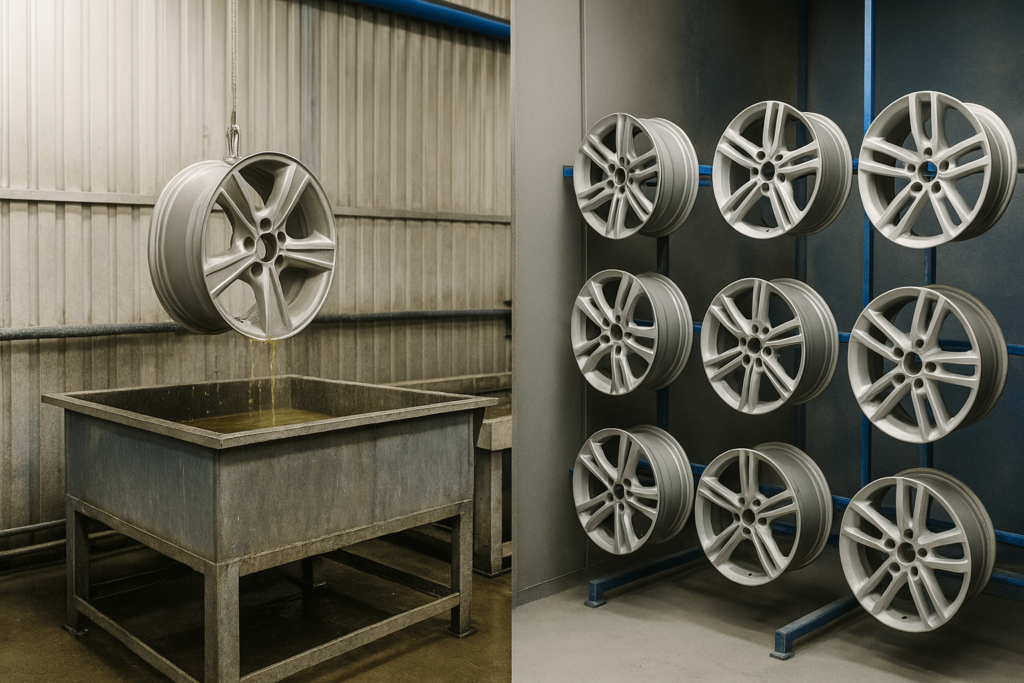
1. Full Chemical Stripping
Factory-applied coatings are built to resist wear and corrosion, so removing them properly takes time. Industrial stripping usually relies on heated alkaline baths or specialized chemical systems that dissolve existing multilayer finishes thoroughly.
Typical stripping time is often 8–12 hours, depending on the previous coating system and the condition of the rim.
For buyers, the risk of incomplete stripping is straightforward: residual coating left in recessed areas weakens adhesion and creates unpredictable batch performance.
2. Neutralisation and Rinse Stabilisation
After stripping, the wheels must be neutralised and rinsed to eliminate chemical residue. If the pH is not stabilised, chemical activity can continue under the new coating, which may later lead to:
blistering
under-film corrosion
premature coating separation
This step may seem minor, but it is one of the hidden differences between decorative finishing and industrial-grade preparation.
3. Media Blasting for Surface Profile Control
Blasting creates the surface texture needed for strong mechanical anchoring. On rims, this directly affects:
film uniformity
edge coverage
adhesion strength
impact resistance
For B2B buyers, it is worth confirming the blasting media, process standard, and inspection approach used by the supplier.
4. Outgassing Before Coating
Cast aluminum rims can retain trapped gases or moisture. During curing, these trapped volatiles may expand and create pinholes or bubbling if they are not released first.
That is why many industrial coaters include an outgassing pre-bake, usually lasting 1–3 hours, before coating begins. For buyers, this is often one of the clearest signs that the supplier is working to reduce warranty-related defects rather than simply speed up throughput.
Days 3–4: Coating Application, Multi-Coat Cycles, and PMT-Controlled Curing
The third and fourth days are where most of the visible finish quality is created—and where rushed work becomes easiest to spot later.
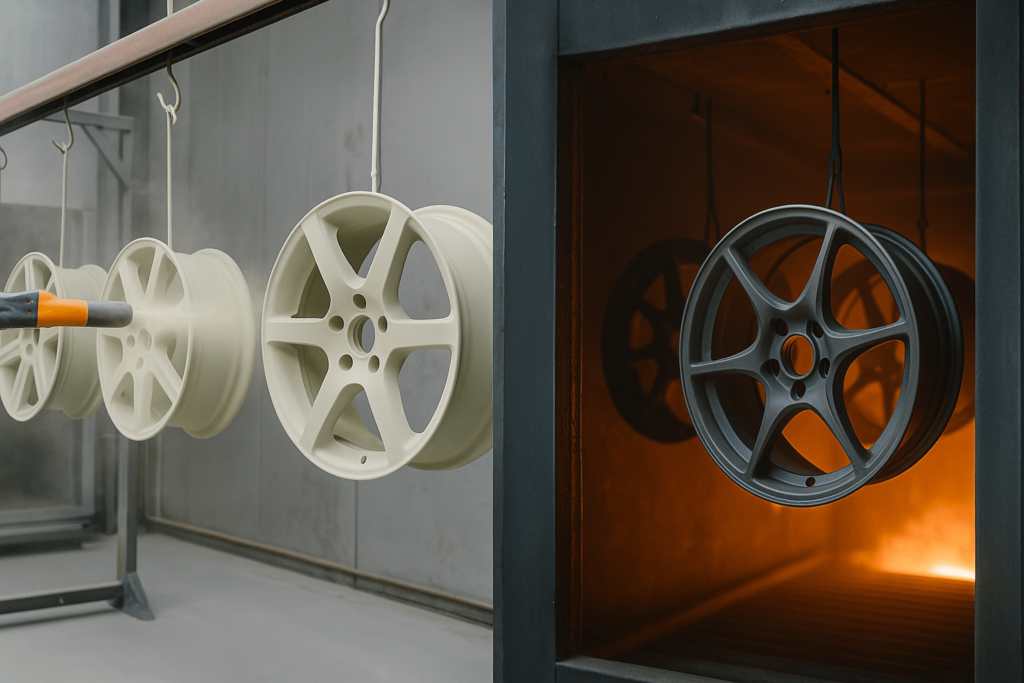
Managing Coverage on Complex Rim Geometry
Rims are not simple flat parts. Deep pockets, spoke transitions, corners, and recessed profiles make even powder distribution more difficult. In these areas, the Faraday cage effect can reduce coverage if spray parameters and grounding are not adjusted correctly.
To control this, experienced coaters may need to adjust:
KV settings
nozzle type
spray angle
grounding setup
number of passes
This matters for buyers because poor coverage in these hidden areas often becomes a future adhesion or corrosion issue.
Single-Coat vs Multi-Coat Timelines
Not every rim finish follows the same production path. A basic single-color coat is faster, but many premium or custom finishes involve:
base coat
effect or translucent layer
protective clear coat
Each additional layer adds curing time, handling time, and contamination-control requirements. That is why buyers should specify the expected finish system clearly at RFQ stage. A supplier quoting the same lead time for both single-coat and multi-coat work may not be allowing enough process time.
PMT (Part Metal Temperature) Controls the Real Cure
One of the most important industrial details is that powder coating cures based on part metal temperature, not just oven air temperature.
Thicker aluminum rims may require 20–30 minutes simply to reach the correct cure temperature. Only after the metal itself reaches target temperature can the actual cure window begin.
| Cure Control Factor | Why It Matters |
| Part metal temperature (PMT) | Determines whether the coating fully cures |
| Ramp-up time | Affects total oven cycle duration |
| Hold time at temperature | Critical for hardness, adhesion, and chemical resistance |
| Cool-down control | Helps maintain finish stability and appearance |
Under-curing can reduce chemical resistance and durability. Over-curing can create brittleness or gloss shift. Buyers should therefore confirm whether the supplier uses thermocouples, PMT verification, or curing logs as part of normal process control.
Controlled Cooling Matters Too
Cooling is not just a waiting period. It helps the coating stabilise before handling, stacking, or applying another layer. Poor cooling control may contribute to:
surface imprinting
gloss inconsistency
internal coating stress
visual variation across a batch
Day 5: Batch Scheduling, Colour Control, Inspection, and Export Preparation
Even when the coating work is technically complete, industrial lead time still depends on scheduling discipline and export handling.
1. Colour Batching Improves Consistency
Changing colors requires booth cleaning, hose purging, and recovery-system preparation. To reduce contamination risk, many industrial coaters batch similar colors together.
For buyers, this batching strategy offers two major benefits:
better color consistency across the order
more stable setup cost over repeat volumes
It also means that lead time is sometimes influenced by where the order fits into the supplier’s color schedule.
2. Capacity Planning Changes by Order Size
A small order may be inserted between larger production runs. A pallet-level or container-level order usually requires reserved capacity, material planning, and sometimes dedicated labor allocation.
This is why buyers planning recurring orders often achieve better delivery stability when they share forecasts early.
3. Final Inspection and Export Packing
Before shipment, a professional coater should verify:
film thickness
edge coverage
surface condition
color / gloss consistency
overall batch appearance
After inspection, correct export packing becomes essential. For long-distance shipments, rims typically need foam separation, protective wrapping, cartons, or other anti-contact packing methods to reduce freight-related damage.
A supplier with a clear packing protocol is usually better prepared for international B2B work than one focused only on the coating stage itself.
Why DIY or Same-Day Services Rarely Meet B2B Requirements
Some buyers still ask whether local same-day services or small workshops can support limited-volume procurement. These services may work for retail repairs, but they rarely meet industrial expectations for repeatability, documentation, and multi-batch consistency.
1. Equipment Limitations Affect Finish Control
Smaller shops often lack:
stable industrial ovens
repeatable curing verification
high-quality spray control
documented quality checkpoints
That can lead to inconsistent film thickness, uneven appearance, or variation across the batch.
2. Preparation Shortcuts Shorten Coating Life
Without proper stripping, neutralisation, blasting, and outgassing, the coating may look acceptable at first but fail much sooner in service.
3. Traceability Is Often Missing
For B2B buyers, especially in sectors such as automotive, equipment, electronics, energy storage, or branded resale, traceability is not optional. A supplier should be able to provide at least basic process records, order tracking, and quality documentation if something goes wrong later.
Practical Summary: A Realistic Timeline for Industrial Buyers
When all process stages are combined, 3–5 business days remains a realistic lead-time range for export-grade powder-coated rims.
Typical Industrial Timeline
| Stage | Typical Timing |
| Days 1–2 | Stripping, neutralisation, blasting, outgassing |
| Days 3–4 | Coating application, PMT-controlled curing, cooling, multi-coat cycles |
| Day 5 | Colour batching, final inspection, packing, export preparation |
For buyers, understanding this timeline makes it easier to:
compare quotations more accurately
spot unrealistic turnaround promises
plan inventory with fewer surprises
choose suppliers capable of repeatable batch quality
Conclusion: Lead Time Should Be Read as a Process Signal
In B2B powder coating, lead time is not just about speed. It is a reflection of how the supplier balances preparation quality, curing discipline, inspection, and shipment readiness.
For industrial buyers, the most reliable supplier is rarely the one promising the fastest turnaround. It is usually the one with a process stable enough to produce consistent finish quality, predictable delivery, and fewer long-term coating failures.