
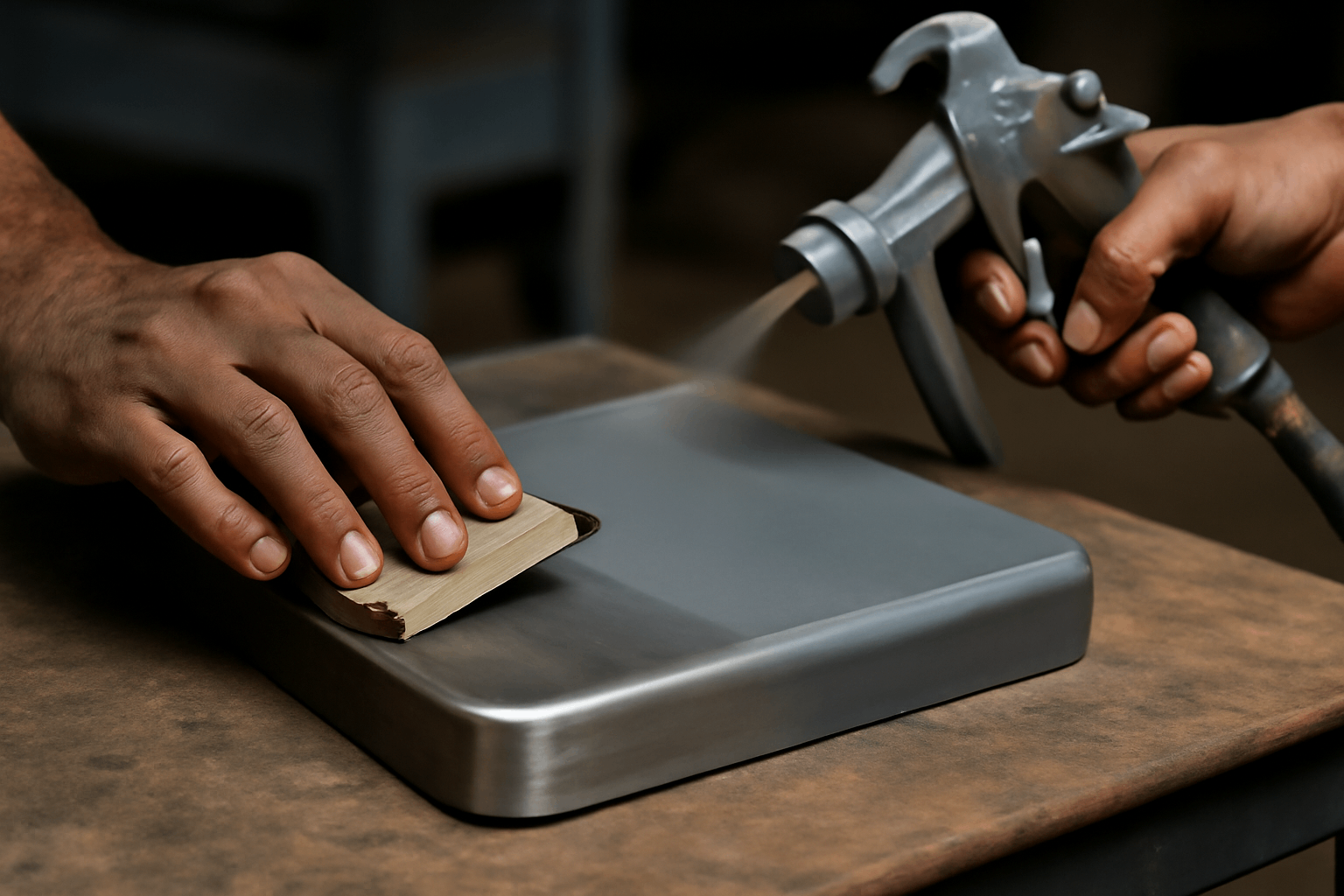
For procurement managers, sourcing agents, and engineers, specifying a coated metal component is never just a finishing decision. It directly affects product durability, warranty exposure, maintenance cost, and supply chain risk.
A failed coating does more than create a cosmetic problem. It can lead to corrosion, field complaints, rework, replacement cost, and even project delays. That is why coating performance should be evaluated from a broader manufacturing and procurement perspective.
A large share of coating failures do not begin with the paint itself. They begin with poor surface preparation. When a surface is not cleaned or prepared correctly, even a premium coating system may fail much earlier than expected.
A reliable coating outcome usually depends on two fundamentals:
Chemical preparation, which removes contaminants that interfere with bonding
Mechanical preparation, which creates the surface profile needed for adhesion
For buyers and OEM teams, understanding these two pillars helps reduce costly errors and improves long-term product performance.
The First Pillar: Chemical Engineering—Eliminating “Invisible Enemies”
One of the most common mistakes in coated metal projects is assuming that a surface is clean just because it looks clean. In reality, many coating failures begin with contamination that cannot be seen during a basic visual check.
For buyers and engineers, this matters because coating risk usually starts before the paint is even applied. If chemical contamination remains on the surface, even a high-quality coating system can fail early.
Surface Energy and the “Invisible Enemy”
Paint adhesion depends heavily on the surface energy of the base metal. When a metal surface is properly cleaned, it has higher surface energy and allows the coating to wet out and bond more effectively.
Contaminants change that behavior. Even a very thin layer of oil, grease, silicone, or process residue can reduce surface energy and interfere with adhesion. The result is often visible later as fish eyes, cratering, delamination, or localized coating failure.
Two Key Contaminants
In practice, two contamination categories cause a large share of adhesion failures:
Organic contaminants such as oils, grease, waxes, and silicones are common in fabrication and handling. These residues can remain from machining, stamping, welding, packaging, or shop-floor contact. If they are not removed first, blasting alone may spread them rather than solve the problem.
Inorganic contaminants such as soluble salts are even more dangerous in harsh environments. Chlorides and sulfates can attract moisture under the coating film and trigger osmotic blistering, underfilm corrosion, and early coating breakdown. This is especially important in coastal, marine, or chemical-adjacent applications.
Solutions: Cleaning vs. Converting
In coating preparation, chemical control usually follows two paths: cleaning and conversion.
Cleaning removes surface contamination before coating. Depending on the substrate and production route, this may involve alkaline cleaning, solvent cleaning, or other controlled pretreatment steps.
Conversion treatments are often used on metals such as aluminum or stainless steel, where the natural surface chemistry may not support reliable paint adhesion on its own. A conversion layer improves the surface condition and creates a better base for coating performance.
For procurement teams, the key point is simple: a paint line is only as reliable as its pretreatment discipline.
The Second Pillar: Mechanical Engineering—Creating a Surface “Grip”
Even a chemically clean surface may still fail if it is too smooth. In many applications, coating performance depends not only on chemical bonding, but also on mechanical anchoring.
That is why proper surface preparation must create a texture the coating can grip. Without that anchor profile, even a good coating system may peel, chip, or separate too early in service.
The Anchor Pattern: Creating a “Mountain Grip”
An anchor pattern is the controlled roughness left on the metal surface after abrasive blasting or other mechanical preparation. It consists of peaks and valleys that allow the coating to flow in, cure, and lock onto the substrate.
This profile is critical. If the profile is too shallow, the coating may not hold well enough. If it is too aggressive, sharp peaks can weaken primer coverage and create future corrosion points.
The “Goldilocks” Problem: The Right Depth Matters
Surface profile depth has to be controlled within the right range. In practical terms, it must match the coating system being used.
Too little profile can reduce adhesion. Too much profile can increase coating stress, reduce effective film build over the peaks, and create conditions for premature rusting below the coating.
That is why profile depth should never be treated as an afterthought. It should follow the coating specification and be verified in production.
Mechanical Case Study: The Failure of “Good Enough” on Carbon Steel
Carbon steel often arrives with mill scale, a brittle oxide layer created during hot rolling. This material may seem stable at first, but it is a weak base for a long-life coating system.
That is why “good enough” preparation often becomes expensive later. A light cleaning method may remove loose contamination while leaving the underlying weak layer in place. Over time, the mill scale can detach, and the coating fails with it.
For projects that require stronger coating performance, buyers and engineers should pay close attention to the specified preparation standard and avoid vague surface prep language in RFQs or drawings.
Verifying Process Control: Trust, but Verify
Surface preparation should never be accepted on claims alone. In coating projects, process control must be verified, not assumed.
For procurement teams, verification is one of the most practical ways to reduce field risk, especially when working with overseas suppliers or parts that will operate in demanding environments.
Verifying Cleanliness: The SSPC-VIS 1 Standard
Visual surface cleanliness standards such as SSPC-VIS 1 help define what an acceptable blasted surface should look like before coating begins. They give both buyer and supplier a clearer reference point instead of relying on subjective judgment.
This kind of visual benchmark improves consistency and reduces disputes over whether preparation was actually completed to the specified level.
Verifying Profile: The ASTM D4417 Standard
Visual cleanliness alone is not enough. Surface profile also needs to be measured.
Standards such as ASTM D4417 provide methods for verifying profile depth using tools like replica tape or depth gauges. For critical projects, this kind of measurable control is much more reliable than assuming the blasted surface is correct by appearance alone.
Advanced Traps: Common Errors That Lead to Coating Failures
Even when the overall coating plan looks correct, small process errors can still cause major failures. Three common traps deserve special attention:
Cross-contamination on stainless steel: If stainless parts are processed using tools or work areas contaminated by carbon steel, free iron can be transferred to the surface. That contamination may later appear as rust staining or coating failure.
Wrong primer choice on galvanized steel: Galvanized surfaces require compatible pretreatment and primer selection. Using an unsuitable coating system can lead to poor adhesion and chemical incompatibility problems.
Flash rust after blasting: Once a steel surface is cleaned aggressively, it becomes highly reactive. If primer application is delayed too long, flash rust can appear quickly and compromise the coating base.
These are not minor workshop details. They are real procurement risks when coating durability is part of the product value.
Conclusion: Mitigating Risk Through Engineering Partnership
Coating failure is often treated as a paint problem, but in many cases it is actually a surface preparation problem. That is why the real decision is not just which coating to buy, but how the substrate will be cleaned, profiled, inspected, and controlled before finishing.
For procurement teams, better specifications upstream usually mean fewer failures, fewer claims, and lower total lifecycle cost downstream.
At Yishang Metal Products Co., Ltd., we support OEM and wholesale customers with custom metal fabrication backed by practical production control. With 26+ years of experience in sheet metal parts, metal cabinets, display racks, metal frames, and other custom metal products, we understand that finishing quality depends on the full manufacturing chain—not just the final coating step.
We work with materials including stainless steel 304/316, low carbon steel, galvanized steel, aluminum, copper, and brass, and support processes such as laser cutting, bending, deep drawing, stamping, welding, CNC machining, surface treatment, assembly, packaging, inspection, and shipment.
📩 If your project depends on durable coated metal parts, send us your drawings or specifications to discuss the right fabrication and finishing approach.