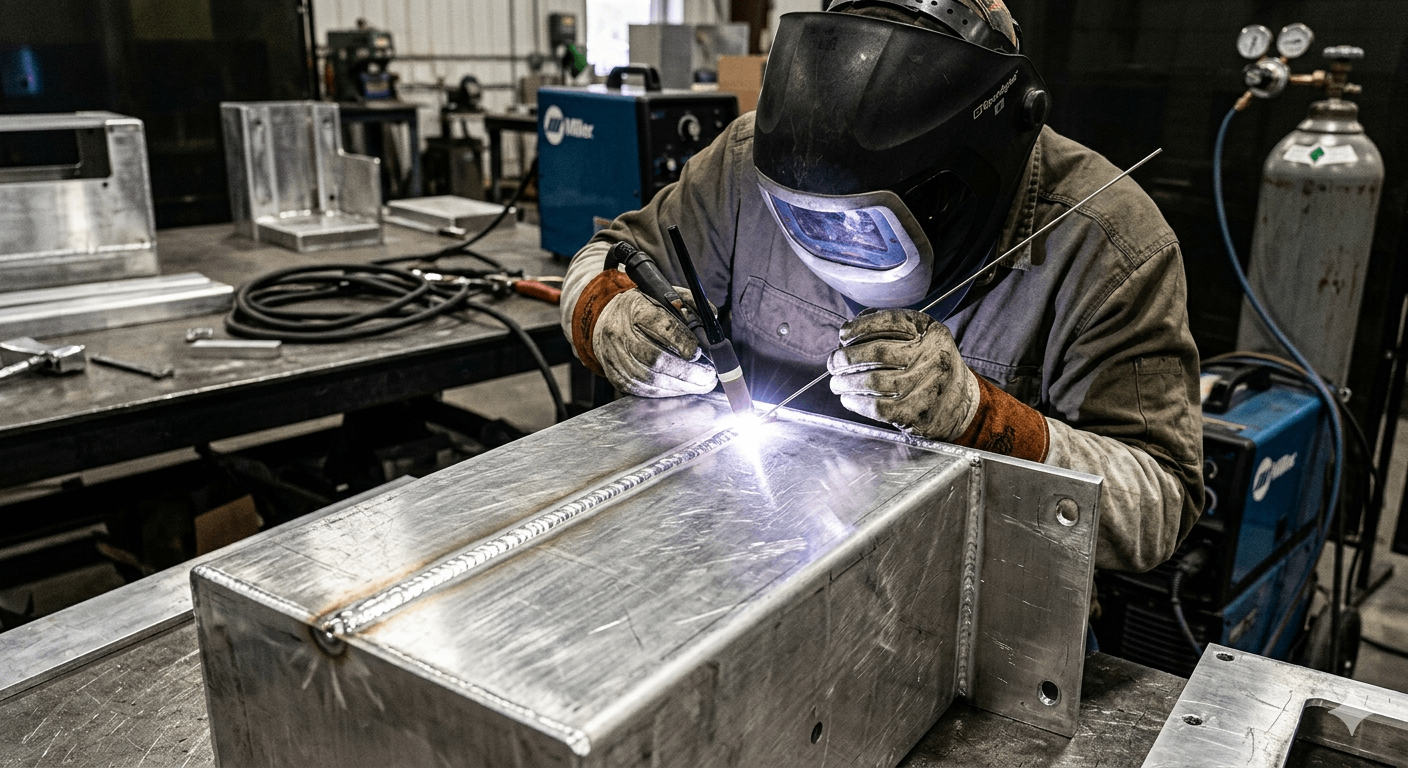
In the complex world of custom metal fabrication, the materials you choose often decide the fate of your final product’s market standing. Aluminum has rightfully earned its place as the premier choice for infrastructure that demands both high strength and a lightweight profile. Whether we are discussing a high-capacity solar battery enclosure or a precision-engineered electrical meter box, the shift toward aluminum is undeniable, especially among overseas wholesale buyers who prioritize long-term performance over short-term savings.
Yet, for a procurement manager, aluminum isn’t exactly the easiest partner. It brings a unique set of metallurgical temperaments that can make or break the ROI of a project. At YISHANG, we’ve spent 26 years learning that a weld is never just a joint; it’s a promise of reliability. When a joint fails in a critical piece of equipment, it’s not just the metal that breaks—it’s the brand’s reputation. This guide is designed to move past the surface-level “how-to” and explore the industrial realities that keep your junction box nema standard products standing strong in the field.
Navigating the Thermal Paradox and Real-World Procurement Risks
The first thing any expert will tell you is that aluminum is a heat-hungry metal. It pulls thermal energy away from the weld zone five times faster than a standard steel enclosure carbon or even a galvanized steel enclosure. In a high-volume factory setting, this creates a “sink” effect. If the technician doesn’t account for this, the initial fusion stays too cool, leading to a defect known as a “cold start.” For a wholesale buyer, this is a hidden nightmare: a mount electrical enclosure that looks fine on the outside but lacks the structural integrity to survive mechanical stress during transit or installation.
Managing this thermal dissipation is where YISHANG sets itself apart. Because aluminum transitions from solid to liquid at around 660 degrees Celsius without changing color—no glowing red warning here—the process demands a level of “muscle memory” that only comes from decades of experience. Our calibration protocols prevent the messy “blow-through” defects that typically plague lower-tier aluminum metal arc welding batches. For your supply chain, this means fewer reworks, predictable lead times, and a product that arrives ready for duty.
Thermal management isn’t just about the weld itself; it’s about the aftermath. If heat isn’t modulated perfectly, the metal expands and contracts unevenly, which can subtly warp the door seals of your enclosure aluminum enclosure. If that seal is off by even a millimeter, the NEMA rating is gone, and your enclosure electrical meter is no longer watertight. We use a specific “Start Hot, Finish Fast” rhythm to ensure that the very first inch of the weld on your solar battery enclosure is as structurally sound as the last. It’s this level of granular control that stabilizes your supply chain and protects your total cost of ownership.
The Invisible Battle: Defeating the Oxide Layer
If you want to gauge a supplier’s true expertise, ask them about their protocol for the oxide layer (Al2O3). This invisible film is a strange paradox: it’s what gives your aluminum workpiece its natural corrosion resistance, but it acts like a stubborn ceramic shield during welding. This layer doesn’t melt until it hits 2000 degrees Celsius, while the aluminum underneath is ready to flow at just 660 degrees Celsius. If a factory rushes this, that oxide breaks into fragments and gets trapped inside the weld.
A lack of a rigorous “Decontamination Ritual” is a liability waiting to happen. While prepping a stainless steel enclosure is a familiar task for most, aluminum is far more demanding. It requires dedicated stainless steel brushes that have never touched iron to avoid the cross-contamination that triggers galvanic corrosion. At YISHANG, our SOPs ensure the surface of every joint is stripped of contaminants and degreased just moments before the arc is struck. This ensures we are fusing virgin metal, not just welding over a dirty skin.
There’s also the issue of hydrogen. Molten aluminum is like a sponge for hydrogen; it will pull moisture from the structure of the metal or even the air itself. As the weld cools, that gas gets trapped, creating sub-surface porosity—essentially tiny bubbles inside the metal. This is a common cause of failure in high-vibration environments, like a solar battery enclosure mounted on heavy machinery. Our “white-glove” standard is our way of ensuring your enclosures solar battery systems remain airtight and structurally hollow-free.
Choosing the Right Path: TIG vs. MIG for Industrial Scale
Material traceability and the right choice of filler metal are where risk management meets the workshop floor. Whether we are building a stainless steel enclosure or an aluminum enclosure, the alloy grade has to be a perfect match for the environment. YISHANG focuses heavily on the 6XXX series, the industry’s reliable standard for an electrical meter box or structural frame.
| Industrial Variable |
TIG Aluminum Welding (GTAW) |
Gas Metal Arc (MIG/GMAW) |
| Primary Use-Case |
Precision push button enclosure |
Large solar battery enclosure |
| Material Thickness |
Ideal for thin-sheet < 3mm |
Superior for structural > 3mm |
| Arc Control |
Pinpoint precision |
High-speed deposition |
| Production Logic |
Quality-first, slower pace |
High-volume efficiency |
| Compliance Standard |
AWS D1.2 / NEMA 4X |
ISO 9001 / AWS D1.1 |
Choosing between tig aluminum welding and metal arc welding via MIG is a strategic move. TIG is our go-to for precision work where the visual finish is as important as the bond. On the other hand, for high-volume orders of control station enclosures, we utilize MIG welding with advanced push-pull systems to ensure the soft wire doesn’t “birdnest” and slow down your lead times.
Beyond the machine, the choice of a shielding gas makes a massive difference. While pure Argon is our baseline, we often blend in Helium for thicker sections. This boosts the energy density, ensuring the arc creates deep fusion in of your aluminum joints. This technical nuance is how YISHANG maintains a near-zero defect rate, even on massive export orders.
Engineering for Compliance: Joint Design and Safety
For the B2B buyer, the “hidden” cost of welding often lies in improper joint design. At YISHANG, we emphasize that a mount electrical enclosure is only as strong as its prep work. For aluminum, a 60-degree V-groove with a precise root opening is often required to ensure 100 percent penetration. Without these engineering specifics, the weld on your junction box nema might look perfect on the outside but fail a simple stress test.
Safety and compliance also go hand-in-hand with quality. We adhere strictly to AWS D1.2 (Structural Welding Code—Aluminum). This isn’t just about the welder’s skill; it’s about the entire factory ecosystem, including smoke evacuation systems to manage toxic ozone and ozone-depleting byproducts. When you source from a partner that prioritizes industrial safety, you are indirectly protecting your brand from the liabilities associated with non-compliant manufacturing.
Beyond the Arc: Ensuring Long-Term Integrity
A weld isn’t finished just because the arc is out. Aluminum is famously sensitive to “Crater Cracking”—those small, star-shaped cracks that appear at the very end of a bead as the metal shrinks. At YISHANG, our technicians use a specific “tail-out” technique, circling back to fill the crater and create a convex finish that resists those shrinkage stresses. This is especially important for enclosures solar battery units that will spend their lives outdoors.
The Heat Affected Zone (HAZ) is the invisible area that procurement teams should watch most closely. Welding can soften heat-treated aluminum (like 6061-T6) by as much as 40 percent near the joint. For load-bearing control station enclosures, we can provide Post-Weld Heat Treatment (PWHT) to restore that strength. To give you complete confidence, we offer several Non-Destructive Testing (NDT) options, from visual audits to liquid dye penetrant tests that catch surface cracks on your aluminum joints.
Frequently Asked Questions (FAQ) for Procurement Managers
Q: Can aluminum be welded to steel for custom enclosures? A: Direct welding of aluminum to carbon steel enclosure material is generally not feasible through arc welding due to the formation of brittle intermetallic compounds. We recommend mechanical fastening or specialized transition inserts for hybrid material projects.
Q: Which shielding gas is best for high-volume aluminum MIG welding? A: For most solar battery enclosure projects, 100 percent pure Argon is the industry standard. However, for sections thicker than 1/2 inch, we often utilize an Argon-Helium mix to enhance heat input and ensure deeper penetration.
Q: Why does my aluminum weld have black soot around the bead? A: Black soot, or “smut,” is typically caused by magnesium oxides. While it can be cleaned, excessive soot often indicates a lack of proper gas coverage or the need for a push-pull system to stabilize the wire feed.
Conclusion: Your Partner in Global Aluminum Excellence
At the end of the day, there is a fundamental difference between a carbon steel enclosure and an aluminum one. Aluminum offers incredible weight savings and heat dissipation, but only if your partner truly understands the soul of the metal. YISHANG bridges that gap between complex physics and your commercial reality. We invite you to see our work for yourself; reach out for a quick inquiry now to discuss how we can support your next big infrastructure project with technical excellence.
Let our 26 years of fabrication wisdom work for your supply chain. YISHANG is dedicated to building metal products that don’t just look good but perform reliably, unit after unit. Our team is standing by to provide a technical consultation and a competitive quote for your high-volume needs—get started with a quick inquiry now.