Introduction: Why Hydroforming Matters to Professional Buyers
In the world of metal fabrication, especially for B2B wholesale buyers sourcing components for EVs, telecom systems, control cabinets, and aerospace applications, the key factors are not just material quality—but cost-efficiency, surface integrity, and geometry control. Hydroforming answers these needs where traditional stamping and welding may fall short.
As a precision metal forming method, hydroforming uses fluid pressure and a single matched die to create parts with minimal welds and superior finish. Unlike stamping, which often requires multiple dies and incurs higher rework rates, hydroforming is ideal for medium-to-high-volume production of complex metal forms.
This guide from YISHANG—a China-based OEM/ODM metal manufacturer—dives into hydroforming from a buyer’s perspective: covering cost-impacting variables, design feasibility, quality metrics, and material compatibility.
What Is Hydroforming? A Technical Primer
How It Works
Hydroforming forms metal parts by using pressurized hydraulic fluid to shape a blank (sheet or tube) inside a custom die. It replaces the upper punch of traditional pressing with uniform fluid pressure, which pushes the metal into the die shape without excessive thinning or cracking.
Two main types of hydroforming are used in industrial applications:
- Sheet Hydroforming: Common for EV housing, telecom panels, and battery cases.
- Tube Hydroforming: Applied in structural frames, heat exchangers, fuel rails.
This technique allows for intricate shapes, tight tolerances, and smooth finishes—all with reduced tooling complexity.

Industrial Relevance and Adoption
Initially developed for aerospace components, hydroforming is now widely used in automotive EV platforms, energy enclosures, and medical cabinet parts. It supports design iterations without full tooling resets, which reduces lead time and cost for batch buyers.
Buyers benefit from more flexible lead time management, simplified variant control, and lower downstream finishing requirements—especially for cosmetic or structural components.
Advantages Over Multi-Die Systems
Unlike traditional stamping, which often requires upper and lower dies for each shape variant, hydroforming uses flexible tooling strategies. The upper pressure system adjusts dynamically, allowing multiple part variants to form within one die set.
This saves not only on tooling investment but also on storage space, maintenance, and changeover time between production batches. It’s particularly relevant for overseas buyers managing long supply chains and demanding SKUs.
Sheet & Tube Hydroforming: Workflow Explained
Sheet Hydroforming Steps
- A flat metal blank is placed over a lower die.
- A flexible diaphragm covers the sheet.
- Hydraulic pressure (typically 400–800 bar) pushes the sheet into the die.
- The part is ejected and trimmed if necessary.
This is especially effective for large-area components requiring cosmetic consistency.
Tube Hydroforming Steps
- Tubes are pre-bent and loaded into dies.
- Ends are sealed and filled with fluid.
- External dies close and pressure is increased.
- The tube expands into the die cavity.
Common applications include HVAC ducting, EV subframes, and fuel system parts.
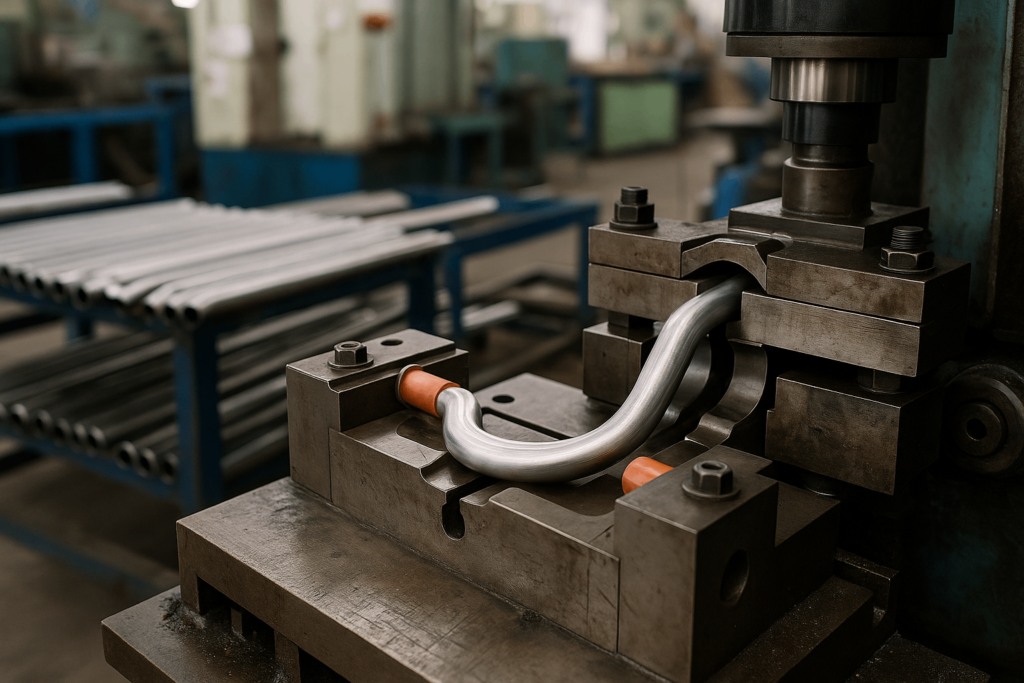
Tooling & System Overview
Tooling is typically made from H13 steel or aluminum alloys. YISHANG utilizes hydraulic servo systems for pressure modulation and integrates FEA simulation during DFM (design for manufacturability) to validate complex geometries before tooling begins.
Additionally, servo-controlled hydraulic systems enable better repeatability across batches, with real-time feedback and pressure curve tuning. For buyers, this translates into more stable tolerance outputs and minimized rejection rates.
Hydroforming vs. Traditional Metal Forming
Tooling Investment Comparison
For projects with multiple variants, hydroforming lowers tooling costs significantly. A single set of base dies can accommodate variations through CAD-adjusted pressure sequences, reducing the need for new upper punches.
For example, automotive customers report tooling savings of 30–45% across 3 product cycles.
Hydroforming also reduces soft tooling degradation, allowing longer tooling life and fewer die refurbishments.
Surface Quality & Downstream Processing
Hydroforming delivers a surface finish as smooth as Ra 0.8–1.6 μm, reducing the need for secondary sanding or deburring. It’s optimal for visible panels and parts with high cosmetic standards.
| Process Avg. Surface Finish Typical Rework | ||
|---|---|---|
| Deep Draw Stamping | Ra 1.6–3.2 μm | Trimming, polishing |
| Sheet Hydroforming | Ra 0.8–1.6 μm | Minimal or none |
This is particularly advantageous for powder-coated or brushed aluminum applications, where a smoother base reduces coating thickness variation.
Material Savings and Waste Ratio
Thanks to even deformation, hydroforming reduces corner thinning and rupture points. Buyers benefit from higher yield per sheet or tube, especially in low-scrap production lines.
Scrap rates can drop by 20–30% compared to stamping, and secondary straightening is rarely needed.
Case Study: Cost Reduction in EV Housing
An EU-based client producing aluminum EV battery enclosures switched from deep draw to hydroforming. With the same outer geometry but tighter bend radii, they reduced their tooling budget by 42% and scrap rate by 28%, while maintaining IP65 enclosure integrity.
YISHANG supported the transition by simulating forming pressure and radius behavior using FEA tools, reducing prototyping rounds from 4 to 1.
Material Compatibility and Use Cases
Suitable Materials for Hydroforming
Hydroforming supports a range of metals commonly used in industrial fabrication:
- Aluminum (3000 & 5000 series): Lightweight, corrosion-resistant, ideal for EV and aerospace components.
- Stainless Steel (304, 316L): Excellent for medical enclosures, control cabinets, and food-grade applications.
- Low-Carbon Steel: Used for structural parts where cost efficiency and stiffness matter.
- Brass and Copper: Limited use due to softness but applicable in specialty telecom parts.
Material selection affects required pressure levels, forming radius, and surface finish. YISHANG provides full material test certificates (MTC) to verify batch conformity.
Use Case Scenarios
- EV Battery Housings: Hydroforming delivers reduced weld lines and IP-rated joints.
- Aerospace Brackets: Lightweight yet durable under stress, shaped with minimal tolerance drift.
- Telecom Panels: Uniform panels with smooth bends for rack integration.
- Medical Enclosures: Stainless steel panels with no welding discoloration.
Understanding how metal type and part geometry interact helps buyers select optimal solutions without overengineering.
Key Design Considerations for Hydroformed Parts
Geometry Constraints
When planning for hydroforming, especially in low- to mid-volume OEM production, several geometric constraints need to be addressed early in the design process:
- Minimum bend radius: Should typically be at least 2–3x the material thickness. This prevents cracking and ensures stable material flow during forming.
- Depth-to-diameter ratio: For deep-drawn shapes, high draw ratios (>2.5:1) may require intermediate annealing or redesign to prevent rupture.
- Wall thinning control: Hydroforming can reduce wall thickness by up to 15%, especially in tight corner regions. Proper simulation is necessary to maintain structural integrity.
Buyers in EV structural parts, server cabinet shells, and telecom enclosures often deal with complex curvatures and corner junctions. YISHANG performs full FEA-based simulation on every part before tool build to ensure all geometric features remain within hydroformable range.
CAD Design Recommendations
From a DFM (Design for Manufacturability) perspective, the CAD model dictates both cost and success rate. We recommend:
- Generous internal and external radii to avoid sharp metal displacement.
- Avoiding blind pockets or steep undercuts without adding draw relief features.
- Clear separation of trimming areas to ensure consistent post-processing.
We accept IGES, STEP, or Parasolid formats, and buyers who submit detailed 2D + 3D files receive optimized RFQs with realistic lead time, cost breakdown, and CPK (process capability index) estimates.
Application-Based Design Tips
For industries like:
- EV structures: Include energy absorption zones and crash-triggered deformation geometries.
- Telecom panels: Design ribbing or dimples to reduce panel vibration without affecting surface finish.
- Food-grade stainless parts: Avoid crevices that could trap residue; hydroforming allows single-contour inner chambers.
In each case, hydroforming offers a distinct advantage over stamping or welding by allowing uninterrupted curves and stronger forms without stress concentrations.
Tolerance Control & Quality Assurance in Hydroforming
Understanding Hydroforming Tolerances
For B2B buyers, tolerance control isn’t just about specs—it’s about predictability and batch consistency. Hydroforming is capable of achieving dimensional tolerances within ±0.05–0.1 mm for most components when supported by proper simulation and die alignment.
Factors that influence tolerance:
- Material springback: Predictable via FEA simulation
- Hydraulic pressure ramping control: Servo systems offer ±2% repeatability
- Tooling surface hardness: Higher tool hardness reduces long-term deformation
For box-type enclosures, typical tolerances YISHANG provides are:
| Feature Type Standard Tolerance | |
|---|---|
| Flat surface deformation | ±0.1 mm |
| Hole position (Ø < 5 mm) | ±0.05 mm |
| Bend angles | ±0.5° |
| Height (deep draw) | ±0.2 mm |
These tolerances are comparable or superior to those in multi-step stamping and welding lines, without cumulative error from secondary operations.
Quality Inspection Strategy
YISHANG operates under ISO 9001 and RoHS-compliant systems. Each hydroforming batch passes through a multi-step quality assurance plan:
- Incoming material verification: Includes batch-level MTC (Material Test Certificate) and tensile testing
- In-process monitoring: Pressure profile sensors + camera-based deformation monitoring
- First Article Inspection (FAI): CMM-based 3D scan vs. CAD file
- Batch Sampling: Following AQL 1.0/2.5 standards per lot size
We support full traceability via laser-etched batch IDs on each formed part, ensuring that overseas buyers can track issues back to raw material or tooling batch.
Statistical Process Control (SPC) & CPK Targets
Hydroforming lends itself well to statistical control due to minimal operator intervention. For volume clients, we maintain SPC dashboards across:
- Key dimensions (X, Y, Z)
- Wall thinning percentage
- Bend consistency angle
Target process capability indices (CPK) exceed 1.33 for critical features. For regulated industries (aerospace, medical), we provide documented control charts as part of PPAP or FA validation packages.
Common Quality Pitfalls and Buyer Checkpoints
Even with hydroforming’s consistency, certain quality risks should be planned for:
- Tool wear over time: Affects edge precision—ensure vendor has die regrinding protocol
- Surface oil stain or residue: Implement post-wash + degreasing
- Under-formed corners: Can be mitigated by increasing localized pressure or slight radius increase
Buyers sourcing parts like telecom enclosures or battery trays should request:
- Surface finish validation (Ra test records)
- Draw ratio simulation report
- Pressure curve history for 3–5 sample units
YISHANG proactively provides these during RFQ and pilot run stages to reduce back-and-forth and enhance buyer confidence.
Cost Engineering: Tooling, Volume & Unit Pricing
Tooling Investment: Fixed vs. Amortized Costs
One of the most significant cost elements in hydroforming is the tooling setup. While traditional stamping may require both upper and lower punches for each SKU, hydroforming typically uses a single die + fluid pressure system—lowering initial tooling investment.
- Typical Tooling Range (Hydroforming): $3,000–$15,000 depending on part size and complexity
- Amortization Strategy: Spreading tooling cost across 5,000–50,000 parts
For long-term buyers, tooling amortization brings unit prices down significantly. At YISHANG, we offer flexible amortization schedules for repeat clients to reduce upfront burden and improve procurement agility.
MOQ (Minimum Order Quantity) Rationalization
Buyers often face uncertainty when forecasting batch size. Hydroforming enables a relatively low MOQ due to faster tool changeovers and fewer setup steps.
| Part Type MOQ Recommendation | |
|---|---|
| Sheet Panels | 300–500 pcs |
| Tube Formed Parts | 500–800 pcs |
| Deep Drawn Boxes | 200–300 pcs |
Lower MOQs are possible for prototyping phases, with tooling reusability built into the design to support ramp-ups. We also support tiered pricing based on lot size, with breakpoints at 1K, 3K, and 10K pieces.
Unit Cost Drivers: What Buyers Should Monitor
Key factors impacting per-unit pricing in hydroforming include:
- Material type & thickness (e.g., 2 mm 304 stainless steel vs. 1 mm aluminum)
- Die complexity (multi-cavity, precision edge features, integrated inserts)
- Cycle time per part (typically 20–40 sec)
- Secondary operations (trimming, laser cutting, cleaning)
- Packaging requirements (cleanroom bagging, foam casing, labeling)
Sample unit price breakdown:
| Item Estimated Cost Range (USD) | |
|---|---|
| Raw Material (per part) | $0.40–$1.60 |
| Forming + Trimming | $0.80–$2.00 |
| Surface Finish (optional) | $0.30–$1.20 |
| QA + Packaging | $0.15–$0.50 |
| Total Per-Unit Price | $1.65–$5.30 |
YISHANG provides RFQ responses within 24h with full breakdown, including tooling amortization schedule, cycle time assumptions, and labor share. Overseas buyers can simulate cost implications based on expected volume increases.
Reducing TCO: Tips for Procurement Teams
- Batch Ordering: Consolidate SKUs with similar geometry to reduce changeover waste
- Standardization: Align features across products to share tooling
- Forecasting: Commit to rolling volume forecasts to enable staggered production and better rate locking
When aligned with an OEM/ODM supplier like YISHANG, these strategies can reduce your total cost of ownership (TCO) by 12–25% over a 2-year horizon.
Hydroforming in Mission-Critical Applications (EVs, Aerospace, Telecom, Medical)
Why Mission-Critical Industries Choose Hydroforming
Industries such as electric vehicles (EVs), aerospace, telecom infrastructure, and medical devices demand components that perform under extreme conditions—with no room for failure. Hydroforming is increasingly the preferred method in these sectors due to its ability to deliver:
- High structural integrity with minimal welds
- Tight tolerance control without secondary machining
- Weight reduction through optimized wall thickness
- Smooth finishes required for hermetic sealing and coating
For overseas procurement teams, hydroforming provides consistency across high-volume orders and simplifies validation under global compliance standards.
Electric Vehicles (EVs)
EV platforms prioritize lightweight strength and EMI shielding. Hydroformed components help achieve:
- Battery enclosures with IP-rated sealing and minimal seam welds
- Chassis components with integrated crash energy zones
- Cooling system manifolds formed from corrosion-resistant aluminum or 316L stainless steel
A European EV manufacturer adopted hydroformed battery trays with integrated drain and cable ducts. Compared to stamped and welded versions, they reduced part count by 3x and assembly time by 40%.
Aerospace Structures
Hydroforming was originally developed for aerospace due to its ability to:
- Form complex curvatures in aluminum alloys and titanium
- Produce lightweight, high-rigidity frames with uninterrupted geometry
- Minimize structural fatigue risks caused by weld seams
Examples include:
- Satellite antenna frames
- Wing rib reinforcements
- Instrument housing with internal fluid channels
YISHANG supports aerospace clients with documented FAI, CPK analysis, and traceability per AS9102 and EN 9100 extensions.
Telecom Infrastructure
Telecom cabinets, enclosures, and waveguide channels require tight EMI shielding and smooth external surfaces to ensure:
- Consistent signal protection
- Easy rack-mounting integration
- Weather resistance for outdoor base stations
Hydroformed aluminum panels provide tighter bends and no spot weld marks, reducing surface prep before powder coating. Custom cutouts for connectors and ventilation are integrated during trimming.
Medical Equipment
In medical OEM production, hydroforming enables:
- Seamless stainless steel housings that resist bacterial growth
- Low-part-count casings for imaging systems
- Formed handles and trays with ergonomic curvature
A US-based medical client adopted hydroformed 304 stainless covers for a sterilizer module. The design eliminated 5 weld lines, improved hygiene, and passed ASTM A967 for surface passivation.
For all mission-critical buyers, hydroforming ensures parts are:
- Dimensionally reliable
- Mechanically robust
- Cost-effective in medium to large volumes
Common Pitfalls in Hydroforming Projects and How to Avoid Them
Pitfall: Ignoring Minimum Forming Radius
One of the most common mistakes in hydroforming design is specifying corners or bends with radii smaller than the material can accommodate. This leads to ruptures or excessive wall thinning. In hydroformed parts, the recommended minimum inside radius is typically 2–3 times the material thickness.
How to avoid:
- Consult with forming engineers during early CAD development.
- Run FEA simulations to assess strain distribution.
- Use rounder contours for deep-drawn or multi-bend geometries.
Pitfall: Overcomplicating Part Geometry
Designers may be tempted to leverage hydroforming’s power by introducing unnecessary features such as aggressive undercuts, blind recesses, or hidden cavities. These often increase tooling costs or render parts unformable within single-step operations.
How to avoid:
- Apply the “functional necessity” rule to each contour.
- Avoid zero-degree sidewalls or draw directions perpendicular to pressure flow.
- Ask for DFM feedback before locking the design.
At YISHANG, we provide annotated 3D models with risk zones flagged in red to help buyers optimize geometry in the pre-tooling stage.
Pitfall: Misaligned Trim Strategy
Post-forming trim is a critical—but often under-engineered—aspect. Designs lacking clear trim margins or toleranced trim zones will suffer from high scrap rates or rework costs. This is especially true for parts with integrated connector ports, mounting holes, or cosmetic edges.
How to avoid:
- Add trim relief geometry (such as straight edge flanges) where trimming will occur.
- Specify tolerance zones for critical edges vs. non-critical ones.
- Use laser or waterjet trim simulations during quotation.
Pitfall: Underestimating Process-Specific Material Behavior
Even if a material is hydroformable, each alloy reacts differently under pressure. For example:
- Aluminum 5052 has excellent corrosion resistance but can wrinkle under rapid pressure.
- 304 stainless may spring back after forming if annealing isn’t properly timed.
How to avoid:
- Review material certificates and pressure curves for previous similar parts.
- Consider tempering or partial annealing for deep-drawn parts.
- Request a test run with pressure modulation.
Pitfall: Treating Hydroforming Like Stamping
Many design errors stem from applying stamping rules (which are punch-based) to hydroforming. Hydroforming relies on pressure distribution, not direct impact, so:
- Sharp angles without material flow support may lead to tearing.
- Excessively large draw depths in one pass can compromise tolerance.
How to avoid:
- Work with a supplier experienced in both methods.
- Request comparative simulations.
- Ask for a staged forming proposal if complexity is too high.
Pitfall: Lack of QA Specification in RFQ
Buyers often neglect to define QA protocols, leading to post-order disputes or mismatched expectations. This is crucial in hydroforming where:
- Cosmetic quality is highly valued (especially for anodized or coated parts).
- Structural parts need repeatable geometry.
How to avoid:
- Define CPK targets or batch sampling frequency in your RFQ.
- Include QA inspection checkpoints in your design notes.
- Ask suppliers (like YISHANG) for a typical QA report template before the order.
Buyer’s Checklist for Successful Hydroforming Projects
For B2B procurement professionals, a successful hydroforming project goes beyond receiving formed parts—it hinges on early-stage alignment, supplier transparency, and measurable quality assurance. This checklist ensures readiness across all stages of engagement.
Pre-RFQ (Request for Quotation) Preparation
Before approaching suppliers, clarify the following internally:
- CAD Package Completeness:
- Ensure full 3D + 2D files with tolerances, surface finish specs, and material notes.
- Highlight critical dimensions and cosmetic surfaces.
- Expected Volume and Forecasting:
- Provide tiered demand expectations (e.g., 3K, 10K, 50K per year).
- Indicate prototyping vs. mass production phase.
- Target Cost Range (if applicable):
- Helps suppliers optimize die complexity, surface finish, and trimming method.
- QA Requirements:
- Define if CPK, FAI, or AQL are mandatory based on industry compliance.
A complete RFQ reduces back-and-forth and speeds up accurate quoting by 2–3 days.
During Quotation Review
When reviewing hydroforming proposals, use this decision matrix:
| Evaluation Item What to Look For | |
|---|---|
| Tooling Cost Breakdown | Fixed vs. amortized, material, number of cavities |
| Cycle Time Estimate | Per-piece time + batch throughput |
| Simulation Support | Includes FEA reports or forming simulation screenshots |
| Trim & Post-Process Plan | Indicated trim method, edge control, optional coating |
| Tolerance Commitment | ±0.05–0.2 mm per feature with example CPK data (if applicable) |
| Packaging & Logistics | Export crate specs, part nesting plan, labeling support |
| Production Lead Time | Prototype vs. full batch, tool fabrication duration |
Ask the supplier to clarify critical-to-quality (CTQ) parameters to avoid ambiguity later.
Before Production Kickoff
Once the project is awarded:
- Kickoff Checklist:
- Confirm die layout drawings
- Confirm sample validation plan (pilot run or pre-series batch)
- Agree on testing methods: Ra measurement, CMM inspection, leak test (if enclosure)
- Batch Traceability:
- Assign part numbers and etching codes
- Request serialization format
- Mutual Risk Control Plan:
- Define non-conformance handling
- Establish deviation approval mechanism
These measures safeguard international buyers managing remote supply chains and customs-sensitive parts.
Supplier Evaluation Criteria (Post-Order)
Hydroforming is a long-term partnership business. Post-order performance should be tracked via:
- Batch Acceptance Rate: ≥98% for cosmetic parts; ≥95% for structural
- Lead Time Deviation: <±3 working days on confirmed schedule
- Corrective Action Response Time: <48h on issues
- Design Change Responsiveness: Within 5–7 working days with revised quote
At YISHANG, we share quarterly QA reports and cost improvement insights with long-term B2B clients to drive co-engineering gains and reduce lifecycle costs.
Terminology Guide + Conclusion
Key Hydroforming Terminology Explained
To assist procurement professionals and engineering leads in cross-team collaboration, here are the most relevant hydroforming terms used in this guide:
| Term | Definition |
|---|---|
| Hydroforming | Metal forming process using fluid pressure to shape a workpiece in a die. |
| FEA (Finite Element Analysis) | Simulation technique to predict deformation, strain, and failure in parts. |
| CPK (Process Capability Index) | Statistical measure of a process’s ability to produce within specification. |
| MTC (Material Test Certificate) | Certificate verifying mechanical and chemical properties of raw material. |
| Deep Draw Ratio | Ratio of part depth to diameter—affects hydroformability of metal blanks. |
| Trim Relief | Design feature enabling cleaner, more accurate post-forming trimming. |
| Servo-Hydraulic System | Pressure system allowing dynamic control for more uniform forming. |
| AQL (Acceptable Quality Level) | Sampling standard for batch inspection during QA. |
| Springback | The tendency of metal to return to original shape after forming stress. |
| RA (Roughness Average) | Measurement of surface smoothness in micrometers (μm). |
These terms are particularly useful when collaborating with overseas manufacturing teams, QA departments, and internal product engineers.
Final Takeaways for B2B Buyers
Hydroforming is not just a forming method—it’s a strategic production option for B2B buyers seeking optimized part performance, supply chain flexibility, and cost-effective production over long-term cycles.
YISHANG’s approach to hydroforming emphasizes:
- Early-stage DFM and simulation to reduce costly rework.
- Tooling amortization support for small-to-medium volume clients.
- QA traceability aligned with ISO and RoHS standards.
- Application-specific co-engineering across EV, telecom, and medical sectors.
When leveraged correctly, hydroforming enables lower TCO (total cost of ownership), faster ramp-ups, and better lifecycle consistency for global buyers managing high-performance products.
Recommended Next Steps & CTA
✔️ Ready to explore hydroforming for your next project?
- Contact us with your 3D/CAD files to receive a free DFM analysis and FEA simulation preview.
- Get a tooling + unit cost quotation within 24h.
- Ask about our first-article sampling program for custom designs.
📩 Contact YISHANG Metal Fabrication or email us at sales@zsyishang.com to begin your hydroforming solution today.