
Introduction: Why Hydroforming Matters to Professional Buyers
In the world of metal fabrication, especially for B2B wholesale buyers sourcing components for EVs, telecom systems, control cabinets, and aerospace applications, the key factors are not just material quality—but cost-efficiency, surface integrity, and geometry control. Hydroforming answers these needs where traditional stamping and welding may fall short.
As a precision metal forming method, hydroforming uses fluid pressure and a single matched die to create parts with minimal welds and superior finish. Unlike stamping, which often requires multiple dies and incurs higher rework rates, hydroforming is ideal for medium-to-high-volume production of complex metal forms.
This guide from YISHANG—a China-based OEM/ODM metal manufacturer—dives into hydroforming from a buyer’s perspective: covering cost-impacting variables, design feasibility, quality metrics, and material compatibility.
What Hydroforming Actually Does
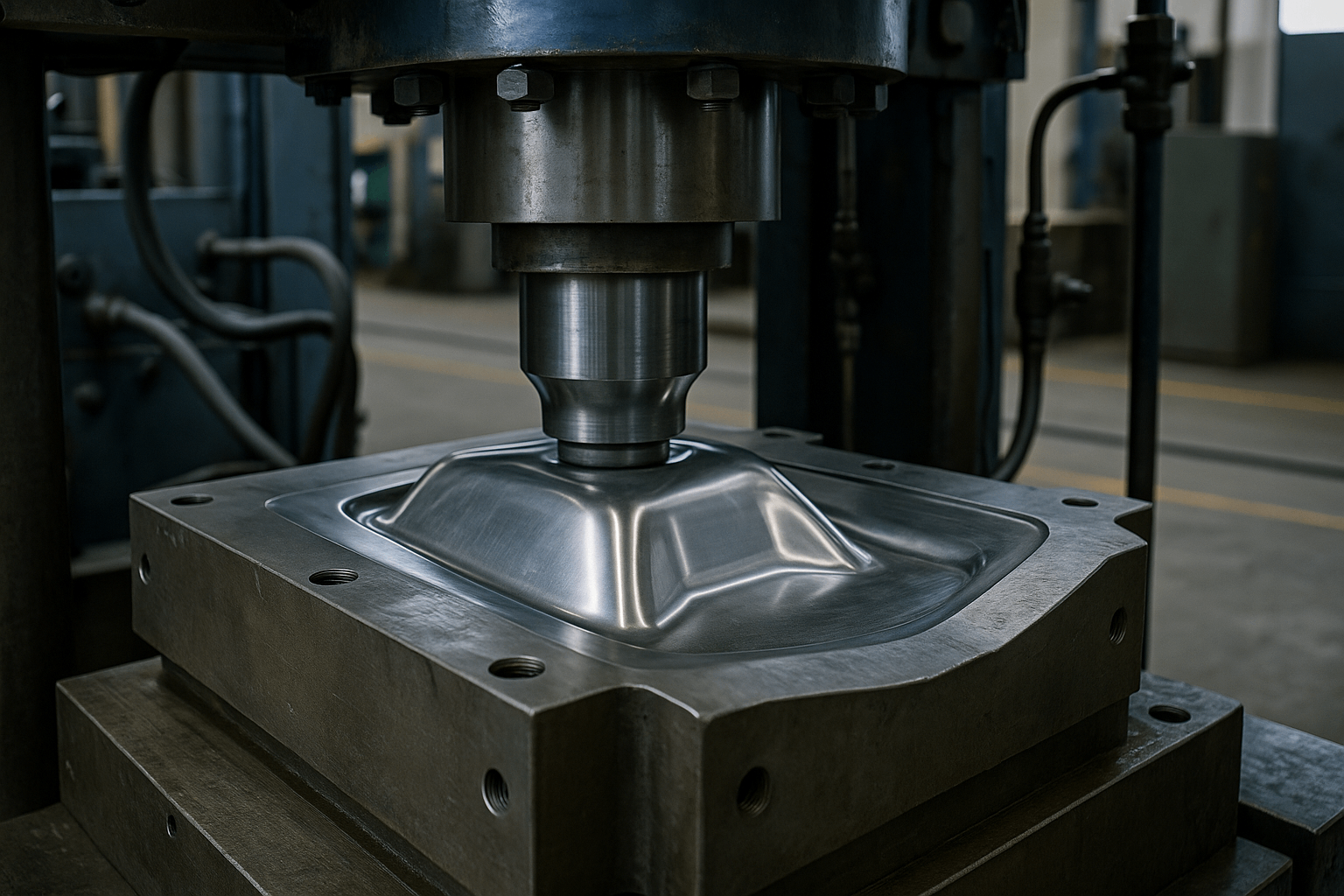
Hydroforming uses pressurized fluid to force metal into a die shape. Instead of relying only on a rigid punch, the forming force is distributed more evenly across the workpiece. That changes how the material flows and often allows the process to form shapes that would be harder, rougher, or more part-intensive with traditional methods.
There are two main industrial categories:
- Sheet hydroforming for formed shells, panels, housings, trays, and enclosure-type parts
- Tube hydroforming for tubular structures, manifolds, rails, frames, and complex hollow sections
The basic idea is simple. The commercial value lies in what that pressure-controlled forming can replace.
How It Works
In sheet hydroforming, a blank is positioned over or within a die, then pressure is applied through a diaphragm or fluid system until the metal conforms to the target geometry.
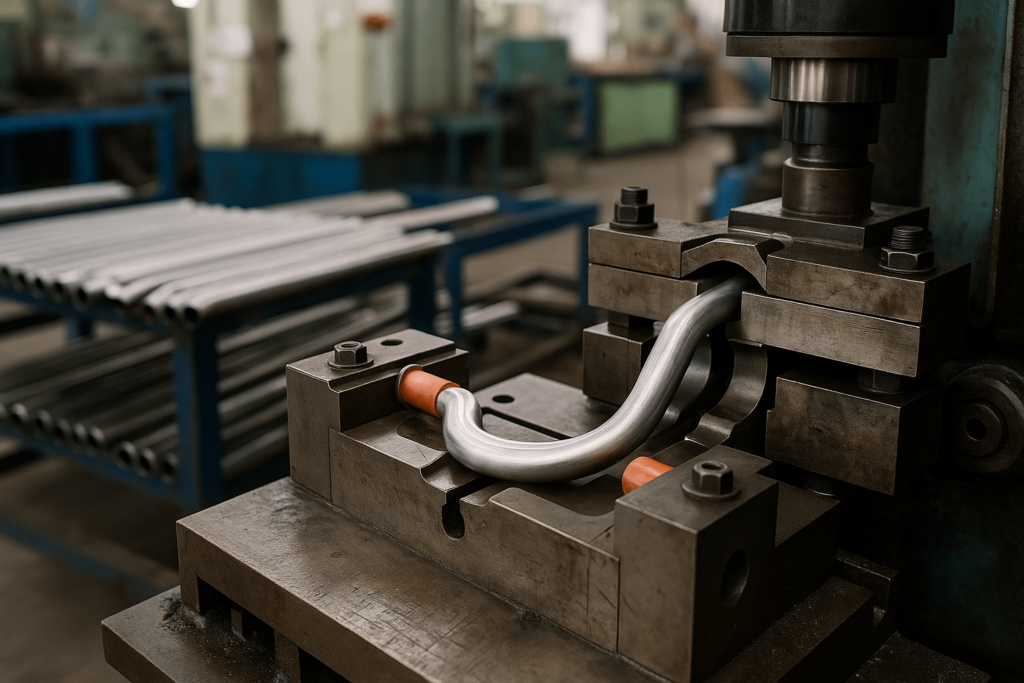
In tube hydroforming, a preformed tube is placed into a die, sealed at the ends, filled with fluid, and expanded under pressure until it takes the required shape.
What matters to buyers is not the textbook sequence. It is the result: fewer joints, more continuous geometry, and often better surface continuity than multi-piece fabrication.

Industrial Relevance and Adoption
Hydroforming first gained strong visibility in aerospace and automotive applications, but its use has broadened. It is now relevant to buyers in:
- EV enclosures and battery structures
- telecom housings and infrastructure panels
- medical casings
- structural tube assemblies
- industrial equipment and cabinet systems
It is especially attractive where appearance, stiffness, reduced weld count, or integrated geometry matter.
Advantages Over Multi-Die Systems
In certain part families, hydroforming reduces the need for multiple tooling stages or multiple joined parts. That can lower total process complexity even if the base tooling is not cheap.
Its advantage becomes strongest when buyers are trying to simplify a part family—not merely source a single part at the lowest initial piece price.
Sheet and Tube Hydroforming: Two Similar Ideas, Two Different Production Realities
The process label may be the same, but sheet and tube hydroforming behave differently in quoting, tooling, and production planning.
Sheet Hydroforming
Sheet hydroforming is typically used for parts such as:
- covers
- trays
- shells
- battery housings
- telecom panels
- cosmetic or semi-structural enclosures
A simplified workflow looks like this:
- Blank preparation
- Positioning over the die
- Pressure forming through diaphragm/fluid system
- Part release
- Trimming and downstream finishing if needed
For buyers, sheet hydroforming is attractive when they want smoother shape transitions, reduced weld seams, and better surface continuity.
Tube Hydroforming
Tube hydroforming is commonly used for:
- structural rails
- HVAC passages
- fluid manifolds
- automotive or EV tube structures
- complex hollow sections
The general process includes:
- Tube pre-bending or preforming
- Placement into matched tooling
- End sealing and fluid fill
- Pressure expansion into die cavity
- Trimming, piercing, or secondary operations
Tube hydroforming often creates the greatest value when a complex welded tube assembly can be replaced by one more integrated part.
Tooling & System Overview
From a buyer’s point of view, the tooling conversation should focus on more than die cost alone.
The useful questions are:
- How part-specific is the tool?
- How much reuse is possible across variants?
- What secondary trim or piercing operations are still required?
- How quickly can the supplier move from simulation to pilot tooling?
Those questions usually tell you more about total program cost than the headline tooling quote.
Hydroforming vs. Stamping, Deep Drawing, and Welded Fabrication
Hydroforming is often considered only after buyers discover that another process creates too many compromises.
Tooling Investment Comparison
Compared with traditional stamping or deep drawing, hydroforming can reduce tooling complexity in programs where multiple rigid tool stages would otherwise be required.
That does not mean tooling is always cheaper. It means the cost structure is different.
Hydroforming becomes commercially attractive when it can:
- reduce the number of tools required
- reduce the number of joined parts
- lower iteration cost during development
- simplify geometry that would otherwise require multiple forming and joining steps
Surface Quality & Downstream Processing
Hydroformed parts are often selected because they come out with smoother, more continuous surfaces than alternative methods for the same geometry.
That matters in:
- cosmetic housings
- powder-coated parts
- brushed or visible aluminum assemblies
- components where weld marks would create rework
The downstream benefit is rarely just appearance. It is reduced correction work.
Material Savings and Waste Ratio
A well-designed hydroforming program can reduce scrap by controlling deformation more evenly than some multi-step alternatives. For buyers, this matters because scrap reduction improves cost predictability and can make volume pricing more stable over time.
Case Logic: Why EV and Enclosure Buyers Consider Hydroforming
Hydroforming is especially relevant to EV, telecom, and enclosure buyers because those products often combine three difficult requirements at once:
- tight packaging constraints
- high appearance expectations
- pressure to reduce part count and welds
That combination is exactly where hydroforming often starts to outperform conventional fabrication.
Which Materials Work Well in Hydroforming?
Hydroforming is not a universal process for every alloy and every geometry. Material behavior still matters.
Commonly compatible materials include:
- Aluminum alloys, especially when lightweight and corrosion resistance matter
- Stainless steel, where clean surfaces and corrosion performance are important
- Low-carbon steel, where cost and structural behavior matter
- Selected copper or brass alloys, in more limited or specialized cases
What buyers should remember is that hydroformability is not just about alloy family. It also depends on:
- thickness
- temper
- required draw depth
- local radii
- downstream trim strategy
That is why a “hydroformable” material can still fail in a poorly designed part.
Use Case Scenarios
Hydroforming tends to make the most sense when the part needs one or more of the following:
- reduced weld count
- integrated curved geometry
- better visible surface quality
- fewer joined subcomponents
- improved stiffness-to-weight efficiency
Typical sectors include EVs, aerospace-adjacent structures, telecom systems, and medical equipment housings.
Design Rules Matter More in Hydroforming Than Many Buyers Expect
Hydroforming rewards good geometry and punishes vague assumptions.
Geometry Constraints
Common risk areas include:
- minimum forming radius that is too small for the material
- excessive depth relative to opening size
- sharp transitions that localize thinning
- undercuts or hidden features that complicate trimming
- deep contours that cannot be stabilized in one pass
These are not minor technical details. They are the reason some parts quote well on paper and then struggle in development.
CAD Design Recommendations
The best RFQs for hydroforming typically include:
- full 3D files
- 2D drawings with critical features marked
- cosmetic zones identified
- trim-critical edges identified
- any sealing, coating, or fit-sensitive surfaces called out early
That level of detail improves quoting quality and reduces later design-to-tool friction.
Application-Based Design Tips
The right hydroforming design is application-specific.
- In EV housings, buyers often need integrated stiffness, sealing logic, and fewer seam lines.
- In telecom parts, vibration control and cosmetic surface quality matter more.
- In food-grade or medical enclosures, internal cleanliness and reduced crevice formation often shape design priorities.
The more clearly those priorities are defined, the better the supplier can evaluate whether hydroforming is truly the right route.
Tolerance Control & QA: What Buyers Should Actually Ask For
Hydroforming can produce very good dimensional consistency, but only when the supplier controls pressure, tooling condition, trimming, and material behavior together.
The useful buyer question is not just, “What tolerance can you hold?”
It is:
Which features are controlled in-form, which depend on trim, and which are likely to move over time as tooling and material lots change?
Understanding Hydroforming Tolerances
Typical achievable tolerances vary by part family, material, feature type, and size. Flatness, hole location, draw height, and bend transition areas all behave differently.
That is why buyers should avoid expecting one blanket number to describe the whole part.
Quality Inspection Strategy
A strong hydroforming supplier usually combines:
- incoming material verification
- first-article dimensional review
- in-process monitoring
- trim verification
- batch sampling based on defined criteria
For appearance-sensitive or sealing-sensitive parts, surface and geometry checks should be explicitly defined in the RFQ.
SPC and CPK Targets
Hydroforming can support process-capability tracking, especially in stable, repeated programs. But buyers should ask for CPK only where the feature is truly critical and the process stage responsible for that feature is clearly defined.
Common Quality Pitfalls and Buyer Checkpoints
Common failure points include:
- tool wear affecting edges or trim quality
- under-formed corners
- variable thinning in high-strain regions
- cosmetic surface residue or handling marks
- geometry that passes first article but drifts in volume
These are all manageable, but only if the supplier is treating QA as a process-control issue rather than a final-inspection issue.
Cost Engineering: Where Hydroforming Saves Money—and Where It Does Not
Hydroforming is often described as cost-efficient, but that only becomes true under the right conditions.
Tooling Investment: Fixed vs. Amortized Costs
Tooling is still a major cost driver. The real question is how quickly that cost can be justified by the production program.
Hydroforming usually makes more sense when:
- part geometry benefits clearly from the process
- volume is high enough to spread tooling cost sensibly
- alternative methods would require more tools, more welds, or more labor
MOQ Rationalization
MOQ should not be treated as a fixed industry myth. It depends on part size, complexity, and the supplier’s production model.
A reasonable MOQ for one hydroformed part family may still be too high for another. That is why buyers should ask for the economic breakpoints, not just the minimum order number.
Unit Cost Drivers Buyers Should Monitor
The main unit-cost drivers are usually:
- material type and thickness
- forming complexity
- tooling amortization
- trimming and secondary operations
- inspection depth
- packaging requirements
The supplier who explains these clearly is usually giving you a more useful quote than the supplier who only gives a low number.
Reducing Total Cost of Ownership
Buyers usually reduce total hydroforming cost by doing some combination of the following:
- grouping similar variants where tooling reuse is possible
- simplifying unnecessary geometry
- aligning volume forecasts more realistically
- distinguishing cosmetic-critical features from non-critical ones
Hydroforming cost is easiest to control when the RFQ is honest about both quantity and function.
Where Hydroforming Becomes Hard to Replace
Some industries return to hydroforming because it solves a recurring combination of problems: weight, surface continuity, stiffness, and part integration.
Electric Vehicles (EVs)
In EV programs, hydroforming is attractive for battery housings, structural enclosures, and related parts where seam reduction and integrated form can improve both packaging and assembly.
Aerospace Structures
Aerospace and adjacent sectors use hydroforming where geometry and weight control matter, especially when continuous form is preferable to joined assemblies.
Telecom Infrastructure
Telecom systems often benefit from hydroformed parts when enclosure geometry, external finish, and repeatable fit all matter at once.
Medical Equipment
Medical equipment housings and covers may favor hydroforming where cleaner surfaces, fewer welds, and more continuous shape support hygiene or appearance expectations.
The common pattern is simple: hydroforming becomes valuable where geometry is doing real work, not just taking up space.
Common Pitfalls Buyers Should Catch Early
Ignoring Minimum Forming Radius
Tight radii may look clean in CAD and fail in forming. This is one of the most common sources of unrealistic hydroforming expectations.
Overcomplicating Geometry
Hydroforming can handle complex shapes, but complexity is not free. Unnecessary contours, hidden pockets, and trim-sensitive details often increase cost faster than buyers expect.
Misaligned Trim Strategy
Trimming is not a side note. A good formed part can still become a poor production part if trim access, trim accuracy, or edge quality were not designed properly.
Underestimating Material Behavior
Even within the same alloy family, forming behavior can shift with temper, thickness, and lot condition. That affects pressure requirements, thinning, and dimensional repeatability.
Treating Hydroforming Like Stamping
Some design teams apply stamping assumptions directly to hydroforming. That often creates avoidable problems because the forming mechanics are not the same.
Leaving QA Too Vague in the RFQ
If the RFQ does not define which surfaces, dimensions, and performance checks actually matter, disputes tend to appear after sampling instead of before tooling.
Buyer’s Checklist for a Strong Hydroforming RFQ
Before RFQ release, buyers should try to confirm:
- 3D and 2D files are complete
- critical dimensions are identified
- cosmetic surfaces are marked
- expected annual or batch volume is realistic
- material grade and thickness are fixed or clearly bracketed
- QA expectations are stated
- trim-critical edges are identified
- any sealing, coating, or assembly-sensitive features are called out
During quotation review, buyers should look for:
- tooling logic, not just tooling price
- clarification on trim method
- expected cycle time or throughput assumptions
- realistic tolerance commitments by feature type
- pilot-run or first-article validation plan
- packaging method for formed parts with cosmetic risk
Before production kickoff, it helps to align on:
- sample approval method
- traceability expectations
- non-conformance handling
- revision control
- dimensional reporting format
That checklist usually does more to prevent hydroforming trouble than a long generic supplier presentation.
Key Hydroforming Terms Buyers Should Understand
A few terms appear repeatedly in hydroforming discussions:
- FEA — simulation used to predict strain, thinning, and risk zones
- CPK — process capability index for statistically important dimensions
- MTC — material test certificate verifying raw material properties
- Springback — material recovery after forming stress is removed
- Trim Relief — geometry allowance that makes trimming more stable and predictable
- Ra — surface roughness average used to describe finish quality
Buyers do not need to become forming specialists, but understanding these terms makes supplier conversations more productive.
Conclusion
Hydroforming is not automatically the right answer for every metal part. But when the geometry, volume, and quality target line up, it can solve problems that stamping, deep drawing, or welded fabrication solve less elegantly.
Its value is usually strongest when buyers need:
- fewer welds
- smoother visible surfaces
- better integrated geometry
- lower rework on difficult shapes
- more stable production once the process is validated
The best hydroforming decisions start early, before tooling is released. That is when geometry, trim strategy, volume assumptions, and QA expectations can still be aligned without unnecessary cost.
At YISHANG, we support OEM and industrial buyers with hydroforming feasibility review, DFM input, tooling logic, and production planning based on real manufacturing conditions—not just process marketing.
Frequently Asked Questions (FAQ)
What is hydroforming best used for?
Hydroforming is best used for parts that benefit from continuous geometry, reduced weld count, smoother surfaces, or more integrated form than conventional fabrication can easily provide.
Is hydroforming cheaper than stamping?
Not always. It depends on part geometry, volume, tooling structure, and how many operations stamping would require for the same result.
What materials work best in hydroforming?
Common materials include aluminum, stainless steel, and low-carbon steel, but suitability still depends on thickness, temper, radii, and part geometry.
Can hydroforming hold tight tolerances?
Yes, but tolerance capability varies by feature type. Buyers should ask which dimensions are controlled directly by forming and which depend on trimming or secondary operations.
What should buyers include in a hydroforming RFQ?
At minimum: complete CAD data, critical dimensions, material spec, volume forecast, cosmetic requirements, trim-sensitive features, and QA expectations.