
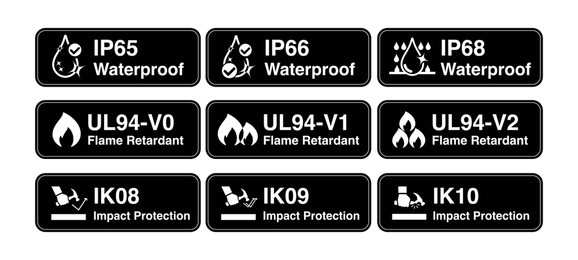
In the high-stakes world of global industrial procurement, “durability” is a word that is often tossed around too lightly. For procurement managers, reliability is the bedrock of a brand’s reputation. This is true whether you oversee sprawling EV charging networks or remote smart city kiosks. Consequently, the IK rating is more than just a label. It measures the bone-deep structural resilience of your hardware against unpredictable field hazards.
Technically speaking, the IK rating is an international numeric classification defined by the IEC 62262 standard. It specifies the degree of protection provided by enclosures against external mechanical impacts. Quite frankly, it moves far beyond what simple moisture-focused IP codes can tell you. To bridge the “fragility gap” in modern design, you must look past the surface and understand the engineering truth hidden in the construction.
For the professional wholesale buyer, this level of technical depth is crucial. In fact, it is the thin line between a high-maintenance liability and a “set-and-forget” asset. When you mount an electrical enclosure in a volatile public space, your choice dictates your Total Cost of Ownership (TCO). At YISHANG, we have always viewed IK ratings as a promise of survival rather than a mere compliance box.
I. Regulatory Framework: Beyond Just Checking a Box
The move to a dedicated regulatory framework was not just a bureaucratic change. Instead, it reflected the increasing complexity of our modern infrastructure. These IK rating industry standards ensure that mechanical resistance is verified in a lab. Whether you are sourcing a junction box nema style unit or a complex electrical meter box, the resistance is proven rather than guessed. Moreover, this standardization allows procurement teams to perform objective “apples-to-apples” comparisons between vendors.
Protecting equipment from damage is a constant headache in high-traffic zones. Unfortunately, this damage is often intentional. An enclosure that fails to meet the necessary degree of protection might save you 10% on the invoice today. However, it often leads to a total loss of internal electronics during the first impact. Therefore, it is vital to ensure your rating aligns with the specific kinetic risks of your site.
From a sourcing perspective, you must think about how impact energy radiates through a chassis. At YISHANG, our design and construction philosophy centers on how materials handle those forces. We prioritize impact resistance during the DFM (Design for Manufacturing) phase. Consequently, we help buyers sidestep the frustrating costs of frequent RMAs and emergency field repairs.
Ultimately, a high IK rating acts as a silent proxy for build quality. For instance, a control station enclosure certified to IK10 signals that every hinge and weld is over-engineered for extreme duty. This technical assurance lets our wholesale partners justify their pricing. In turn, they win the long-term contracts that truly matter in the B2B space.
II. The Physics of Impact: Deciphering the 01 to 10 Scale
Mastering the procurement of specific items like a push button enclosure requires comfort with non-linear physics. The ik levels range from IK00 up to IK10, which represents 20 Joules of energy. While IK01 to IK06 cover light-duty indoor needs, the jump to IK10 requires a different level of geometric thinking. This is because each step up the scale represents a significant increase in required resistance.
The physics involved is straightforward but unforgiving: Energy equals mass times gravity times height. To achieve IK10, an enclosure push button or solar battery unit must survive a 5kg steel hammer dropped from 400mm. That 20-Joule force is enough to split a weak corner weld or shatter a low-grade alloy. For this reason, your choice of manufacturer is, at its core, a safety decision.
| Application Environment | Potential Risk Level | Recommended IK Rating | Logic for Procurement |
|---|---|---|---|
| Indoor Server Rooms | Low (Accidental bump) | IK04 – IK06 | Prioritize airflow over heavy armor |
| Industrial Workshops | Medium (Tool drops) | IK07 – IK08 | A smart balance of cost and metal gauge |
| Public Transit/EV Sites | High (Vandalism/Crash) | IK10 | Non-negotiable for liability protection |
| Mining/Oil & Gas | Extreme (Heavy Machinery) | IK10+ (Custom) | Often requires internal structural stiffeners |
A well-engineered aluminum enclosure manages this energy wave through elastic deformation. Essentially, the metal “breathes” by flexing to absorb the hit and then snapping back. Furthermore, this split-second movement keeps internal components safe from catastrophic shock. Without this resilience, an electrical meter box could suffer internal short circuits after a single impact.
III. Material Mastery: Where Integrity Meets the Substrate
Choosing your substrate is perhaps the most critical decision in the entire process. A carbon steel enclosure offers fantastic rigidity and cost-effectiveness for indoor use. When processed correctly, these units provide a rock-solid baseline for IK08 ratings. However, procurement managers must watch out for brittleness. This happens if the steel is not tempered correctly during the fabrication process.
For demanding coastal or corrosive environments, the stainless steel enclosure is the undisputed king. The material stainless steel has a natural yield strength and ductility. Consequently, it absorbs massive energy without fracturing. Whether you source a material stainless steel unit or a hybrid, the true ROI shows up years later. The box remains durable despite brutal environmental exposure.
Aluminum alloys are a great lightweight alternative, but they have limitations. For instance, a quick steel enclosure aluminum comparison shows that aluminum needs thicker walls to match the same IK level. On the other hand, a galvanized steel enclosure offers a middle path. These units provide the impact resistance of steel with added sacrificial protection against rust. This is especially valuable in outdoor utility deployments.
At YISHANG, we believe design must follow the material’s natural grain. To illustrate, a stainless steel enclosure with sharp corners is more prone to stress-cracking than one with radius corners. We even analyze how powder coating affects surface tension. If a coating is too brittle, it can crack upon impact. This leaves your galvanized steel enclosure vulnerable to the elements.
IV. Strategic DFM: The Art of Structural Resilience
Achieving IK10 is not just about throwing more metal at the problem. Instead, it is about “energy management.” Over 26 years of fabrication at YISHANG, we have learned that geometry often beats thickness. A precision-engineered junction box nema unit uses internal stiffening to prevent “oil-canning” effects. As a result, your solar battery enclosure stays airtight and functional.
Furthermore, there is the “Gasket Paradox” to consider. A heavy impact can cause a millisecond of structural deflection. This is often just enough to momentarily unseat the seals. We solve this by designing our control station enclosures with deep gasket channels. Consequently, the moisture protection of the unit remains completely intact even after a major IK10 strike.
We also pay close attention to the “Heat-Affected Zone” (HAZ) during welding. Specifically, this area can easily become a fracture point if handled poorly. By using advanced laser-welding techniques, we minimize this zone. This preserves the original strength of the stainless steel or aluminum. For our wholesale partners, this means fewer failures in the field and a stronger reputation.
V. Looking Ahead: Smart Sensors and the Road to IK11
The hunger for impact resistance continues to grow as we track industry evolution. We are already seeing “ultra-rugged” requirements push toward an unofficial “IK11” rating. This rating would withstand a staggering 50 Joules of energy. While not yet part of the formal standard, it shows where the market is headed. This is especially true for sectors like mining and correctional facilities.
In the near future, enclosures will likely get a lot smarter. Integrated impact sensors could alert a central station the moment a junction box nema suffers a hit. This “active” protection can be compared to the passive IK rating we use today. In addition, it offers a layered defense that could drastically cut manual inspection costs for your clients.
At the end of the day, your goal is to protect a long-term investment. Whether your project is in a residential area or a punishing mining site, the IK rating industry is moving toward stronger designs. At YISHANG, we stay at the edge of these technical shifts. Therefore, our partners always have access to the best housing technology available.
Choosing the right IK rating is essentially an insurance policy for your brand. By partnering with experts who understand material nuances, you secure your supply chain against the unpredictable. We would love to hear from you. Please share your inquiry today and let us engineer a high-protection solution that actually lasts.
YISHANG: Precision Engineering. Proven Protection.