
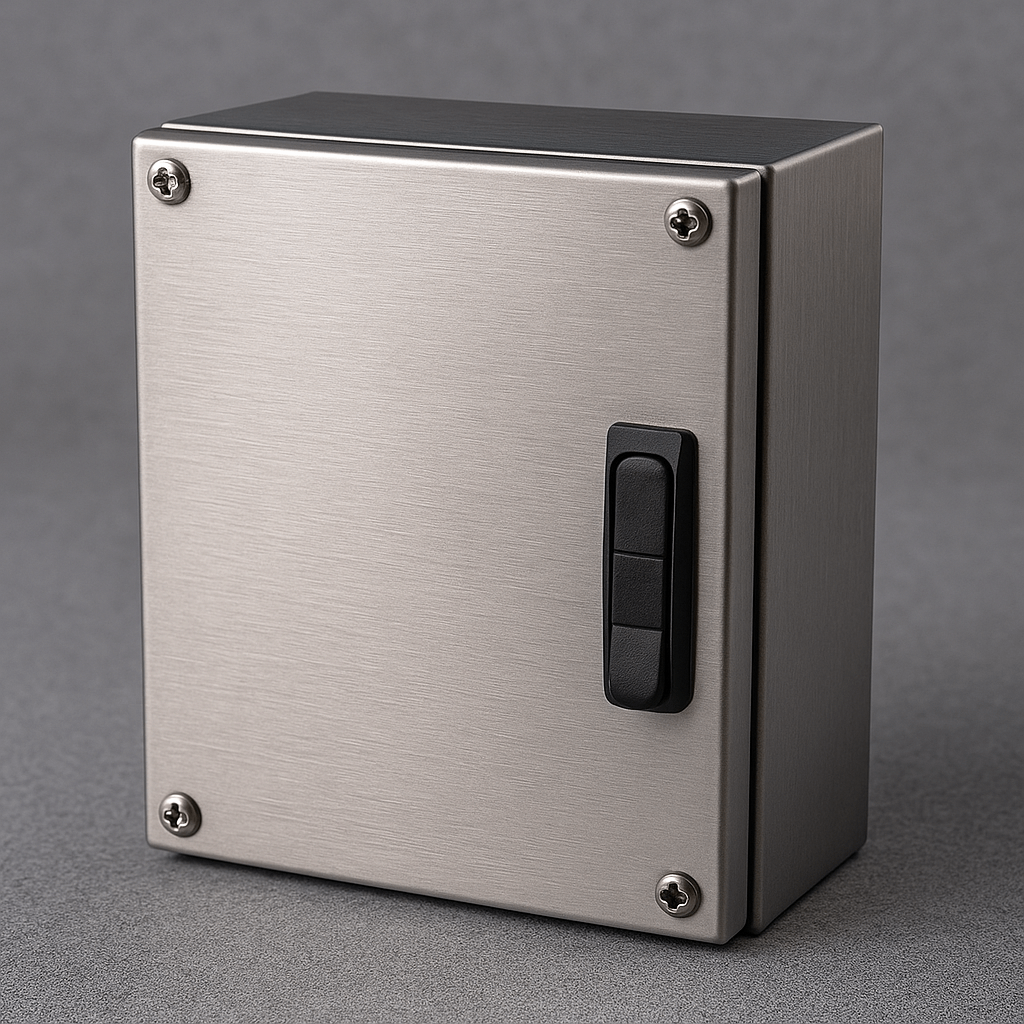
For procurement professionals and project engineers, specifying an electrical enclosure is a decision that goes far beyond a line on a quotation sheet. A small mistake at this stage can affect project cost, equipment reliability, installation performance, and long-term maintenance risk.
Vague terms such as “weatherproof” are not enough for serious industrial sourcing. Buyers need a clearer basis for decision-making, and that is exactly where the IP rating system becomes useful. It provides a more precise way to judge whether an enclosure is suited to the real operating environment.
This guide takes a buyer-focused look at the IP45 metal enclosure—what it means, where it makes sense, what can go wrong, and how to choose a solution that protects both equipment and total cost of ownership.
5 Minutes to Master: What is an IP45 Rating?
In industrial buying, an IP rating is more than a technical label. It is a practical way to judge whether an enclosure can survive its real operating environment. For buyers, engineers, and OEM teams, understanding IP45 helps reduce specification mistakes that later turn into leakage, downtime, or replacement cost.
An IP45 metal enclosure is designed for environments where directed water exposure matters more than full dust sealing. It is often a smart choice when equipment must handle moisture, washdown splashes, or wind-driven rain, but the application does not justify the extra cost of a fully dust-tight enclosure.
Decoding the Code: The Meaning of ‘4’ and ‘5’
The two digits in the IP code describe two different types of protection. The first digit refers to protection against solid objects. The second digit refers to protection against water.
The “4” for solids: This means the enclosure blocks solid objects larger than 1.0 mm. In practical terms, it helps prevent accidental entry of small tools, wires, or similar objects, while also improving safety around internal components.
The “5” for water: This means the enclosure can resist low-pressure water jets from any direction. It is a meaningful step above simple splash resistance and is suitable for environments where equipment may face washdown, spray, or forceful rain exposure.
The Core Purpose: The Niche of an IP45 Enclosure
Taken together, the IP45 rating fits a clear niche: wet or semi-exposed environments where water protection is important, but full dust-tight sealing is not necessary. That is why IP45 often makes sense in projects where buyers want dependable performance without paying for protection levels the application does not actually need.
For procurement teams, this matters because the right enclosure rating is not about buying the highest number. It is about buying the right level of protection for the actual risk.
Comparing IP Ratings: Choosing the Right Level of Protection
Choosing an enclosure rating is a balance between performance, cost, and long-term reliability. Over-specifying can waste budget. Under-specifying can lead to water ingress, field failures, and early replacement.
For buyers comparing enclosure options, the most useful question is simple: What exactly is the equipment likely to face in daily operation? That is the starting point for a better IP rating decision.
IP45 vs. IP44: The Critical Difference Between a Splash and a Jet
The difference between IP44 and IP45 is mainly about water exposure.
- IP44 is intended for protection against splashing water.
- IP45 is designed to withstand low-pressure water jets.
That difference may seem small on paper, but in real applications it is important. If equipment may be cleaned with a hose, hit by stronger spray, or exposed to wind-driven water, IP45 offers a safer margin than IP44.
IP45 vs. IP54: The Strategic Trade-off Between Water and Dust
The comparison between IP45 and IP54 is really a choice between more water protection and more dust protection.
- IP45 gives better resistance to directed water.
- IP54 gives better resistance to dust ingress.
That means the right option depends on the site. A relatively clean area with regular washdown may favor IP45. A dusty indoor space with limited water exposure may favor IP54.
For procurement teams, this is where application knowledge matters more than simply choosing the higher-looking number.
IP45 vs. IP65/IP67/IP68: Understanding Higher Levels of Protection
When buyers compare IP45 vs. IP65, the main difference is dust sealing. IP65 adds full dust-tight protection, which is valuable in dirty, outdoor, or powder-heavy environments.
Moving higher still:
- IP67 is associated with temporary immersion protection.
- IP68 is intended for continuous immersion under defined conditions.
But higher numbers do not automatically mean a better commercial choice. If the real threat is washdown or rain rather than dust or immersion, paying for an IP67 or IP68 enclosure may add cost without adding meaningful value.
The right enclosure is the one that matches the actual use case—not the one with the most impressive rating on paper.
NEMA vs. IP Rating: A Note for the North American Market
North American projects often refer to NEMA ratings instead of IP codes. The two systems are related, but they are not identical.
In general, NEMA classifications cover a broader set of enclosure performance considerations, including issues such as corrosion and environmental durability that are not defined the same way in the IP system.
For buyers working across international projects, it is important not to assume direct one-to-one equivalence without checking the real application requirements.
Top Applications for IP45 Enclosures
The practical value of IP45 becomes much clearer when viewed through real operating conditions. Below are several applications where IP45 metal enclosures can be a strong fit from both a performance and cost perspective.
Scenario 1: Food Processing and Pharmaceutical Facilities
Food and pharmaceutical environments are often cleaned regularly, and that means enclosures may face frequent low-pressure hose-down exposure.
If dust is limited but water contact is routine, an IP45 enclosure can be a practical solution. In these settings, buyers should also consider material selection, weld quality, gasket performance, and cleanable surface finish, especially when hygiene and long-term durability matter.
Scenario 2: Outdoor Advertising and Telecom Infrastructure
Outdoor advertising cabinets, telecom boxes, and partially sheltered control housings often operate in environments with rain, condensation, and changing humidity.
Where the installation site is exposed to moisture but not heavy dust, IP45 can offer a balanced solution. It gives the project stronger water resistance than light splash-rated options while avoiding unnecessary overspending on a more heavily sealed enclosure.
Scenario 3: Coastal and Chemical-Adjacent Applications
In coastal areas or sites near chemical exposure, ingress rating is only part of the equation. Corrosion resistance becomes equally important.
In these projects, an IP45 enclosure may still be suitable from a sealing perspective, but the enclosure material should be selected carefully. For example, 316 stainless steel is often preferred over lower-grade materials in aggressive environments where salt spray or chemical vapor can shorten service life.
Precision in Fabrication: What Makes or Breaks IP45 Integrity
A correct IP rating on paper does not guarantee reliable field performance. Real IP45 integrity depends heavily on how the enclosure is designed, fabricated, assembled, and finished.
For buyers, this means supplier capability matters just as much as the stated protection level.
Common Failures in Subpar Enclosures
Common failure points in lower-quality enclosures include:
- Poor gasket design or compression, which leads to leakage over time.
- Incomplete or inconsistent welds, which create hidden entry paths for water.
- Door or latch misalignment, which prevents even sealing pressure.
- Weak surface treatment or poor material choice, especially in corrosive environments.
These issues are easy to overlook during sourcing, but they often determine whether an enclosure performs well in the field or fails early.
Key Features of a Quality IP45 Rated Enclosure
A high-quality IP45 enclosure typically shows several important features:
- Consistent gasket application for reliable sealing performance.
- Clean, controlled welding that avoids distortion and leakage paths.
- Rigid door and panel construction to maintain sealing pressure.
- Verified material traceability, especially for stainless steel projects.
- Accurate fabrication of cutouts, mounting points, and mating surfaces.
At this stage, the enclosure stops being a catalog product and becomes a manufacturing-quality issue.
Installation Pitfalls: When an IP45 Rating Fails in the Field
Even a well-made enclosure can lose its performance if it is installed poorly. In many cases, field failure is not caused by the enclosure body itself, but by site-level installation mistakes.
Common Site-Level Mistakes
Typical installation mistakes include:
- Improper cable entry sealing, especially when field drilling is uncontrolled.
- Mounting gaps or uneven wall contact, which can allow hidden water paths.
- Incorrect fastening torque, which may distort panels or reduce gasket performance.
- Use of non-matching accessories, such as glands or hardware that do not support the target rating.
A good enclosure can only perform as intended when installation standards are controlled as part of the full project scope.
Customization Considerations: Balancing Cost, Compliance, and Practicality
For OEM projects, enclosure customization is often necessary. The challenge is to add the right modifications without weakening protection, raising cost unnecessarily, or making production harder to control.
That is where an experienced metal enclosure manufacturer can add real value—by balancing compliance, manufacturability, and project practicality.
Key Areas for Customization:
Key areas buyers often customize include:
- Cable cutouts and openings, which should be produced accurately to protect sealing performance.
- Surface finish, including brushed stainless, powder coating, or application-specific corrosion protection.
- Mounting structure, such as wall-mounted, pole-mounted, recessed, or integrated support options.
- Labeling and identification, including durable marking for asset control and project traceability.
Conclusion: When to Choose IP45 Over IP54 or IP65
The best enclosure choice is not always the one with the highest IP number. It is the one that fits the real operating environment, maintenance conditions, material risks, and project budget.
An IP45 metal enclosure can be an excellent choice when the application requires dependable protection against directed water, but does not require full dust-tight or immersion-level sealing. When designed well, fabricated accurately, and installed correctly, it offers a strong balance of performance, durability, and cost control.
➤ Ready to Customize Your IP45 Enclosure?
At Yishang Metal Products Co., Ltd., we support wholesale and OEM customers with custom metal enclosure manufacturing built around real production needs. With 26+ years of experience in sheet metal fabrication, metal cabinets, metal frames, and enclosure production, we help buyers balance protection level, material choice, fabrication quality, and cost.
We work with materials including stainless steel 304/316, low carbon steel, galvanized steel, aluminum, copper, and brass, and support processes such as laser cutting, bending, stamping, welding, CNC machining, surface treatment, assembly, packaging, inspection, and shipment.
For buyers looking for long-life, custom industrial enclosures with practical OEM/ODM support, IP45 can be a smart and efficient choice when specified correctly.
Why Partner with YISHANG:
- 26+ years of custom metal manufacturing experience
- OEM & ODM support for wholesale projects
- ISO 9001 and RoHS certified factory
- Custom enclosure fabrication with flexible material and finish options
- Export experience serving customers in 50+ countries
📩 Send us your drawings, specifications, or CAD files to discuss your IP45 enclosure project.