
For overseas OEM buyers and wholesale sourcing teams, the most useful supplier content answers one practical question: can this product be manufactured in a stable, repeatable, and commercially manageable way?
Most buyers do not need another broad overview of sheet metal processes. They already know what sheet metal fabrication includes. What they want to understand is where a complex build is likely to become unstable, how that instability affects supply, and whether a supplier understands those risks early enough to prevent them.
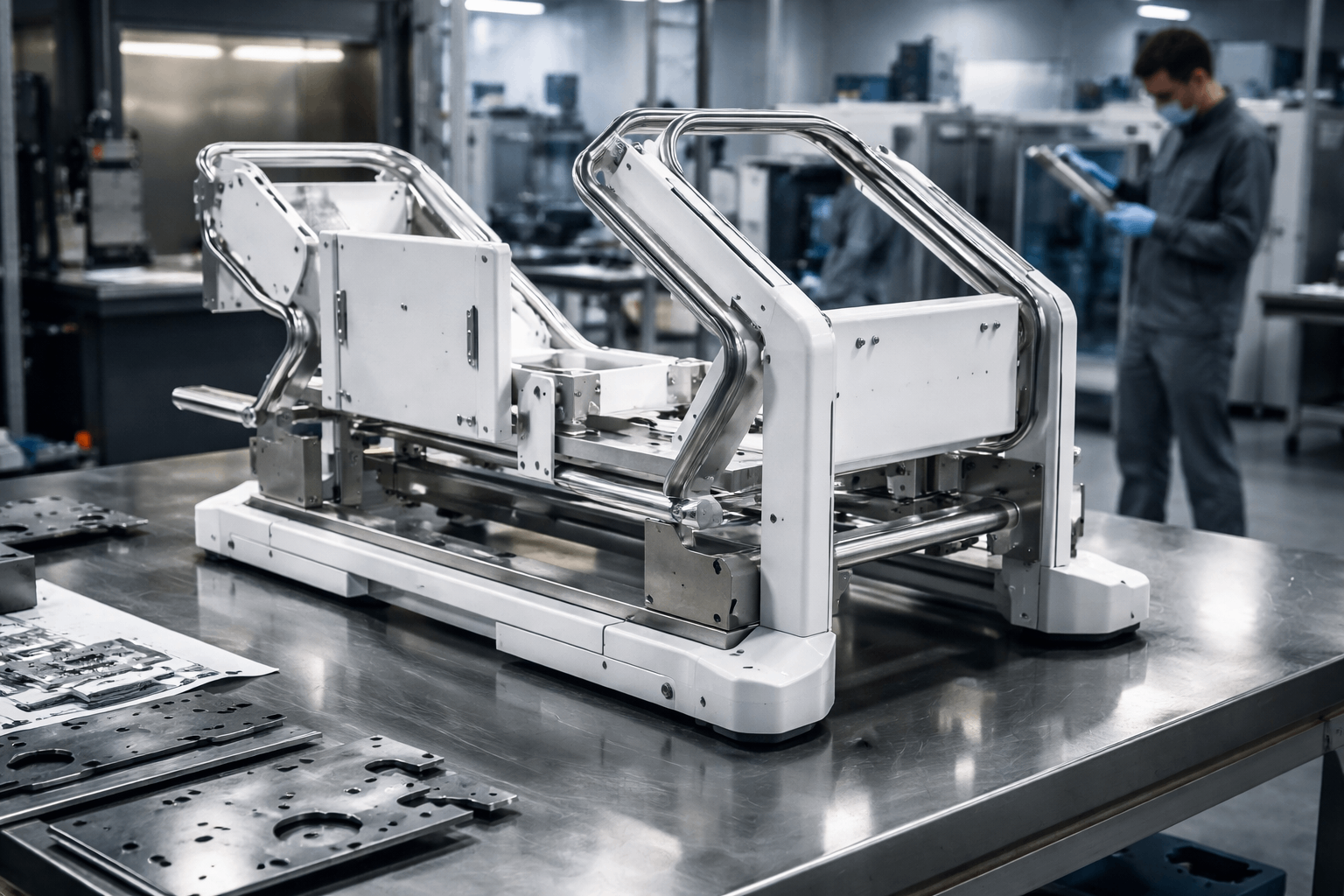
That is what makes Turn Medical’s Pronova-O2 a useful case. Public information presents it as automated proning equipment that supports patient positioning and improves caregiver access and cleaning efficiency. All Metals also notes that the program involved roughly 650 parts, with a significant portion in medical sheet metal. For a procurement team, that detail signals a product where geometry, finish, assembly, and revision control all matter at the same time.
This article stays focused on that manufacturing reality. Rather than repeating generic claims about innovation or capability, it looks at the control points that matter most in supplier evaluation: tolerance stability, cleanable finishes, process coordination, and the transition from prototype to repeatable production. That is the same practical mindset YISHANG applies in custom metal manufacturing for wholesale buyers.
Why a Product Like Pronova-O2 Creates a Different Manufacturing Challenge
Proning equipment is not difficult simply because it serves a medical use case. It becomes difficult when several requirements must hold together in the same build. The structure must support real patient loads. Caregivers need clear access around the equipment. The exterior must stay cleanable and visually controlled. At the same time, the product must support repeat orders and stable lead times.
When these demands are viewed one by one, each seems manageable. The difficulty appears when they start interacting. A structure can be strong and still become sensitive to tolerance variation. A product can look refined in a sample build and still become difficult to finish consistently in production. A design can function well in use and still create avoidable cost or delay if hardware locations, weldments, and assembled surfaces are not coordinated carefully.
This is where engineering product design and supply risk begin to overlap. Buyers are not purchasing a prototype alone. They are choosing a supply relationship. For overseas teams in particular, instability raises costs quickly. Every avoidable issue creates more emails, more approvals, more lead-time pressure, and weaker reorder confidence.
That is why this case matters beyond the device itself. It shows how a demanding fabricated product becomes a test of manufacturing judgment. Buyers are less persuaded by long capability lists than by evidence that a supplier understands where a project typically gains control or loses it.
The First Control Point: Geometry and Tolerance Stability
Geometry is the first place where a demanding build either becomes stable or starts to drift. Dimensional control affects every later assembly decision. In complex medical sheet metal programs, visible strength matters, but it is not the whole story. The harder question is whether dimensions stay predictable enough for repeatable assembly.
That includes bend position, hole location, weld movement, bracket relationships, and tolerance stack-up across connected parts. In a one-off build, a team can often solve small deviations through direct communication or extra fitting effort. In repeat production, the same deviations become more expensive because they affect assembly flow, hardware installation, inspection time, and final consistency.
This is one reason experienced sourcing teams listen closely to how a supplier talks about production. A supplier that talks only about part accuracy may still be thinking too narrowly. A supplier that talks about fit-up, weld distortion, assembly behavior, and downstream variation is usually closer to the buyer’s actual concerns.
Once a build includes hundreds of parts, the real issue is not whether one component passed inspection. The real issue is whether the overall product remains stable enough to quote, build, inspect, and reorder with confidence. In practical terms, that means processes such as laser cutting, CNC punching, CNC machining, forming, and welding cannot be managed as isolated steps. They have to support one geometry logic from start to finish.
For wholesale buyers, this is also where supplier conversations become more revealing. Geometry control upstream shapes quote accuracy, inspection effort, and reorder reliability. Strong suppliers explain where dimensional risk will appear, how it may affect assembly, and what teams can do upstream to avoid repeated downstream correction. That kind of explanation is often more useful than hearing that a supplier has advanced equipment.
The Second Control Point: Finish Quality, Seams, and Cleanable Surfaces
After geometry, the next major control point is the finished surface of the product. In healthcare-related equipment, cleanability is not a soft feature. Fabrication details shape it directly. Seam treatment, edge quality, exposed joints, surface transitions, and final marking all influence how users maintain the product and how they judge it in use.
This is why finishing should not be treated as the last cosmetic step, especially in products where cleaning and visual control both influence acceptance. For buyers, finish quality is often a signal of process maturity. A mechanically acceptable structure can still feel underdeveloped if coatings vary, edges are inconsistent, or printed markings do not align cleanly with the final build.
The Pronova-O2 case makes this point especially relevant because public product information emphasizes streamlined cleaning. Once ease of cleaning becomes part of the product story, fabrication detail becomes commercially important. The supplier needs to think through seam exposure, coating behavior, finishing order, and how later assembly steps may affect surface quality.
In practical production terms, that can involve powder coating, silk screening, hardware insertion, and final assembly sequencing. Buyers do not search for these terms just to collect process names. They care because poor coordination between finishing and assembly often leads to cosmetic rework, marking inconsistency, or a product that looks less controlled than expected.
This is also where broad phrases such as “high-quality finish” become less useful. Buyers respond better when a supplier can explain how finish consistency is protected, how seam behavior is handled, and how finishing interacts with hardware, labels, and final assembly. The more practical the explanation, the more credible the supplier sounds.
The Third Control Point: Process Coordination Across the Full Build
Once geometry and finish are understood, the next question is whether the full manufacturing chain stays coordinated. This is often where complex projects either become manageable or begin to create friction between engineering, purchasing, and production.
A supplier may offer a wide range of capabilities, but that does not automatically produce a stable result. The more operations a product involves, the more important it becomes to keep revisions, process logic, and documentation aligned from one step to the next.
In a program like this, the chain may include laser cutting, tube laser cutting, punching, CNC machining, forming, robotic welding, hardware insertion, finishing, and assembly. Each stage brings its own variables. Buyers do not only ask whether those capabilities exist. They also ask whether the supplier can keep them connected so one stage does not quietly undermine the next.
This matters especially when welded structures, hardware positions, and finish-sensitive surfaces all interact in the same build. A supplier with weak internal coordination may still produce acceptable parts, but the buyer ends up spending more time clarifying revisions, confirming build status, and resolving issues that should have been prevented earlier.
By contrast, strong process coordination reduces handoff risk and gives buyers a clearer path from drawing release to dependable supply. It shortens clarification cycles. It supports faster approvals and gives buyers more confidence that machining, forming, welding, hardware integration, electromechanical assembly, and documentation flow are being managed as one controlled system.
For YISHANG, this is one of the most practical lessons in the case. Broad capabilities matter, but they matter most when they reduce risk for the customer. Buyers are not looking for the longest capability list. They are looking for the shortest path between product intent and stable supply.
From Prototype to Production: Where Buyers Decide Whether a Supplier Is Scalable
Prototype work often creates early confidence because the product exists and teams have validated the concept in hardware. For sourcing teams, a more important question comes next. Can the supplier move from early builds to repeatable production without losing control of geometry, finish, documentation, and timing?
This is the point where many buyers decide whether a supplier is simply capable or genuinely scalable. At the prototype stage, teams have more room for engineering intervention, selective rework, and direct communication. Production works differently. Buyers need revision traceability, practical inspection methods, stable packaging logic, and clear communication even when the team is not physically next to the build.
The public description of the Pronova-O2 project suggests frequent revisions during earlier phases. That detail matters because revision-heavy products expose the maturity of a supply partner very quickly. A stable supplier does not just accept drawing changes. The supplier understands what those changes mean for forming sequence, weld accessibility, hardware position, coating consistency, and final assembly.
In this context, design for manufacturing is not just about cost reduction. It is also about protecting schedule confidence, inspection clarity, repeatable output, and overall build stability as the product matures. For buyers, that translates into more accurate quoting, fewer avoidable delays, and better reorder confidence after the first production run.
This is also one of the strongest signals in supplier communication. Dependable suppliers explain risk in plain language, link manufacturing choices to schedule and cost, and show where one change may create consequences elsewhere in the build. Buyers do not search request a quote because they only want a quick number. They want a supplier who can quote responsibly and support the product after the PO is placed.
What Wholesale Buyers Can Take From This Case
A case like this is useful when it helps buyers make better judgments, not when it simply repeats the supplier’s own marketing language. The most practical takeaway is that complex fabricated products should be evaluated as systems.
That means asking a few grounded questions. Does the supplier understand system-level geometry rather than just part-level accuracy? Can they explain how finish quality, seam treatment, and marking consistency affect the final product? Can they coordinate cutting, machining, forming, welding, finishing, and assembly without turning each revision into a separate troubleshooting cycle?
These questions connect directly to purchasing outcomes. If the supplier maintains control in those areas, the buyer is more likely to see stable lead times, smoother approvals, and more consistent quality across repeat orders. If the supplier does not, even a technically impressive sample may turn into a weak long-term supply relationship.
That is why this article stays tightly tied to manufacturability rather than drifting into broad industry commentary. The real issue is not simply that proning equipment is innovative. The real issue is whether a demanding product can be supplied in a way that remains commercially reliable over time.
Conclusion: Why This Case Matters Beyond One Product
The Pronova-O2 example shows why advanced sheet metal fabrication projects should be viewed as controlled manufacturing systems rather than isolated part-making exercises. In a build with many interacting parts, the strongest supplier is usually the one that can connect geometry control, finish consistency, process coordination, and revision discipline into one stable production flow.
For overseas buyers, that is what creates trust and makes a supplier easier to scale over multiple orders. A supplier creates value not only by making parts, but also by reducing uncertainty as the project moves from concept support to ongoing production. If your next program involves medical sheet metal, welded structures, precision assemblies, or revision-heavy manufacturing, YISHANG can review the build with your team and help you move toward a more reliable supply plan.