
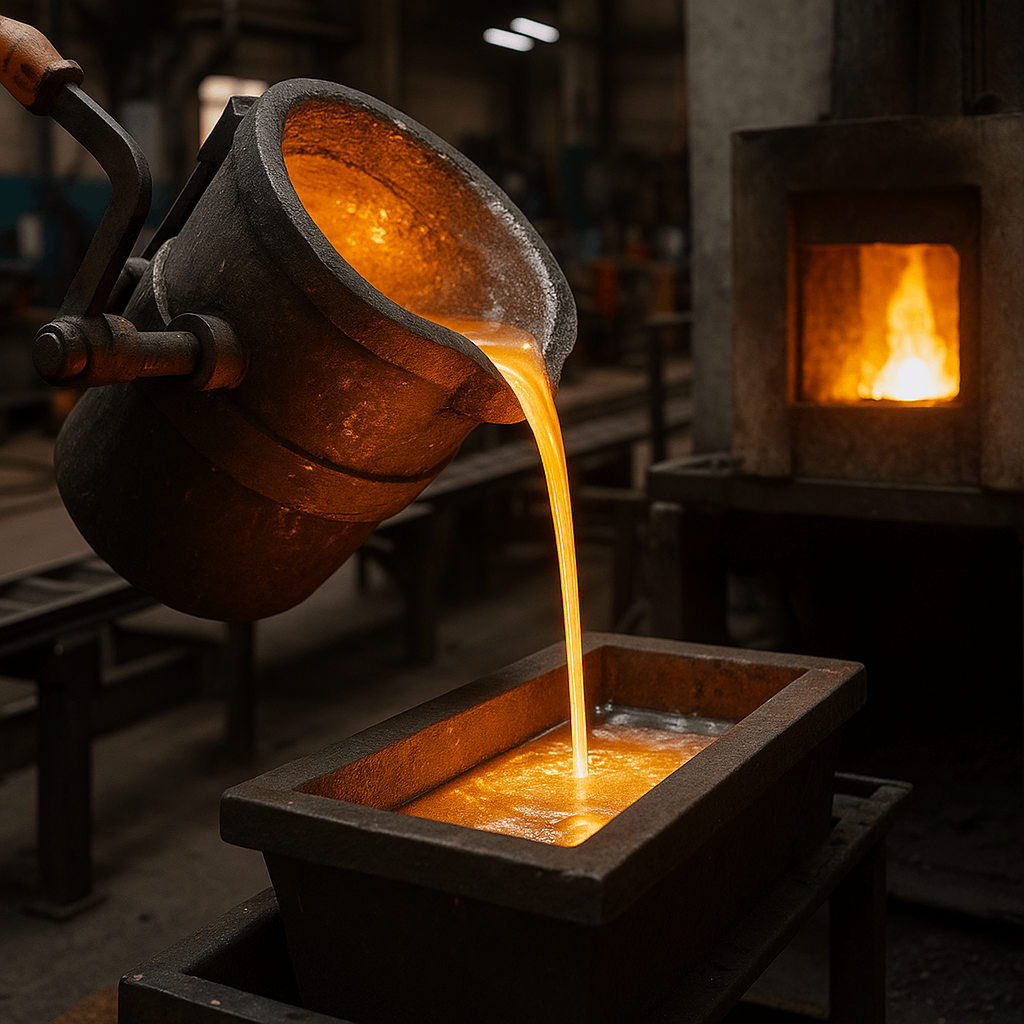
Introduction: Why a Metal's Melting Point Is a Strategic Variable in Procurement
In metal sourcing, melting point is not just a number for engineers. It affects furnace settings, cycle time, energy use, tooling choices, safety controls, and sometimes the entire cost structure of a project.
Lead melts at 327.5°C (621.5°F). That relatively low melting temperature is one reason it remains relevant in battery grids, shielding components, solder-related applications, cast parts, and other controlled metal-processing environments.
For international wholesale buyers and procurement teams, understanding lead’s melting point helps clarify more than “how hot the furnace should be.” It supports better alloy selection, safer processing, more accurate RFQs, and fewer surprises during production.
Understanding the Melting Point of Lead
Lead’s melting point of 327.5°C places it in a useful range for low-temperature metal processing. It melts at a higher temperature than tin, but far below aluminum or copper. This makes it easier to cast, form, or re-melt in controlled production compared with many structural metals.
Its thermal behavior is tied to weaker metallic bonding, which makes lead relatively easy to bring into a molten state. For manufacturers, that predictability matters. It helps with controlled fusion in applications such as solders, ballast weights, shielding forms, and cast lead components.
| Metal | Melting Point (°C) | Common Applications |
| Tin | 231.9 | Soldering, plating |
| Lead | 327.5 | Batteries, shielding, soldering |
| Zinc | 419.5 | Die casting, galvanizing |
| Aluminum | 660.3 | Aerospace, automotive, packaging |
| Copper | 1085 | Electrical, plumbing, heat exchange |
Lead also has a low latent heat of fusion and a specific heat capacity of 0.128 J/g·K. In practical terms, less thermal input is needed to process it compared with higher-melting metals. For cost-controlled manufacturing, that can be a real advantage.
Quick Facts: Lead Melting Temperature for Engineers and Buyers
For quick engineering reference:
Melting point of lead in Celsius: 327.5°C
Melting point of lead in Fahrenheit: 621.5°F
Related search terms: lead melt point, lead melting temp, lead melting temperature
These values are useful when engineers calculate furnace settings, safety margins, preheating steps, or mold compatibility. For buyers asking “what temperature does lead melt at,” the short answer is clear: lead melts at 327.5°C / 621.5°F.
Why Lead's Melting Point Matters to Industrial Buyers
For sourcing teams, lead’s relatively low melting temperature can translate into practical manufacturing value:
lower furnace energy demand;
reduced thermal stress on equipment;
faster casting or re-melting cycles;
easier control in repeat production.
This is especially relevant in battery, cable, shielding, and casting-related supply chains, where stable melt behavior supports consistent output.
Knowing the lead melting temperature also helps with tooling decisions. Mold materials, preheating requirements, solder compatibility, cooling behavior, and downstream assembly conditions all depend on the material’s thermal window.
Melting Point of Lead Alloys in Industrial Use
Industrial lead alloys do not all melt the same way. Composition changes the melting range, flow behavior, and final application suitability. For buyers, this matters when sourcing materials for high-volume casting, soldering, battery components, or specialty metal parts.
| Alloy | Composition | Melting Range (°C) | Applications |
| Pb-Sn | 63% Sn / 37% Pb | 183 (eutectic) | High-precision soldering |
| Pb-Sb | ~8% Sb / balance Pb | 250–300 | Grids, jackets, bushings |
| Pb-Ca | ~0.1% Ca / balance Pb | 320–330 | Battery plates, cabling |
The practical point is straightforward: buyers should not specify “lead alloy” too generally. A Pb-Sn solder alloy, a Pb-Sb casting alloy, and a Pb-Ca battery alloy behave differently in processing.
YISHANG supports lead alloy sourcing and production discussions based on required melting behavior, mold speed, cycle time, and final component requirements.
Safety & Compliance in Lead Melting Environments
Lead melting requires strict safety control. At operating temperatures, airborne lead particles and process fumes can create occupational health risks if ventilation and handling procedures are poorly managed.
The original article references OSHA’s 50 μg/m³ PEL for airborne lead exposure and OSHA 29 CFR 1910.1025 as important compliance benchmarks. For sourcing teams, this means supplier evaluation should include more than price and lead time. Safety infrastructure matters.
Controlled melt operations may include HEPA-filtered ventilation, downdraft fume extraction, thermal shielding, process logs, and third-party testing when required. These controls help protect workers and reduce compliance risk for buyers sourcing lead-based components.
Lead Recycling: Why Melting Point Enhances Reusability
Lead’s low melting point also supports recycling. Because it can be re-melted at relatively modest temperatures, scrap lead can often be recovered and re-alloyed with lower energy input than many higher-melting metals.
The original article notes that the EPA estimates more than 85% of lead products globally are recycled. For procurement teams working toward circularity or ESG targets, this recyclability can be part of the sourcing discussion.
In practical manufacturing, controlled re-melting helps reduce slag, improve usable yield, and keep recycled material within predictable process limits. The key is process control—not simply melting scrap and hoping for consistency.
Lead Melt Point vs. Other Common Metals
The lead melt point becomes easier to understand when compared with other common metals.
| Metal | Melting Temp (°C) | Melting Temp (°F) |
| Lead | 327.5 | 621.5 |
| Tin | 231.9 | 449.4 |
| Aluminum | 660.3 | 1220.5 |
| Brass (varies) | ~900 | ~1650 |
Lead melts at a much lower temperature than most structural metals. That is why it can be more energy-efficient for casting, forming, and controlled re-melting operations.
Use Cases That Rely on Lead's Thermal Profile
For wholesalers, lead’s thermal behavior helps determine application fit and downstream performance.
Common use cases include:
Power storage: Lead’s predictable melt behavior supports dense battery plate formation.
Shielding: Its fusion range allows casting into compact shielding forms.
Electrical applications: Eutectic Pb-Sn alloys support rapid bonding at lower process temperatures.
These characteristics help explain why lead remains relevant in automotive, telecom, energy storage, and defense-related manufacturing.
Lead-free alternatives continue to gain regulatory attention, but they may bring trade-offs. Bismuth alloys can have wider melting ranges, while silver-based options may be expensive. In many industrial contexts, lead remains competitive because of:
Dimensional control: Tight melting ranges support high-tolerance mold filling.
Thermal efficiency: Lower melting temperature can reduce furnace cycles.
Cooling stability: Predictable cooling behavior helps maintain process consistency.
Conclusion: What Procurement Teams Need to Know
Lead’s melting point is not a piece of trivia. It affects furnace settings, alloy selection, tooling decisions, safety controls, energy use, recycling potential, and final part consistency.
For procurement teams sourcing lead-based castings, solders, shielding parts, or battery-related components, understanding the melting temperature helps reduce production uncertainty and improve supplier communication.
The best sourcing approach is to define the alloy, melting behavior, application environment, safety requirements, and documentation needs before production starts. YISHANG supports lead-related metal sourcing with specification review, quality assurance, and export-ready documentation.
Frequently Asked Questions (FAQ)
Q1: Can you supply custom lead alloys with specific melting ranges?
Yes. YISHANG can support tailored lead alloy solutions with defined melting behavior for industrial requirements.
Q2: How does the melting point of lead affect manufacturing processes?
It influences furnace temperature settings, casting speed, cooling behavior, mold compatibility, and process stability in high-volume manufacturing.
Q3: Do you offer export documentation and compliance support?
Yes. YISHANG can provide RoHS, ISO, MSDS, and standard shipping documents for export orders.
Q4: What is the lead melt point used for in industry?
Lead’s melt point is important in soldering, battery grid production, cable sheathing, radiation shielding, and controlled casting processes.
Q5: What is the difference between lead’s melting temperature and its boiling point?
Lead melts at 327.5°C, while its boiling point is much higher at 1749°C. Most industrial applications only require heating lead to its melting temperature for forming, casting, or coating.