If you source sheet metal parts internationally, bending services can look like the simplest step in the process. The part is cut, a press brake forms the angles, and everything should fit. In real production, however, bending is often where batch consistency, cost predictability, and downstream fit are either secured or quietly undermined.
Most bending-related failures do not appear at the machine. They surface later—when assemblies refuse to align, when welded frames pull out of square, or when a cosmetic finish highlights distortion that was previously invisible. These outcomes are frustrating because they feel unpredictable. In practice, they follow repeatable patterns that experienced metal bending shops learn to manage.
This article is written for overseas wholesale buyers and OEM sourcing teams. It focuses on repeatability, quoting accuracy, and downstream manufacturing risk—not on marketing language. The goal is to help you evaluate bending capability the same way you evaluate suppliers: through decisions, assumptions, and long-term outcomes.
Bending Rarely Fails at the Press Brake — It Fails After That
For wholesale buyers, the most expensive bending problems are the ones that pass early inspection. Many suppliers measure the bend angle at the press brake, record the value, and release parts once they meet the drawing. On a first article inspection, the part can look perfect and still create problems later. This is why an “approved sample” does not automatically mean the process is production‑ready.
A bent part is never used in isolation. It must match mating components, fixtures, weld sequences, and finishing requirements. A small angular deviation can translate into a significant assembly mismatch when a part has multiple bends, long flanges, or tight hole‑to‑edge relationships. During welding, residual stress introduced during bending can relax under heat, causing distortion that was not present in loose parts. During powder coating or painting, even slight waviness becomes visually unacceptable.
For buyers sourcing bent services in volume, this delayed failure mechanism is critical. The risk is not a single bad part; it is a repeatable deviation that affects entire batches. Strong bending services therefore focus on controlling how variation propagates after bending, not just on meeting nominal bend angles at the machine.
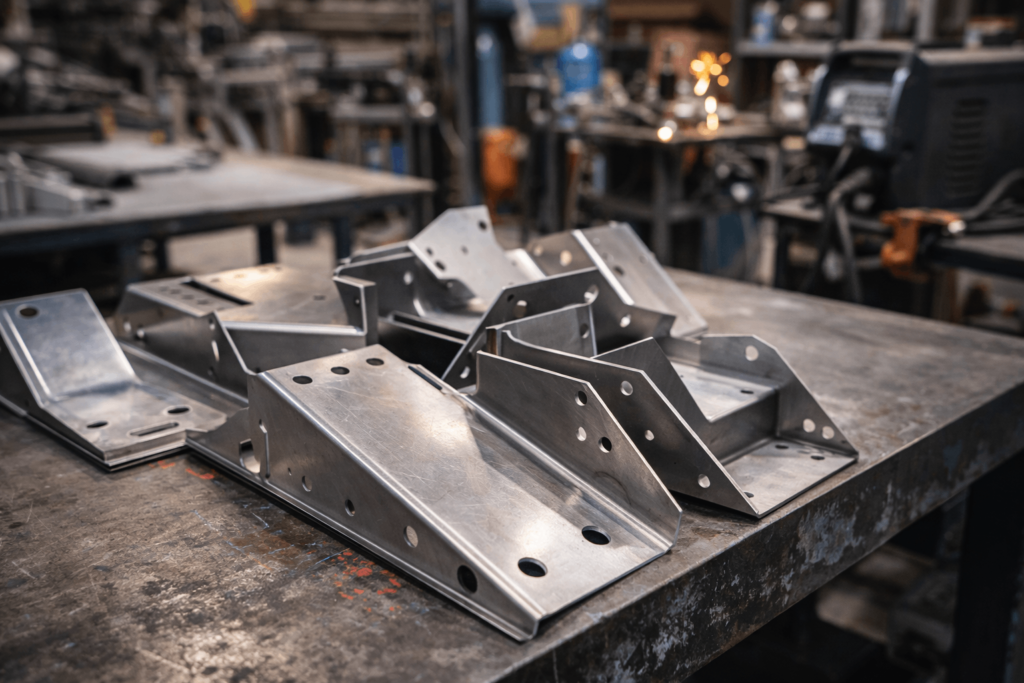
The Hidden Assumptions Behind Every “Simple” Bend
Most sourcing problems in bending begin with assumptions that are reasonable on paper but fragile in production. One common assumption is material consistency. Even when the material grade is correct, yield strength and thickness vary between mills, coils, and batches. These differences directly affect springback and final geometry. A supplier can follow the drawing precisely and still see results drift over time.
Another assumption is that automation guarantees stability. CNC bending services typically improve repeatability by controlling ram depth, backgauge position, and bend sequence. However, automation does not remove uncertainty—it shifts it. If bend allowance, bend deduction, or material parameters are incorrect, the CNC system will reproduce the same deviation consistently. Buyers often see “CNC” and assume the risk is solved, when it has actually moved into data validation.
A third assumption involves tolerance interpretation. Many buyers specify an angle tolerance and expect it to translate directly into assembly success. In practice, functional fit depends on dimensional relationships, not just angle accuracy. This is where tolerance stack‑up appears: several acceptable deviations combine into one unacceptable assembly outcome.
When evaluating suppliers, listen for how they address assumptions. Reliable bending services ask early questions about functional dimensions, assembly datums, and downstream processes. These questions are not delays; they are practical risk controls.
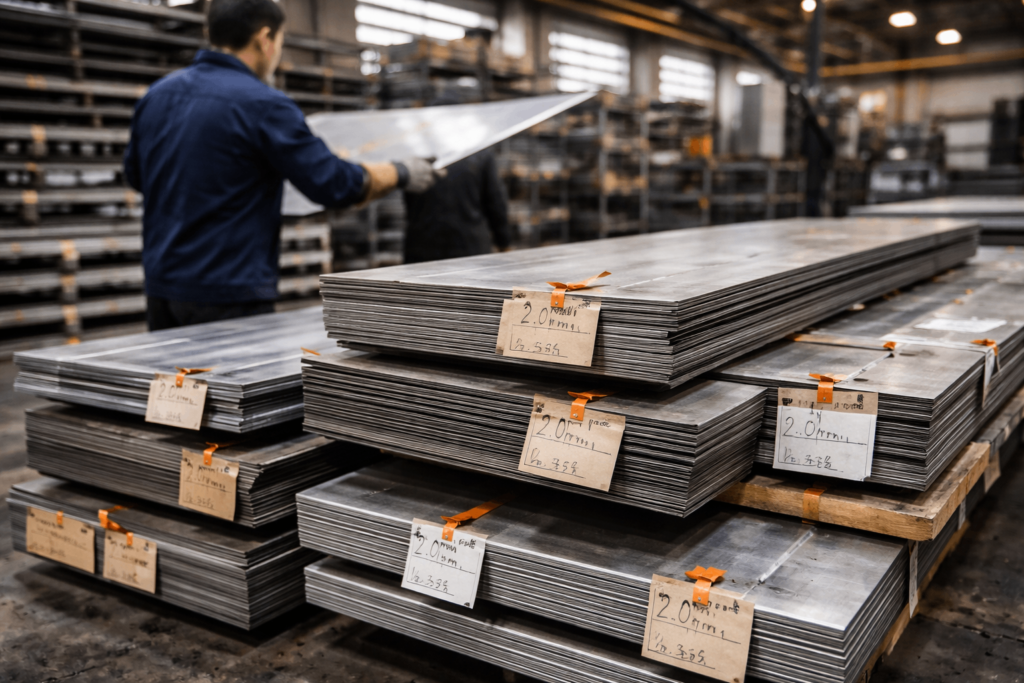
Bending Accuracy Is Not a Number — It’s a Range
Buyers often request a single accuracy statement such as “±0.5°.” While convenient, this is an incomplete model. In real manufacturing, bending accuracy behaves as a range influenced by material variation, tooling condition, part geometry, bend sequence, and temperature. Treating accuracy as a range helps align expectations with production reality.
It is also important to distinguish angle accuracy from part accuracy. Angle accuracy measures the bend itself. Part accuracy determines whether the component fits in the assembly—flange lengths, hole alignment, and critical distances. A part can hit the angle target and still fail because the flat pattern, K‑factor assumption, or cumulative dimensional effects were not controlled.
For procurement teams, a more useful question than “What angle tolerance can you hold?” is “Which dimension is functional, and how do you control it?” Experienced suppliers will discuss datums, gauging strategy, and feedback loops rather than quoting a single number.
The table below shows how to align bending expectations in an RFQ. The values are not promises; they are reference points that help buyers and suppliers communicate clearly.
| What you specify | What it actually controls | What to also clarify |
|---|---|---|
| Angle tolerance | Repeatability at the bend | Functional datums and mating features |
| General dimensional tolerance | Overall fit | Which dimensions are critical to assembly |
| Surface requirement | Cosmetic acceptance | Finish type and visible faces |
| Batch requirement | Long‑term consistency | Lot size, reorder cadence, FAI/AQL plan |
When accuracy is defined in functional terms, late‑stage surprises become far less common.
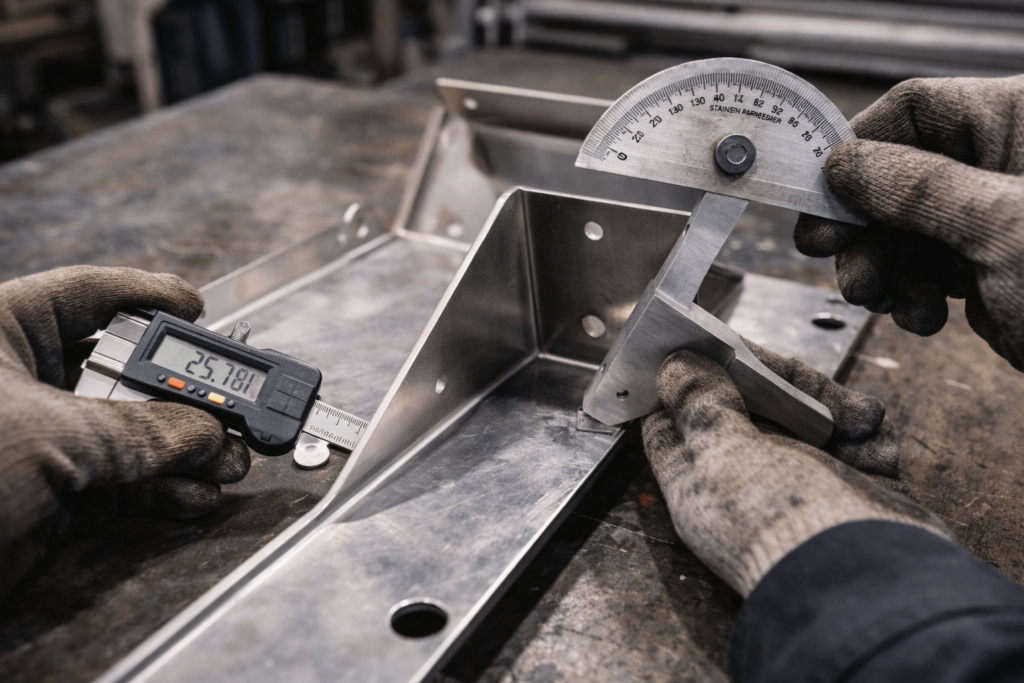
How Bending Tolerances Are Measured (And Why It Matters)
One frequent source of disagreement in international sourcing is measurement method. The same bend can produce different results depending on whether it is measured on the inside radius, outside surface, or centerline. Without alignment on measurement method, buyers and suppliers may believe they agree while evaluating different data.
Another common gap is the difference between “typical” and “maximum” deviation. A process may produce most parts close to nominal while still allowing occasional outliers. For volume production, understanding both values is more important than approving a single sample.
A practical way to avoid disputes is to confirm measurement method and acceptance criteria during quoting. Clarifying whether tolerances apply to centerline, inside, or outside dimensions—and whether acceptance is based on typical capability or maximum deviation—reduces ambiguity and protects both sides.
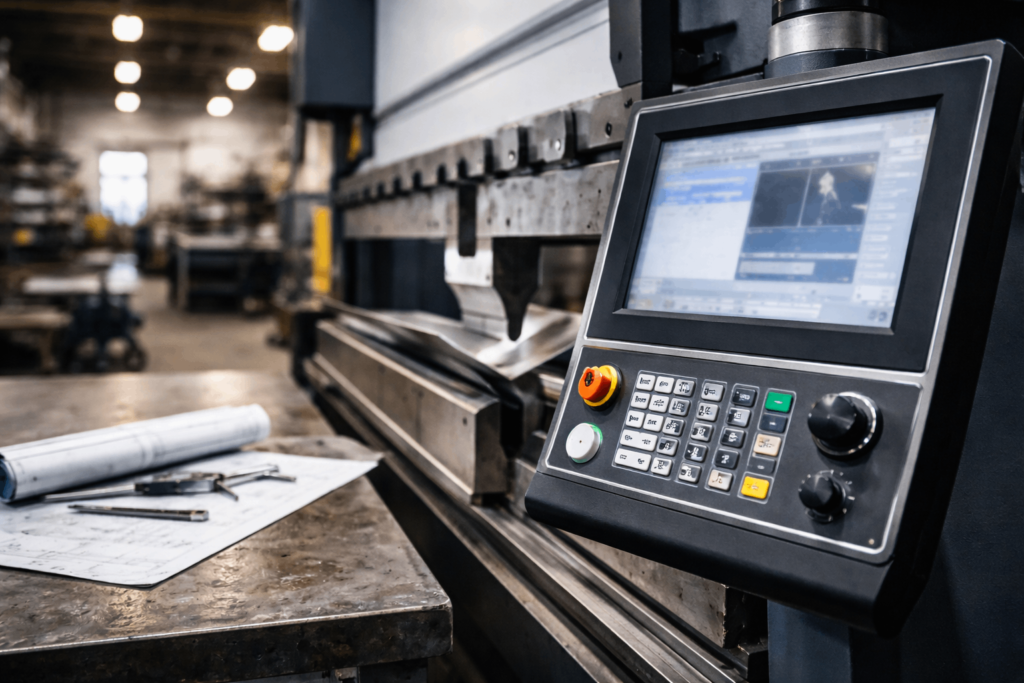
CNC Bending Changes Where Errors Come From
For many buyers, choosing a supplier with modern equipment feels like choosing quality. A capable cnc bending shop can indeed reduce operator‑dependent variation and improve repeatability, especially on complex parts with multiple bends.
However, CNC does not remove error. It changes the source of error from manual execution to planning quality. The machine will do exactly what it is told. If bend tables, material data, or tool selections are incorrect, the system will reproduce that deviation on every part. This is why “CNC capability” and “production stability” are not the same claim.
When comparing cnc bending services, ask how bending data is validated. For example, how are programs adjusted when material lots change? What systems are in place to track and respond to tool wear? And how is consistent V‑die selection maintained to support repeatability over long runs? You are not looking for perfection; you are looking for evidence that variation is actively managed.
Flat Pattern Errors: When Angles Are Right but Parts Don’t Fit
One of the most common bending problems appears when angles measure correctly but holes or flanges fail to line up. This usually traces back to flat pattern assumptions rather than bending execution.
K‑factor and bend allowance values determine how a flat sheet stretches during forming. Using generic or fixed values may work for prototypes but drift in production as material behavior changes. When this happens, parts meet angle requirements but miss functional dimensions.
For buyers, the key question is not the formula used but the validation method. Ask whether the supplier relies on fixed assumptions or on bend tables verified for your material and thickness. This small clarification can prevent repeated assembly issues later.
Most Bending Problems Are Decided Before the First Bend
Many bending issues are locked in before the press brake ever touches metal. This is why design‑for‑bending feedback is one of the most valuable contributions a supplier can make to wholesale buyers.
Feature placement is a frequent cause of downstream problems. Holes or slots too close to a bend line may distort after forming. Tight inside radii increase cracking risk, particularly in thicker materials or custom aluminum bending projects where elongation limits matter. Long flanges may twist or oil‑can unless supported by proper tooling or sequence.
When sourcing custom bent metal, it helps to confirm that the supplier understands functional intent. A drawing may show a nominal 90° bend, but the real requirement may be a flange‑to‑flange distance that ensures assembly fit. Suppliers who focus on functional dimensions can recommend tolerances that are both achievable and cost‑effective.
This same logic applies to custom metal tube bending and metal tube bending services. Tube parts introduce additional variables such as ovality, wall thinning, and centerline radius. Without clarifying how these will be measured and accepted, repeatability suffers.
Regarding bar bending service, it is worth clarifying scope. In this context, bar bending refers to industrial flat or solid bar forming, not construction rebar schedules. Precision, repeatability, and material behavior remain the primary concerns.
Prototyping Validates Assumptions, Not Production Stability
Prototypes are essential, but they are often misunderstood. A prototype confirms that geometry is possible and that the part broadly matches the drawing. It does not prove that production will remain stable across batches.
Prototype builds usually receive extra attention, and material may come from a convenient batch rather than long‑term supply. This can hide sensitivity to variation. When production scales, these variables reappear.
For buyers sourcing custom bent aluminum or other formed components, prototypes should be used to test assumptions: springback sensitivity, sequence effects, and inspection methods. A small pilot run often reveals more about repeatability than a single sample.
Why Bending Quotes Are Accurate but Still Misleading
A bending quote is usually accurate within its assumptions. It reflects material type, thickness, number of bends, and stated tolerances. Problems arise when production reality differs from those assumptions.
Online quoting tools can provide quick guidance, but they often assume ideal geometry and stable material behavior. When parts require additional engineering review, protective handling, or tighter functional tolerances, actual cost can change. The quote itself is not dishonest; it is incomplete.
For overseas wholesale buyers, clarity is the fastest way to improve quote accuracy. Communicate which dimensions are critical, expected order volumes, material preferences, finish requirements, and inspection expectations. This reduces change orders and friction later.
The Real Cost of Bending Appears Downstream
Bending influences almost every downstream operation. If a formed part is slightly off, welding fixtures must compensate. Assemblers may force alignment, introducing stress. Finish quality may suffer when gaps or surfaces are inconsistent. These issues are costly because they appear late.
This is why bending acts as a cost amplifier. A small deviation introduced during forming can multiply into hours of labor, fixture adjustment, or scrap after finishing. For buyers, the relevant metric is not piece price alone, but total manufacturing cost.
Suppliers who plan bending with downstream needs in mind—welding, coating, and assembly—help protect schedules and margins. Asking about downstream context is a positive signal, not a complication.
Choosing Bending Services Is a Risk Allocation Decision
Capability lists describe machines, not risk management. For wholesale procurement, choosing bending services is ultimately about deciding where variability is absorbed.
Some risks, such as material variation, cannot be eliminated. Others, such as unclear functional requirements or unrealistic tolerances, can be addressed early. Mature suppliers make these risks visible and manageable rather than promising perfection.
If you source internationally, prioritize partners who speak the language of repeatability: process alignment, documented inspection, and consistent feedback. That matters more than the length of an equipment list.
At YISHANG, we support wholesale buyers who need consistent results across reorders. Our focus is practical communication and engineering‑led review, so production can scale without surprises.
Final Thoughts and Next Steps
Bending rarely fails randomly. When bent parts cause problems, the cause is usually a predictable interaction between material behavior, data assumptions, and downstream requirements. Understanding these patterns allows buyers to reduce rework, stabilize costs, and select suppliers more confidently.
If you are sourcing custom bent metal, custom aluminum bending, or metal tube bending services for repeat orders, share your drawings and functional requirements. A short manufacturability review can clarify risk early. Contact YISHANG for a technical discussion or a quote.