
1. Redefining the Metal Fabrication Meaning for Global Buyers
For global buyers, the definition of metal fabrication should go beyond “making parts from metal.” In real procurement work, metal fabrication is the coordinated process of converting sheet, tube, bar, plate, and other semi-finished metals into functional products through cutting, forming, welding, machining, surface finishing, assembly, and packaging.
That broader definition matters. When a buyer sources server cabinets, retail display racks, machine frames, electrical enclosures, brackets, chassis, or custom hardware, they are not only buying metal parts. They are buying engineering judgment, process control, cost discipline, and the supplier’s ability to repeat the same result across hundreds or thousands of units.
The Distinction: Metal Fabrication Manufacturing vs. Commodity Production
Metal fabrication manufacturing is different from commodity production. Commodity production usually focuses on high-volume, standardized items—fasteners, cans, wires, or simple stamped goods—where the design changes little and dedicated tooling carries most of the work.
Metal fabrication is more flexible. It is often used for custom or semi-custom products that require different dimensions, cutouts, materials, finishes, mounting points, or branding details. In other words, fabrication is where engineering variation becomes part of the product.
For buyers, this distinction is important. If your project needs custom ventilation, special brackets, modular assembly, private-label appearance, export packaging, or structural changes for a specific market, you need a fabrication partner—not simply a commodity supplier.
The “Value-Add” in the Metal Fabrication Description
A useful metal fabrication description should include value-added work. Cutting and bending are only part of the story. A capable fabricator may also support material selection, DFM review, welding strategy, finishing choice, inspection planning, assembly, kitting, labeling, and export packaging.
This is where a fabrication supplier begins to affect total cost of ownership. A cheaper quote may not stay cheaper if the buyer later needs extra polishing, rework, repacking, or local assembly. A more integrated supplier can often reduce these hidden costs by designing the production route more carefully from the beginning.
2. The Engineering Lifecycle: Where Cost and Quality are Determined
The cost of a fabricated metal product is not decided only on the workshop floor. Much of it is locked in during design review, tolerance planning, material selection, and process routing. By the time production starts, many cost drivers are already fixed.
That is why professional buyers should treat engineering review as part of sourcing, not as a separate technical formality.
Design for Manufacturing (DFM): The First Line of Defense
Design for Manufacturing, or DFM, is where a supplier checks whether a drawing can be produced efficiently, repeatedly, and at the right cost. A good DFM review does more than find errors. It looks for better ways to make the part.
For example, a welded corner might be redesigned as a continuous bend. A complicated assembly may be simplified with tabs, slots, PEM fasteners, or fewer separate parts. A decorative surface may need grain direction control before brushing or powder coating. Small changes like these can reduce welding, grinding, labor time, scrap, and inspection pressure.
For high-volume orders, even a minor DFM improvement can have a large commercial effect.
Tolerance Analysis and ISO Standards
Tolerances define how precise a fabricated part must be. But tighter tolerances are not automatically better. They usually require more setup time, better fixtures, slower processing, additional inspection, and sometimes higher scrap.
A mature fabrication supplier helps buyers apply tight tolerances only where they matter—mating surfaces, hole patterns, bearing points, sealing areas, or visible alignment zones. For hidden brackets or non-critical covers, a standard tolerance may be enough.
Using practical standards such as ISO 2768, and marking critical dimensions clearly, helps control cost without sacrificing function.
3. The Core Processes: A Procurement Perspective on Scalability
To evaluate a fabrication supplier, buyers need to understand more than whether the factory owns machines. The real question is whether the process flow can support your volume, tolerance, finish, and delivery expectations.
Most metal fabrication programs are built around three core process families: cutting, forming, and joining or assembly.
1. Precision Cutting (Subtractive)
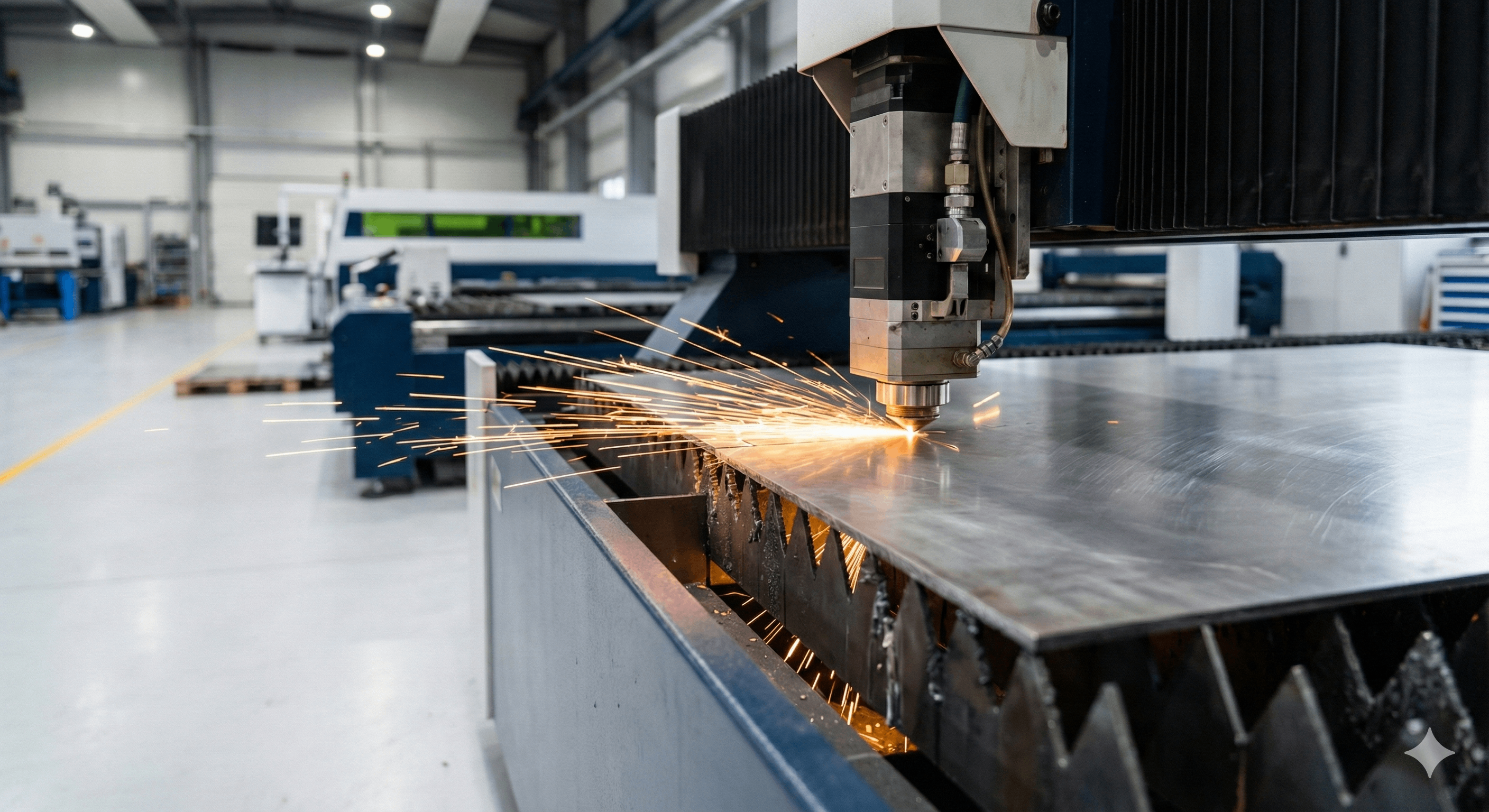
Precision cutting is usually the first physical step. Fiber laser cutting, punching, sawing, waterjet cutting, and CNC machining all separate material into the shapes needed for production.
For export-oriented sheet metal fabrication, fiber laser cutting is especially common because it offers fast setup, clean edges, and high flexibility for custom designs. But the value is not only in cutting speed. Nesting efficiency—the way parts are arranged on the sheet—has a direct effect on material utilization and final cost.
Since metal material can represent a large share of the total part cost, poor nesting wastes money before the part even reaches bending.
2. Deformation and Forming
Forming includes bending, rolling, deep drawing, stamping, and other processes that reshape metal without removing much material. It sounds straightforward, but in production it requires experience.
Different materials behave differently. Stainless steel has strong springback. Aluminum may crack if the bend radius is too tight. Galvanized sheet can suffer coating damage if tooling is not suitable. These details become more serious when hundreds or thousands of parts must match the same assembly.
For cabinets, racks, kiosks, vending machine bodies, and industrial frames, forming accuracy affects everything that follows: welding fit, door alignment, hole position, packaging size, and final assembly.
3. Joining and Assembly
Joining includes welding, riveting, fastening, clinching, adhesive bonding, soldering-related assembly, and mechanical assembly. In many metal fabrication projects, this stage determines both strength and labor cost.
Welding may be manual, robotic, TIG, MIG, spot, or seam-based depending on the part. Robotic welding can improve consistency on repeat orders, while skilled manual welding is still useful for complex or lower-volume assemblies.
For visible products, weld quality also affects finishing cost. Poor welds often require extra grinding and polishing. Good joint design, proper fixtures, and stable heat control help reduce that burden from the start.
4. Quality Assurance Protocols: Mitigating Sourcing Risk
For overseas buyers, fabrication quality is partly about trust—but it should never rely on trust alone. Quality must be built into the process and supported by inspection records, sample approval, in-process checks, and clear acceptance standards.
First Article Inspection (FAI) and PPAP
First Article Inspection, or FAI, verifies that the first production parts match the drawing and approved process. It is especially useful when a part has tight dimensions, complex bends, welded structures, or functional holes.
For automotive or high-precision industrial programs, PPAP-style documentation may also be required. This gives buyers more confidence that the process is stable before full production starts.
In-Process Quality Control (IPQC)
In-process quality control checks the part while production is still running. This may include bend angle checks, hole position measurement, weld inspection, coating thickness measurement, and surface appearance review.
Catching problems early is far cheaper than finding them at final inspection. A good fabrication partner will not wait until the end of a 5,000-piece order to discover that a bend angle has drifted.
5. Material Science: Sourcing Strategy for Wholesale Buyers
Material choice shapes the whole fabrication route. It affects cutting speed, bend radius, welding method, finish selection, corrosion resistance, weight, packaging, and final cost. For buyers, material selection is not only an engineering issue—it is a sourcing strategy.
Stainless Steel: Grades and Applications
Stainless steel is widely used for enclosures, food equipment, medical-related housings, display parts, and outdoor products. Grade 304 is the common workhorse for general corrosion resistance. Grade 316, with molybdenum, is better for marine, chemical, or chloride-exposed environments.
For welded stainless parts, low-carbon grades such as 304L or 316L may be selected to reduce sensitization risk. Buyers should request material traceability when performance is important, including mill test reports where needed.
Aluminum and Carbon Steel
Aluminum is useful when weight reduction, corrosion resistance, and clean appearance matter. 5052 is often preferred for sheet metal bending and enclosures because it forms well. 6061 is stronger and more suitable for CNC-machined parts or structural components, but it is less forgiving in tight bending.
Carbon steel remains one of the most cost-effective materials for structural fabrication. It is strong, available, and economical, but it needs proper finishing—powder coating, plating, galvanizing, or painting—to prevent corrosion.
6. Surface Finishing: The Intersection of Compliance and Aesthetics
Surface finishing is where appearance, corrosion resistance, compliance, and customer perception meet. A part may be well fabricated, but if the coating peels, rust appears, or the color varies between batches, the buyer still has a problem.
RoHS Compliance and Environmental Standards
For export markets, finishing must meet both performance and compliance expectations. RoHS, REACH, and customer-specific requirements may restrict certain hazardous substances in coatings, plating, or chemical treatments.
Buyers should ask whether powder coating, zinc plating, nickel plating, passivation, anodizing, or other finishing methods are supported by appropriate documentation when required.
Durability Testing
Durability testing helps confirm whether a finish can survive shipping, installation, and real use. Common checks include salt spray testing, coating thickness measurement, cross-hatch adhesion testing, hardness checks, and visual inspection under agreed lighting conditions.
For wholesale buyers, these tests are not just technical details. They reduce disputes and help protect your customer relationship after delivery.
7. Logistics Optimization: The Hidden Value in Fabrication
Logistics is often where fabrication experience creates hidden savings. A product can be well made and still be expensive to import if it wastes container space, scratches easily, or requires costly repacking after arrival.
Knock-Down (KD) Design Strategy
Knock-down, or KD, design turns welded or fully assembled products into flat-pack or semi-assembled structures. This is especially useful for display racks, cabinets, shelving, frames, and some enclosure systems.
A good KD design reduces shipping volume while keeping assembly simple and structural performance reliable. In many projects, this can reduce landed cost more effectively than negotiating a slightly lower unit price.
Packaging Engineering
Packaging is part of fabrication value. Powder-coated panels may need foam separation. Polished stainless steel may need protective film. Heavy welded frames may need reinforced corners, pallets, or crates. Small parts may require kitting and labeling to simplify final assembly.
For export buyers, packaging design affects damage rate, warehouse efficiency, customer satisfaction, and repeat orders.
8. Conclusion: Elevating Your Sourcing Strategy
For B2B buyers, the real definition of metal fabrication is not only the act of cutting and shaping metal. It is the ability to turn engineering intent into repeatable, scalable, shipment-ready products.
A strong fabrication partner helps reduce cost through DFM, improves consistency through process control, manages materials and finishing intelligently, and designs packaging and logistics with export reality in mind.
At Yishang Metal Products Co., Ltd., we support OEM and wholesale customers with custom metal fabrication for enclosures, racks, display structures, brackets, cabinets, frames, housings, and industrial components. With 26+ years of manufacturing experience, we support processes including laser cutting, bending, stamping, welding, CNC machining, surface treatment, assembly, inspection, packaging, and shipment.
📩 If you are sourcing custom metal products or evaluating a fabrication supplier, send us your drawings or requirements to discuss a practical production approach.
Frequently Asked Questions (FAQ)
What are the main types of metal fabrication?
The main types include cutting, forming, joining, machining, surface finishing, and assembly. Common processes include laser cutting, punching, bending, stamping, welding, CNC machining, powder coating, plating, and packaging.
How does “fabrication” differ from “manufacturing”?
Manufacturing is a broad term for producing goods. Fabrication is a specialized part of manufacturing that focuses on building metal products from sheet, tube, bar, plate, or other semi-finished materials. It usually offers more customization than commodity production.
Why is Design for Manufacturing (DFM) important in fabrication?
DFM helps reduce cost, avoid production problems, improve assembly, and make the product easier to manufacture at scale. It can identify unnecessary welds, difficult bends, over-tight tolerances, poor material choices, or packaging problems before production begins.
What is the standard tolerance for steel fabrication?
General sheet metal fabrication tolerances vary by process, material, and part size. Many projects use ISO 2768 as a practical reference. Critical dimensions should always be marked clearly on the drawing instead of applying tight tolerances everywhere.