Overseas wholesale buyers rarely search for metal stamping services because they want a textbook definition of stamping. In most cases, the search intent is far more practical. Buyers want to know whether a supplier can support repeatable production at scale, not just deliver acceptable samples. What matters is consistency across lots, containers, and time, especially once a program moves beyond its first production run.
Metal stamping itself is deceptively simple to observe. A press cycles, a die forms metal, and parts accumulate quickly. Yet long-term success is determined by everything around that press stroke: tooling strategy, material consistency, tolerance intent, process discipline, and how variation is handled when it inevitably appears. These factors decide whether stamping becomes a stable manufacturing solution or a recurring sourcing problem.
This guide is written for B2B procurement teams, sourcing managers, and engineers evaluating custom metal stamping services for wholesale and OEM programs. It reflects how buyers actually think and search—through the lenses of risk, cost over time, quality stability, lead time predictability, and change control—rather than through generic process descriptions.
Why Metal Stamping Often Fails After the First Production Run
Most stamped parts look acceptable during the first production run because the conditions are unusually controlled. Initial lots are often slower, more closely supervised, and produced with carefully selected “known good” material. Tooling is new, cutting edges are sharp, and operators compensate manually when small deviations appear. Under these conditions, even a marginal setup can produce parts that pass inspection and appear production-ready.
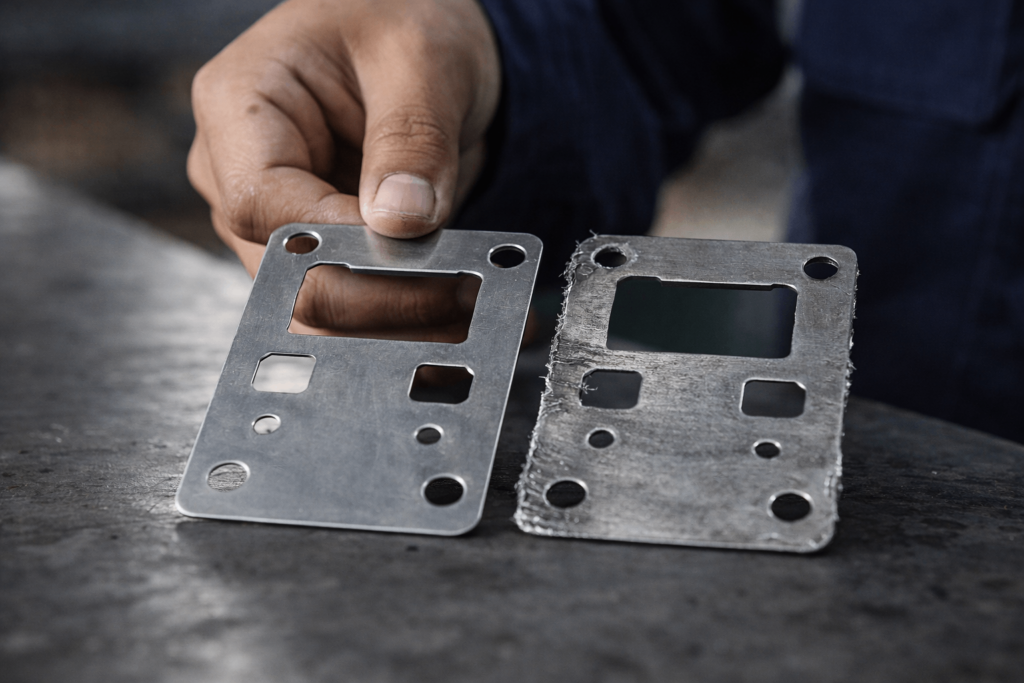
The real test begins when production transitions from observation to repetition. Press speeds increase, shifts rotate, coil lots change, and tooling begins to wear. At this stage, stamping issues rarely appear as sudden failures. Instead, they show up as gradual trends: hole locations drifting, bend angles migrating, burr height increasing, or parts no longer sitting flat in downstream assemblies. None of these issues look dramatic on day one, but their cumulative effect is costly.
For wholesale buyers sourcing metal stamping parts, this distinction is practical rather than theoretical. Cost impact usually comes from compounding friction rather than single defects. Extra inspection time, rework loops, delayed shipments, and slower assembly all add up. When stamped parts feed automated or semi-automated assemblies, even small variation can cascade into misalignment, fasteners not starting cleanly, cosmetic damage during forcing, or yield loss.
The sourcing question that matters is therefore not whether a supplier can produce a compliant sample. It is whether the supplier can hold the same outcome after 10,000 hits, 50,000 hits, and beyond. A production-ready metal stamping service is designed to remain stable when early, ideal conditions disappear. A quote-driven service is optimized to look good at first article. That difference defines long-term sourcing success.
Choosing Metal Stamping Is a Manufacturing Commitment, Not Just a Process Choice
When buyers shortlist suppliers, metal stamping is often compared with CNC machining, laser cutting, or bending. While all of these processes can produce sheet metal components, they behave very differently once production begins. CNC and laser processes are inherently flexible. If a feature shifts or a tolerance proves too tight, programs and toolpaths can often be adjusted with limited disruption.
Stamping operates under a different model. Once tooling is built, the program is committed to a manufacturing system where repeatability depends on mechanical geometry rather than software edits. This commitment is precisely what makes stamping cost-effective at scale. It is also what makes a poor early decision expensive to unwind.
The first lock-in is tooling. In a stamping program, the die becomes the production engine. A drawing change that appears minor—moving a hole, adjusting a flange, increasing a radius—may require die modification, re-tryout, and re-qualification. For this reason, experienced buyers treat custom part stamping as an engineering commitment and plan change control early in the program.
The second lock-in is volume. Stamping economics rely on stable demand that can amortize tooling investment and justify robust process control. When demand is uncertain, seasonal, or likely to stop after a single program, stamping can still work, but the risk profile changes. In these cases, the lowest quoted unit price is often not the lowest total program cost.
The third lock-in is flexibility. Stamping excels at repeating a stable design but is less forgiving when designs are still evolving. When frequent revisions are expected, a hybrid approach—using flexible processes early and transitioning to stamping later—can reduce total risk. For wholesale procurement teams, stamping becomes a strategic advantage only when it aligns with the product’s lifecycle.
What Actually Determines the Outcome of a Metal Stamping Service
A 60‑Second Fit Check for Wholesale Buyers
Before investing time in detailed engineering discussions, experienced procurement teams usually want to answer one question quickly: Is this supplier structurally capable of supporting my stamping program? Rather than relying on marketing language, buyers confirm a short list of fundamentals that signal whether further discussion makes sense.
| What buyers usually confirm first | Why it matters in real production |
|---|---|
| Typical stamping formats supported (progressive, transfer, single-hit) | Indicates whether tooling strategy matches part complexity and volume |
| Common material families (steel, stainless, aluminum alloys, copper alloys) | Signals experience with material behavior and springback control |
| Typical material thickness ranges | Helps assess forming force, wear expectations, and tolerance stability |
| Secondary operations (deburring, tapping, welding, surface finishing) | Reduces handoffs that increase lead time and quality risk |
| In-process quality controls (gauging, trend checks) | Shows whether teams build stability into the process instead of relying on final inspection |
Beyond this initial fit, long-run stamping performance depends on a small set of variables that rarely appear in quotes. Press tonnage, bed size, and machine count indicate capacity, but they do not predict stability for precision metal stamping parts over months of production.
Tooling Is Not a Cost — It Is the Product
In custom metal stamping, tooling is the core manufacturing asset. The stamped part is the output, but the die is what makes that output repeatable, scalable, and economically viable. Treating tooling as an upfront cost to minimize is one of the most common ways buyers inadvertently increase total cost over time.
Tooling decisions influence far more than part geometry. They determine strip layout, forming sequence, stress distribution, scrap generation, and where tolerances can be held reliably. A progressive die can distribute operations across stations to reduce peak strain and increase throughput, while a simpler die may cost less initially but lead to higher scrap, downtime, and variation later.
For wholesale buyers evaluating a stamped metal parts manufacturer, tooling discussions often reveal supplier maturity. A capable supplier can explain maintenance plans, expected wear points, insert replacement strategies, and alignment control. They can also clarify which design changes are feasible without rebuilding the tool, an important consideration in real-world programs where revisions are inevitable.
A practical way to evaluate tooling ROI is to connect it directly to costs buyers actually experience in production. When tooling controls drift and burr growth, sorting effort drops. Reduced unplanned downtime lowers schedule risk and protects delivery commitments, while improved strip layout directly cuts scrap and material waste. These benefits translate directly into fewer delayed containers and more predictable unit costs.
When Metal Stamping Becomes Economical — and When It Quietly Becomes Risky
Metal stamping is often selected because it becomes cost-efficient at scale. That advantage is real, but the economics are not linear, and neither is the risk. Both change sharply around the break-even point.
At low volumes, tooling and setup dominate unit cost. Low-volume stamping can work for stable designs, but it leaves limited room for iteration. When revisions are expected, savings from stamping may never fully materialize. At medium volumes, economics may look attractive while hidden risks grow. Production runs long enough for tool wear to appear, but not long enough to justify deeper refinements, leading to drift and increased rework.
High-volume stamping offers the greatest benefit when the supplier is prepared. Long runs justify preventive maintenance, in-process checks, and handling automation. They also make it easier to stabilize material supply and process windows. The difference between short-run and long-run stamping is therefore not just quantity, but the presence of systems that detect and correct drift early.
| Production scenario | What drives unit cost most | Common stability risk | Practical sourcing note |
|---|---|---|---|
| Low volume (hundreds to a few thousand) | Setup + tooling amortization | Frequent design changes | Consider flexible manufacturing or simplified tooling |
| Medium volume (tens of thousands) | Tooling amortization + scrap + downtime | Wear-related drift | Invest in tooling robustness and control plans |
| High volume (hundreds of thousands to millions) | Cycle time + maintenance discipline | Wear and handling damage | Treat tooling as an asset with preventive maintenance |
Aligning tooling strategy and controls with the volume curve is what turns stamping economics into predictable value.
Material Behavior Over Time and Its Impact on Stamped Parts
Materials are often presented as a checklist—steel, stainless steel, aluminum, copper, brass—but this view is incomplete for buyers sourcing custom stamped metal parts. In production, what matters is how materials behave over time and across batches.
Steel stamping parts commonly show burr growth as trimming edges wear. Stainless steel often requires higher forming forces and exhibits more pronounced springback. Aluminum can be sensitive to surface condition and lubrication, which is why buyers frequently look for aluminum stamping suppliers with proven process control. These effects rarely appear as immediate failures. Instead, they manifest as drift: gradual changes in angle, flatness, edge condition, or fit.
For procurement teams, material consistency is a production control issue rather than a purchasing detail. Thickness variation and yield strength distribution influence die loading and wear rates. Surface condition affects lubrication effectiveness and the risk of galling. Without control, the process window narrows, increasing scrap and delivery risk.
| Material variable | Typical production impact | Why procurement should care |
|---|---|---|
| Thickness variation | Burr growth, feature shift | Higher sorting and scrap risk |
| Yield strength variation | Angle drift | Assembly fit issues |
| Surface condition | Galling, scoring | Tool life and appearance risk |
| Work hardening | Cracking in tight features | Geometry-related failure risk |
A stable stamping program anticipates material drift and manages it proactively.
Tolerances in Stamping and What They Mean for Procurement
“Tight tolerances” frequently appear in searches for stamping services because buyers want predictability. In stamping, however, tolerances must be understood differently than in machining. The process relies on material flow and elastic recovery rather than programmable toolpaths, which means dimensions tend to drift gradually as tools wear and material properties change.
Functional tolerances—those that affect assembly and performance—are usually achievable with proper tooling and control. Problems arise when non-functional tolerances are specified without regard to process behavior. Over-constraining features accelerates wear, increases scrap, and raises cost without improving product performance.
For wholesale buyers, productive tolerance discussions focus on function, datums, and acceptable variation in real assembly conditions. Where appropriate, referencing GD&T concepts such as datum strategy (often aligned with ASME Y14.5) can reduce misunderstanding. Suppliers offering custom precision metal stamping services typically frame tolerance capability in terms of control windows and trend monitoring rather than single-point promises.
| Feature type | Practical tolerance consideration | Buyer takeaway |
|---|---|---|
| Hole location | Datum control in tooling | Ask how datums are established |
| Bend angle | Springback and wear sensitivity | Expect a controlled range |
| Edge condition | Tool sharpness and material | Define acceptability by function |
How Product Risk Shapes Stamping Decisions
Many articles categorize stamping by industry, but experienced buyers manage risk at the product level. A cosmetic bracket assembled manually may tolerate variation that would be unacceptable in a component feeding an automated line. Parts defining alignment or sealing surfaces carry higher risk than purely structural elements.
In each case, stamping may still be appropriate, but the control strategy must match the risk profile. Wholesale buyers think in downstream outcomes: whether variation slows assembly, triggers returns, or requires sorting on arrival. They also consider how likely design changes are once production begins.
Stamping works best when design stability and repetition outweigh the cost of flexibility. Applying this risk-based view helps procurement teams align stamping strategy with real-world constraints.
How Experienced Buyers Evaluate a Metal Stamping Supplier
Selecting a metal stamping supplier is not simply comparing prices. For wholesale sourcing, it is a judgment about whether a supplier can support stable output, predictable lead times, and controlled quality over the life of a program.
Experienced buyers look for evidence of process control rather than broad capability claims. They listen for how suppliers monitor drift, define response triggers, and maintain tooling during long runs. They also evaluate how changes are handled, since real programs inevitably evolve.
| Buyer concern | What to verify | Indicator of maturity |
|---|---|---|
| Long-term stability | Drift monitoring approach | Trend-based controls |
| Volume capability | Maintenance strategy | Preventive plans |
| Assembly fit | Burr and edge control | Defined acceptance criteria |
| Material variation | Coil management | Stable sourcing approach |
| Engineering changes | Change control process | Feasibility review |
Suppliers that connect capability to predictability are typically better partners for custom sheet metal stamping programs.
Final Perspective for Wholesale Sourcing Teams
Metal stamping services are widely available. What differentiates reliable partners is not access to presses, but the quality of decisions made before production begins. Tooling strategy, volume planning, material control, and tolerance alignment determine whether stamping delivers predictable value or recurring issues.
For sourcing teams, the most useful question is simple: instead of asking whether a supplier can stamp a part, ask whether they can keep it stable as conditions change. When that question is answered clearly, stamping becomes one of the most scalable and dependable manufacturing options available.
If you are reviewing a new stamping program or troubleshooting drift in an existing one, a short technical discussion can often clarify the right path forward. YISHANG supports buyer-side decision making for custom stamped metal parts, including feasibility review, tooling strategy discussion, and long-run production planning.