
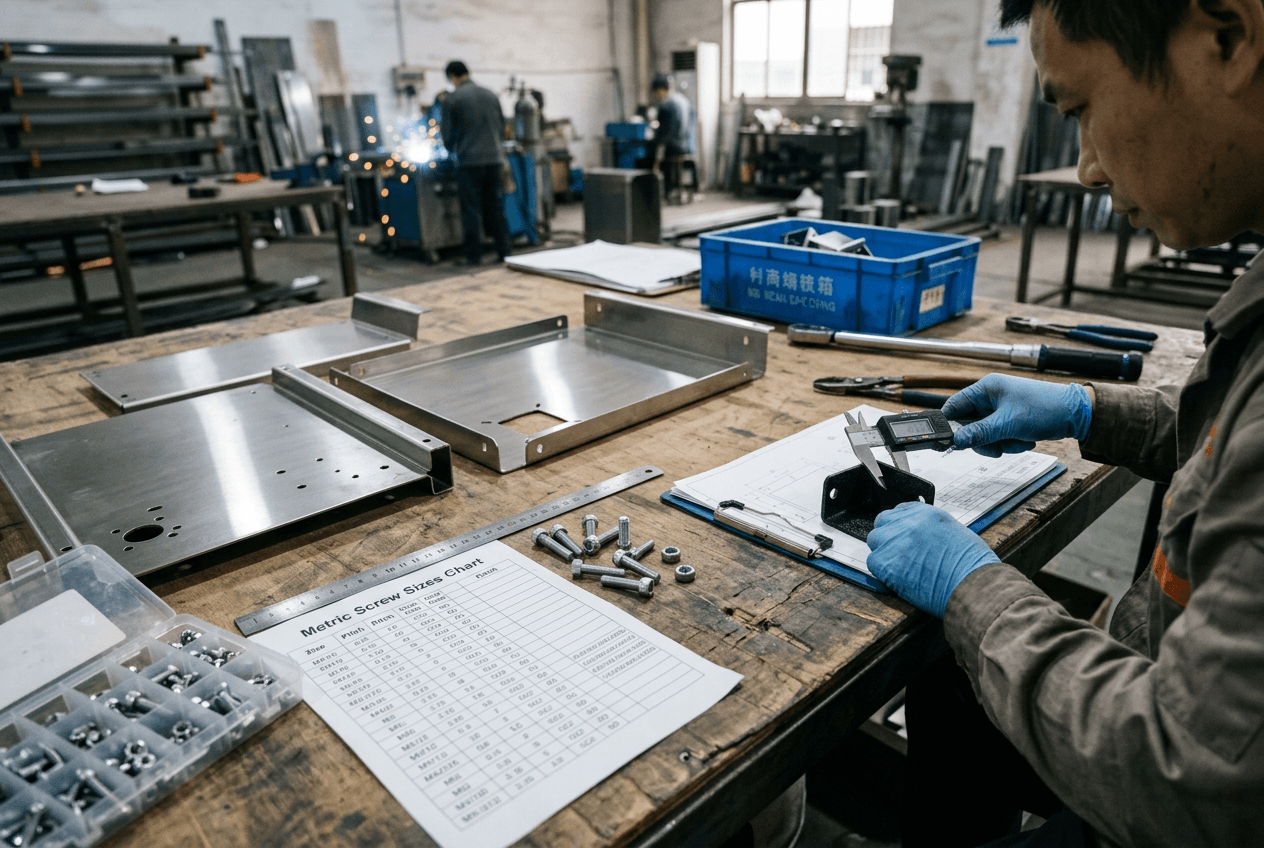
A metric screw sizes chart looks simple on paper. M4 means M4. M5 means M5. M6 means M6. But in sheet metal fabrication, the chart only names the fastener. It does not freeze the hole condition, the coating build-up, or the final assembly state.
That gap creates a real procurement risk. Two suppliers can review the same drawing and quote different processes because they interpret the screw holes differently. One prices masking, thread protection, and post-coat cleaning. Another assumes the customer will handle fit issues later. The drawing may still be correct. The RFQ is not.
For buyers of sheet metal parts, metal enclosures, brackets, frames, and welded assemblies, this is where hidden cost and hidden rework begin. A part can pass dimensional review in bare metal and still fail at assembly after powder coating, welding cleanup, or handling. The metric screw sizes chart helps standardize hardware selection, but it cannot protect the project unless the finish assumptions are frozen before quote submission.
This article focuses on that risk: fastener size is rarely the problem. The real problem is the space between the chart and the finished part.
When the screw size is right but the quote is built on the wrong hole condition
Most quote disputes start with a simple assumption. A buyer writes M5 tapped holes into the drawing and expects a ready-to-assemble enclosure. The supplier sees the same note and asks a different question: coated or uncoated, masked or cleaned, cosmetic or hidden, production-ready or prototype-only? If those answers are missing, the quote may still look complete, but it covers a different manufacturing path.
That matters because hole state changes labor and risk. A clearance hole needs one process. A tapped hole needs another. A threaded hole that must remain open after powder coating needs masking or post-process chasing. A grounding point may need bare metal contact. A washer seat may need coating control around the face. None of those decisions appear in a metric screw sizes chart.
When the RFQ leaves these points open, the supplier will price according to its own standard. One shop may plan to mask every critical hole. Another may coat first and clean later. A third may assume minor thread interference is acceptable. Those quotes are not directly comparable, even if the unit price looks close.
What the supplier must know before pricing
The drawing should identify which holes are clearance, tapped, self-clinching, or used for grounding. It should also show which faces must stay free of coating and which holes can tolerate cleanup after finish. If a fastener must install directly at receiving inspection, say so. If the assembly team can chase threads, say that too. The more explicit the hole condition, the less likely the quote will hide an assumption.
This is especially important for sheet metal fabrication where one part may combine laser cutting, bending, welding, inserts, and finishing. A single overlooked hole can affect a whole batch. For Yishang and similar fabricators, clear hole-state notes allow the shop to judge manufacturability before it prices the job.
Why powder coating changes assembly fit on enclosures, brackets, and frames
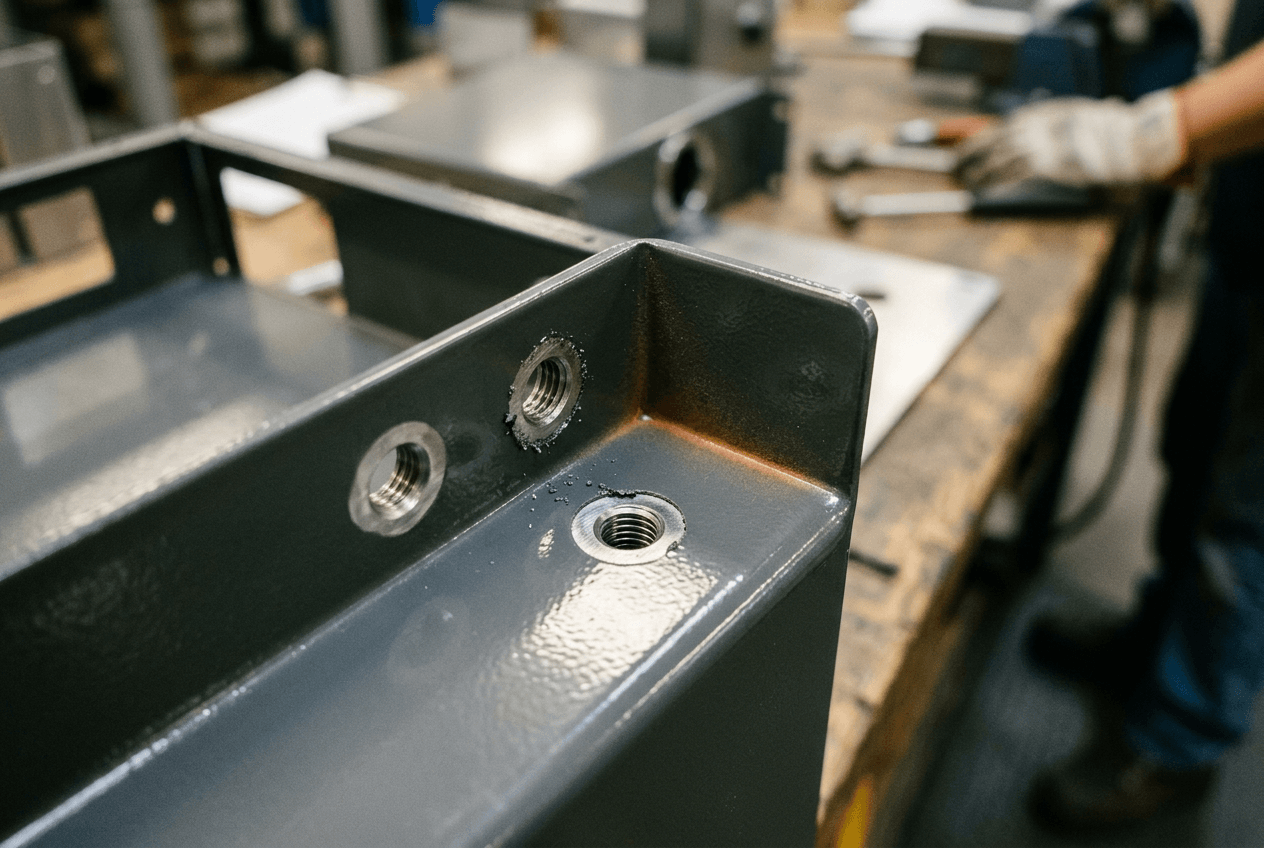
Powder coating does more than change appearance. It changes surface height, contact feel, and sometimes thread engagement. A metric screw sizes chart still says the hardware is M4, M5, or M6, but the finished part may no longer behave like bare metal. The problem shows up at the interface, not in the drawing title.
On an enclosure door, a coated hinge leaf can sit proud if the mating face also carries coating. On a bracket, a screw head may not seat fully if powder accumulates around the counterbore. On a welded frame, a coated contact face can stop two members from closing tightly. The part may measure close enough on paper, but the assembly line feels the difference immediately.
Buyers often underestimate how small changes add up. A thin coating layer can narrow thread space, reduce grip quality, or create a soft interference at a landing surface. That becomes more serious when the project uses several fasteners across one assembly. One hole is annoying. Twenty holes become a line stop.
Two project examples that show the risk
A control enclosure project used M5 door screws and a black exterior powder coat. The prototype was approved in raw steel. When the coated batch arrived, the screws bound at the first turn because the thread notes never said whether to mask or chase after coating. The supplier had priced a standard finish. The buyer had expected assembly-ready threads.
In another project, a welded bracket set needed M6 mounting holes for a machine frame. The quote assumed coating on every visible surface. The buyer later discovered that the mating pads needed bare contact for alignment. The parts were structurally fine, but the coating created a stack-up problem that delayed installation. The chart was accurate. The finish assumption was not.
These examples show a common pattern. The failure starts with a vague RFQ, moves into a quote based on the wrong process, and ends with fit issues during assembly. The cost is not only rework. It also includes sorting time, delayed delivery to the next operation, and extra approval cycles.
Why prototype approval can still miss batch inconsistency
A prototype can prove geometry and still fail to prove production fit. That is a major buyer risk in sheet metal parts because the sample often arrives before finishing is fully controlled. If the first article is evaluated in raw metal, the buyer may approve dimensions that change once the batch goes through coating, handling, or welded cleanup.
This risk shows up when the sample process differs from the production process. A hand-built prototype may receive extra deburring, more careful thread cleaning, or lighter coating. A batch of welded assemblies may get a faster line process, more handling marks, or a thicker finish. The metric screw sizes chart stays the same, but the real assembly condition does not.
Buyers should treat prototype approval as a controlled checkpoint, not a final promise. If the finished product will be coated, then the sample should be checked in the coated state. If the product uses inserts, grounding studs, or flush screw heads, those details should be tested in the actual finish condition. Otherwise, the prototype only proves that the idea works, not that the production process will repeat it.
This is one place where an early drawing review helps. A manufacturer such as Yishang can review whether the prototype and production methods are likely to match. That is not about promotion. It is about avoiding the common mistake of approving a sample that never represented the final batch.

How RFQ notes should freeze screw size, finish, and assembly state together
A good RFQ does not ask the supplier to guess where the hardware ends and the finish begins. It freezes both in the same package. That means the buyer should define the screw size, but also the hole state, the finish condition, and the acceptance rule for assembly. Without those links, the supplier may quote a part that meets the drawing but fails the build.
For sheet metal fabrication, the most useful notes are specific. State whether the hardware installs in coated or bare metal. Mark whether tapped holes must arrive ready for direct assembly. Identify which faces are cosmetic, which are hidden, and which must remain conductive. If thread chasing is acceptable, say where and how much. If it is not acceptable, make that clear. These notes remove ambiguity from the quote and reduce the chance of post-delivery surprises.
Tolerance language matters here too. A hole that accepts an M5 screw in a prototype may need a different practical allowance once finish is added. The RFQ should say whether the supplier is quoting for a standard fit, a coating-aware fit, or a controlled assembly fit. Buyers do not need to over-specify every feature. They do need to define the features that affect installation.
RFQ details that prevent hidden assumptions
- List the screw sizes and identify whether each hole is tapped, clearance, or grounding-related.
- State whether coating must be masked off threads, pads, mating faces, or inserts.
- Define whether the part must assemble directly on arrival or can be cleaned up before use.
- Note which surfaces are cosmetic and which can tolerate finish variation.
- Attach drawing revisions, quantity, material, and any sample photos of the target fit.
These details help a fabricator price the same work the buyer intends to buy. They also shorten clarification cycles. If the shop can see the finish and assembly condition early, it can flag manufacturability issues before cutting and welding start.
How to compare quotes without letting the metric screw sizes chart hide the real cost driver
Price comparison becomes misleading when one quote includes finish control and another does not. The lower quote may simply omit masking, thread cleanup, or inspection time. On paper, that looks efficient. In production, it becomes a risk transfer to the buyer.
Procurement teams should compare the process behind the price. Ask how the supplier plans to protect threads, how it handles mating faces, and what it does if coating blocks a screw start. Ask whether the quote assumes rework after finish. Ask whether inspection checks the final assembly condition or only the raw dimensions. These questions expose the real cost driver, which is usually not the metric screw sizes chart itself.
Lead time can also shift when the finish assumptions are unclear. A shop that discovers thread interference late may need to re-run parts, clean parts by hand, or wait for approval on a coated sample. That delay often costs more than the original masking work would have cost. The fastest quote is not always the safest one.
For buyers who want a clean RFQ path, Yishang can review drawings, check assembly logic, and confirm whether the finish notes match the hardware plan before quote release. That helps the team compare apples to apples instead of comparing two different assumptions wrapped in similar prices.
Send the drawing, material requirement, quantity, tolerances, screw sizes, and finish expectations when you request a quote. If the part must arrive ready for assembly, say so in the RFQ. If coating, masking, or thread cleanup is part of the scope, define it clearly. The more the buyer freezes early, the less the project depends on late-stage corrections.
Frequently Asked Questions
Why is a metric screw sizes chart not enough for sheet metal RFQs?
The chart standardizes the hardware name, but it does not define hole condition, coating build-up, or assembly readiness. A quote can still miss masking, thread cleanup, or mating-face protection if the RFQ does not spell those out.
What finish details most often change the price of an enclosure or bracket?
Masking tapped holes, protecting grounding points, and keeping mating faces free of coating usually add labor. Cosmetic control on visible faces can also increase inspection and rework time. Those costs are often hidden when the drawing only lists the screw size.
Can a prototype pass and still fail in batch production?
Yes. A prototype may be checked in raw metal or built with extra handwork. Batch parts follow a repeatable process, so coating thickness, thread cleanup, and handling can change the fit. Buyers should approve the coated sample if coating affects assembly.
What should buyers specify for M4, M5, and M6 holes in coated parts?
They should say whether each hole is tapped or clearance, whether it must stay open after coating, and whether direct assembly is required. If the hole is used for grounding or a critical mating joint, that should be marked on the drawing too.
How can buyers compare two quotes fairly when one supplier includes masking?
Ask both suppliers to state whether the quote includes masking, thread chasing, finish protection on mating faces, and final inspection of assembly fit. Once the scope is identical, the price comparison becomes meaningful. Without that, a lower quote may just hide less work.
What should be sent when asking Yishang for a sheet metal quote?
Send the drawing, material requirement, quantity, tolerances, screw sizes, coating or finish expectations, and any assembly photos or sample notes. That lets the factory review manufacturability and price the real build condition instead of guessing from the chart alone.