
Introduction
In industrial sourcing, brand recognition can be helpful—but it can also become a shortcut.
That is often what happens with enclosure procurement. A familiar name like Rittal quickly signals quality, certifications, system compatibility, and global acceptance. For many projects, that reputation is justified. The issue is not whether Rittal is good. The issue is whether it is always the most appropriate answer once budget, customization, lead time, installation reality, and project scale enter the discussion.
For many overseas buyers, the real question is not “Is Rittal a trusted brand?” It is:
“Does this project actually need everything built into the Rittal premium—or would a capable OEM enclosure supplier deliver the same functional outcome more efficiently?”
This article looks at that question from a sourcing perspective. Instead of arguing from brand preference, it focuses on enclosure selection based on specification, use case, and procurement logic.
What Makes Rittal the Benchmark?
Rittal has earned its position for clear reasons.
Global Standardization and Certification Assurance
For multinational projects, standardization matters. Rittal’s enclosure systems are widely recognized because they are supported by strong certification coverage, consistent documentation, and established system logic across series such as VX, AX, and TS.
For buyers managing telecom, data center, rail, or multi-country industrial deployments, that consistency can reduce approval friction and simplify engineering alignment across sites.
The Real Value Behind the Premium Price
The higher price of a premium enclosure is not only paying for sheet metal. It often includes a broader support structure:
- spare-part continuity
- design ecosystem compatibility
- longer-term service confidence
- stronger documentation discipline
- lower perceived procurement risk in highly regulated projects
That value is real.
The sourcing mistake happens when buyers assume that every project benefits equally from that premium. In some cases—especially highly exposed or regulation-heavy applications—the extra cost is justified. In others, it is not.
Where Procurement Logic Breaks Down
Overspecification Driven by Brand Bias
One of the most common sourcing mistakes is not choosing a poor enclosure. It is choosing an enclosure that is better than necessary for the actual operating risk.
That usually happens when brand confidence replaces specification discipline.
Buyers may default to:
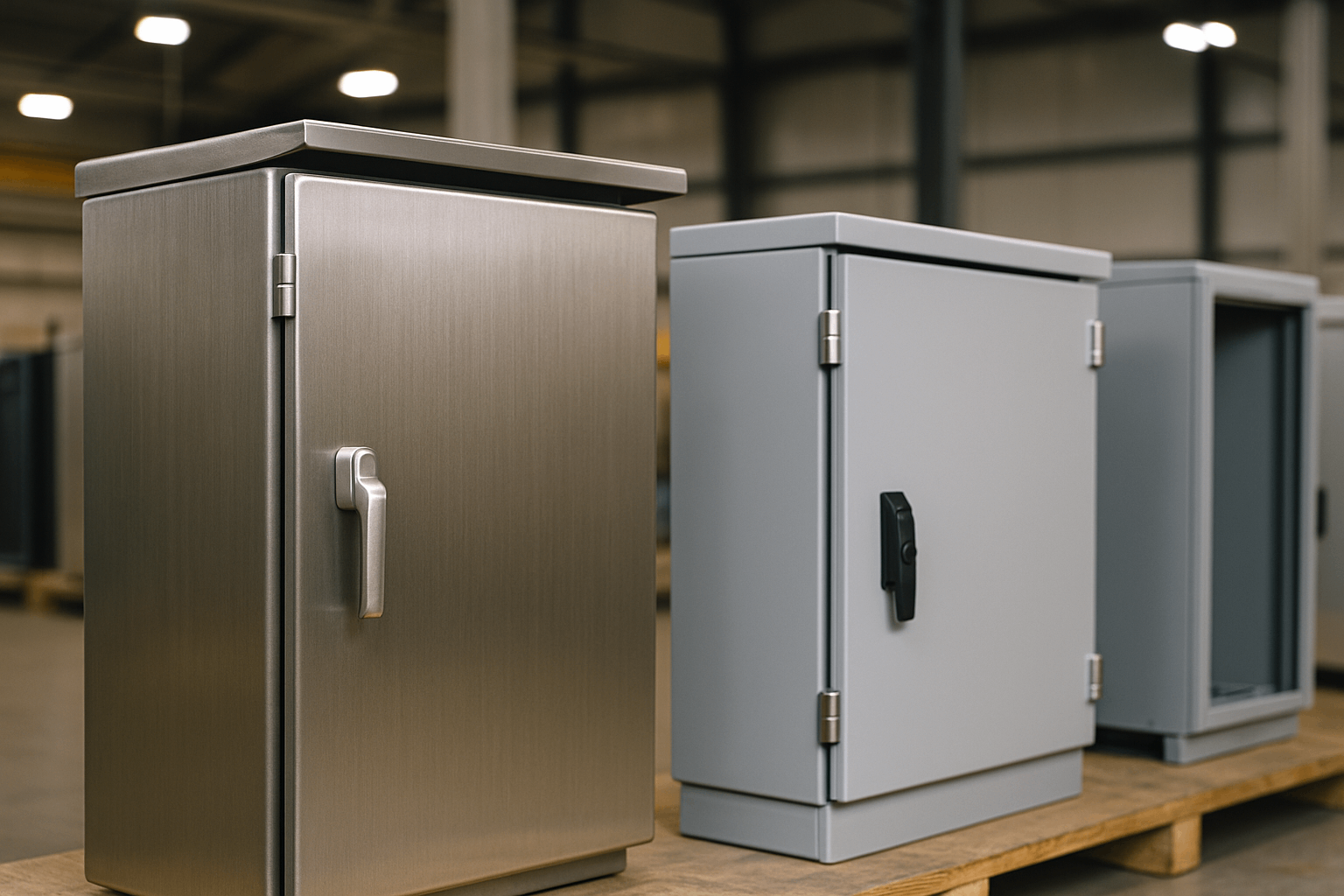
- stainless steel where coated steel would perform adequately
- IP66 where IP54 or NEMA 3R would be enough
- active cooling where passive thermal management would work
- premium modular systems where a fixed custom build would be easier to install and cheaper to deploy
The result is familiar: higher cost, longer approval cycles, and complexity that adds little real value.
The Flexibility Gap in Modular Systems
Premium modular systems are often excellent in controlled planning environments. They can be less convenient when real projects change late.
Field conditions often demand adjustments such as:
- different conduit entries
- alternate gland plate arrangements
- last-minute HMI changes
- revised cable routing
- customer-specific internal layout changes
This is where OEM suppliers often have an advantage. A capable manufacturer can build the enclosure around the actual drawing instead of asking the project to adapt to the catalog.
Strategic Sourcing for B2B Buyers
The best enclosure decisions usually come from a sourcing matrix, not from brand habit.
How to Build a Sourcing Matrix That Works
Before comparing vendors, buyers should define the real project variables.
| Evaluation Category | Variables to Define |
| Mounting Type | Pole, wall, flush, pad, floor, rack |
| Ingress Rating | NEMA 1–13, IP54, IP65, IP66, IP67, IP68 |
| Material | Galvanized steel, aluminum, SS304, SS316 |
| Interface Type | Push buttons, PLC cutouts, HMI windows, service access |
| Certification Priority | CE, RoHS, UL, ISO 9001, NEMA |
| Cooling Needs | Passive vents, filtered fans, air conditioners |
| Tracking / Branding | QR codes, serial labels, laser marking, customer branding |
Once those details are defined, enclosure sourcing becomes more objective. Buyers can compare whether they actually need a premium catalog solution or whether a custom OEM supplier can match the functional need more directly.
Why YISHANG Aligns with B2B Procurement Behavior
With more than 26 years of OEM manufacturing experience, YISHANG supports buyers who need enclosure solutions that are practical, scalable, and project-specific.
We support customers with:
- rapid prototyping and production planning
- MOQ flexibility for pilot runs and phased rollouts
- engineer-led customization instead of catalog-only limitation
- inspection documents and freight-oriented packaging support
The core advantage is simple: we adapt the enclosure to the project, instead of forcing the project to fit a fixed enclosure platform.
Application-Specific Comparisons: Rittal vs OEM
Modularity Without the Lock-In
Advanced enclosures often need to integrate sensors, drives, controllers, HMIs, and field-specific components. Premium systems do this well, but they can also create dependence on proprietary modules or enclosure families.
For many buyers, long-term sourcing flexibility matters just as much as immediate compatibility.
OEM suppliers such as YISHANG can build around open integration logic, supporting components from brands like Siemens, Schneider, ABB, and others without forcing the customer into one enclosure ecosystem.
Functional Design Beats Theoretical Ratings
A specification sheet can confirm ingress level or material type. It cannot tell you whether the installer can work inside the enclosure efficiently.
Good enclosure design should consider:
- cable routing practicality
- service access
- internal layout logic
- hinge placement
- panel accessibility
- ease of modification during installation
Those details affect labor time, serviceability, and end-user satisfaction far more than buyers sometimes expect.
When to Mix Premium and OEM
The smartest sourcing strategy is often not “premium only” or “OEM only.” It is a mixed model.
For example:
- use Rittal in high-risk, highly standardized, or globally audited applications
- use YISHANG for bulk custom enclosures, PLC cabinets, wall-mount units, or project-specific rollout programs where flexibility and cost control matter more
That hybrid approach is often what gives buyers the best balance of quality, budget, and lead time.
Final Takeaway: Source by Specification, Not Tradition
Rittal’s reputation is well earned. That does not mean it is automatically the best answer for every enclosure project.
Today’s buyers are under pressure to deliver:
- technical fit
- cost control
- delivery speed
- documentation and compliance
- repeatability across volume orders
Those goals are not always served by defaulting to the most recognized brand.
In many projects, the better sourcing question is not “Should we buy Rittal or not?”
It is:
“Which enclosure supplier best matches the actual risk level, technical requirement, customization need, and rollout speed of this project?”
That is where a capable OEM manufacturer can outperform legacy assumptions.
At YISHANG, we support industrial buyers with:
- engineer-led enclosure customization
- shorter lead-time planning
- lower total cost through spec-aligned manufacturing
- global compliance support for export-oriented projects
If your enclosure program needs a more flexible sourcing path, the better answer may not be tradition. It may be specification discipline.