
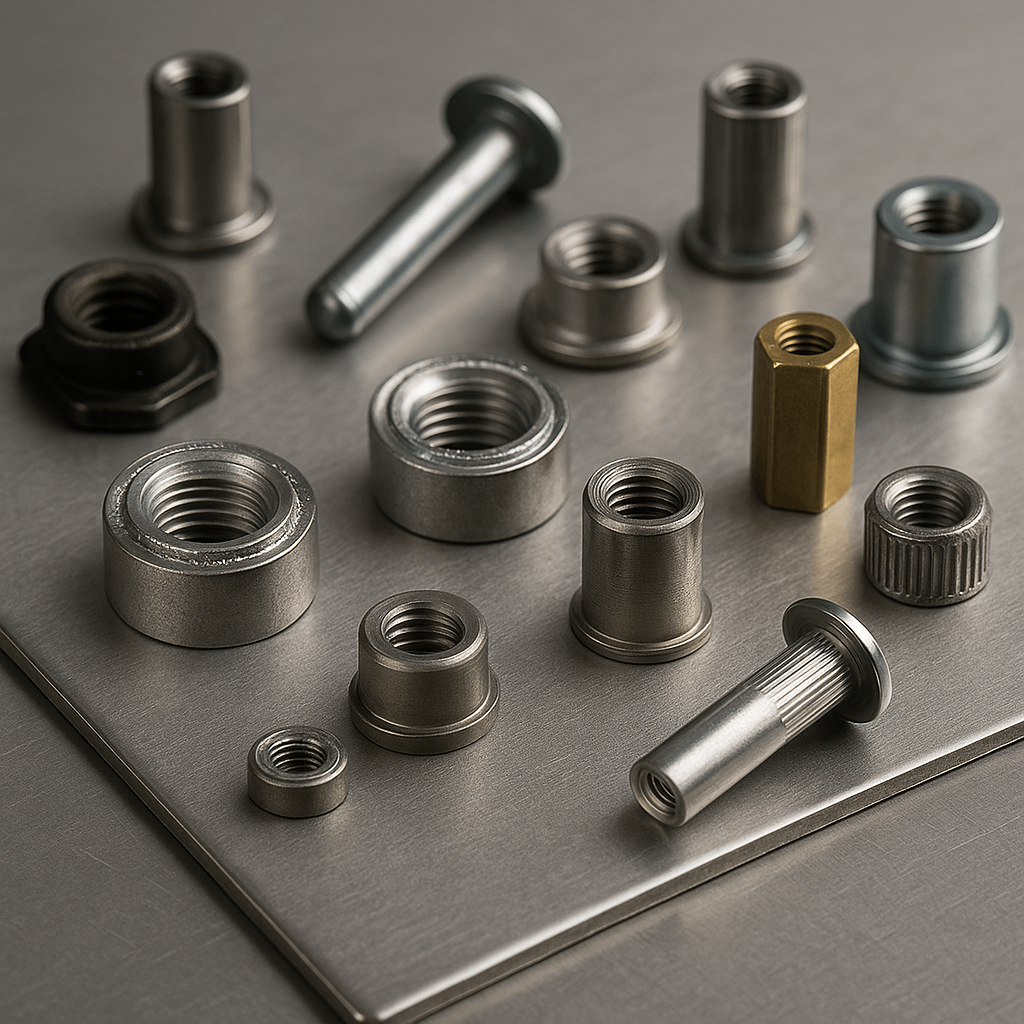
The Engineer’s “Get-it-Right-First-Time” Quick Reference: Key Hardware Design Parameters
In precision sheet metal manufacturing, a small fastener can create a large failure. A self-clinching nut that spins under load, a rivet nut installed in the wrong hole size, or a cable tie mount placed too close to a bend line can delay production, damage finished panels, and create warranty issues that are far more expensive than the hardware itself.
For engineers and procurement teams, sheet metal hardware should not be treated as a low-value commodity. It is part of the product’s structure, serviceability, safety, and assembly efficiency. The right hardware choice can reduce labor time, simplify assembly, and prevent field failures. The wrong choice—often only noticed after production starts—can be painfully expensive.
The Three Golden Rules of Self-Clinching Fastener Design:
The design rules for self-clinching fasteners are simple, but they are not optional.
The hardness rule
The fastener must be harder than the host sheet metal, usually by at least 20 points on the Rockwell B scale. The sheet must deform into the fastener’s clinching features—not the other way around.The hole preparation rule
The mounting hole must follow the fastener manufacturer’s tolerance. It should not be chamfered or aggressively deburred, because that removes the sheet material needed for proper cold flow.The load direction rule
For self-clinching nuts, the mating screw should normally be installed from the opposite side of the fastener head. This places the joint in its strongest load direction and helps prevent pull-through failure.
Quick Reference Data for Common Self-Clinching Hardware
The values below are useful for early design review and RFQ discussions. Final dimensions should always be confirmed against the selected fastener manufacturer’s datasheet.
| Hardware Type | Thread Size | Min. Sheet Thickness | Recommended Hole Size (+0.08 / -0.00 mm) | Min. Centerline to Edge |
| Nuts (S/CLS/SP) | M3 | 1.0 mm | 4.22 mm | 4.8 mm |
| Nuts (S/CLS/SP) | M4 | 1.0 mm | 5.40 mm | 6.9 mm |
| Nuts (S/CLS/SP) | M5 | 1.0 mm | 6.35 mm | 7.1 mm |
| Nuts (S/CLS/SP) | #4-40 | 0.040″ / 1.0 mm | 0.166″ / 4.22 mm | 0.19″ / 4.8 mm |
| Nuts (S/CLS/SP) | #6-32 | 0.040″ / 1.0 mm | 0.188″ / 4.76 mm | 0.22″ / 5.6 mm |
| Studs (FH) | M3 | 1.0 mm | 3.0 mm | 5.6 mm |
| Studs (FH) | M4 | 1.0 mm | 4.0 mm | 7.2 mm |
| Studs (FH) | M5 | 1.0 mm | 5.0 mm | 7.2 mm |
| Studs (FH) | #4-40 | 0.040″ / 1.0 mm | 0.111″ / 2.82 mm | 0.220″ / 5.6 mm |
| Studs (FH) | #6-32 | 0.040″ / 1.0 mm | 0.137″ / 3.48 mm | 0.250″ / 6.4 mm |
| Standoffs (SO/BSO) | M3 | 1.0 mm | 4.22 mm | 6.0 mm |
| Standoffs (SO/BSO) | M4 | 1.27 mm | 7.14 mm | 8.0 mm |
| Standoffs (SO/BSO) | #4-40 | 0.040″ / 1.0 mm | 0.166″ / 4.22 mm | 0.23″ / 5.8 mm |
| Standoffs (SO/BSO) | #6-32 | 0.040″ / 1.0 mm | 0.213″ / 5.41 mm | 0.27″ / 6.9 mm |
Note: Use this table for preliminary planning only. Always verify the exact part number, material, sheet thickness, installation force, and edge distance with the supplier’s datasheet.
Redefining Hardware: From “What to Choose” to “What Problem to Solve”
Good hardware selection does not start with a catalog page. It starts with a problem: a thin sheet needs a reusable thread, a closed tube needs a blind attachment point, a service panel must not lose screws, or cables must be controlled inside a compact enclosure.
When hardware is selected this way, it becomes part of the engineering solution rather than a late-stage purchasing item.
Challenge 1: How to Create Strong, Reusable Threads in Thin Sheet Metal?
Thin sheet metal is often too thin for reliable tapped threads. Self-clinching nuts, studs, and standoffs solve this by creating strong, permanent threads or mounting points directly in the sheet.
During installation, the fastener is pressed into a properly sized hole. The softer sheet material cold-flows into the fastener’s undercut or annular recess, while serrations or knurls resist rotation. This creates two forms of strength: resistance to being pushed or pulled out, and resistance to spinning under torque.
For production teams, the benefit is clear. The thread becomes part of the panel, loose hardware is reduced, and assembly becomes faster and more repeatable.
Challenge 2: When the Backside is Inaccessible or Ultimate Strength is Required
Some designs do not allow access to the backside of the panel or tube. In that case, a standard nut is impossible. Rivet nuts, also called nutserts, are often the practical answer. They are installed from one side and collapse behind the panel to create a reusable thread.
Rivet nuts are especially useful for tubular frames, sealed enclosures, aluminum extrusions, and structures where backside access is limited.
For maximum strength, weld nuts may be selected instead. Projection welding creates a metallurgical bond between the nut and the sheet, making it suitable for structural or safety-critical applications. But welding brings heat, and heat changes the process sequence. Weld nuts must be installed before painting, powder coating, or plating.
Challenge 3: How to Design for Serviceability and Absolute Safety
In equipment that requires regular maintenance, loose screws can become a real problem. A screw dropped inside a server, telecom cabinet, medical device, or control enclosure can damage electronics or create safety risk.
Captive panel fasteners solve this by keeping the screw attached to the access panel even when loosened. Spring-loaded versions retract the screw after release, preventing it from falling into the product.
Tool-less designs work well for frequent service access. Tool-driven designs are better where security or safety standards require restricted access. The right choice depends on how the product will actually be opened and maintained in the field.
Challenge 4: The Unseen Guardian of Reliability – Cable Management
Cable management hardware is easy to overlook, but it often decides whether an enclosure remains reliable over time. Loose cables can rub against sharp edges, block airflow, vibrate against metal surfaces, or create electrical faults.
Self-clinching tie mounts, standoffs, clamps, and grommets help route cables safely and consistently. Compared with adhesive mounts, mechanically attached hardware is more reliable under heat, vibration, aging, and long-term service.
For buyers sourcing cabinets, server chassis, energy storage enclosures, or industrial control boxes, cable management should be reviewed early—not added as an afterthought.
Avoiding “Production Traps”: 5 Costly Design for Manufacturability (DFM) Mistakes
Most hardware failures are not mysterious. They often come from predictable DFM mistakes: wrong hole size, wrong material hardness, wrong installation sequence, wrong tool, or incompatible metals.
These mistakes may look small on a drawing, but they become expensive during production.
Trap 1: The Hardness Mismatch – “Why did my fastener crush during installation?”
A self-clinching fastener must be harder than the sheet. If the sheet is as hard as—or harder than—the fastener, the fastener may collapse, deform, or fail to lock.
This often happens when standard stainless fasteners are installed into stainless steel panels. In such cases, special hardened fasteners are required. The fastener material, sheet material, and hardness values should be checked before mass production begins.
Trap 2: Improper Hole Sizing and Placement – “Why is the panel bulging and the fastener spinning?”
The installation hole is not a casual clearance hole. It is a controlled feature. If the hole is too large, the fastener may spin. If it is too small, installation force may damage the panel. If it is chamfered, the sheet loses material needed for clinching.
Placement matters as well. A fastener too close to an edge can cause bulging or cracking. A hole too close to a bend line may become oval after forming. These are classic drawing-stage problems that show up later as production scrap.
Trap 3: Ignoring the Process Sequence – “Why did welding destroy my powder-coated finish?”
The joining method affects the whole manufacturing sequence. Welding creates heat and must generally happen before finishing. Self-clinching installation, by contrast, is a cold-forming process and can often be done after plating or coating, depending on the part and finish.
If the process sequence is wrong, the factory may need to rework finished parts—or scrap them entirely. Buyers should confirm hardware installation timing during the DFM stage.
Trap 4: The Wrong Installation Method – “Why did the fastener fall out after I hammered it in?”
Self-clinching fasteners are not hammered in. They require a controlled, parallel pressing force from a suitable press. The sheet material needs time and pressure to flow correctly into the fastener’s locking features.
Hammering creates shock, damages the finish, distorts the fastener, and produces unreliable joints. Over-pressing is also risky because it can crush the fastener head, damage threads, or deform the panel.
Trap 5: Material Incompatibility and Galvanic Corrosion – “Why is my aluminum enclosure rusting around the steel screws?”
Hardware material must be compatible with the panel and the service environment. When dissimilar metals touch in the presence of moisture, galvanic corrosion can occur. For example, steel hardware in an aluminum enclosure may accelerate corrosion around the joint.
This risk increases in humid, outdoor, marine, or chemically exposed environments. The solution may be compatible fastener materials, plated hardware, insulating washers, protective coatings, or a different joint design.
Beyond the Price Tag: Calculating the “True Cost” of a Fastener
The cheapest fastener is not always the lowest-cost fastener. Procurement teams need to look at total installed cost, not only unit price.
A fastener that costs more per piece may reduce assembly labor, eliminate loose parts, simplify inventory, improve reliability, and lower warranty risk. In volume production, those savings can outweigh the purchase price difference.
The Iceberg Model of Fastener Costs
The visible cost is the fastener price. The hidden costs include:
assembly labor and handling time;
number of loose components;
inventory and SKU management;
installation tooling;
rework and scrap;
inspection time;
field failure and warranty claims.
For example, a traditional screw, washer, and nut may look cheaper than a self-clinching nut. But if the assembly worker must handle three loose items at every joint, the labor cost can quickly exceed the hardware savings.
Cost-Benefit Case Study Analysis
Consider a high-volume enclosure with many attachment points. Using self-clinching nuts may cost more at the hardware level, but it removes loose nuts and washers from the assembly line. Across thousands of units, the labor savings, lower error rate, and faster assembly often justify the higher component cost.
Another example is a powder-coated tubular frame. Weld nuts may seem strong and economical, but they must be welded before coating. Rivet nuts can often be installed after coating, simplifying finishing and reducing the risk of surface damage. The best choice depends on strength needs, appearance requirements, production sequence, and assembly cost—not just the fastener price.
Precision Sheet Metal Hardware FAQ
Below are practical answers to common hardware questions from engineers, procurement teams, and sheet metal product designers.
What are the common types of hardware used in precision sheet metal fabrication?
Common hardware includes self-clinching nuts, studs, standoffs, captive panel fasteners, weld nuts, rivet nuts, blind rivets, tie mounts, cable clamps, hinges, grounding studs, and access-panel hardware.
How do self-clinching nuts differ from weld nuts or rivet nuts?
Self-clinching nuts are pressed into ductile sheet metal and lock mechanically through cold flow. Weld nuts are fused to the sheet using heat and provide very high strength, but must be installed before finishing. Rivet nuts are installed from one side and are useful when the backside is inaccessible.
What is the purpose of TY-D® tie-down hardware?
TY-D® tie-down hardware provides a permanent anchor point for cable ties inside sheet metal enclosures. It helps route cables safely without relying on adhesive mounts, which may fail under heat, aging, or vibration.
What are the benefits of using locking nuts in sheet metal fabrication?
Locking nuts help prevent screws from loosening under vibration or thermal cycling. They can reduce the need for separate lock washers or chemical thread-locking compounds, making assembly cleaner and more reliable.
What are the most critical DFM rules for self-clinching fasteners?
The key rules are: choose a fastener harder than the sheet, use the correct hole size, avoid chamfering the installation hole, respect minimum edge distance, keep holes away from bend distortion zones, and install the fastener with proper pressing equipment.
Can you install self-clinching fasteners after painting or finishing?
In many cases, yes. Since self-clinching installation does not use heat, fasteners can often be installed after plating or powder coating. However, the finish thickness, risk of surface marking, and fastener type should still be reviewed before production.
Conclusion
Smart hardware selection is one of the quiet foundations of precision sheet metal manufacturing. It affects assembly speed, structural reliability, serviceability, cable routing, corrosion resistance, and long-term product performance.
For buyers, the lesson is straightforward: do not choose hardware only by price or habit. Choose it based on the problem it must solve, the material it will enter, the load it will carry, the process sequence it requires, and the environment it must survive.
At Yishang Metal Products Co., Ltd., we support OEM and wholesale customers with custom sheet metal fabrication and hardware integration for enclosures, racks, cabinets, frames, brackets, display structures, and industrial components. With 26+ years of manufacturing experience, we support processes including laser cutting, bending, stamping, welding, CNC machining, hardware installation, surface treatment, assembly, inspection, packaging, and shipment.
📩 If your project involves self-clinching fasteners, rivet nuts, weld nuts, captive hardware, or sheet metal assembly design, send us your drawings or requirements for a practical DFM review.