

For B2B buyers sourcing sheet metal parts at scale, spot welding offers reliability, speed, and a clean finish. Especially in contract welding & fabricating, it’s a core process for consistent, automated output.
From EV frames to appliance casings, this technique ensures dependable joints with minimal distortion. It’s not outdated—it’s optimized for modern sheet metal workflows.
This guide serves as a practical spot welding vendor evaluation checklist for global sourcing teams pursuing the best welding for sheet metal sourcing.
Understanding the Process: How Spot Welding Works in Practice
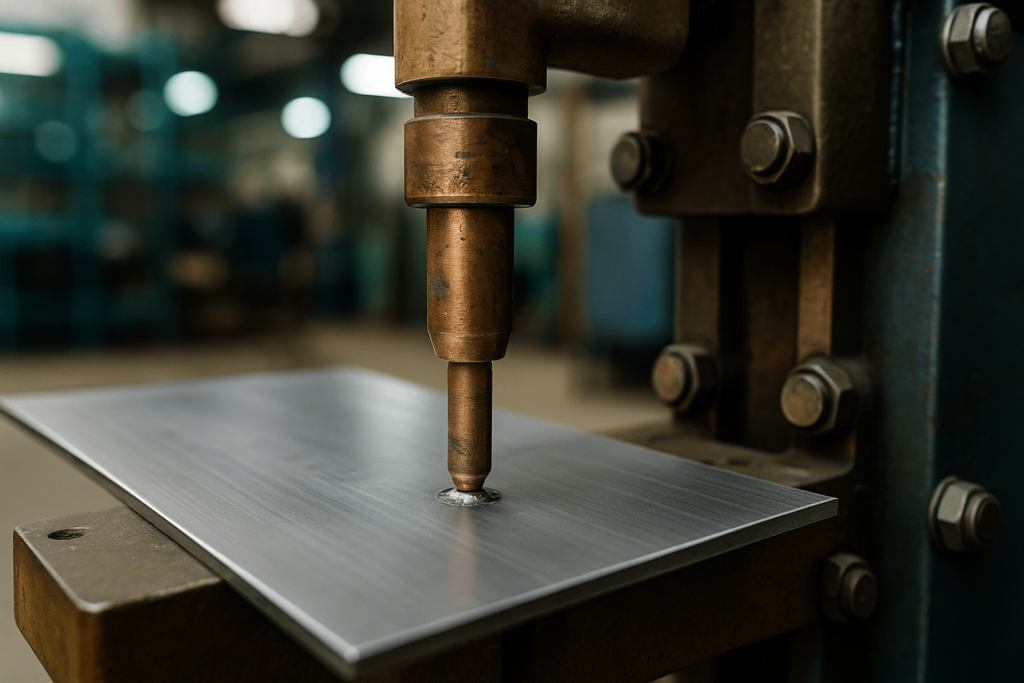
Spot welding joins overlapping sheet metals—usually lap joints—using pressure and a high-current electrical pulse. Electrodes concentrate the heat to create a molten zone. Once the metal cools, it forms a strong weld nugget.
This method suits stainless steel, galvanized steel, and aluminum—though aluminum spot welding challenges like oxide resistance demand advanced control. Suppliers must manage current, pressure, and timing precisely, especially for 4130 or 4140 weldability. Even small deviations can weaken weld quality or cause porosity.
Engineering Parameters That Define a Reliable Spot Weld
Current and Time
Effective spot welding requires high-amperage, short-duration pulses. Overheating can lead to expulsion; insufficient energy causes cold welds. For best welding results on sheet metal, the current-time balance must be optimized.
Clamping Pressure
Proper clamping ensures surface contact. Under-pressure causes arcing; over-pressure flattens the weld nugget. Servo-controlled systems offer consistent force—a key advantage in welding assembly for robotics.
Material Adaptability
For diverse industries, suppliers must handle different materials. Aluminium welding requires oxide layer management and current calibration. Spot welding offers advantages over brazing welding or solder welds in strength and speed.
Electrode Shape & Dressing
Tip shape affects heat concentration. Smaller tips increase focus but wear faster. Vendors with automated tip dressing deliver consistency across large volumes. This affects both quality and cost efficiency.
Weld Spacing and Pattern
Incorrect spacing leads to thermal buildup or weak joints. Smart weld layouts support better strength and enable design for welding principles in production.
Where Spot Welding Excels: Use Cases and Industry Fit
Automotive Assemblies
Robotic spot welding performs over 5,000 welds per vehicle. It’s used in chassis, doors, and frames due to low heat distortion and high throughput—ideal for MIG vs arc welding considerations.

Battery & Energy Modules
Battery tabs, often made from aluminum or nickel, need precise low-heat welds. Spot welding reduces thermal impact, making it safer than soldering in energy-critical applications.
Enclosures and Appliances
Spot welding creates clean, flush joints for metal cabinets and household appliances. Its minimal post-processing and strong bonds make it preferable to solder welds in load-bearing areas.
Custom Fabrication, Displays & Low-Volume Runs
For displays, kiosks, and batch-size-one projects, spot welding’s flexibility enables short lead times and cost savings. It also integrates smoothly into digital workflows, such as CNC bending and laser cutting. Its ability to support low-volume flexibility and integrate seamlessly with CNC and laser workflows makes it ideal for bespoke, cost-sensitive projects.
Spot Welding vs. Other Joining Methods
| Method | Strengths | Drawbacks | Ideal For |
|---|---|---|---|
| Spot Welding | Fast, low distortion, no filler | Limited to lap joints | Sheet metal, auto, batteries |
| TIG Welding | High-quality, visually clean | Slow, labor-intensive | Visible seams, aerospace |
| MIG Welding | Scalable, filler-compatible | Can warp thin materials | Structural frames, 2F welds |
| Brazing Welding | Joins dissimilar metals | Weaker mechanical bond | HVAC, electronics |
| Soldering | Low-temp, fine detail | Poor structural strength | Electronics, PCBs |
Understanding soldering versus welding matters. For structural integrity and speed, spot welding outperforms soldering and MIG in many B2B applications.
Evaluating Suppliers: Key Factors for Sourcing Spot Welding
When sourcing welding metal services, B2B buyers should prioritize capability over catalog claims. Here are decisive factors:
Traceability: Can weld profiles be stored and repeated accurately?
Material Scope: Can the supplier manage 4130 steel welding or aluminum?
Tooling & Flexibility: Use of modular jigs and back step welding supports varying designs.
Maintenance: Is electrode tip dressing automated and scheduled?
Compliance: ISO 9001, RoHS, and application-specific standards are critical.
Real-time monitoring and adaptive control are now common in robotic systems. These benefits of robotic welding directly impact production consistency.
Practical Quality Control That Impacts Results
Surface Prep
Contamination increases resistance. Common causes of porosity in welding include oil, oxide, or dust. Vendors must implement degreasing or brushing protocols before welding. A tack weld is a temporary welding technique, often applied before full-strength welding to maintain part positioning and improve consistency.
Cooling Systems
Poor water flow can deform electrodes, shortening tool life. Monitoring coolant flow rate ensures weld quality over long runs.
Monitoring and Feedback
Visual inspection isn’t enough. Sensors tracking voltage, force, or nugget formation enable inline control. This reflects top-tier contract welding & fabricating capability.
Quality Sampling
Peel tests and section cuts verify consistency. Consider requiring checks on 5 basic welding joints—especially fillet joints, which are one of the five basic weld joints in structural fabrication. Understanding tack weld vs spot weld outcomes can help determine when each technique is best used.
Final Takeaway: Spot Welding as a Procurement Asset
Spot welding is a scalable, cost-effective solution that aligns with today’s lean manufacturing and procurement standards. For many sheet metal applications, it remains a dependable option where reliability and automation-readiness are priorities.
For buyers weighing TIG vs arc welding or welding versus soldering in their next RFQ, spot welding delivers proven ROI. Working with suppliers like YISHANG, who integrate control, versatility, and compliance, simplifies your sourcing process.
Have a project? Reach out to YISHANG to discuss how we support your sheet metal welding needs—on time, on spec, and at scale.
FAQ
Q1: Is spot welding effective on aluminum?
Yes, but requires higher current and precise surface cleaning. Ask your supplier about their aluminum welding track record. Aluminum spot welding challenges include oxide layers and thermal conductivity.
Q2: What leads to porosity in spot welds?
Oil, oxide, poor clamping, or insufficient coolant flow are common causes of weld porosity.
Q3: Why choose spot welding over soldering in structural assemblies?
Soldering lacks mechanical strength. Spot welding offers superior durability and speed in industrial fabrication.
Q4: What is the difference between spot weld and tack weld in fixture assembly?
Tack welds are temporary welds used to hold pieces in position before final welding. Spot welds are permanent and carry structural load.