
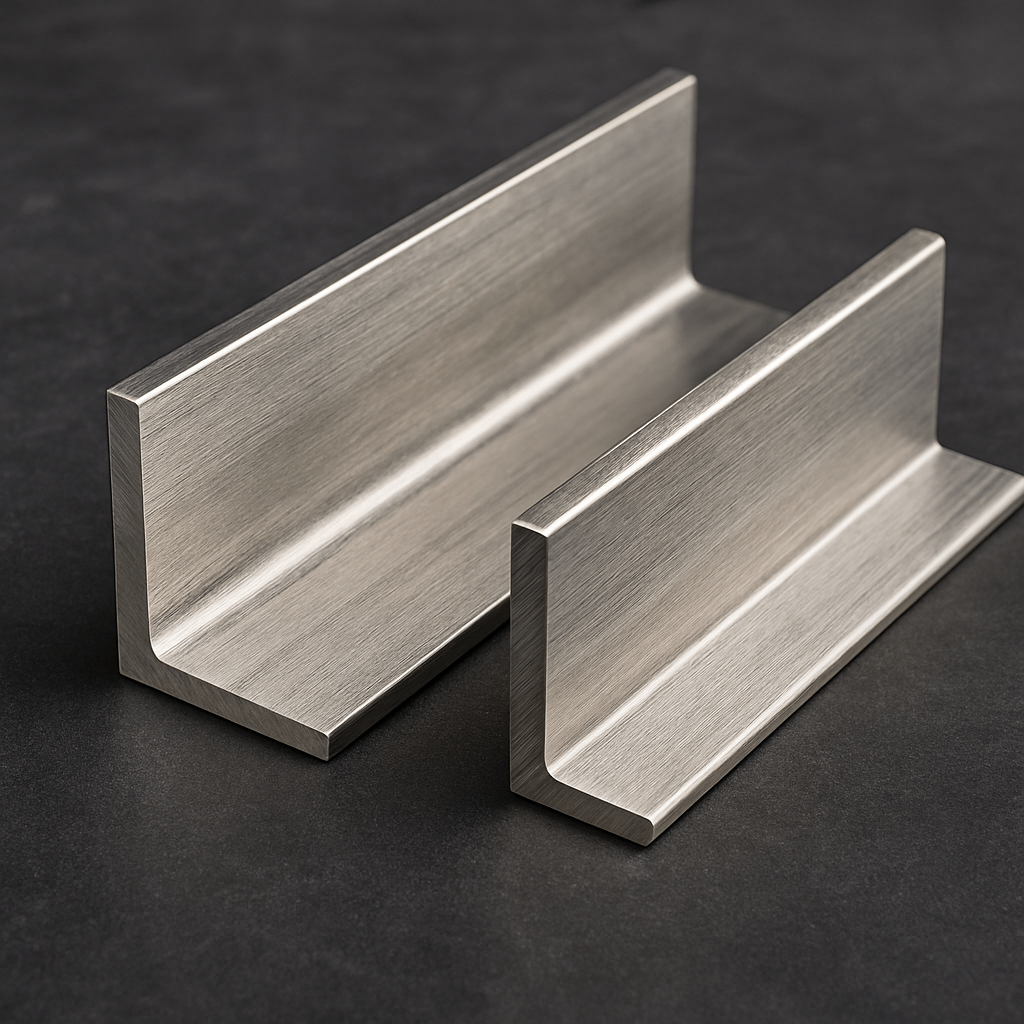
Introduction: Why Stainless Steel Angle Profiles Are a Strategic Procurement Decision
Stainless steel angle profiles are often treated as standard stock items, but for serious buyers they are specification-driven structural products. Grade choice, forming route, tolerance level, finish condition, and corrosion environment all affect whether the angle performs well over time or becomes an avoidable maintenance problem.
For procurement teams, this makes stainless angle more than a line-item purchase. It is a decision tied to service life, fabrication compatibility, compliance, and total cost of ownership.
That is why informed sourcing begins not with price alone, but with the relationship between environment, processing method, and expected product life.
The First Critical Choice: Grade 304 vs. 316 — A Data-Driven Decision
The first major decision is usually the alloy grade. In practical sourcing, the 304 vs. 316 question is rarely academic. It is about whether the project environment justifies the added corrosion resistance and cost of 316.
Scenario-Based Recommendations
Grade 304/304L remains the standard choice for many indoor, low-chloride, and general industrial applications where cost efficiency and dependable corrosion resistance are both needed. Grade 316/316L is the stronger option where chlorides, coastal moisture, aggressive cleaning chemicals, or marine exposure raise the corrosion risk beyond what 304 can comfortably handle.
For buyers, the important point is not to over-specify 316 where 304 is enough, but also not to under-specify 304 where early pitting or crevice corrosion is likely.
Authoritative Data Point
Corrosion comparison data is useful only when interpreted correctly. It should support, not replace, real environment-based judgment. Salt-spray and field performance comparisons consistently show that 316 gives a stronger corrosion margin where chlorides are present.
Quick-Reference Decision Matrix
| Feature | Grade 304 / 304L | Grade 316 / 316L |
| Chloride resistance | Moderate | Superior |
| Relative cost index | 1.0x | 1.2x–1.3x |
| Best environment | Inland / dry / mild | Coastal / marine / chemical |
| Weldability | Excellent | Excellent |
This type of comparison helps buyers match corrosion risk to budget instead of defaulting to the highest grade without justification.
Form Follows Factory: Hot-Rolled, Cold-Drawn & Laser-Fused
After grade selection, the next key decision is how the stainless angle is produced. Forming method affects corner shape, straightness, tolerance level, visual finish, fabrication suitability, and cost.
Hot-Rolled: Built for Strength and Value
Hot-rolled stainless angle is typically the most economical choice for structural and utility-focused use. It is well suited to heavier-duty applications where visual sharpness is less important than strength, availability, and price stability.
Cold-Drawn: For Precision Projects and Aesthetic Use
Cold-drawn angle is generally selected when buyers need tighter dimensions, cleaner edges, and better visual consistency. It is more suitable for exposed installations, cleaner fabrication results, and applications where appearance and precision matter together.
Laser-Fused: The Custom Fabricator’s Weapon of Choice
Laser-fused stainless angle is often chosen for custom work, sharp-corner requirements, and fabricated architectural or engineered assemblies where standard rolled profiles are not the best fit. For buyers, its main advantages are flexibility, cleaner geometry, and easier customization.
Where It’s Used: Real Applications in Industrial Sectors
Stainless steel angle is used across multiple industries because it can serve both structural and support functions while tolerating environments that would quickly damage painted carbon steel.
Construction and Architecture
In architectural and construction projects, stainless angle is commonly used in façade framing, support brackets, visible trim structures, canopies, and exposed support details where corrosion resistance and appearance must work together.
Food Processing and Pharma
Food, beverage, and pharmaceutical environments often favor stainless angle because it supports hygienic design, washdown resistance, and long-term surface stability. In these sectors, grade selection and finish quality are both important.
Coastal, Marine, and Offshore
Coastal and marine applications are where 316/316L usually justifies its premium most clearly. Salt exposure, moisture retention, and chloride attack quickly expose the difference between a material that only looks acceptable at purchase stage and one that remains serviceable in the field.
Energy and Utilities
In utility, refinery, and energy-support structures, stainless angle is often chosen where corrosion resistance, low maintenance, and long project life matter more than the lowest initial cost.
Fabrication FAQ: Common Production Pitfalls & Fixes
Q: Why do drill bits dull quickly on stainless?
Austenitic stainless steels work-harden easily, so incorrect speed, light feed, or excessive heat can quickly damage tooling. Stable setup, suitable tooling, and proper coolant matter.
Q: Why is my welded stainless warping?
Stainless expands more and retains heat differently than carbon steel. Distortion control depends on welding sequence, restraint strategy, and heat input discipline.
Q: Why does my new weld rust?
New weld rust is often caused by contamination, poor post-weld cleaning, or failure to restore the passive surface correctly. This is a processing issue, not necessarily a base-metal problem.
Quality Control & Procurement Considerations
Quality control for stainless angle procurement should verify more than grade name alone. Buyers should confirm heat traceability, chemistry, mechanical properties, dimensions, finish condition, and forming consistency.
Material Test Reports (MTR) — What to Check
MTR review should confirm the batch identity, alloy chemistry, and relevant mechanical data for the supplied material. This is especially important in projects where 316 is specified for corrosion reasons or where structural loading makes material consistency critical.
How to Justify the Cost: TCO vs. Initial Price
The strongest commercial case for stainless angle is usually total cost of ownership, not entry price. Maintenance, repainting, corrosion-driven replacement, service interruption, and appearance-related claims all tend to favor stainless where the environment is demanding enough.
Sustainability Bonus
Stainless steel also supports circular-material thinking through high recyclability and strong retained scrap value. For some buyers, that adds a useful ESG and lifecycle argument alongside the engineering case.
Conclusion: Procurement Wins Through Informed Engineering
The best stainless steel angle purchase is not the cheapest one and not automatically the highest-grade one. It is the one correctly matched to the environment, fabrication route, compliance requirement, and project life.
At Yishang Metal Products Co., Ltd., we support OEM and wholesale customers with custom metal fabrication for structural supports, brackets, frames, enclosures, and other industrial metal parts. With 26+ years of manufacturing experience, we support processes including laser cutting, bending, stamping, welding, CNC machining, surface treatment, assembly, packaging, inspection, and shipment.
For projects involving stainless steel profiles or related fabricated parts, we help customers align material choice, fabrication method, and export-ready quality control with real application needs.
Quick Reference FAQ
Is stainless steel angle magnetic?
304 and 316 are generally non-magnetic in annealed condition, though cold working can introduce slight magnetism.
Stock lengths?
Standard stock lengths are common, but custom cut lengths are also widely available depending on supplier capability and order volume.
Can it be bent?
Yes, but stainless requires more controlled bending force and better allowance for spring-back than mild steel.
How to clean a brushed finish?
Use mild cleaning methods and wipe along the grain direction. Avoid aggressive contamination sources that may damage the finish or promote surface staining.