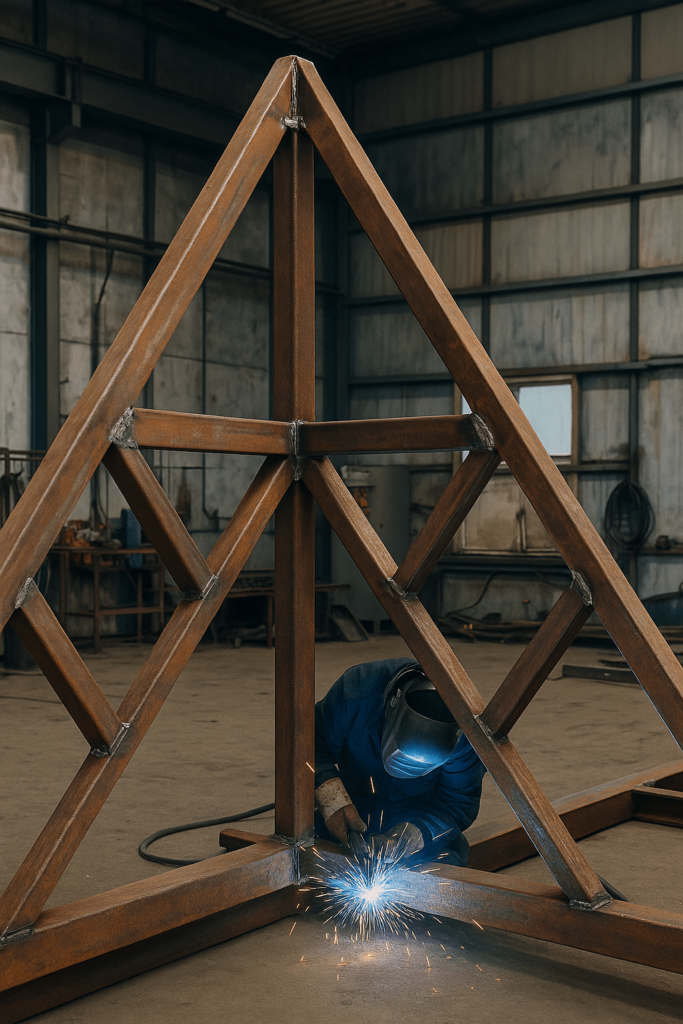
Steel trusses are widely used in industrial and commercial construction because they can carry significant loads across long spans while using material efficiently. Their geometry allows forces to be distributed through a network of members instead of relying on a single heavy beam.
For procurement teams, truss selection is not only a structural design decision. It also affects fabrication complexity, transport planning, installation method, coating requirements, and total project cost.
Because many steel trusses are prefabricated and shipped in sections, buyers should evaluate them as both structural systems and manufactured products.
Why Truss Choice Matters to Buyers
Different truss forms can solve similar span problems, but they do not create the same manufacturing burden. A truss with more nodes, more weld length, or more complicated geometry may increase fabrication time, inspection effort, and freight cost even if its structural concept appears attractive in design.
That is why procurement review should consider not only span and load, but also repeatability, transportability, and assembly efficiency.
Structural Functionality: How Steel Trusses Distribute Loads
Steel trusses work by converting applied loads into axial tension and compression within their members. This allows a relatively light framework to span longer distances than many conventional beam-based solutions.
A typical truss includes top chords, bottom chords, and web members arranged so that loads are transferred efficiently to the supports. The geometry of these members determines how well the truss balances structural strength with weight efficiency.
For buyers, this structural behavior leads to practical outcomes such as lower steel consumption per span, fewer intermediate supports, and easier integration into prefabricated or modular building systems.
Key Steel Truss Types for Industrial & Commercial Projects
Different truss types are selected according to span, load distribution, roof form, fabrication complexity, and architectural intent.
Pratt Truss
Commonly used where repeated spans and predictable structural performance are needed. Its configuration is widely recognized in transport-related and industrial applications.
Warren Truss
Known for its repeating triangular pattern and relatively even force distribution. Often used in factory and commercial-span structures.
Howe Truss
Used in some agricultural and mixed-material applications where its load path and member arrangement suit the structural layout.
Fink Truss
Frequently used in pitched roof systems because it provides a practical balance between span support and material efficiency.
Bowstring Truss
Valued in long-span buildings such as hangars, arenas, and public structures where curved roof geometry and open interior space are important.
North Light & Sawtooth Truss
Often associated with industrial roofs where daylighting and ventilation strategy are part of the building concept.
King and Queen Post Trusses
Often associated with industrial roofs where daylighting and ventilation strategy are part of the building concept.
Scissor Truss
Selected where a vaulted interior profile is needed without relying on a flat bottom chord.
Fan, K, and Flat Trusses
Used in specialized layouts, modular structures, or projects where simplified roof or transport conditions make these configurations practical.
A steel truss may work structurally but still create avoidable cost if fabrication complexity is too high. Buyers should review manufacturability together with structural performance.
Key metrics include:
Node count and weld length — These directly affect labor time, weld inspection effort, and distortion risk
Material availability — Steel grade selection depends on regional standards and supply stability
Surface treatment — Galvanizing, primer systems, or painted coatings affect both durability and logistics timing
Tolerance control — Bolt-hole positioning, overall length, and assembly interfaces all influence site fit-up
Table: Fabrication Efficiency by Truss Type
Truss Type
Avg. Weld Time
Node Complexity
Assembly Time
Fink
Low
Low
Fast
Pratt
Medium
Medium
Moderate
Bowstring
High
High
Slow
Flat
Low
Low
Fast
For procurement review, these factors help explain why two trusses with similar span capacity may still differ significantly in manufacturing cost.
Real-World Applications and Procurement Pitfalls
Selecting a steel truss involves balancing structural need with practical constraints such as fabrication effort, freight size, erection method, and compliance requirements.
Logistics centers and warehouses: Often favor truss forms that can be fabricated repeatedly and assembled quickly on site
Airports and large halls: May require long-span solutions that reduce intermediate supports but increase transport and fabrication complexity
Retail or modular rollouts: Often prioritize simpler forms that reduce shipping volume and installation variability
Common procurement pitfalls include:
Over-specifying architectural complexity that increases node count and weld time
Ignoring fabrication tolerance requirements that later affect site fit-up
Failing to align the truss specification with the required regional code or certification framework
From Engineering File to Finished Product
Buyers usually benefit from suppliers who can convert engineering files into production-ready outputs without losing control over geometry, weld sequence, material traceability, or coating requirements.
A practical production route often includes:
Design interpretation of DWG, DXF, BIM, or equivalent structural files
Material planning according to the required regional standard
Precision cutting and forming for truss members and connection plates
Assembly and QA through fixtures, inspection, and trial fit checks where needed
Packing and logistics designed to protect coated or machined surfaces during shipment
This type of integrated workflow is especially important where buyers are ordering multiple units, phased deliveries, or export lots.
Steel Truss Trends Relevant to Sourcing Teams
Truss procurement is being influenced by wider construction trends such as modular building, lower-carbon design, and faster site assembly methods.
Common sourcing directions now include:
Disassemblable joints for relocatable or modular structures
Coating systems with documented environmental performance where carbon reporting matters
Bolt-on or simplified site assembly strategies to reduce field labor and installation uncertainty
For buyers, these trends mean that fabrication planning increasingly has to align with logistics strategy and sustainability reporting, not only structural design.
Conclusion: Build Smart, Source Smart
Steel trusses should be evaluated not only by structural theory, but also by how efficiently they can be fabricated, protected, shipped, and installed.
For procurement teams, the best truss choice is usually the one that meets structural requirements while keeping node complexity, weld volume, compliance risk, and logistics burden under control.
A good truss supplier should be able to explain both the structural rationale and the manufacturing consequences of the selected design.
A Practical RFQ Screening Rule
If a supplier can identify the truss type but cannot explain weld complexity, coating route, packaging method, and compliance path, the quotation is incomplete.
For steel truss procurement, manufacturing logic is part of the structural decision itself.
If you have any questions or need a quote, please send us a message. One of our specialists will get back to you within 24 hours and help you select the correct valve for your needs.