Introduction: From Sourcing to Success—Making Smarter Steel Procurement Decisions
In the world of wholesale procurement, every decision impacts the bottom line. Sourcing different structural steel shapes is no exception. The choice between a W-beam and a Hollow Structural Section (HSS) is far more than a technical detail; it’s a commercial decision that affects project costs, timelines, and logistics.
While architects focus on design loads, your priority is delivering quality-assured materials on schedule and within budget. This guide is written for you—buyers, procurement managers, and sourcing specialists navigating the complexities of bulk steel purchases.
Rather than list structural shapes in isolation, this guide bridges engineering intent and supply chain reality. You’ll learn how a shape’s geometry affects strength, availability, fabrication, and total cost of ownership.
Understanding steel profiles from a fabricator’s point of view allows you to identify risks early, ask smarter questions, and ensure smoother project execution—from factory to foundation.
1. Understanding the Core Profiles: A Functional Overview for Buyers
At its heart, structural steel design is a process of matching an optimized geometric form to a specific set of forces. For a procurement professional, understanding the fundamental purpose of each shape is key to appreciating its value, cost, and application.
Knowing the function of different structural steel helps you understand the “why” behind the specifications on your bill of materials—and how each shape’s geometry contributes to overall structural performance.
The Problem: Resisting Bending (Flexure)
For any horizontal member spanning a distance—be it a floor beam or a bridge girder—the primary enemy is bending. The solution must provide the highest possible resistance to this force while using the least amount of material. This is where the iconic I-beam (W-Shape) demonstrates its geometric genius.
Its design places the majority of its mass in the top and bottom flanges, as far as possible from the member’s neutral axis. This configuration maximizes its moment of inertia, the property that directly measures a shape’s resistance to bending.
Procurement Insight: Due to their efficiency and widespread use, I-beams are the workhorse of the construction industry. This translates to high availability from mills worldwide and generally the most competitive cost-per-ton for applications where bending is the primary load. They are a staple commodity in the steel supply chain, offering dependable performance and predictable costs.
The Problem: Resisting Twisting (Torsion) & Multi-Axis Compression
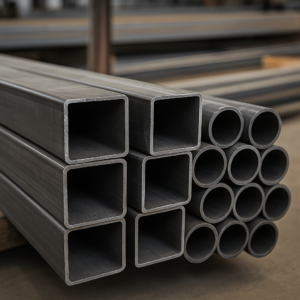
While I-beams are champions of bending in one direction, they are notoriously weak when it comes to twisting forces. This is where Hollow Structural Sections (HSS)—closed square, rectangular, or circular tubes—become the indispensable solution. Their closed, symmetrical profile gives them exceptionally high torsional resistance.
Procurement Insight: HSS profiles are a higher-value product. Their manufacturing process is more complex, often resulting in a higher cost per ton compared to standard I-beams. When you see HSS on a specification sheet, it signals a need for superior strength in multiple directions. It’s also a flag to account for potentially higher material and fabrication costs in your project budgeting.
The Problem: Simple Tension & Bracing
In many structures, particularly trusses and braced frames, some members are designed to handle only pure tension or light compression. For these applications, using a heavy I-beam would be wasteful. The most economical and effective solution is the Angle (L-Shape).
This simple L-shaped profile is lightweight and easy to fabricate, making it the jack-of-all-trades for connections and bracing.
Procurement Insight: Angles are highly economical and widely stocked. Their simple geometry makes them fast and inexpensive to fabricate. For a wholesale buyer, ensuring a reliable supply of common angle sizes is essential for providing a complete and competitive structural steel solution, especially when serving projects with tight lead times.
The Problem: Mounting & Support
Sometimes, the primary design challenge isn’t pure strength but constructability—specifically, the need to attach a member flush against a flat surface. The solution is the Channel (C-Shape), a profile with a flat back and two projecting flanges.
This flat surface is its core advantage, allowing for easy and secure mounting to walls, frames, and other structural elements.
Procurement Insight: Like angles, channels are versatile, widely available, and cost-effective. They are essential for applications like stair stringers, lintels, and equipment frames. Having access to a range of channel sizes is crucial for serving a broad array of construction needs beyond just the primary frame—and for adapting to late-stage design modifications.
2. The Fabricator’s Perspective: 5 Design Decisions That Impact Your Bottom Line
In procurement, details defined during design often determine cost outcomes on the production floor. At YISHANG, we’ve seen how even small geometric choices in structural steel can create ripple effects—delays, rework, shipping issues—that hurt budgets and erode margins.
The good news? With the right perspective, many of these pitfalls are avoidable.
Here are five commonly overlooked design decisions that significantly impact procurement, along with the insights you need to plan ahead.
Trap #1: Assuming All W-Shapes Are Equal
Not all wide-flange beams behave the same. Variations in flange width, web thickness, and steel grade matter not only for structural performance, but also for welding, bolting, and compatibility with standardized connectors.
Procurement Insight: Always double-check that specified W-shapes are available in your sourcing region. Some sizes may not be stocked locally, requiring substitution or extended lead times.
Trap #2: Over-Specifying Tight Tolerances
Designers may call for ultra-precise cuts or connections that exceed standard fabrication tolerances. While this may improve fit-up in theory, it can dramatically raise production costs.
Procurement Insight: Communicate early with your fabricator about tolerance requirements. Understanding the tradeoff between precision and price helps you make smarter sourcing decisions.
Trap #3: Choosing HSS Without Considering End Connections
HSS profiles are strong, sleek, and architecturally clean—but their closed shape makes end-plate and moment connections more complex and costly.
Procurement Insight: Ask your supplier how HSS profiles will be fabricated and connected. Preplanning connections can prevent costly surprises during installation.
Trap #4: Forgetting About Handling and Shipping Constraints
Large profiles or long sections may require special handling, escorts, or custom packaging. Some shapes—especially deep channels or jumbo beams—introduce logistical complexity that isn’t obvious from a drawing.
Procurement Insight: Factor in delivery constraints as early as possible. Work with your supplier to optimize bundle sizes and weight per shipment.
Trap #5: Delaying Fabricator Involvement
Waiting to consult your fabricator until the design is finalized is a costly mistake. Early input helps identify oversights and streamline manufacturing.
Procurement Insight: Involve your fabricator early. Collaborative planning results in better pricing, fewer delays, and smarter shape selection.
3. Steel in Application: Real-World Case Studies That Reveal Shape-Driven Decisions
Theory informs decisions—but real-world execution defines outcomes. In this section, we explore how shape selection impacted timelines, budgets, and complexity on actual projects. For procurement professionals, these examples offer practical insight into how structural profiles influence more than just load-bearing capacity.
Case Study 1: Pre-Engineered Warehouse Project – India
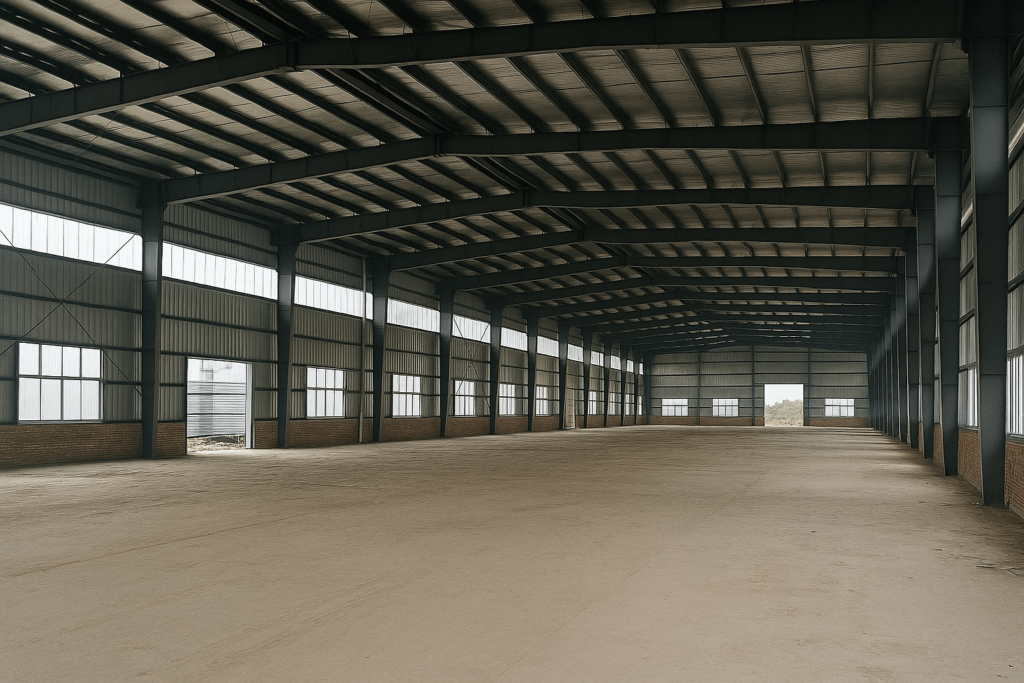
A 60,000-square-foot logistics hub in India faced aggressive deadlines and limited budget flexibility. The original design specified standard W-beams across all structural levels. After a review with our engineers, we proposed switching secondary members to rectangular HSS.
The result: easier alignment, faster welding, and simpler on-site installation. This change reduced fabrication hours by 15%, and shipping costs fell due to tighter, more compact bundles.
Procurement Insight: Don’t just consider cost per ton—factor in the total cost of assembly. A slightly more expensive profile like HSS can produce meaningful savings through labor and logistics efficiencies.
Case Study 2: Curved Pedestrian Bridge – Singapore
This high-profile bridge project required a sweeping, spiral form in a dense urban environment. Traditional I-beams were ruled out due to twisting risks and visual bulk. We worked with the design team to use curved round HSS profiles with internal stiffening plates.
Cold-bending the sections and applying CNC notching allowed for seamless curvature and accurate fit-up. All profiles met strict aesthetic and structural demands with less on-site modification.
Procurement Insight: Torsion and aesthetics are often underestimated in procurement specs. Round HSS may carry a premium, but its closed geometry is ideal for projects requiring curved or exposed structural elements.
Case Study 3: Retrofit Expansion of a Chemical Plant – United States
An aging plant required new catwalks, platforms, and access ladders—all installed without halting operations. Spatial constraints and safety regulations limited what could be lifted or welded on-site.
Our team designed lightweight assemblies using angle iron and C-channels, pre-welded in modules offsite. Mounting brackets were laser-cut and pre-drilled for immediate fit.
Procurement Insight: Retrofit projects often prioritize fast, disruption-free installation. Choosing simple, lightweight profiles streamlines coordination and supports phased delivery.
4. Standards & Specifications: How Codes and Certifications Influence Shape Selection
Structural steel doesn’t exist in a vacuum. Every profile you procure must conform to a web of international standards and regulatory codes that influence not only legality—but compatibility, safety, and downstream fabrication processes. For global B2B buyers, understanding these frameworks is essential.
ASTM and ISO: Global Foundations for Steel Classification
Most structural profiles are governed by standards such as:
- ASTM A992 – the dominant spec for W-shapes in building framing.
- ASTM A500 – covers cold-formed welded and seamless carbon steel HSS.
- ISO 657 – defines global dimensional tolerances for structural steel.
Procurement Insight: Referencing shape alone is insufficient. Always verify material grade and applicable standards to ensure strength, weldability, and corrosion resistance match project specs—especially when sourcing internationally.
AISC Compliance and Design Code Alignment
Designers rely heavily on the American Institute of Steel Construction (AISC) to calculate load paths, bracing requirements, and member sizing. If imported steel shapes deviate from AISC-defined proportions, even slightly, those differences can disrupt structural assumptions.
Procurement Insight: Align supply with the design code in use. Profiles with mismatched flange widths or web thickness can compromise connection designs or trigger re-approvals. Confirm compatibility before committing to mill orders.
Fire Ratings and Coating Considerations
Fire-resistant designs often require intumescent coatings or fireproof wraps. Shapes with fewer surface irregularities—like HSS—can reduce coating volume and labor.
Procurement Insight: The right profile can simplify passive fire protection compliance. Consider this during material selection to minimize future costs, especially for buildings with required fire ratings.
Traceability, Certifications, and Market Access
In export projects to the EU, Middle East, or Southeast Asia, certification requirements like CE Marking or EN 1090 are common. These require full traceability—from steelmaking heat numbers to mechanical test data.
YISHANG supports ISO 9001 and RoHS compliance, with detailed MTRs (Material Test Reports) available for all batches.
Procurement Insight: Certifications are more than checkboxes. They’re market enablers. Ensure your supplier offers complete documentation for every stage of production and delivery.
5. Trends & Innovation: How Emerging Technologies Are Shaping Structural Profiles
Structural steel procurement is evolving. Sustainability initiatives, digital design tools, and new fabrication techniques are transforming how structural profiles are selected and sourced. For wholesale buyers, keeping pace with these changes is essential to stay competitive and responsive to client needs.
Green Steel and Low-Carbon Sourcing
As governments push for lower emissions, steelmakers are investing in electric arc furnace (EAF) technology and carbon-reduction strategies. A growing number of mills now offer “green steel” with lower embodied carbon.
Procurement Insight: While green steel may carry a premium, it can unlock access to sustainability-driven projects and help clients meet LEED or BREEAM certification targets. Buyers who proactively offer low-carbon options gain a strategic edge.
BIM Integration and Digital Collaboration
Building Information Modeling (BIM) has become standard on large-scale construction projects. Steel profiles are increasingly selected for how well they integrate into digital workflows, not just their mechanical properties.
Procurement Insight: Profiles aligned with BIM libraries and detailing standards reduce modeling time, RFIs, and rework. Partnering with a fabricator experienced in BIM ensures faster turnarounds and tighter design coordination.
3D Printing and Hybrid Steel Components
While not yet mainstream for structural sections, additive manufacturing is gaining ground for complex nodes and hybrid assemblies. These combine rolled steel with laser-cut or printed elements.
Procurement Insight: In high-spec projects—like aerospace hangars or architectural landmarks—custom steel components created via hybrid methods offer both aesthetic and structural advantages. Suppliers who can accommodate such methods gain access to niche, high-value contracts.
AI-Driven Optimization Tools
Artificial intelligence is now used to generate shape-optimized structural systems that use less steel without sacrificing strength. These models often propose nonstandard geometries or custom fabrication blends.
Procurement Insight: As more projects incorporate AI-based design platforms, expect to see unique shape requests. A responsive supplier network—able to source or fabricate nontraditional profiles—will become a key differentiator.
The Bigger Picture
Innovation affects more than steel composition or design—it directly impacts profile selection, logistics, and how procurement supports project goals. Understanding these shifts allows buyers to anticipate trends, advise clients more effectively, and build future-proof supply chains.
Conclusion: Steel Shapes, Smarter Strategies—Procurement That Builds More Than Structures
Choosing the right structural steel profile is no longer a technical afterthought—it’s a strategic decision that shapes the financial, logistical, and operational outcomes of every project. From classic I-beams to digitally optimized geometries, each profile represents not only structural capacity, but also an opportunity to reduce costs, improve buildability, and align with modern project demands.
This guide has walked through core shape functions, fabrication realities, real-world applications, compliance requirements, and technological shifts—all with the B2B procurement professional in mind. Whether you’re sourcing for a logistics park, a high-rise core, or a modular retrofit, the steel profiles you choose directly influence your margins, schedule, and client satisfaction.
At YISHANG, we bring 26+ years of experience delivering custom-fabricated structural components for global buyers in over 50 countries. Our team supports every step of the process—from profile selection and compliance documentation to fabrication, packaging, and international logistics.
Let’s work together to simplify your steel procurement. Whether you need I-beams, HSS, angles, or custom assemblies, our factory delivers ISO 9001-certified solutions that meet the demands of modern construction.
[Contact YISHANG | Custom Structural Steel Solutions →]
Frequently Asked Questions (FAQs)
1. What is the best structural steel profile for warehouse construction?
For large-span warehouses, I-beams (W-shapes) are commonly used for primary framing due to their high bending resistance, while HSS tubes are often selected for bracing and secondary members for their clean lines and torsional strength.
2. How does HSS compare to I-beam in terms of cost and application?
HSS typically has a higher cost per ton due to its closed shape and manufacturing process, but it offers superior torsional resistance and aesthetic appeal. I-beams are more economical and ideal for flexural load-bearing.
3. Can I request custom steel profiles from YISHANG?
Yes. YISHANG specializes in custom steel fabrication for global buyers. We support OEM/ODM for I-beams, HSS, angles, channels, and more—tailored to your project’s specifications.
4. What certifications do your steel profiles meet?
Our products meet ISO 9001 and RoHS standards. For international projects, we provide complete documentation, including Material Test Reports (MTRs), CE-ready formats, and full traceability.
5. Do you offer international shipping for bulk structural steel orders?
Absolutely. YISHANG exports to over 50 countries with custom steel packaging, sea/air freight coordination, and support for bulk steel procurement logistics.