Introduction: A Practical Titanium Fabrication Guide for Wholesale Sourcing
Titanium is often chosen when an industrial product has little room for failure: harsh corrosion, high fatigue loading, tight weight limits, or long service life. That is why you see titanium components across aerospace, marine systems, chemical processing equipment, and selected energy applications.
For overseas wholesale buyers, titanium fabrication is less about “learning a material” and more about reducing sourcing risk. A quote can look competitive on paper but still fail in production if the supplier cannot manage heat, contamination, dimensional stability, or documentation.
This article explains titanium fabrication from the point of view most relevant to procurement: how titanium materials become manufacturable stock, why fabricating titanium behaves differently on the shop floor, what typical manufacturing routes look like, and which supplier decisions affect cost, lead time, and consistency.
You will also find buyer-focused checkpoints (certificates, inspection expectations, process controls) and design notes that reduce rework and shorten RFQ cycles.
Titanium Fabrication Starts with Material Production and Traceability
From Ore to Titanium Sponge
Titanium parts are built on material quality. Before any cutting, machining, or welding, titanium must be produced, refined, and converted into mill products. For buyers, this upstream chain is where many “hidden” differences appear: lot-to-lot consistency, mechanical property stability, and traceable documentation.
Titanium is typically extracted from mineral ores such as rutile and ilmenite. Through chemical processing, titanium is converted to titanium tetrachloride and then reduced using magnesium in the Kroll process. The reaction occurs around 800–850°C and produces a porous metal known as titanium sponge.
Ingot Production and Refining
Producers then melt the sponge and consolidate it into ingots, commonly using vacuum arc remelting (VAR) or electron beam melting (EBM). Vacuum conditions limit contamination from oxygen and nitrogen, both of which can change ductility and toughness. High-spec markets may request multiple remelts to stabilize chemistry and microstructure.
Conversion into Mill Products
After producers create ingots, they roll, forge, or extrude titanium into mill products. The form you buy changes how the part is made, how scrap is generated, and which processes dominate the quote.
| Titanium material form | Typical fabrication route | Why buyers care |
|---|---|---|
| Titanium sheet / plate | Cutting + forming + welding, or machining from plate | Yield and flatness affect cost and fit-up |
| Titanium bar / billet | CNC machining titanium parts | Bar size and straightness affect cycle time |
| Titanium tube / pipe | Titanium tube pipe fabrication + welding, bending, end forming | Ovality and surface condition affect sealing |
| Titanium wire | Springs, clips, medical components | Surface quality affects fatigue performance |
A practical buyer takeaway: always confirm that the supplier can provide the correct material standards and traceability. In many industrial RFQs, that means a Mill Test Certificate (MTC) showing heat number, chemistry, mechanical properties, and product form. Depending on the application, you may also see ASTM references (for example, titanium sheet/plate or titanium bar standards) and internal customer specifications.
When buyers say “we want stable quality,” the working definition is usually simple: the material lot is identifiable, the certificates match the purchased grade, and the finished component performs consistently across repeat orders.
Why Fabricating Titanium Feels Different on the Shop Floor
Heat Behavior During Machining
Titanium is not “difficult” because it is exotic. It is difficult because it creates manufacturing conditions that punish weak process control. Understanding those conditions helps procurement teams interpret why certain suppliers quote longer lead times, why some processes are restricted, and why quality plans matter.
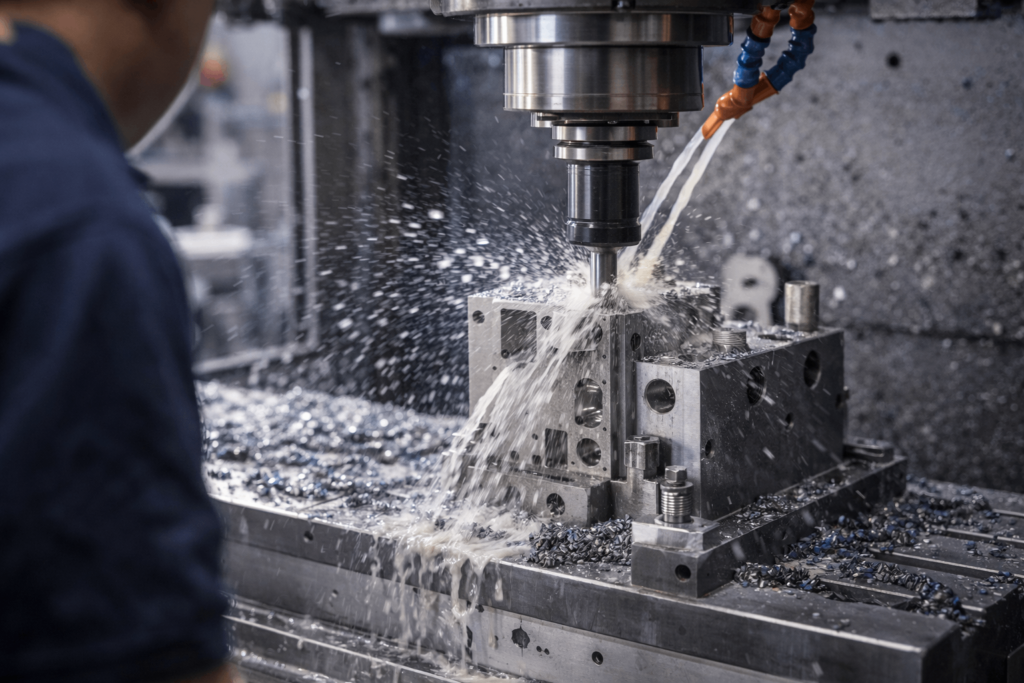
Titanium has relatively low thermal conductivity compared with many common structural metals. During machining, heat generated at the cutting interface does not move away quickly into the workpiece. Instead, it concentrates near the cutting edge. This is a major reason tool wear accelerates and why CNC machining titanium typically runs at lower surface speeds than aluminum.
Chip Behavior and Tool Wear
That heat concentration interacts with chip behavior. Titanium chips retain heat and can re-contact the tool or workpiece if chip evacuation is poor. Practical implications show up as shortened tool life, unstable surface finish, and higher cycle times. A capable shop compensates with coated carbide tooling, stable toolpaths, controlled feeds, and effective coolant delivery.
Forming Springback
Titanium forming has a different challenge: elastic recovery. Titanium’s lower modulus of elasticity contributes to springback after bending. In titanium sheet metal fabrication, springback affects angle accuracy, hole alignment after forming, and assembly fit-up. That is why experienced fabricators tune bend allowances, use appropriate tooling radii, and sometimes consider warm-forming for complex parts.
Welding Contamination Risk
Titanium welding introduces another contamination constraint. At elevated temperatures, titanium reacts readily with oxygen, nitrogen, and hydrogen. If the weld zone is exposed to air while hot, embrittlement can occur. In practice, titanium welding relies on inert shielding (commonly argon) that protects the weld pool and surrounding heat-affected zone until the metal cools below roughly 400°C.
From a buyer’s perspective, this is the “why” behind questions such as: Do you back purge? Do you use trailing shields? How do you control surface cleanliness and gas flow? These are not academic details; they determine whether welds remain ductile and consistent over production lots.
The Three Most Common Manufacturing Routes for Titanium Parts
A buyer-friendly way to evaluate titanium fabrication is to stop thinking in isolated processes and start thinking in manufacturing routes. Most titanium components follow one of three routes, and each route has a different cost structure, risk profile, and documentation focus.
Route A: Machined Titanium Components
Machined titanium parts typically begin as titanium bar, billet, or plate. CNC machining titanium includes milling, turning, drilling, and tapping to reach geometry and tolerance. This route is common when tight dimensional control is required or when the part has complex 3D features.
For wholesale purchasing, the key cost drivers are cycle time, tooling, and scrap rate. Titanium machining is generally slower than machining carbon steel or aluminum. Tooling strategies matter, and a supplier’s ability to hold tolerance repeatedly without excessive tool changes often separates stable production from inconsistent output.
What to ask on an RFQ: target tolerances, surface finish requirements, critical-to-function dimensions, and inspection plan. Buyers who clarify these early tend to avoid re-quotes and delays.

Route B: Fabricated Titanium Sheet Structures
Titanium sheet metal fabrication is used when the part is an enclosure, housing, bracket assembly, cover, ducting component, or panel. The route usually flows as: cutting → forming → welding/assembly → finishing.
This route is often competitive for large components because it avoids heavy machining of solid stock. But sheet fabrication is sensitive to flatness, springback, weld sequence, and fit-up. If the part must seal, align with inserts, or fit into a larger assembly, the supplier’s fixture design and weld control matter.
For procurement, a useful mindset is “fit-up is quality.” A quotation should reflect not only cutting and bending, but also the time to maintain dimensional stability through welding and finishing.

Route C: Forged Titanium Components
Engineers select forging when fatigue strength and reliability are critical, or when a part benefits from refined grain structure. Forged titanium components are frequently machined after forging to achieve final dimensions.
From a sourcing standpoint, forging has two implications. First, it may introduce longer lead times due to billet prep, tooling, and forging schedules. Second, it can reduce downstream machining volume, which may offset cost in high-performance parts.
When comparing suppliers, confirm whether forging is performed in-house or sourced, and whether traceability and heat treatment records can be provided if required.
Key Titanium Fabrication Processes and What They Mean for Buyers
After the route is selected, individual processes determine feasibility, cost, and repeatability. For wholesale buyers, the goal is not to memorize every method, but to know what each process “signals” about capability and risk.
Titanium Machining
Titanium machining is sensitive to heat and tool condition. A reliable process uses stable toolpaths, appropriate tool coatings, consistent coolant delivery, and clear chip evacuation. If a supplier routinely machines titanium alloys (including Grade 2 and Grade 5 titanium), they should be able to explain how they manage tool life and maintain surface finish.
If your project involves threaded features, thin walls, or deep pockets, ask how the supplier prevents chatter and distortion. These features are common failure points that create rework in production.
Titanium Welding
Titanium welding quality depends heavily on shielding. TIG (GTAW) is widely used because it offers controlled heat input, but the welding environment must be clean. Back purging, trailing shielding, joint preparation, and post-weld inspection are practical differentiators.
Buyers sometimes ask for a “pretty weld.” In titanium, appearance can be meaningful because discoloration may indicate inadequate shielding. Instead of focusing only on looks, request a clear welding procedure approach and inspection plan (visual acceptance criteria, dimensional checks, and any specified NDT).
Cutting Titanium
Cutting choices affect downstream fit and mechanical performance. Laser cutting is efficient and precise for thinner titanium sheets. Waterjet cutting avoids heat-affected zones and is often chosen for thicker sections or parts sensitive to thermal effects.
In titanium sheet fabrication, cutting quality directly influences bend accuracy and weld fit-up. If the part has tight forming tolerances, discuss edge condition expectations early.
Titanium Forming
Forming titanium is not only about force; it is about controlling springback and surface condition. Bend radius selection, tool condition, and process sequence determine whether angles land within tolerance.
If your part has a sealing surface or must align to other components, ask for sample measurement points on prototypes. For repeated orders, consistent forming is often more valuable than aggressive cost reduction.
Titanium Heat Treatment and Stress Relief
Manufacturers may apply heat treatment to adjust strength, relieve residual stress, or stabilize microstructure, especially in certain titanium alloys. Not every part needs it, but when it is specified, documentation and process control matter.
For buyers, the practical question is whether the supplier can follow the required specification and provide records. If your application has no formal heat treatment requirements, stress relief may still be relevant for distortion control in thin-walled machined parts.
Surface Treatment on Fabricated Titanium Parts
Surface treatment on fabricated titanium parts often serves a functional requirement, not cosmetic. Common needs include cleaning, passivation, bead blasting, polishing, or coatings for wear/corrosion performance.
If the end use involves fluid contact, medical environments, or chemical exposure, surface condition can affect corrosion behavior and contamination risk. Buyers should specify surface finish targets and cleaning expectations, and confirm packaging methods to prevent scratches or handling contamination.
Real Production Challenges That Drive Cost, Lead Time, and Risk
Most sourcing issues with titanium are not caused by one “hard process.” They come from the interaction of multiple constraints in a real production line.
Tool life is the first driver. Because machining titanium concentrates heat at the tool edge, wear can increase quickly if parameters drift. Suppliers who treat tooling as a controlled variable (tool change planning, tool inspection routines, and stable programming) tend to deliver better lot consistency.
Thermal distortion is another driver, especially in thin sections. Heat from machining or welding can shift geometry slightly. A capable shop uses fixtures, sequencing, and conservative parameters to keep distortion within tolerance. This is where prototype validation pays off: if the supplier can demonstrate dimensional stability after welding and finishing, repeat orders become much lower risk.
Material utilization matters because titanium is expensive. Scrap generated by inefficient nesting, excessive machining allowance, or rework can change the economics of an order. Buyers can help by providing clear revision control and avoiding late design changes after prototyping.
Finally, process stability in welding is a consistent differentiator. Gas quality, flow stability, cleanliness, and shielding coverage are practical factors that determine whether weld performance stays consistent. For wholesale buyers ordering repeated batches, stability matters more than a single “good sample.”
Procurement Factors That Improve Conversion from RFQ to Stable Supply
Wholesale buyers typically search and speak in practical terms: “lead time,” “repeatable quality,” “material certificates,” “inspection report,” “packaging,” and “shipping.” A titanium supplier that supports these expectations reduces the time you spend managing suppliers.
Capability Fit: Match the Supplier to Your Part Route
Projects centered on CNC machining titanium should focus on suppliers with strong machining capacity, disciplined tool management, and reliable inspection capability. For titanium sheet metal fabrication, the priorities shift toward forming consistency, weld control, and well-designed fixtures that maintain dimensional stability during assembly. When forging enters the manufacturing route, traceability of the billet source and coordination with upstream forging schedules become the key procurement considerations.
A supplier can be strong in one route and average in another. Clarifying route early prevents procurement friction later.
Documentation and Quality Control that Buyers Actually Use
For most industrial RFQs, the essentials include ISO 9001 quality management, MTC / heat number traceability, dimensional inspection reports, and clear revision control. Depending on the market, additional standards may apply (for example, internal specifications, customer drawings, or industry welding criteria).
Rather than requesting “everything,” buyers often get better results by naming what matters: critical dimensions, acceptance criteria, and required documentation at shipment.
Lead Time Reality: Where Time Is Spent
Titanium parts often require sequential steps: cutting → forming or machining → welding → finishing → inspection → packaging. The longest delays are typically caused by queue time (machine scheduling), weld preparation/fit-up, and rework loops.
If you need stable replenishment, ask suppliers how they manage scheduling for repeat orders and whether they can support forecast-based production.
A Short Supplier-Comparison Checklist
Buyers do not need a long audit to reduce risk. A simple checklist often helps:
- Can you provide MTC and traceability?
- How do you control titanium welding shielding (back purge / trailing)?
- What inspection equipment supports your tolerance claims?
- What is the realistic capacity for repeat batches?
- How do you package to protect surface finish?
These questions align with how overseas wholesale buyers search and evaluate partners.
Standards and Documentation Buyers Commonly Expect
When you review top-ranking titanium fabrication pages, you will notice that they earn trust by being concrete about standards, not just processes. For wholesale sourcing, naming the relevant standards upfront reduces RFQ cycles, avoids mismatched quotes, and improves first-article success.
For titanium mill products, buyers commonly reference ASTM B265 when sourcing strip, sheet, or plate materials. Bars and billets used for CNC machining titanium parts are typically purchased under bar standards such as ASTM B348, depending on the alloy grade and product form. In applications involving titanium tube and pipe fabrication—especially when sealing or pressure performance is critical—procurement specifications frequently include tube standards like ASTM B861 for seamless titanium tubing.
On the welding side, buyers may reference industry welding requirements (for example, aerospace programs, customer specifications, or welding guides) and will often ask how shielding is controlled. In practice, high-quality titanium welding commonly involves back purging and trailing shielding, and some references specify very low oxygen levels for backing gas.
For inspection and shipment, the most requested documents typically include MTC (heat number traceability), dimensional inspection reports, and clearly controlled drawing revisions. When the application is safety-critical, buyers may also specify NDT methods such as dye penetrant testing for welds, radiographic inspection, or PMI for material verification.
| What buyers ask for | What it proves | When it matters most |
|---|---|---|
| MTC / Heat number traceability | Chemistry and mechanical properties match the grade | Repeat batches, regulated industries |
| Dimensional inspection report | Tolerances were verified and recorded | Tight fits, assemblies, sealing surfaces |
| Welding procedure control | Shielding and cleanliness are managed consistently | Titanium weldments, pressure-related parts |
| NDT records (if required) | Weld integrity and defect control | Aerospace, critical enclosures, fatigue loads |
A useful practical step is to attach a short “RFQ package” to your inquiry: drawing + tolerance notes + material grade/form + required docs at shipment. Suppliers that respond with a clear process route and inspection plan usually create fewer downstream surprises.
Design Decisions that Reduce Titanium Fabrication Cost Without Sacrificing Performance
Many sourcing problems can be avoided at the design stage. The goal is not to simplify the part for the supplier; it is to remove avoidable risk that increases lead time and drives rework.
Sharp internal corners increase tool load and concentrate heat, especially in deep pockets. Smoother transitions and appropriate corner radii improve tool life and reduce cycle time. For buyers, this often translates to more stable quotes across suppliers because fewer shops struggle with the same geometry.
Wall thickness balance is also important. Extremely thin titanium sections can distort under machining heat or welding sequence. When thin walls are required, discuss distortion control methods and inspection points during prototyping.
Alloy selection affects manufacturability. Grade 2 titanium is often selected for corrosion resistance and good formability. Ti-6Al-4V offers higher structural strength but can be more demanding in machining and forming. If your application can accept a more formable grade, fabrication cost can drop and yield can improve.
Finally, tolerance strategy matters. Tight tolerances should be reserved for true functional requirements. When buyers specify unnecessarily tight tolerances on non-critical features, cycle time and inspection time increase, but product performance does not.
When Titanium Makes Sense for Industrial Enclosures and Harsh-Environment Housings
Many wholesale buyers in metal fabrication also source enclosures: an enclosure electrical meter box, a push button enclosure, or solar battery enclosure designs used in outdoor or corrosive locations. In these categories, material choice often drives lifecycle cost more than initial part price.
A steel enclosure can be cost effective, and stainless steel enclosure options work well in many environments. But in severe corrosion settings—salt exposure, certain chemical atmospheres, or high humidity with aggressive contaminants—titanium can become the more stable long-term choice.
It is common to compare steel enclosure vs aluminum enclosure, carbon steel enclosure vs aluminum, and galvanized alternatives such as galvanized steel enclosure. These comparisons are valid in many projects. Titanium is not a universal replacement, but it is worth evaluating when coating maintenance is difficult, downtime is expensive, or the enclosure protects high-value electronics.
A practical procurement approach is to map the environment and maintenance expectation to material selection. If a project can tolerate repainting, carbon steel and galvanized steel may be reasonable. If the project requires long life with minimal maintenance, stainless steel or titanium may be stronger candidates.
This section stays tightly connected to titanium fabrication because enclosures and housings often rely on titanium sheet metal fabrication routes: cutting, bending, welding, and surface finishing.
Emerging Manufacturing Technologies that Expand Titanium Options
Titanium manufacturing continues to evolve. While most industrial orders still rely on machining and sheet fabrication, advanced processes can expand design possibilities or improve efficiency.
Additive manufacturing, often called titanium 3D printing, enables engineers to produce complex geometries that would be expensive to machine. This can be valuable for weight-optimized structures or parts with internal channels. For wholesale procurement, additive manufacturing is typically used in specialized programs rather than commodity supply.
Superplastic forming is another process used for complex titanium sheet shapes. Under controlled temperature conditions, titanium becomes highly ductile and can be formed into intricate geometries with fewer weld seams.
On the machining side, adaptive CNC strategies, improved coolant delivery, and better tooling coatings continue to increase machining stability and reduce tool wear. These improvements do not eliminate the challenges of fabricating titanium, but they widen the range of feasible designs.
Frequently Asked Questions Buyers Search Before Sending an RFQ
Wholesale buyers often search in short, practical queries. These quick answers are written in the same spirit: to reduce sourcing risk and accelerate decisions.
What is titanium fabrication? Titanium fabrication is the set of manufacturing steps used to convert titanium mill products into finished parts and assemblies. In real procurement terms, it is a route decision: machining from bar or plate, fabricating from sheet, building from tube/pipe, or forging plus finish machining.
Why is titanium difficult to machine? Titanium concentrates heat at the cutting edge and chips retain heat. That drives tool wear, slows cutting speeds, and increases the importance of chip evacuation and coolant delivery. A supplier’s tooling plan and machining stability typically have more impact on consistency than minor price differences.
Is titanium welding difficult? Titanium welding is reliable when shielding and cleanliness are controlled. Most failures come from contamination while the weld and heat-affected zone are still hot. Buyer questions about back purging, trailing shields, and gas quality are the right questions.
What is the best way to cut titanium sheet? Laser cutting is efficient for thinner sheet and high-precision profiles. Waterjet cutting avoids heat-affected zones and is often preferred for thicker sheet or parts sensitive to thermal effects. The “best” method depends on thickness, tolerance, and downstream forming requirements.
Which documents should I request with titanium parts? Start with MTC/traceability and dimensional inspection reports. Add welding documentation and NDT only if your application requires it. Clear revision control and acceptance criteria usually reduce lead time more than requesting a long list of documents.
Conclusion: A Buyer-Ready View of Titanium Fabrication
Titanium fabrication succeeds when material traceability, process control, and route selection are aligned with the part’s real requirements. For wholesale buyers, the most reliable sourcing outcomes come from clear specifications, realistic tolerance strategy, and supplier evaluation based on capability—not only price.
If you would like to discuss a specific titanium part, enclosure, or assembly, YISHANG can support technical review and manufacturability feedback. Send your inquiry today with drawings and target requirements, and we will respond with a practical production approach and quotation.