Executive Summary: The 30-Second Briefing for Procurement Professionals
Titanium is widely used in aerospace, medical devices, energy systems and high-performance industrial equipment because of its exceptional strength-to-weight ratio and corrosion resistance. However, forming titanium into complex shapes is significantly more difficult than forming steel or aluminum.
Traditional stamping and forming processes often lead to cracking, excessive springback, and severe tool wear when applied to titanium alloys such as Ti-6Al-4V. These manufacturing challenges increase production cost and limit design freedom.
Titanium hydroforming offers an alternative approach. By using controlled fluid pressure rather than purely mechanical force, the process allows titanium sheets or tubes to deform more uniformly. When performed in a controlled warm forming range, hydroforming can significantly improve formability and reduce defects compared with conventional forming techniques.
Let’s break it down step by step.
What Is Titanium Hydroforming?
Titanium hydroforming is a metal forming process that uses pressurized fluid to shape titanium sheets or tubes against a die cavity. Instead of forcing the material into shape with rigid mechanical tools alone, hydraulic pressure distributes force evenly across the surface of the titanium.
This forming approach reduces localized stress concentrations and allows titanium to flow more gradually during deformation. As a result, hydroforming is particularly useful for producing complex geometries that would be difficult or impossible to achieve through conventional stamping or deep drawing.
Hydroforming is commonly applied to titanium components such as aerospace ducts, pressure housings, structural nodes and medical equipment enclosures.
Chapter 1: Why Titanium Parts Fail During Conventional Forming
For a procurement professional, a failed part on the production line is a cascade of costly problems: material waste, schedule delays, and potential supply chain disruptions. When working with a premium material like titanium, these failures are magnified. Understanding the root cause of these titanium forming challenges is essential for mitigating risk and selecting a capable manufacturing partner.

Cracking During Titanium Forming
One of the most frequent and costly failures in the cold forming of titanium is catastrophic fracture. A deep draw or tight-radius bend often results in a cracked and scrapped part. This isn’t necessarily due to poor material quality—it reflects a fundamental issue with titanium ductility at room temperature. High-strength alloys like Ti-6Al-4V possess a hexagonal close-packed (hcp) crystal structure at ambient conditions.9 This atomic structure offers fewer slip systems (the internal deformation mechanisms) than the face-centered cubic structures found in aluminum or steel.
As a result, titanium doesn’t deform easily under tensile stress. When the forming forces exceed what this limited ductility can tolerate, cracks initiate quickly, particularly around corners and deep-drawn zones. Traditional stamping and deep drawing rely heavily on material stretch, which explains why these methods often yield unacceptably high scrap rates when applied to titanium sheets or tubing.
Galling and Adhesion in Titanium Forming
Another hidden—but equally damaging—risk in titanium forming is galling, an adhesive wear phenomenon. During high-pressure contact, titanium’s thin oxide layer can rupture, exposing highly reactive base metal to the tooling surface. This triggers microscopic welding between the titanium and die—far more aggressively than in steel or aluminum.1 As the part is formed or released, it may seize or tear, damaging both the part and the die.
This problem cascades: surface finish suffers, secondary polishing may be needed, and dies require frequent reconditioning or replacement. Standard oil-based lubricants commonly used for carbon steel are often ineffective or even counterproductive when applied to reactive titanium alloys. Advanced coatings or dry-film lubricants are typically required to prevent adhesion and extend tool life.
Springback Problems in Titanium Components
Dimensional inaccuracy is one of the most frustrating outcomes of titanium forming—and it’s often caused by extreme springback. Titanium’s high strength (~950 MPa UTS for Ti-6Al-4V) and relatively low elastic modulus (~114 GPa vs ~200 GPa for steel) create an unusual combination: the material is difficult to plastically deform, yet it stores significant elastic energy.
Once forming pressure is released, that energy causes the part to rebound unpredictably. This is especially problematic for precision parts with tight geometric tolerances. Cold-formed titanium brackets, channels, or housings may pass forming but fail inspection due to deformation outside spec. To counter this, tool geometry often needs to be overcompensated, or secondary operations like sizing or stress relief added—at the cost of time, tooling complexity, and budget.
“My Part is Brittle After Heating”: The Alpha Case Risk
Heating titanium to improve ductility may seem like a straightforward fix—but it introduces a critical metallurgical risk: the alpha case. Above ~425°C (800°F), titanium exposed to oxygen begins to form a hardened, oxygen-enriched layer on the surface.12 This brittle layer, known as alpha case, compromises fatigue resistance and can crack under dynamic or impact loads.
The risk is invisible but dangerous: a part may look flawless after forming, yet exhibit early failure during service. Removing alpha case requires post-forming chemical milling or machining, which adds steps and cost. Avoiding its formation altogether requires vacuum furnaces or inert atmospheres—raising the barrier for economic hot forming. For industries like aerospace, where fatigue and reliability are paramount, uncontrolled alpha case is a deal-breaker.
Chapter 2: The Physics of Pressure — How Hydroforming Controls the Uncontrollable
Why Fluid Pressure Improves Titanium Formability
Titanium alloys have limited slip systems at room temperature, which restricts their ability to deform without cracking. When forming forces are applied unevenly, local stress concentrations can quickly exceed the material’s ductility limits.
Hydroforming addresses this issue by applying pressure through a fluid medium. The pressure acts uniformly across the workpiece surface, reducing localized stretching and enabling more stable deformation.
This uniform loading condition is particularly beneficial for titanium alloys that exhibit high strength but relatively limited ductility during cold forming.
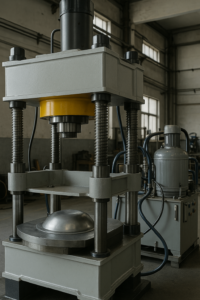
Titanium’s formability issues stem from its atomic structure and high strength, but these challenges can be overcome not by brute force, but by intelligent pressure application. Titanium hydroforming provides a fundamentally different forming paradigm: instead of mechanically forcing the titanium into shape with rigid tooling, it uses controlled, high-pressure fluid to apply a uniform and omnidirectional force.
Redefining Contact: Reducing Galling and Die Friction
In conventional stamping or press forming, the titanium blank remains in continuous contact with die surfaces. This contact causes friction, galling, and die wear—especially problematic with reactive metals like titanium. Hydroforming significantly minimizes this by introducing a fluid-mediated forming interface. In sheet hydroforming, a flexible diaphragm or fluid bladder pushes the titanium into a cavity. In tube hydroforming, internal fluid pressure expands the titanium outward into a closed die shape.
Because the titanium isn’t scraped across metal tooling, galling is virtually eliminated, and tooling life is extended. Friction is reduced, which not only protects surface quality but also ensures more uniform stress distribution. For industries requiring clean, scratch-free surfaces—such as medical device components or decorative aerospace applications—this is a decisive manufacturing benefit.
Controlling Springback Through Uniform Pressure
Titanium’s elastic rebound behavior can be difficult to predict. Hydroforming helps neutralize this by applying pressure evenly across the entire surface. This omnidirectional forming environment limits localized over-stressing and mitigates unpredictable springback—a common failure mode in cold stamping.
Warm hydroforming, typically performed between 250°C and 350°C, further improves consistency. Within this warm forming window, additional slip systems activate in the hcp crystal structure, enhancing ductility without initiating alpha case. The result: titanium parts that emerge with tighter dimensional tolerances—often within ±0.25 mm—even on asymmetric or non-uniform geometries. These advantages are critical when producing warm forming titanium parts for high-performance sectors.
Forming Deep Draws Without Cracks
Where traditional methods struggle with draw depths or tight radii, hydroforming thrives. The hydrostatic pressure environment allows the titanium to flow gradually rather than stretch abruptly, significantly reducing thinning and eliminating crack-prone stress concentrations.
Warm-forming-grade titanium alloys like Ti-6Al-4V and Ti-3Al-2.5V can be hydroformed into deep, complex shapes without failure. With proper lubrication—such as boron nitride or phosphate ester dry films—and controlled forming speeds, draw depths exceeding 50 mm are achievable. This enables single-piece production of housings, brackets, or enclosures that would otherwise require multi-stage forming or welding.
For OEMs looking to replace multi-part titanium assemblies, hydroforming unlocks the ability to design monolithic components that are stronger, lighter, and easier to inspect and assemble. To explore how this process applies to your titanium sheet metal parts, consult a specialized supplier.
Chapter 3: Replacing Multi-Part Welded Assemblies with One-Piece Forming
In many sectors—especially aerospace, defense, and high-end automotive—engineers face a recurring dilemma: parts must be both lightweight and geometrically complex. Traditional methods resolve this with multi-part welded assemblies. However, each weld introduces risks—heat distortion, stress concentrations, non-uniform strength, and extended quality inspection. Hydroforming replaces this paradigm with one-piece structures that are stronger, lighter, and easier to inspect.
This design freedom is particularly advantageous in applications requiring sealed, high-pressure, or vibration-resistant titanium enclosures. Whether forming aerospace ducting, exhaust manifolds, or structural nodes, hydroforming reduces weld fatigue risk and improves part longevity. For high-reliability titanium applications, it can eliminate the cost of post-weld inspections, X-rays, and rework altogether.
Compared to subtractive methods like 5-axis CNC machining, hydroforming uses significantly less raw material and minimizes machining time. In many cases, a near-net shape formed via hydroforming can be completed with minimal final machining—saving both time and cost. When performing a hydroforming vs machining cost comparison, hydroforming can reduce titanium scrap by up to 80%, cut cycle times, and lower per-unit pricing by more than 30% for complex geometries.
For those seeking consistency, precision metal forming via hydroforming offers tight tolerance control, lower rejection rates, and a streamlined QA process. Unlike stamped or welded assemblies, hydroformed parts exhibit uniform wall thickness and stress distribution, reducing the risk of fatigue or distortion over time.
Chapter 4: Industrial Applications of Titanium Hydroforming
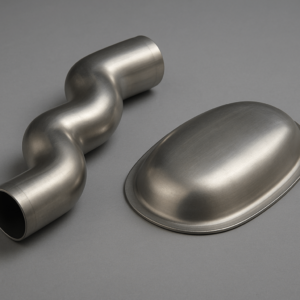
Let’s shift from theory to application. Below are representative examples of how titanium hydroforming is applied in industrial and aerospace manufacturing environments.
Case Study 1: Titanium bellows for high-purity fluid systems
A semiconductor equipment OEM needed seamless, flexible titanium bellows that could withstand ultra-clean environments. Traditional welding introduced contamination and increased failure risk. By warm hydroforming a single Ti-3Al-2.5V blank, the final part achieved concentric bellows with no weld seams, 100% helium leak-tight performance, and over 5 million flex cycles.
Case Study 2: Aircraft exhaust duct redesign
An aerospace tier-one supplier sought to redesign a welded titanium duct system for a fighter jet engine bay. The prior design required five pieces and four weld seams, introducing hot-spot risks and additional weight. Using warm tube hydroforming, YISHANG produced a one-piece duct with complex cross-sectional transitions and no welding. This reduced weight by 14% and saved 3.2 hours of assembly time per unit.
Case Study 3: Lightweight Satellite Structures
Satellite bus structures often demand thin-gauge titanium for shielding, housing, or truss frames. In one aerospace project, hydroforming was used to create a one-piece titanium structural member with internal ribbing. Forming thin-wall titanium sheets to such complexity would be nearly impossible via stamping due to the high risk of tearing and springback.
With hydroforming, YISHANG achieved dimensional consistency within 0.2 mm and eliminated the need for any post-weld heat treatment. The resulting structure was 18% lighter than a comparable aluminum design and exceeded vibration fatigue benchmarks. This demonstrated the advantage of thin-wall titanium forming for weight-sensitive aerospace applications where performance and safety margins are tight.
Chapter 5: Key Process Parameters in Titanium Hydroforming
Hydroforming titanium is not simply a matter of pressure—it’s a precision process governed by tightly controlled parameters. These controls ensure that the final part achieves both structural integrity and dimensional accuracy.
Below is a summarized table of the key forming parameters YISHANG maintains in serial production for aerospace and medical-grade components:
| ParameterTypical Value / RangeNotes | ||
|---|---|---|
| Forming Pressure | 30–80 MPa (warm forming) | Higher pressures for deep draws or thick sections |
| Temperature Range | 250°C – 350°C | Prevents alpha case, enables additional slip systems |
| Forming Time | 5 – 90 seconds | Depends on part size and draw depth |
| Lubrication | Boron nitride, phosphate ester | Prevents galling; avoids titanium-tool welding |
| Springback Compensation | 5% – 12% geometric offset | Iterative tuning of tooling offset |
| Wall Thickness Uniformity | ±10% across draw area | Achievable with controlled pressure profiles |
| Tolerance Capability | ±0.25 mm | Varies by geometry, lubricant, and temperature |
Warm forming titanium parts at this level of control demands both engineering expertise and repeatable production environments. OEMs evaluating titanium hydroforming suppliers should verify whether these parameters can be achieved and consistently held in serial production.

Conclusion: From R&D Curiosity to Production Workhorse
Titanium hydroforming has become an important forming technology for manufacturing complex titanium components. By combining controlled fluid pressure with warm forming conditions, the process can reduce cracking, limit galling, and improve dimensional accuracy compared with conventional forming methods.
For applications requiring lightweight structures and high corrosion resistance, hydroforming enables engineers to produce complex titanium parts that would otherwise require multiple welded components or extensive machining.
As industries continue to adopt titanium for high-performance applications, hydroforming provides a practical manufacturing route for producing strong, lightweight and geometrically complex components.
Last updated: March 2026