
Introduction
When buyers source transmission shafts, they are not just buying a machined round part. They are buying torque capacity, fatigue life, dimensional stability, balance quality, and long-term reliability under repeated load.
That is why shaft sourcing has a bigger impact than it first appears. A weak or poorly controlled shaft can trigger vibration, premature bearing wear, spline failure, warranty claims, and expensive downtime in the field. In high-volume OEM programs, even small variation in shaft quality can turn into large-scale service issues.
For procurement teams, engineers, and OEM buyers, the real question is not simply what a transmission shaft is. The real question is:
Which shaft design, material, and manufacturing route best fit the load, geometry, service environment, and cost target of the project?
This guide answers that question from a manufacturer’s perspective. Instead of treating shafts as generic power-transmission parts, it focuses on how function, material choice, geometry, and process discipline combine to determine real-world performance.
Understanding Transmission Shafts by Function
Not all shafts do the same job, even when they look similar in a drawing or BOM.
The easiest way to understand shaft requirements is to group them by function.
Drivetrain and Powertrain Shafts
These shafts move torque between major drivetrain components and usually work under variable speed, changing angle, and repeated torsional load.
Common examples include:
- propeller shafts (driveshafts)
- axle shafts (half-shafts)
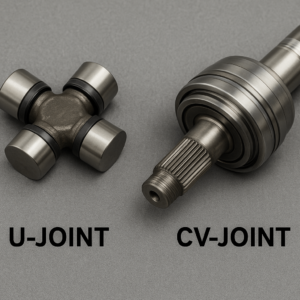
- CV-joint connected shaft assemblies
For buyers, the main concerns here are balance, fatigue resistance, joint quality, and safety margin under cyclic load.
Gearbox Internal Shafts
These shafts operate inside manual or automatic transmission systems and usually require tighter dimensional control, better surface finish, and stronger gear-interface accuracy.
Typical examples include:
- main shafts
- countershafts
- idler shafts
Their risk profile is different from external drivetrain shafts. Here, geometric precision and fit with bearings, gears, and splines are often just as important as raw strength.
Specialized and Application-Specific Shafts
Some shafts are driven less by standard automotive architecture and more by application-specific design logic.
These may include:
- hollow shafts for weight reduction
- flexible shafts for non-linear routing
- specialized industrial machine shafts
- engine-related rotating shafts used in adjacent power systems
For sourcing teams, this category usually requires closer supplier involvement because the performance demands are less standardized and more design-dependent.
Why Shaft Type Changes the Sourcing Logic
A transmission shaft should never be sourced only by dimensions.
Two shafts with similar diameter and length may require completely different manufacturing control depending on how they work.
For example:
- a propeller shaft may prioritize torsional durability, balance, and weld quality
- a gearbox shaft may prioritize spline accuracy, bearing fit, and journal finish
- a hollow shaft may prioritize weight-to-stiffness efficiency and wall-thickness consistency
- a flexible shaft may prioritize torque delivery through curved routing rather than static strength alone
This is where many sourcing errors begin. Buyers sometimes treat shafts as commodity machined parts, when in practice the performance logic varies sharply by application.
Material Selection: The Foundation of Shaft Performance
For most shaft programs, material choice shapes not only strength but also machining strategy, heat treatment cost, fatigue behavior, and long-term field reliability.
The common mistake is to choose material only by tensile strength. In reality, buyers need to balance:
- fatigue life
- machinability
- heat-treat response
- weight target
- corrosion exposure
- unit cost and batch stability
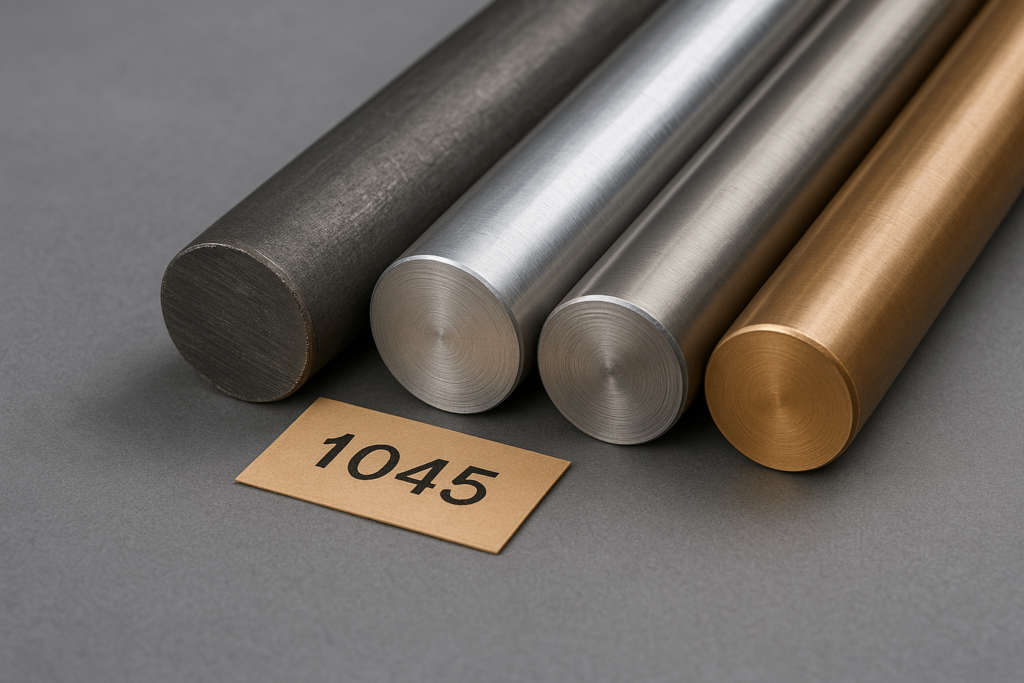
Below is a practical comparison of common shaft material options.
| Material | Typical Strength Level | Main Advantages | Main Trade-Offs |
| 1045 Carbon Steel | Medium | Good machinability, affordable, widely available | Lower fatigue strength than higher alloy steels |
| 4340 Alloy Steel | High | Strong fatigue resistance, good for heavy-duty shafts | Higher cost and more demanding heat treatment |
| 6061 Aluminum Alloy | Moderate | Light weight, corrosion resistance, easy machining | Lower strength and lower fatigue capacity than steel |
| Carbon Fiber Composite | High specific stiffness | Very low weight, useful for inertia-sensitive designs | Very high cost, more complex joining and inspection |
How Buyers Should Read This Comparison
- 1045 works well for many general industrial shafts where cost and machinability matter
- 4340 is a stronger choice when fatigue life and torque load are more demanding
- 6061 can be useful when weight matters more than maximum torque capacity
- carbon fiber is usually reserved for premium or highly specialized applications
The right question is not “Which material is best?”
It is:
Which material gives the project the right balance of strength, machinability, fatigue life, and cost?
Critical Design Geometry: Where Form Dictates Function
A shaft may use the right material and still fail early if the geometry is poorly designed.
This is because fatigue cracks and overload damage often begin at geometric transitions rather than in the middle of a smooth shaft body.
Important design features include:
- diameter transitions
- shoulders and undercuts
- keyways
- splines
- fillet radii
- wall thickness in hollow designs
Solid vs Hollow Shaft
A hollow shaft often provides a better strength-to-weight balance than many buyers expect. Because torsional load is carried more efficiently away from the center, removing core material can reduce weight without proportionally reducing performance.
That is why hollow shafts are common where rotating inertia matters.
Keyed vs Splined Shaft
Traditional keyed shafts are familiar and economical, but the keyway creates a local stress concentration.
Splined shafts distribute load across more contact area and are often preferred where:
- torque is higher
- fatigue life matters more
- repeated assembly and disassembly is expected
- alignment and concentricity are more critical
For buyers, this means shaft geometry is not just a design-office issue. It has direct implications for service life, manufacturing complexity, and supplier capability.
The Manufacturing Process: From Raw Stock to Precision Component
The same shaft drawing can produce very different real-world results depending on how it is made.
A capable supplier controls not only final dimensions, but also the process route that created them.
Typical stages include:
Rough Forming
For fatigue-critical shafts, forging is often preferred because it improves grain flow and can support better long-term durability. For less demanding applications, bar stock may be fully appropriate.
CNC Turning and Milling
Turning, milling, drilling, and spline or keyway cutting create the functional geometry. This is where concentricity, step accuracy, and dimensional repeatability are established.
Heat Treatment and Surface Finishing
Depending on the application, shafts may require heat treatment, grinding, passivation, black oxide, plating, or other surface finishing. These are not cosmetic extras. They often affect wear behavior, corrosion resistance, and interface reliability.
For sourcing teams, one important lesson is this: shaft performance depends on the manufacturing route almost as much as on the drawing itself.
A Practical Guide to Shaft Failure Analysis
Buyers do not need to become metallurgists, but understanding a few common shaft failure patterns helps when evaluating suppliers and field returns.
Fatigue Failure
Fatigue is one of the most common shaft failure modes. It develops gradually under repeated loading and usually starts at a stress concentrator such as a keyway, fillet, surface defect, or spline root.
Typical signs include:
- beach marks
- crack growth zones
- failure starting from one local origin
Overload Failure
Overload failure usually happens from a single excessive torque event or a sudden shock load. The fracture often appears more abrupt and may show torsional deformation or ductile tearing depending on the material.
Corrosion Fatigue
In corrosive environments, surface attack can create crack-initiation points that shorten shaft life dramatically. This is especially important for agricultural, marine, and outdoor equipment programs.
For procurement teams, failure analysis is valuable because it turns warranty events into sourcing intelligence. It shows whether the root cause was material, geometry, heat treatment, machining quality, or real misuse in the field.
The Future of Shaft Technology
Shaft design is changing as drivetrain systems, automation platforms, and maintenance expectations evolve.
Challenges in Electric Vehicle Drivetrains
EV drivetrains create a different kind of shaft demand:
- higher RPM
- faster torque response
- more noticeable NVH issues
- stronger importance of balance and bidirectional load behavior
That means even when shaft geometry looks simple, the manufacturing tolerance requirements may become more severe.
Smart Shafts and Predictive Maintenance
In more advanced industrial systems, shafts are increasingly part of condition-monitoring strategies. Sensor-based monitoring of vibration, load, and thermal behavior can help predict failure before catastrophic breakdown occurs.
For buyers, this signals a long-term shift: shaft sourcing will not only be about metallurgy and machining, but also about integration readiness and data-support capability.
Buyer-Focused FAQ
What components make up a typical driveshaft assembly?
A typical driveshaft assembly may include the tube, yokes, joints, flanges, and sometimes a center support bearing depending on length and architecture.
How do U-joints and CV-joints compare?
U-joints are simpler and widely used, but CV-joints maintain more uniform rotational behavior under angle. The right choice depends on drivetrain layout and smoothness requirements.
What is a Guibo or flex disc?
It is a flexible coupling element used to absorb vibration and soften driveline shock in certain systems.
What is the difference between a transmission shaft and a machine shaft?
Transmission shafts mainly transfer power between assemblies. Machine shafts may also act as integrated working elements within the machine itself.
What should buyers ask before requesting shaft quotations?
At minimum, buyers should clarify:
- material grade
- torque or load requirement
- speed range
- environment
- dimensional tolerances
- whether balancing, heat treatment, or surface finish is required
Conclusion
A transmission shaft may look simple on paper, but its real performance depends on a tightly linked combination of:
- functional design
- material choice
- geometry discipline
- manufacturing accuracy
- process control
For OEM buyers and high-volume procurement teams, that means shaft sourcing should never be treated as a basic machining purchase.
At YISHANG, we support global customers with custom shaft manufacturing, CNC machining, material selection support, surface treatment coordination, and ISO 9001-based production discipline.
If you are reviewing a new shaft program or comparing suppliers for an existing one, the best next step is to evaluate not only price—but also how well the supplier understands the shaft’s real working conditions.