For overseas B2B buyers, wholesale distributors, and sourcing engineers, the machine shop floor often feels like a black box—you send a drawing and later receive finished metal parts. But behind every quote is an engineering decision that shapes your Cost Per Part (CPP), lead time, and tolerance stability. One of the most important decisions is which type of milling machine is used to produce your custom components.
At YISHANG, a metal products manufacturer in China with over 26+ years of OEM & ODM metal fabrication experience and exports to 50+ countries, we’ve learned that matching machine physics to each project is the key to sustainable cost and performance. This guide breaks down the main types of milling machine used for metal parts and explains how each one influences production economics, consistency, and precision—so that procurement teams can make faster, smarter sourcing decisions.
We will focus on practical questions that buyers often ask, such as:
- Which milling machine type is more suitable for mass production?
- When should I pay more for 5‑axis machining?
- How does machine selection affect surface finish, tolerance, and scrap rate?
- What should I check when sourcing CNC milled parts from China?
Milling machine operation and basic milling usage
Before we compare different kinds of milling machine, it helps to understand what a milling machine actually does in daily production. In simple terms, a milling machine is a CNC or manual machine tool that uses a rotating cutter to remove material from a metal workpiece. Different milling machine operations—also called different types of milling operations—are combined to achieve the final geometry.
Common milling operations and usage examples include:
- Face milling – creating flat reference surfaces on plates, frames, and blocks
- End milling and contour milling – profiling edges, pockets, and 3D shapes
- Slotting and keyway milling – producing slots, grooves, and keyways in shafts or hubs
- Side milling – machining vertical faces and shoulders along the sides of parts
- Drilling, boring, and reaming – creating precise holes as part of the milling cycle
- Thread milling – generating internal or external threads with a rotating tool
- Gear and spline milling – cutting teeth or splines on shafts and hubs
For overseas buyers, you do not need to memorize every technical term. But knowing that different types of milling, milling operations, and milling machine usage exist will help you ask better questions in RFQs—for example: “Which operations will you use on this part, and which type of milling machine will you run it on?”
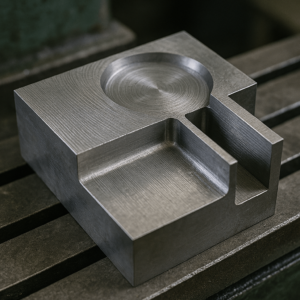
Vertical vs. Horizontal Architecture: The Core Production Decision
When comparing quotations from different CNC machining suppliers, you may notice dramatic cost differences even for similar parts. Very often, this is not a “mystery price”, but simply the result of a different milling machine architecture and process strategy.
Vertical Milling Machines: Agility for High‑Mix Production
Vertical machining centers (VMCs) are the most common CNC milling machines in job shops. Their upright spindle orientation gives operators clear visibility and easy setup, making them ideal for prototypes, custom parts, and short runs.
Key characteristics of vertical milling machines for metal parts:
- Easy fixture changes – good for high‑mix, low‑volume orders
- Lower machine cost than horizontals, so more suppliers have them
- Good accessibility for operators and in‑process inspection
However, the vertical orientation forces chips to fall back into the cutting zone, increasing the risk of chip recutting, which leads to tool wear, surface‑quality issues, and inconsistent part finish.
For procurement teams, this may translate into:
- Slightly higher unit cost for tougher materials (stainless steel, tool steel)
- More variance in surface appearance across large batches
- Higher risk of heat buildup and burrs on difficult‑to‑machine alloys
In summary, VMCs are excellent for flexibility and small batches, but not always the most efficient choice for long‑term, repetitive production of the same metal component.
Procurement tip – when VMCs make sense
- RFQs for 5–500 pcs mixed SKUs, frequent design changes, or engineering prototypes
- Parts with moderate tolerance requirements where cosmetic variation is acceptable
- Early‑stage projects where you need fast sampling and DFM feedback
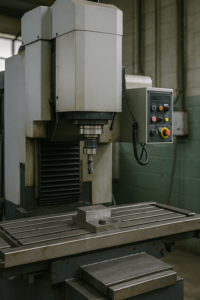
Horizontal Milling Machines: Stability and Efficiency for Volume Production
Horizontal machining centers (HMCs) flip the orientation—spindles are parallel to the ground. Gravity becomes an advantage as chips evacuate naturally, reducing heat and eliminating recutting.
Typical advantages of horizontal milling machines:
- Higher material removal rates (MRR)
- Longer tool life thanks to uninterrupted chip flow
- Support for rotary tombstone fixtures enabling multi‑side machining in one cycle
- Pallet‑changing systems that maximize spindle uptime (often 85%+)
For bulk orders, this results in shorter cycle times and consistently lower Cost Per Part.
From a buyer’s perspective, using HMCs is especially beneficial when you:
- Repeat the same part over a long period
- Need tight tolerance and consistent finish across thousands of pieces
- Want to reduce the risk of late deliveries caused by long machining times
Procurement tip – when to ask for horizontals
- Annual demand above 2,000–3,000 pcs of the same design
- Parts with multiple machined sides where tombstone fixturing is possible
- High‑value parts where scrap or rework is expensive
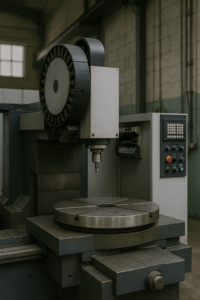
Rigidity and Structural Design: Bed Mills vs. Knee Mills
Once you understand vertical vs. horizontal, the next layer is machine rigidity. Stability determines whether a part holds tight tolerances over thousands of cycles.
Knee Mills: Versatility for R&D and Light Work
Knee mills—known for their adjustable table (the “knee”)—are highly flexible for complex, small‑quantity work. However, under heavy cutting loads, their cantilevered table can deflect.
These machines are ideal for:
- Proof‑of‑concept builds and R&D parts
- One‑off repairs or workshop tooling
- Light fabrication tasks or simple brackets
But they are not optimal for high‑consistency, high‑volume production of precision metal components.
Bed Mills: Built for Strength and Accuracy
In bed‑type milling machines, the table remains fully supported, eliminating deflection. Vertical movement is handled by the spindle head, not the table.
This architecture ensures:
- Superior rigidity for deeper cuts
- Better surface finishes on stainless steel and other hard materials
- Higher repeatability across thousands of cycles
At YISHANG, bed mills are standard for heavy‑duty fabrication where reliability and accuracy cannot slip, especially for steel frames, machine bases, and thick plates.
Procurement tip – what to ask suppliers
- “For this part, are you planning to use a bed mill or knee mill?”
- “How do you control deflection when machining thick or long parts?”
- “Can you keep the same machine setup for entire batches to avoid variation?”
Multi‑Axis Machining: Reducing Setups and Increasing ROI
Many buyers assume 5‑axis CNC milling machines are only for aerospace or medical implants, but their biggest value in B2B sourcing lies in setup reduction and tolerance control.
Why Multiple Setups Increase Cost and Risk
In traditional 3‑axis machining, parts requiring features on multiple sides must be manually re‑fixtured. Each re‑clamping:
- Adds labor cost
- Introduces potential misalignment
- Increases scrap probability
- Creates position errors between critical faces or holes
For simple brackets or plates, this may not be a problem. But for precision housings, medical parts, or complex aluminum structures, this can cause hidden quality risk.
5‑Axis “Done‑in‑One” Machining
5‑axis machining centers add rotational axes, allowing the tool or component to tilt. YISHANG leverages 5‑axis machining to finish multiple surfaces in one continuous setup.
Benefits include:
- Eliminated stacking errors between multiple clamping operations
- Tighter positional tolerances and improved geometric accuracy
- Shorter lead times due to reduced fixturing and handling
- Improved tool stability thanks to shorter cutters and optimized tool angles
For complex or tight‑tolerance parts, 5‑axis machining often provides the lowest total cost, even if the hourly rate is higher.
Procurement tip – when to consider 5‑axis
- Complex 3D surfaces, organic shapes, or free‑form geometry
- Parts with critical alignment between multiple faces, holes, or slots
- Projects where reliability and repeat orders are more important than the lowest first price
Specialized High‑Volume Machines: Drum and Duplex Milling
For extremely high‑volume jobs, two specialized machine types offer unmatched productivity and consistency.
Duplex Milling Machines
With two opposing spindles machining both faces simultaneously, duplex mills:
- Reduce cycle times for block squaring
- Ensure excellent parallelism and flatness between faces
- Cut machining time nearly in half for suitable geometries
They are ideal for large orders of:
- Manifolds and valve blocks
- Pump housings
- Structural blocks for machinery
Drum Milling Machines
Drum mills continuously rotate workpieces around a vertical drum, passing them through stationary cutters.
This “carousel” system:
- Eliminates loading delays between parts
- Enables uninterrupted batch processing
- Improves throughput for automotive and hydraulic components
While YISHANG focuses primarily on flexible custom production with CNC machining centers, understanding these machines helps buyers choose the correct supplier tier for ultra‑high‑volume parts.
Procurement tip – think in tiers
- Use flexible CNC suppliers (like YISHANG) for custom, multi‑SKU, medium‑volume projects
- Use highly specialized production lines (duplex, drum, transfer lines) once design and volume are very stable
Large‑Scale Fabrication: Gantry and Boring Mills
For oversized or heavy industrial parts, only specialized large‑format milling machines are suitable.
Gantry (Bridge) Milling Machines
Gantry mills distribute cutting forces through two vertical columns and a crossbeam, offering:
- Outstanding rigidity for long travel distances
- Accurate machining of large plates and welded frames
- Stable performance even on heavy workpieces
They prevent the “sagging” issues seen in oversized C‑frame machines.
Horizontal Boring Mills (HBM)
Horizontal boring mills (HBMs) feature extendable quills or boring bars that reach deep into large parts. They excel in machining:
- Valve bodies and pump housings
- Hydraulic cylinders
- Large castings needing deep bores and precise alignment
Their reach and stability make them essential for heavy equipment manufacturing and energy projects.
Procurement tip – when large‑format machines are required
- Check part size vs. machine travel; ask suppliers for maximum X/Y/Z travel
- For long‑term projects with large weldments or frames, ensure your supplier has gantry or HBM capability or a stable partner network
Material‑Specific Machining Requirements
Matching the machine to the material type prevents failures and reduces waste. At YISHANG we regularly machine stainless steel 304/316, low carbon steel, galvanized steel, aluminum, red copper, and brass.
Aluminum (6061/7075) – Lightweight but Chip‑Intensive
Challenges:
- Large chip volume
- Tendency to smear or clog flutes
Optimal machines and setups feature:
- High spindle speeds (12,000+ RPM)
- Fast feed rates and high MRR
- Excellent chip evacuation on vertical or horizontal machining centers
Stainless Steel (304/316) – Work‑Hardening and Heat
Challenges:
- Work‑hardening under aggressive cutting
- Heat retention that damages tools and affects dimensions
Requires:
- High torque at low RPM
- Rigid machine construction (box‑way machines or heavy C‑frames)
- Vibration‑absorbing cast iron frames
Titanium and Inconel – Difficult but Manageable
Challenges:
- Poor thermal conductivity
- High tool wear and cutting forces
Solutions include:
- 5‑axis machines for constant tool engagement
- High‑pressure coolant systems
- Trochoidal milling strategies for heat control
Procurement tip – align material, machine, and tolerance
- Always mention material grade + tolerance + surface requirement clearly in RFQs
- Ask suppliers how they control heat and tool wear for that material type
- For demanding alloys, prefer suppliers with experience and proven case studies
Quality Control: Metrology as a Competitive Edge
Cutting metal is only half the process—verifying accuracy is equally critical for B2B buyers who need stable quality over many shipments.
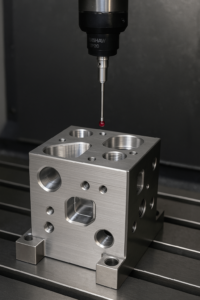
Ballbar Calibration
YISHANG performs routine ballbar testing to detect microscopic errors in:
- Squareness
- Backlash
- Servo synchronization
This proactive approach prevents drift during long production cycles and supports repeatable CNC milling accuracy.
In‑Process Probing
Modern CNC probing allows automatic inspection during machining. Benefits:
- Automatic compensation for tool wear
- Reduced scrap rate
- Assurance of consistent dimensional accuracy
Our workflow integrates QA into the machining cycle—not after it—ensuring reliability from first part to last. Combined with ISO 9001 quality management and RoHS‑compliant materials, this builds trust for long‑term cooperation.
Procurement Decision Matrix for Milling Machine Types
Use this simple framework to match machine capability with your production needs when evaluating suppliers or comparing quotes.
- High Mix / Low Volume
Recommended: 3‑axis or 5‑axis VMCs
Typical application: custom brackets, metal enclosures, prototypes, engineering builds - High Volume / Low Mix
Recommended: HMCs with pallet pools, drum or duplex milling for suitable parts
Typical application: automotive components, repeat OEM parts, standardized connectors - Large / Heavy Components
Recommended: Gantry mills, HBMs
Typical application: machinery frames, structural parts, large welded assemblies - Complex Geometries / Tight Tolerances
Recommended: 5‑axis simultaneous machining
Typical application: medical components, precision housings, energy components
Selecting a supplier with the right machine type ensures predictable performance, fewer surprises, and more competitive pricing over the full project life cycle.
Hybrid Manufacturing: The Future of Precision Engineering
Hybrid machining centers combine additive manufacturing (DED laser) with subtractive milling.
This enables:
- Repair of high‑value components with localized build‑up and re‑machining
- Printing complex structures followed by precision milling on the same machine
- Reduced material waste and shortened lead time for certain geometries
While hybrid systems are still more common in aerospace and energy industries, understanding them helps buyers see where future cost and lead‑time advantages may come from in the coming years.
Practical Checklist Before You Source CNC Milled Metal Parts from China
To connect the theory with real‑world procurement, use this simple checklist when sending RFQs or evaluating suppliers for milled metal parts.
- Clarify application and volume
- Annual volume and batch size (e.g. 200 pcs per batch, 2–3 times/year)
- End‑use industry: automotive, electronics, medical, construction, vending machine, energy storage, etc.
- Define technical requirements
- Material grade (e.g. SS304, SS316, DC01, galvanized steel, 6061, 5052, 7075)
- Critical tolerances and GD&T requirements
- Surface treatment (powder coating, anodizing, galvanizing, polishing, etc.)
- Ask about machine types and process flow
- Which types of milling machine will be used (vertical, horizontal, 5‑axis, gantry, etc.)?
- Will there be multiple setups or “done‑in‑one” machining?
- How is fixturing designed to control deformation?
- Confirm quality control capability
- ISO 9001 certification and QC procedures
- Measurement equipment (CMM, height gauge, gauges)
- In‑process inspection vs. only final inspection
- Review communication and documentation
- Technical drawings (2D + 3D) and BOM clearly understood
- Ability to provide FAI (First Article Inspection) reports for new projects
- Sample approval process before mass production
- Check supplier experience
- Years of experience in CNC milling and sheet metal fabrication
- Export experience with your target market (EU, US, Japan, etc.)
- Case experience in your industry segment
Using this checklist helps overseas buyers quickly identify whether a supplier truly understands milling machine selection, process control, and B2B export requirements.
FAQ: Types of Milling Machine and CNC Milling Services
Q1. Which types of milling machine are most common for OEM metal parts?
For most OEM metal parts, the most common are 3‑axis vertical machining centers, horizontal machining centers, and 5‑axis CNC milling machines. For larger structures, gantry mills and horizontal boring mills are used. Highly specialized machines like duplex or drum milling machines appear in very high‑volume, standardized production lines.
Q2. Is 5‑axis milling always more expensive?
The hourly rate of a 5‑axis machine is usually higher. However, for complex parts, 5‑axis can reduce the number of setups, fixtures, and rework, so the total Cost Per Part can actually be lower, especially for repeat orders with tight tolerances.
Q3. For wholesale buyers, is it enough to know the machine type?
Machine type is important, but not the only factor. You should also consider programming skill, process stability, tooling strategy, quality control, and communication. A supplier with the right mindset and engineering capability can make the same machine produce much better results.
Q4. How do I know if a supplier really has the machines they claim?
You can request equipment lists, factory photos, or video calls from the workshop. For key projects, arrange a third‑party audit or on‑site visit. Serious suppliers are usually happy to share evidence of their capacity.
Q5. Can YISHANG provide both CNC milling and other metal fabrication services?
Yes. Besides CNC milling and turning, YISHANG provides sheet metal laser cutting, bending, deep drawing, stamping, welding, CNC machining, surface treatment, assembly, and packaging. This allows overseas buyers to consolidate multiple processes into one supplier and reduce management cost.
Conclusion: Smart Machine Choices Drive Stronger Supply Chains
Modern milling machines are highly engineered systems that directly influence cost, consistency, and manufacturability. For overseas buyers and wholesale distributors, understanding the types of milling machine used on your projects is a powerful way to:
- Ask better technical questions in RFQs
- Compare quotes on more than just unit price
- Reduce risk of quality issues and delivery delays
At YISHANG, we focus on aligning the right milling machine type and CNC machining process with your cost and performance goals. From horizontal mills for automotive castings to 5‑axis platforms for medical or electronic components, we deliver engineered solutions—backed by ISO 9001 quality control, RoHS‑compliant materials, and over 26 years of OEM & ODM experience in metal products.
If you are planning your next project for custom CNC milled metal parts, sheet metal enclosures, or metal frames and structures, our engineering team can help you:
- Review your drawings for manufacturability (DFM)
- Choose suitable milling machine types and processes
- Balance cost, lead time, and quality for long‑term cooperation
Looking to optimize your next production run? Contact YISHANG’s engineering team for expert guidance on milling strategy and cost‑efficient production planning for your B2B metal components.