
Introduction
To many buyers, welding rods still look like a simple consumable line item.
In real distribution and fabrication work, they are anything but simple.
A rod that is right for one customer can be wrong for another. The difference may come down to base metal, welding position, machine type, moisture exposure, or the skill level of the end user. When distributors get that mix wrong, the consequences usually show up downstream—in spatter complaints, failed inspections, cracked welds, higher rework rates, and uncomfortable conversations with customers.
That is why this topic matters.
Stick electrodes may account for a small share of the total project value, but they influence a huge share of welding reliability. A poor choice in rod classification, diameter, or storage handling can create problems that are expensive to trace later.
This guide is written for:
importers and wholesalers of welding consumables
industrial distributors serving workshops, contractors, and repair markets
procurement managers supporting fabrication-heavy sectors such as construction, machinery, agriculture, and equipment manufacturing
The goal is practical: to help you understand the main types of stick welding rods, interpret common AWS designations such as E6013 and E7018, build a smarter stock profile, and reduce quality problems linked to storage, transport, and wrong application matching.
1. What Stick Welding Rods Really Are — and Why They Matter to Buyers
Stick welding, or SMAW (Shielded Metal Arc Welding), uses a consumable coated electrode to create the arc and supply filler metal at the same time.
Each rod has two essential parts:
a metal core wire, which becomes part of the weld
a flux coating, which stabilizes the arc, creates shielding gas, forms slag, and influences weld behavior
That basic structure explains why rods that look similar on a shelf can behave very differently in real use.
1.1 What Are Welding Rods Made Of?
The core wire is usually based on:
mild steel
low-alloy steel
stainless steel
cast-iron-compatible alloys
nickel-based systems for repair or specialty use
The coating chemistry is just as important. Common coating families include:
Rutile — easy starting, smoother arc, user-friendly handling
Cellulosic — aggressive arc, deep penetration, strong root-pass capability
Basic / low-hydrogen — better toughness and lower crack risk, but much more moisture-sensitive
Iron-powder enhanced — faster deposition and higher productivity in the right positions
For distributors and procurement teams, the commercial reality is simple: two rods may be close in price, yet produce very different results in weld appearance, defect rate, usability, and storage risk.
2. Understanding AWS Classification: The Language Behind the Label
For carbon steel SMAW products, AWS codes are the fastest way to understand what a rod is designed to do.
2.1 What Does E7018 Mean?
A designation like E7018 breaks down as follows:
E = Electrode
70 = minimum tensile strength of 70,000 psi
1 = suitable for all-position welding
8 = a low-hydrogen coating type, commonly used on AC or DC+
For buyers, this coding matters because it helps prevent wrong substitutions, especially when multiple brands are stocked in the same warehouse.
2.2 Suffixes Matter More Than Many Buyers Realize
A rod such as E7018-H4R gives extra information:
H4 = low diffusible hydrogen level
R = improved moisture resistance in the coating system
Those suffixes are not decoration. They affect storage strategy, field reliability, and suitability for structural or code-sensitive work.
3. The Four Main Types of Welding Electrodes — at Industry Level
Some users search for the four types of welding electrodes as a broad welding-industry category rather than a pure SMAW question. In that wider sense, the four groups are:
Stick electrodes (SMAW)
Solid wire electrodes (MIG / GMAW)
Flux-cored wire electrodes (FCAW)
Tungsten electrodes (TIG / GTAW)
This article stays focused on stick electrodes, because they remain one of the most important consumable categories for many industrial distributors and field-service buyers.
4. The Main Types of Stick Welding Rods and Where They Fit Best
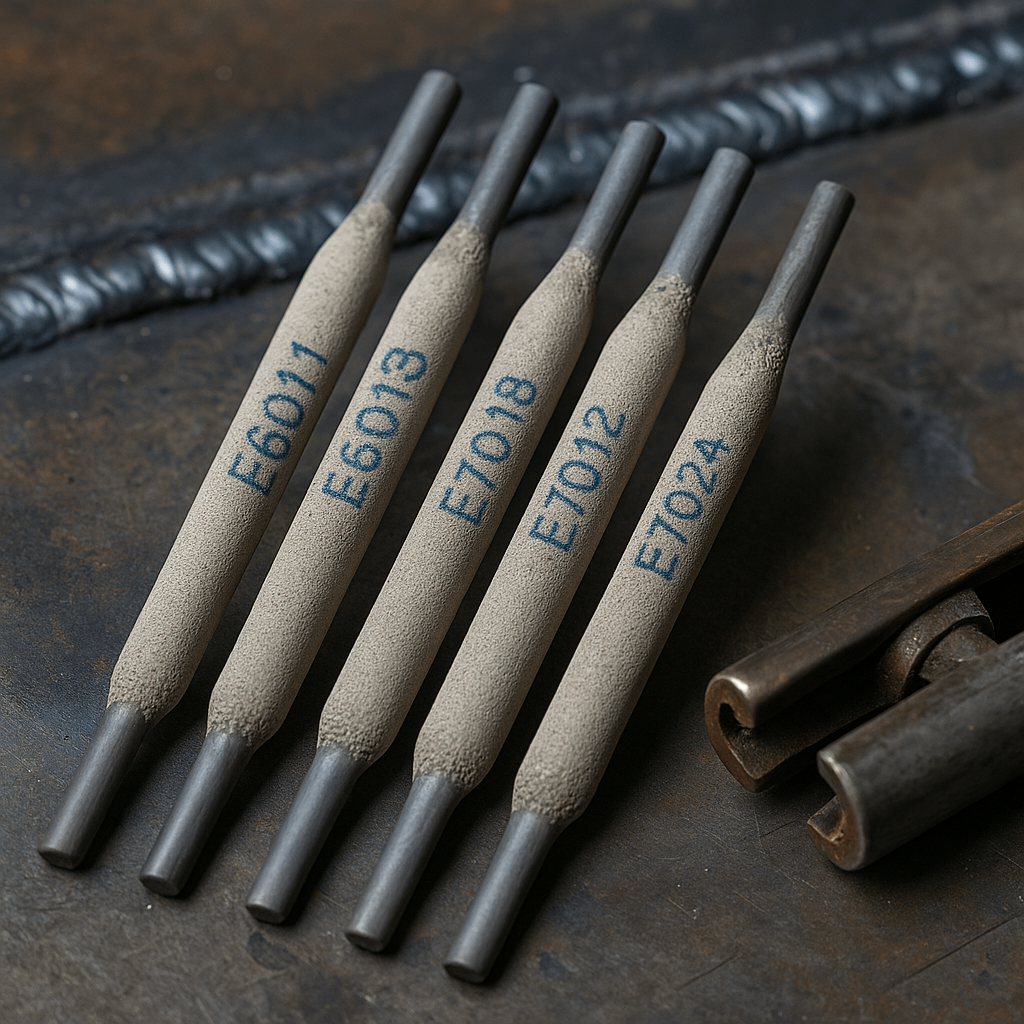
For most distributors, five rod families carry the bulk of real-world demand: E6010, E6011, E6013, E7018, and E7024.
4.1 E6010 — Deep Penetration and Strong Root-Pass Performance
Type: high-cellulose sodium
Best for: pipelines, root passes, field repair, dirty joints with imperfect preparation
Current: typically DC+ only
What buyers should know: excellent penetration, but not beginner-friendly; storage and handling also need attention because drying it incorrectly affects performance
4.2 E6011 — One of the Most Versatile Stocking Rods
Type: high-cellulose potassium
Best for: maintenance work, farm repair, mixed field jobs, workshops using AC machines
Current: AC or DC
Why distributors like it: broad usefulness and better flexibility where customer machine quality varies
4.3 E6013 — Easy to Run, Easy to Sell, Easy to Misapply
Type: rutile
Best for: light fabrication, thin sections, general repair, appearance-focused work on mild steel
Current: AC or DC
Commercial note: this is often one of the easiest rods to move because users like the smooth arc and clean-looking bead, but it is not the right answer for every structural application
4.4 E7018 — The Structural Workhorse
Type: low-hydrogen, often iron-powder enhanced
Best for: structural steel, machinery, heavier fabrication, code-sensitive work
Current: commonly AC or DC+
Distributor warning: this rod brings strong mechanical performance, but it also creates one of the biggest storage-risk categories in the warehouse because moisture control matters
4.5 E7024 — Productivity Rod for the Right Position
Type: heavy iron-powder coating
Best for: long flat or horizontal fillet welds where deposition speed matters
Current: AC or DC
Commercial fit: strong productivity value, but much narrower use range than E6011 or E7018
4.6 Rod Comparison Table: Polarity, Application, and Stocking Value
| Electrode | Polarity / Current | Best-Fit Use | Main Distributor Note |
| E6010 | DC+ | Root passes, pipelines, repair on difficult joints | Strong performance, but more skill-dependent |
| E6011 | AC / DC | Repair, farm, workshop, mixed-power environments | Very flexible and broadly useful |
| E6013 | AC / DC | Thin mild steel, light fabrication, appearance-focused work | Easy seller, but not a universal structural rod |
| E7018 | AC / DC+ | Structural steel and tougher service demands | Excellent performance, but moisture-sensitive |
| E7024 | AC / DC | Flat, high-deposition welds | Strong niche productivity rod |
5. How Distributors Should Choose the Right Stick Welding Rod for Customers
The best rod is not the one with the strongest sales history. It is the one that matches the customer’s actual use case.
The key variables are usually:
base metal
welding position
power source availability
required weld strength
skill level of the welder
whether the customer values speed, appearance, or code-level reliability most
5.1 Quick Selection Guide
| Customer Need | Practical Rod Recommendation |
| General mild steel repair with AC power | E6011 or E6013 |
| Structural steel work | E7018 |
| Root passes, field welding, rusty or poorly prepared joints | E6010 or E6011 |
| Thin sheet or appearance-focused light work | E6013 |
| Long flat fillet welds with productivity priority | E7024 |
5.2 Welding Rod Sizes That Distributors Commonly Need
| Rod Diameter | Typical Use |
| 2.0–2.5 mm | Thin material, lower-current work |
| 3.2 mm | The most universal size for many workshops |
| 4.0 mm | Heavier fabrication and thicker material |
| 5.0 mm | Industrial productivity-focused work |
5.3 Typical Amperage Reference
| Rod Diameter | Approx. Amperage Range |
| 2.5 mm | 70–100 A |
| 3.2 mm | 90–130 A |
| 4.0 mm | 130–180 A |
| 5.0 mm | 180–240 A |
These numbers vary by manufacturer, but they are useful when supporting customer selection and troubleshooting.
6. Moisture Control: One of the Most Overlooked Risks in Welding Rod Distribution
In long-distance distribution, moisture is often the hidden reason a good rod performs like a bad one.
6.1 Low-Hydrogen Rods Need Real Storage Discipline
If E7018 and similar low-hydrogen rods absorb too much moisture, customers may see:
hydrogen cracking
porosity
inspection failure in UT or RT work
loss of confidence in the distributor, even if the rod was originally compliant
That is why low-hydrogen inventory needs:
vacuum-sealed or moisture-resistant packaging
good warehouse humidity control
clear stock rotation discipline
6.2 Cellulosic Rods Need Different Handling
Cellulosic rods such as E6010 and E6011 should not simply be treated the same way as low-hydrogen rods.
Over-drying can damage performance. In most cases, the better approach is:
room-temperature storage
stable humidity conditions
no unnecessary oven treatment
6.3 Packaging Can Improve Distributor-Level Quality Control
Good packaging is not just a shipping detail. It can directly reduce claims and improve customer satisfaction.
Useful packaging choices include:
foil or vacuum-sealed packs
smaller job-site pack formats
clear batch labeling and traceability
7. Specialty Stick Electrodes Create High-Margin Opportunities — If You Stock Them Correctly
Beyond the mainstream rods, many distributors build real value through specialty products.
7.1 Stainless Steel Stick Welding Rods
Common examples include:
E308L — for 304 / 304L stainless
E309L — for joining stainless to carbon steel
E316L — for more corrosion-resistant stainless applications
These rods are often relevant in food equipment, chemical environments, and mixed-material fabrication.
7.2 Cast Iron Repair Rods
For cast iron repair, the usual categories include:
ENi-CI — high nickel, easier machining after repair
ENiFe-CI — stronger and often more tolerant in difficult repairs
These are lower-volume items, but they often solve high-value customer problems.
7.3 Hardfacing Electrodes
Hardfacing rods serve wear-heavy industries such as:
mining
agriculture
recycling
material handling
For the right distributor, these niche products can improve margin and deepen customer dependence.
8. When SMAW Is Not the Best Process
From a fabrication standpoint, stick welding remains useful, but it is not always the smartest production method.
8.1 Where SMAW Shows Its Limits
In higher-volume manufacturing, SMAW often loses ground because of:
more heat distortion on thin sheet metal
higher spatter and cleanup demand
greater operator variability
lower throughput compared with MIG, TIG, or laser-based processes
8.2 YISHANG’s Fabrication Perspective
At YISHANG, our production environment often relies more heavily on:
robotic MIG welding
TIG for precision seams
fiber laser welding for specific controlled applications
That does not make SMAW irrelevant. It simply means buyers should understand where SMAW is strong and where another process may deliver better productivity or consistency.
9. Troubleshooting Guide for Distributors
A useful distributor article should not stop at classification. Customers often call only when something has already gone wrong.
| Issue | Likely Cause | Practical Response |
| Porosity with E7018 | Moisture exposure | Review packaging, rebaking practice, and stock rotation |
| Fingernailing | Off-center coating or poor manufacturing control | Review supplier QC and batch consistency |
| Cracking in cast iron repairs | Wrong rod selection or poor repair procedure | Shift to ENi-CI / ENiFe-CI and review preheat / cool-down method |
| Excess spatter | Wrong rod choice or poor settings | Recheck amperage, arc length, and whether E6013 or E7018 is a better fit |
| Arc blow in DC welding | Magnetic interference | Suggest AC-capable options such as E6011 or E7018-AC where appropriate |
A troubleshooting section like this improves the distributor’s technical credibility and can reduce unnecessary returns.
10. FAQ: Common Buyer Questions About Stick Welding Rods
What are the 4 main types of welding electrodes?
At a broad industry level, they are:
Stick electrodes (SMAW)
Solid wire electrodes (MIG / GMAW)
Flux-cored wire electrodes (FCAW)
Tungsten electrodes (TIG / GTAW)
This guide focuses on stick electrodes, because they remain highly relevant in industrial distribution.
What is the best stick welding rod for mild steel?
That depends on the job:
E6011 for dirty surfaces or AC-powered repair work
E6013 for cleaner light fabrication and easier handling
E7018 for stronger structural weld requirements
What do the numbers on welding rods mean?
In AWS coding, the number indicates key performance traits such as:
tensile strength
welding position
flux type
current compatibility
Which welding rod is easiest for beginners?
For many users, E6013 is the easiest starting point because of its smoother arc and easier slag removal.
What sizes of welding rods should distributors usually stock?
A practical starting profile is:
E6011: 2.5 mm, 3.2 mm, 4.0 mm
E6013: 2.5 mm, 3.2 mm, 4.0 mm
E7018: 3.2 mm, 4.0 mm
E7024: 4.0 mm and larger where relevant
How long can welding rods be stored?
That depends heavily on rod type and packaging.
Low-hydrogen rods: long shelf life when sealed; controlled handling after opening
Cellulosic rods: should not be over-dried; stable room-condition storage is usually more appropriate
11. About YISHANG: Real Fabrication Experience Behind This Guide
YISHANG is a China-based metal products manufacturer serving customers in more than 50 countries. With over 26 years of OEM/ODM experience, we work across sheet metal parts, cabinets, racks, frames, enclosures, display structures, and welded assemblies.
Our material scope includes:
stainless steel
low-carbon steel
galvanized steel
aluminum
copper
brass
Because welding is part of our daily manufacturing environment, the recommendations in this guide come from real fabrication practice rather than theory alone.
12. Conclusion: Welding Electrodes Should Be Treated as a Strategic Category
Stick welding rods may look simple on paper, but for distributors they are a strategic product group.
The right stock profile, storage method, packaging control, and customer guidance can help you:
reduce rework and complaint rates
improve customer confidence
support more reliable weld quality in the field
build stronger long-term technical credibility
For distributors handling everything from high-volume E6013 to moisture-sensitive E7018 and niche stainless or cast iron repair electrodes, better product knowledge translates directly into better commercial decisions.
At YISHANG, we support global partners with practical fabrication insight and OEM/ODM manufacturing experience. If your team is planning a welding-related product line, fabrication program, or industrial sourcing project, our engineering team is available to discuss it.