For overseas wholesale buyers, sourcing metal components is a risk-management exercise long before it becomes a price negotiation. Your margin depends on stable quality, predictable lead times, and parts that assemble smoothly across repeated orders—not just a good-looking first sample.
Water jet fabrication often shows up on RFQs because it is a cold-cutting method: it can process many metals without the thermal distortion associated with laser or plasma. That reputation is fair. But “no heat” does not mean “no variables.” It simply shifts which variables matter and how they show up later.
This guide is written for procurement teams who evaluate water jet metal cutting as part of a production system. You will see how the process affects batch consistency, downstream manufacturability, inspection strategy, and supplier control—so you can work more effectively with water jet cutting manufacturers and avoid surprises when orders scale.
1. What Water Jet Fabrication Delivers at Production Scale
Water jet fabrication removes material through mechanical erosion. A high-pressure stream of water—often mixed with abrasive media—cuts metal without melting it, so there is no heat-affected zone at the cut edge. For wholesale sourcing, the real value of that cold cut is not the theory; it is the stability it can bring to repeat-order programs.
When thermal cutting changes the microstructure near the edge, downstream steps may behave differently from batch to batch depending on thickness, geometry, or machine condition. With water jet metal cutting, the base material’s mechanical behavior is more likely to remain consistent because the process does not rely on heat input. In purchasing terms, that can mean fewer “this batch bends differently” conversations and less time spent firefighting production variation.
Cold cutting, material integrity, and why buyers feel the difference
Wholesale buyers often notice process stability indirectly. Assembly stations run faster. Welders spend less time correcting fit-up. Final inspection catches fewer edge-related anomalies. These outcomes are not guaranteed by the words “water jet,” but they are more achievable when the cut does not introduce thermal stress.
This matters most when your parts are not standalone items. If your components feed into a cabinet, enclosure, frame, or welded assembly, variability shows up as labor cost and delivery risk. A process that preserves material behavior is easier to standardize, especially across repeated shipments.
The process signatures you still need to manage
Water jet fabrication does introduce inherent signatures: kerf geometry, surface striations, and minor taper. These are not defects by default; they are process realities. The commercial issue is not whether they exist, but whether they are controlled.
Capable water jet cutter manufacturers can manage these characteristics with stable parameters, good maintenance, and appropriate cutting strategies. When control is weak, small edge differences can accumulate across thousands of parts and become an assembly headache.
How to translate “water jet” into procurement language
In RFQs and supplier discussions, the most helpful shift is from naming a process to defining an outcome. Instead of only stating “water jet fabrication,” describe what matters to your program: edge condition at mating surfaces, perpendicularity at critical features, and consistency across lots.
That approach gives suppliers something measurable to align with—and gives you clearer criteria for evaluating samples against production reality.
2. Why Water Jet Fabrication Is Not a Drop-In Replacement
A common sourcing assumption is that water jet fabrication can replace laser or plasma without changing drawings, tolerances, or inspection criteria. This sometimes “works” during prototyping, then breaks down at volume when fixtures, operators, and downstream processes amplify differences.
Thermal cutting methods create a predictable set of artifacts: localized heat, potential warping, and an edge condition shaped by melting and resolidification. Many designs unintentionally accommodate those artifacts through legacy tolerances or fixture habits. When switching to water jet fabrication, the heat artifact disappears, but edge geometry and surface texture become more influential.
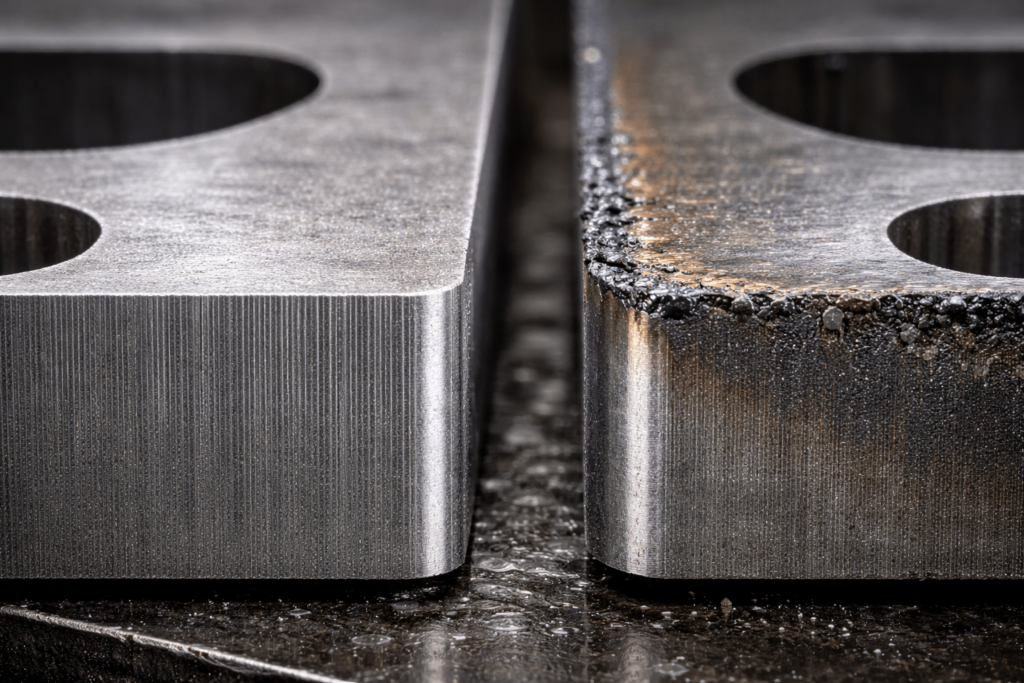
What changes when you switch processes
With water jet metal cutting, kerf taper and striation direction can affect how parts sit against reference faces, how tabs align in slots, and how fasteners start. These effects are subtle on a single part, and loud on a line running thousands of units.
That is why “same DXF, different process” can produce different assembly behavior even when dimensions check out. Procurement teams that treat process changes as engineering changes—rather than purchasing substitutions—reduce the likelihood of late-stage disputes.
Avoiding the classic prototype-to-production trap
During sampling, parts are often handled by senior technicians, assembled slowly, and adjusted manually. Volume production is different: operators follow standardized work, and small misfits become big throughput losses.
If you plan to source from multiple water jet cutting manufacturers, keep acceptance criteria consistent across suppliers. When criteria are vague, each supplier optimizes differently, and your incoming lots will not behave the same.
A practical way to specify without over-constraining
You do not need to over-engineer the RFQ with machine settings. What you do need is clarity on functional surfaces. Define which edges are cosmetic, which edges are mating, and which edges are weld-critical.
That single step aligns supplier effort with your real cost drivers—and keeps you from paying for unnecessary finishing on non-critical features.
3. Dimensional Accuracy Versus Functional Consistency
Wholesale quality issues rarely appear during first-article inspection. They show up later—during assembly at your customer, during field service, or when a “good” batch is followed by a batch that behaves slightly differently. Water jet fabrication can produce tight dimensions, but functional consistency depends on more than measurements.
In assemblies, tolerances stack. Small geometric differences become real when multiple parts meet at once. If your product relies on alignment, repeatable fit-up, or welded joints, the cut edge becomes a functional interface, not just a boundary.
Why “within tolerance” can still fail at scale
A part can meet nominal dimensions yet introduce friction or misalignment because of edge squareness, taper, or surface texture. On a prototype, you might not notice. On a production line, that friction becomes time, rework, and inconsistent yield.
For wholesale buyers, this is a critical distinction: quality is not only conformance to drawings. Quality is conformance to downstream reality.
Functional validation as a procurement tool
A strong sourcing practice is to validate parts in the way they are actually used. If a bracket is welded, validate weld fit and penetration consistency. If a panel is bent, validate bend repeatability and how the edge behaves near the bend.
This is not about adding bureaucracy. It is about protecting yourself from the costliest failure mode in wholesale programs: approving parts that pass measurement but fail in production.
Inspection strategy that matches manufacturing behavior
Rather than requesting “full inspection” in a generic sense, align inspection to risk. For many water jet programs, the highest leverage checks are edge-related: perpendicularity where parts mate, burr-like irregularities at critical surfaces, and repeatability across a sample set.
Where appropriate, buyers can also request basic capability evidence for stable runs—such as dimensional results across multiple parts from the same batch. This supports a more reliable transition from sample to mass production.
4. Water Jet Fabrication and Downstream Manufacturability
Most wholesale buyers are not purchasing a finished product. You are purchasing an input that will be bent, welded, assembled, coated, or integrated into equipment. That is why water jet fabrication should be evaluated by how it supports downstream manufacturability, not by how clean the cut looks on a table.
A useful mindset is this: cutting is the first operation that defines the geometry every later operation must respect. If the first operation creates variation in functional areas, every later operation has to absorb it.
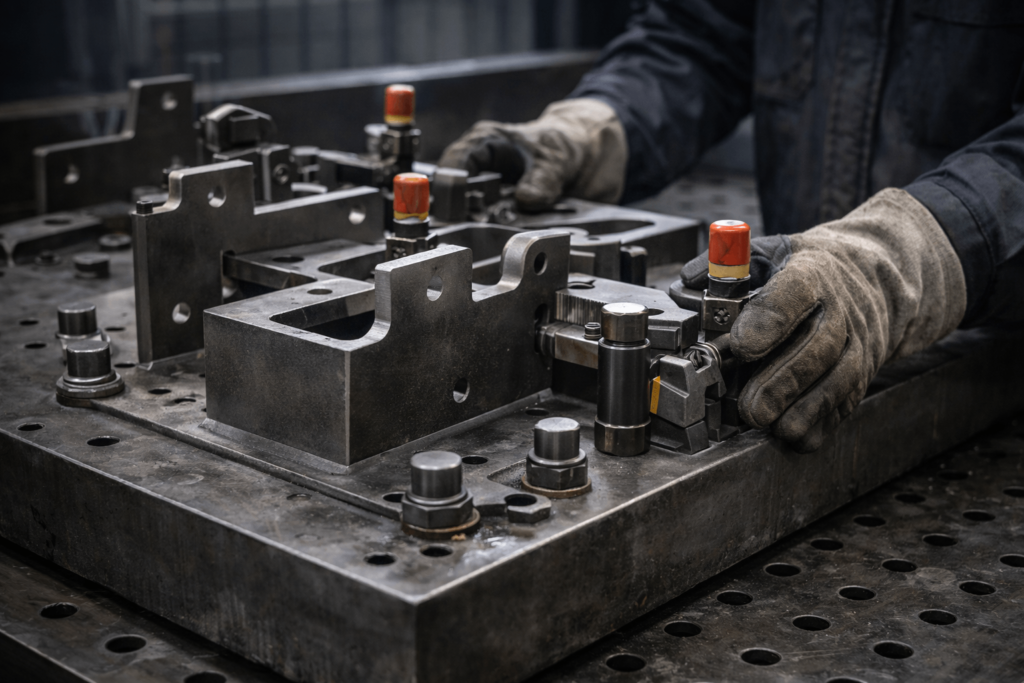
Bending and forming: stability is more than “no heat”
Cold cutting helps because it avoids thermal stress. But bend behavior still depends on edge condition near bend lines and how stress distributes around cut features.
If a design places bends close to intricate cut geometry, the supplier’s ability to control edge condition becomes directly tied to bend repeatability. That is a manufacturing reality procurement teams can protect by clarifying which features are bend-critical.
Welding and fit-up: where edge condition becomes a cost driver
Weld outcomes are sensitive to joint fit. Water jet edges can be excellent for welding when geometry is controlled and preparation is matched to the joint.
Where variability exists—minor taper, texture, or inconsistent squareness—welders compensate with extra time. In wholesale programs, that “extra time” becomes a hidden cost that does not appear in the cutting quote.
Assembly and throughput: why buyers should care about repeatability
In assembly-heavy products, the most expensive failures are not catastrophic. They are small: misaligned holes, tight slots, inconsistent tab engagement.
These issues are often blamed on “tolerance” in general. In reality, they are frequently linked to how the cut edge interacts with fixtures and mating parts. Procurement teams who include assembly context in supplier communication see fewer of these surprises.
5. Comparing Water Jet and Thermal Cutting Through a Procurement Lens
Many comparisons focus on speed and hourly rate. Buyers should care more about manufacturing risk—because risk translates into rework, missed deliveries, and customer dissatisfaction.
Thermal cutting can introduce irreversible effects: warping, localized hardening, and microcracking risks in certain scenarios. Even when these issues are rare, they are hard to “inspect out” if they only show up after downstream processing.
Risk you can audit versus risk you discover late
Water jet fabrication shifts the risk profile toward mechanical characteristics—edge finish, kerf consistency, and repeatability. These are typically easier to specify, audit, and verify than hidden thermal effects.
For overseas sourcing, that matters. Predictable, auditable risk is easier to manage across distance and time zones than unpredictable variation that emerges late in the supply chain.
A practical comparison buyers can actually use
Instead of asking which process is “better,” consider which failure is more costly in your program. If a part distorts from heat and ruins downstream forming, the cost may be high and difficult to recover. If a water jet edge needs light finishing on a non-critical area, the cost is usually easier to manage.
That does not make water jet a default choice. It makes it a rational choice when the cost of irreversible change outweighs the cost of controlling mechanical signatures.
Where long-tail searches often point buyers
Many buyers search phrases like “water jet vs laser cutting for stainless” or “best cutting method for thick plate.” Those searches are really about risk and stability.
Your supplier’s ability to explain trade-offs clearly is often a better predictor of success than their ability to quote quickly.
6. When Water Jet Fabrication Strengthens Supply Stability
There are sourcing scenarios where water jet fabrication supports long-term stability in ways that matter directly to wholesale procurement. These scenarios are typically defined by downstream sensitivity: the later operations cannot easily correct early variability.
Structural components and tight-tolerance assemblies often fall into this category. If a part is part of a welded frame, an enclosure system, or a precision mounting structure, early stability reduces downstream labor and protects delivery schedules.
Repeat orders and consistent behavior across shipments
Repeat orders are where wholesale programs win—or lose—profitability. If one batch requires extra adjustment, your true cost rises even if the unit price stays the same.
Because water jet metal cutting preserves base material behavior, it can support more consistent forming and joining behavior over time. That consistency can reduce “special handling” that gradually creeps into production when parts vary.
When correction is impractical
Some supply chains have little room for correction. Parts may be coated after cutting, shipped to another facility, or integrated into products with strict delivery windows.
In these cases, preventing irreversible variability early is often cheaper than correcting it later. Water jet fabrication is valuable when it preserves options and reduces late-stage surprises.
A note on thickness and geometry sensitivity
Many procurement teams turn to water jet for thicker sections or complex geometry where thermal distortion risk is higher. The key is not thickness alone, but how sensitive your downstream steps are to edge and flatness.
The right supplier will help you define that sensitivity and set expectations that hold in production.
7. When Water Jet Fabrication Adds Cost Without Sourcing Value
Water jet fabrication is not universally optimal. Using it where its advantages do not matter can increase unit cost without improving supply outcomes.
High-volume thin metal parts can often be produced more economically with processes optimized for throughput and automation. In those cases, the premium for water jet may not return value—especially if downstream steps are not sensitive to heat effects.
A common pitfall in sourcing is assuming that a more capable process always produces a better commercial outcome. In reality, the best process is the one that meets requirements with the lowest total risk.
If your product is tolerant to thermal cutting artifacts and production speed is critical, a faster process may be the better sourcing decision.
Feature limits and when to consider alternatives
Certain micro-features, extremely tight corner radii, or ultra-fine detail may be outside the practical window for water jet metal cutting, depending on thickness and requirements.
In such cases, a hybrid approach may be appropriate: water jet for rough profiling and secondary machining for critical features. Procurement teams can reduce cost by only paying for precision where it matters.
What buyers should ask when water jet seems expensive
When quotes are higher than expected, it is usually not “because water jet is expensive.” It is because cycle time, edge requirements, or fixturing complexity increase to meet your outcome.
A transparent supplier will explain which requirement drives cost and propose alternatives that protect function while reducing expense.
8. How Experienced Buyers Assess Water Jet Fabrication Partners
Selecting a process is only half the decision. The other half is selecting a partner that can control the process consistently over time. This distinction becomes critical for overseas wholesale buyers, because distance, language, and time zones all magnify the cost of inconsistency.
When evaluating water jet cutting manufacturers or water jet cutter manufacturers, experienced buyers focus less on machine brand and more on evidence of process control. The question is not whether a supplier owns a water jet, but whether they can repeatedly produce parts that behave the same way in your downstream operations.
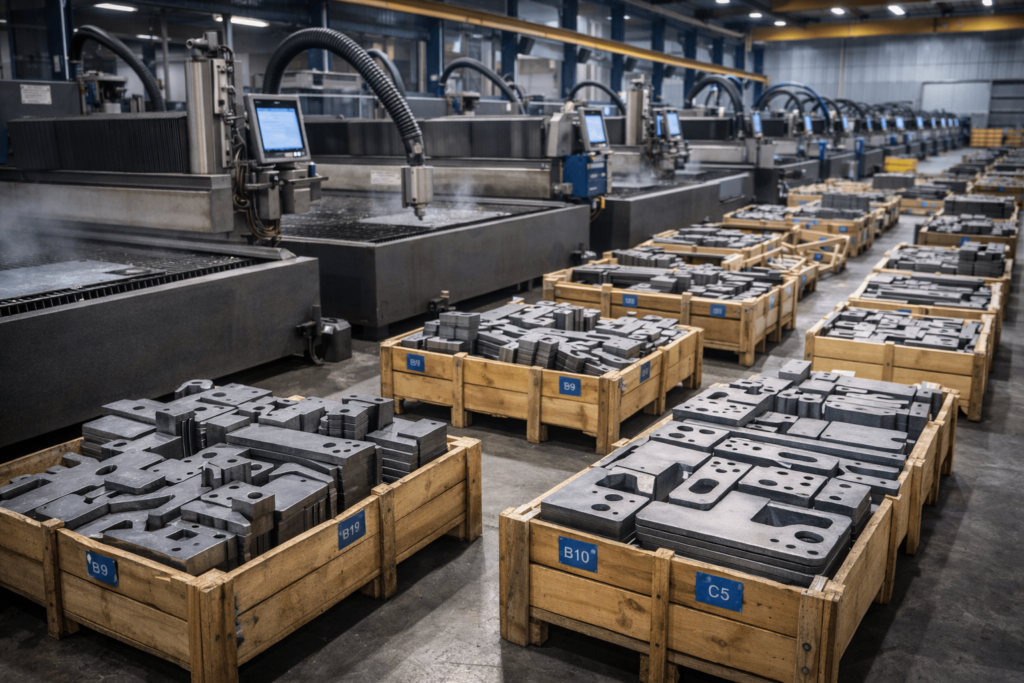
What “control” looks like in real production
Control is not a marketing claim. It shows up in stable results across multiple parts from the same run, consistent edge quality at functional features, and the ability to explain why a specific cutting strategy was chosen. Suppliers who understand kerf behavior, taper management, and edge finish can usually connect those choices back to assembly or welding requirements.
In contrast, suppliers who focus only on quoting speed or nominal tolerances may struggle once volumes increase. For wholesale programs, that gap often appears as late deliveries, repeated clarifications, or rising rework cost.
Process evidence buyers should expect
Mature water jet cutting manufacturers are accustomed to providing basic production evidence. This may include first article inspection results, multi-part sampling from a single batch, or clarification of how critical edges are verified. Even when formal standards are not required, familiarity with concepts such as AQL sampling, FAI documentation, or capability tracking is a strong signal of readiness for repeat orders.
Buyers do not need to request excessive paperwork. The goal is to confirm that quality is designed into the process, not inspected in at the end.
Shortlisting manufacturers for overseas sourcing
When narrowing down suppliers, experienced buyers often ask a small set of practical questions:
- How do you control edge quality on parts that will be bent or welded?
- What changes when cutting thicker metal or harder alloys?
- How do you verify consistency across a full production run?
Clear, specific answers indicate a production partner. Vague assurances usually indicate a prototype-oriented shop.
Where YISHANG fits—without the hard sell
At YISHANG, water jet fabrication is treated as a sourcing commitment rather than a single operation. Our focus is on stable output, controlled edge behavior, and alignment with downstream processes such as bending, welding, and assembly.
If you are reviewing suppliers for a current RFQ or planning a repeat-order program, a brief manufacturing feasibility discussion can clarify expectations early. You are welcome to contact YISHANG to review drawings, functional surfaces, and production requirements before committing to volume.
9. Technical Factors Buyers Should Understand (Without Becoming Engineers)
Many high-ranking articles explain water jet technology in detail, but wholesale buyers benefit more from understanding which technical factors actually affect cost, lead time, and consistency. A few core concepts account for most real-world outcomes.
Edge quality levels and production speed
Water jet cutting is often discussed in terms of edge quality levels, commonly described from rough to fine. Higher edge quality produces smoother surfaces and better perpendicularity, but requires slower cutting speeds. In practice, moving from a rough cut to a fine cut can reduce cutting speed by several times, especially on thicker metal.
For buyers, the implication is straightforward: premium edge quality should be reserved for functional surfaces. Applying the highest quality level everywhere increases cost without improving assembly or performance.
Pressure, taper, and predictability
Most industrial water jet systems operate at ultra-high pressure. Higher pressure improves cutting capability but also places greater demands on maintenance and process stability. Taper—the slight angle created as the jet exits the material—is a natural effect that must be managed, particularly on thicker sections.
Capable suppliers compensate for taper through cutting strategy and, in some cases, multi-axis control. What matters to buyers is not the exact pressure value, but whether the supplier can hold perpendicularity where it affects fit and function.
Why these factors matter in procurement terms
Edge quality, pressure stability, and taper control directly influence downstream labor. If parts drop into fixtures cleanly, weld joints fit consistently, and bends repeat as expected, total cost remains predictable.
If these factors vary, the cost shows up later—in assembly time, rework, and missed schedules. Understanding this connection helps buyers ask better questions and interpret quotes more accurately.
10. Metal Cutting Reality: Where Water Jet Fits Best
Search results for water jet metal cutting often highlight material versatility, and that versatility is real. Water jet cutting is commonly used on stainless steel, aluminum, carbon steel, copper alloys, and harder or heat-sensitive metals.
From a sourcing perspective, the more important question is not which metals can be cut, but when water jet cutting protects downstream processes. Thicker sections, mixed-material assemblies, and parts that will be welded or bent close to cut edges often benefit from cold cutting because material behavior remains predictable.
Conversely, thin sheet parts produced in very high volumes may not gain enough benefit to justify slower cutting speeds. In those cases, faster processes can reduce unit cost without introducing unacceptable risk.
For wholesale buyers, material choice, thickness, and downstream sensitivity should be evaluated together. Water jet fabrication is most effective when it reduces correction later in the supply chain.
11. Frequently Asked Procurement Questions About Water Jet Cutting
How tight are tolerances with water jet metal cutting?
Water jet cutting can achieve good dimensional accuracy, but practical tolerances depend on material thickness, geometry, and edge quality requirements. Buyers should focus less on nominal tolerance numbers and more on whether functional features repeat consistently across a batch.
Is water jet better than laser for thick stainless steel?
For thicker stainless sections, water jet cutting avoids thermal distortion and hardening that can complicate bending or welding. The trade-off is cutting speed. Buyers should weigh the cost of slower cutting against the cost of downstream correction.
What drives cost in water jet fabrication quotes?
Key cost drivers include cutting speed (linked to edge quality), material thickness, abrasive consumption, and setup complexity. When quotes appear high, it is often because premium edge requirements are applied broadly instead of selectively.
How should buyers compare water jet cutting manufacturers?
Beyond price, buyers should compare consistency evidence, communication clarity, and understanding of downstream use. Suppliers who ask about assembly, welding, or bending usually deliver more predictable results.
Can water jet cutting handle repeat overseas orders reliably?
Yes—when the supplier has stable process control and clear acceptance criteria. Repeatability depends more on discipline and communication than on the machine itself.
Conclusion: Water Jet Fabrication as a Practical Sourcing Decision
For wholesale buyers, water jet fabrication is not simply a cutting method. It is a way to manage manufacturing risk, protect downstream operations, and stabilize long-term supply.
When specified with functional priorities in mind and executed by capable partners, water jet metal cutting supports consistent production and predictable outcomes. When treated as a generic substitute, it can introduce avoidable variation.
If you are comparing suppliers or refining specifications for a repeat-order program, an early discussion about functional surfaces and downstream processes can prevent costly adjustments later. Contact YISHANG to review your drawings and production expectations with a manufacturing team.