I. Introduction
Welded metal furniture has become a core product category for international wholesale buyers serving contract interiors, hospitality projects, retail chains, and modern residential markets. For this audience, welded frames are not simply a style; they are a structural and commercial choice that must perform under real-world pressure. Sourcing teams care less about “industrial look” photos and more about whether a welded chair or table can survive thousands of use cycles without complaints.
Compared to knock-down products designed for DIY assembly, welded furniture arrives as a finished structure. The frame is fixed in the factory, not by the end user. This reduces assembly errors, eliminates most fastener loosening, and keeps dimensions consistent from the first container to the fiftieth. For wholesalers supplying cafés, hotels, coworking spaces, transit facilities, and educational environments, this stability directly affects warranty risk, online reviews, and client retention.
When purchasing teams search suppliers, they rarely type only “welded furniture”. They tend to use phrases such as welded metal furniture manufacturer, wholesale metal frame seating, contract welded furniture, commercial outdoor furniture, OEM welded furniture, and sometimes explore welded furniture ideas when planning new ranges or project-based welded furniture projects. They are scanning quickly for signs that the factory understands contract use, export standards, and how welding impacts cost and performance. This article is written for that professional reader.
II. Structural Definition and Why It Matters to Buyers
From a technical standpoint, welded furniture consists of metal components that are permanently joined by welding. Tubes, rods, bars, and plates are fused into a continuous frame. There are no structural screws for the customer to tighten and no brackets that can work loose over time. For a buyer, this definition is important because structural continuity is directly linked to long-term stability and perceived quality in the field.
By contrast, fastener-based systems rely on mechanical joints. Each joint introduces small clearances that can open under repeated loading. On paper, both constructions may pass initial testing. In daily use, however, the welded version keeps its alignment for longer, especially in high-traffic environments such as foodservice or education.
From a procurement angle, the difference can be summarised as follows:
| Attribute | Welded Metal Frame | Fastener-Based Frame |
|---|---|---|
| Structural Behaviour | Continuous load path | Multiple discrete joints |
| Typical Failure Point | Deformation under overload | Loosening or misassembly |
| Assembly Risk | Very low at end user | High in DIY channels |
| Maintenance Demand | Low, mainly cleaning | Retightening and part replacement |
| Batch Consistency | High with fixtures | Variable if assembled locally |
Because welded joints distribute force along a heat-affected zone, they support better fatigue resistance in common furniture tests (for example EN or BIFMA seating standards). This is why many specifications for contract seating and tables either recommend or assume welded subframes. For wholesalers, this gives a technical story to support higher positioning than entry-level flat-pack products.
Welded construction also supports cleaner geometry. Thin-wall tubing can be mitred and joined without bulky brackets, which helps designers create slimmer profiles and families of SKUs that share the same base structure. When a buyer is planning a line of stools, chairs, and small tables, this becomes a practical advantage.
III. Performance Factors That Drive Sourcing Decisions
When wholesale buyers assess welded furniture, they rarely follow a consumer-style checklist. Instead, they ask whether the product can survive specific usage patterns, pass target tests, and remain repeatable over multiple production runs. Three performance angles are especially important: structural behaviour, finishing quality, and lifecycle economics.
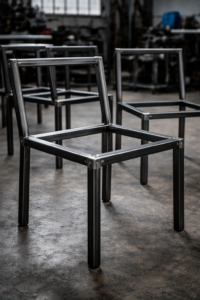
1. Structural Behaviour Under Real-World Loads
In commercial environments, furniture is not treated gently. Chairs are dragged across hard floors, people lean back on rear legs, barstools take side impact near counters, and shelves carry uneven loads. Welded joints help absorb these lateral, torsional, and impact forces because the frame behaves as a single unit rather than a collection of parts.
As a practical reference, many contract chairs use thin-wall steel tubing in the range of 20–30 mm outside diameter with wall thickness between 1.2–2.0 mm. When properly gusseted and welded with controlled heat input, these frames can withstand dynamic test loads above 150 kg and cyclic loading that simulates years of use. For buyers supplying schools, canteens, airports, or coworking spaces, this is the level of reliability that protects brand and project relationships.
2. Finishing Systems and Corrosion Behaviour
Finishing is where customers often judge quality at first glance. It is also where weak welding processes quickly show themselves. Excessive spatter, distortion, or grinding marks become visible once powder coating or plating is applied.
Factories experienced in welding furniture projects usually match welding methods and finishing systems carefully. Typical combinations include:
- Powder coating on mild steel for indoor and standard outdoor use
- E-coat plus powder for higher corrosion resistance and chip protection
- Brushed or polished stainless steel for foodservice, retail, and healthcare
- Anodised aluminium for coastal balconies or poolside furniture
Export buyers often ask for salt-spray test results when developing outdoor welded furniture ranges. Stainless steel 316 and anodised aluminium generally perform best in coastal climates, while pretreated mild steel is suitable for inland locations. Knowing which combination is used allows a wholesaler to give realistic performance expectations to their own customers.
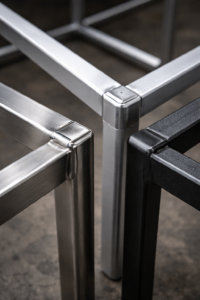
3. Lifecycle Economics and Warranty Risk
From a sourcing perspective, the question is not only “What is the price per piece?” but also “What happens after two or three years of use?”. Welded frames reduce one of the most common failure mechanisms in seating and tables: loose fasteners. Fewer wobbling stools mean fewer site visits, fewer refunds, and fewer negative reviews.
Another economic factor is that a sound welded frame can often be refurbished. Tops, seats, or upholstery can be changed without replacing the structure. For hospitality chains or institutional customers, this supports refurbishment cycles instead of complete replacement. For wholesalers, this becomes a concrete selling point supported by engineering logic rather than marketing phrases.
IV. Material Systems and What They Mean for Buyers
Material choice in welded furniture is not only a design decision; it affects welding difficulty, finishing options, corrosion resistance, and pricing. Understanding material systems helps buyers read drawings and quotations with a more critical eye.
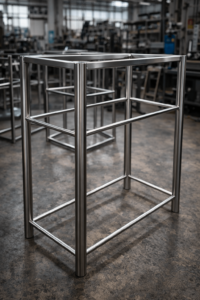
Mild Steel (Carbon Steel)
Mild steel, such as Q235 or ASTM A36, is the standard workhorse for welded furniture. It welds well using MIG or TIG, bends predictably, and works smoothly with powder coating. For volume programs, its wide availability and competitive cost make it the default option.
Procurement teams pay attention to tube dimensions and thickness because these influence both strength and cost. During quotation, asking for exact tube specifications and tolerances helps avoid silent cost cutting or substitutions later in the project.
Stainless Steel (304/316)
Stainless steel is chosen for projects where hygiene, appearance, and corrosion resistance are critical. TIG-welded stainless frames can be finished in brushed, satin, or mirror polish without visible seams. This makes them suitable for foodservice, healthcare, retail display, and coastal outdoor furniture.
While stainless raises the unit cost, it allows wholesalers to position their collections higher in the market. It also reduces complaints about surface rust in harsh environments. Stainless steel welded furniture is often found in premium hospitality and restaurant ranges.
Aluminium
Aluminium offers low weight and good natural corrosion resistance. It is widely used in balcony sets, poolside lounges, and marine projects. Because aluminium conducts heat quickly and has a persistent oxide layer, TIG welding requires skill and well-controlled parameters.
Anodising is a popular finishing choice, providing a hard, protective surface with metallic colour options. For buyers, aluminium welded frames mean easier handling, reduced shipping weight, and strong appeal in outdoor lifestyle markets.
Mixed Material Combinations
Many successful welded furniture ideas use a metal frame plus wood, composite, stone, glass, or upholstered surfaces. The frame carries the load; the other materials create warmth and branding. For wholesalers, this provides a way to refresh collections regularly while keeping the same proven frame platforms.
V. Application Scenarios with Direct Procurement Context
Different end-use environments place different demands on welded metal furniture. Connecting application scenarios with procurement logic helps ensure that product decisions match market realities.
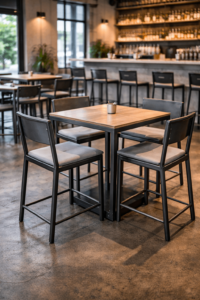
Commercial and Hospitality Projects
Restaurants, cafés, hotels, coworking spaces, and transit terminals all share high-frequency use and high visibility. Furniture must look aligned and feel stable for the entire contract period. In these programs, welded frames support contract seating standards and reduce service calls.
Wholesalers focused on hospitality channels often specify welded barstools, dining bases, communal tables, and banquette frames. Projects typically require consistent geometry across large quantities, so fixture-based production becomes a key point in supplier evaluation.
Residential and Rental Markets
In modern apartments and build-to-rent projects, metal frames are used to achieve slim silhouettes and durable construction. Welded bed bases, shelving, and dining frames allow developers and landlords to provide long-lasting fittings without oversized visual impact.
For wholesalers, welded furniture in residential channels can be positioned above disposable flat-pack items as a “buy once, use for years” alternative. This positioning is especially relevant in markets where sustainability and waste reduction are growing concerns.
Outdoor and Coastal Channels
Outdoor welded furniture requires careful pairing of material and coating. Stainless steel 316 and anodised aluminium are well suited to coastal climates; pretreatment plus powder-coated mild steel can work well inland. Procurement teams sourcing for garden centres, resort chains, or seaside restaurants will typically ask about salt-spray performance, drainage hole design, and coating thickness.
Aligning outdoor materials with realistic environmental conditions prevents premature failures and supports repeat business instead of one-season turnover.
VI. Key Categories of Welded Furniture for Wholesale Ranges
Search results for welded furniture ideas and welding furniture projects often show long lists of stools, tables, shelves, and benches aimed at DIY welders. Wholesale buyers look at many of the same categories but through a different lens: volumes, lead times, loading, and finish consistency. Mapping categories to buying decisions helps align your range planning with real demand.
1. Seating for Hospitality and Contract Spaces
Chairs, barstools, counter stools, lounge chairs, and benches form the backbone of most welded furniture projects in hospitality and foodservice. For these items, buyers focus on stacking capability, seat height standards, footrest strength, and how upholstery or seat panels will be attached to the metal frame.
When reviewing designs, it helps to confirm test targets and any specific requirements such as stack heights for banquet halls or barstool heights for different markets. Welded metal seating with properly designed bracing can support dense layouts without increasing maintenance.
2. Tables and Work Surfaces
Dining tables, coffee tables, side tables, and communal work tables are frequent items in project specifications. Welded table bases—whether in steel, stainless, or aluminium—provide the rigidity that large tops require. Buyers compare base weights, footprint sizes, and bolt patterns for attaching tops.
Including a welded base size matrix in your range allows tops to be swapped without redesigning the metal frame. This approach satisfies both design variety and manufacturing efficiency, and it aligns well with how many leading brands structure their welded table collections.
3. Storage, Shelving, and Display
Retail shelving, back-of-house storage, plant stands, and light racking systems are all natural applications for welded frames. Here, the emphasis is on load ratings, tie-back options for walls, and compatibility with adjustable shelves.
When planning welded display or shelving ranges, wholesalers can use a small number of standard frame modules in different heights and widths. Variable shelves and back panels provide visual variety, while the welded structure keeps complexity under control in production and assembly.
4. Beds, Platforms, and Frames
Welded bed frames and platforms appear both in residential and hospitality projects. Metal frames are chosen for their durability, resistance to loosening, and ability to integrate storage or under-bed clearance.
For wholesale programmes, it is practical to define a consistent frame architecture that can scale from single to king sizes. Standardised corner brackets, support rails, and centre beams keep SKUs manageable while still addressing different markets and mattress sizes.
5. Décor, Accessories, and Light Structures
Plant stands, console frames, coat racks, simple hall trees, and wall-mounted brackets are common welded furniture ideas that complement a core seating and table range. Although each piece is small, together they increase average order value and help your customers build complete stories in their spaces.
From a sourcing point of view, these accessories are ideal for utilising leftover material or tube lengths and can share the same finishes as primary items. This keeps colour consistency across collections and reduces finishing complexity.
VII. Design Constraints and Cost Drivers in OEM/ODM Programs
Many overseas buyers engage in OEM or ODM development rather than simply purchasing open-line products. In this context, understanding how design decisions influence welding, fixturing, and finishing helps keep projects on budget.
Slim Profiles and Open Geometry
Slim profiles are a common requirement in contemporary collections. Metal allows chair legs, table bases, and shelving structures to look light while remaining strong. However, thin-wall tubing is more sensitive to heat and distortion. That means fixtures, welding sequences, and cooling control matter.
When reviewing welded furniture ideas during development, buyers benefit from asking how certain joints will be fixtured and what tolerances can be held. This avoids surprises when samples and mass production units show small but visible differences.
Mixed Material Integration
Welded frames often carry wooden, stone, laminate, or upholstered elements. The way these elements attach—via inserts, brackets, screws, or adhesives—affects assembly time, packaging design, and field service. For example, a welded steel table base with threaded inserts offers straightforward installation for different tabletops.
During quotation, it is useful to clarify where welding ends and where mechanical connections begin. This also helps in planning spare parts or future refresh cycles for the same core frame.
Modular Frames for Project Installations
For large-scale projects, such as retail fixtures or hotel fit-outs, welded modules may be joined on site. Subframes are welded in the factory and connected via bolts or plates during installation. This approach balances shipping density with structural integrity.
Buyers managing project orders can discuss which parts will be welded as single units and which will be modular. Clear decisions at this stage improve packing efficiency and reduce site work.
VIII. Market Misconceptions and How Wholesalers Can Respond
Downstream customers often have incomplete or inaccurate views of welded metal furniture. Wholesalers can use informed explanations to build trust and close sales.
One common misconception is that welded frames always look industrial. In reality, finishing determines style. Powder-coated pastel colours, fine textures, and combinations with wood or fabric can make welded items feel warm and domestic, not cold or harsh.
Another misconception is that welded furniture is automatically heavy. While solid steel bars are heavy, thin-wall steel tubing and aluminium can produce light structures. Many outdoor chairs that feel light in the hand are, in fact, welded aluminium or light-gauge steel.
A further misconception is that welded structures cannot be repaired. In commercial environments, weld repairs and reinforcements are normal when accidents occur. A stable welded frame can also be refinished, whereas some cheap flat-pack items must be discarded entirely once damaged.
Finally, some clients believe that knock-down furniture is more premium because it can be disassembled. For high-use settings, this flexibility is less important than long-term stability. Wholesalers can explain that welded construction is selected specifically to reduce movement and extend service life.
IX. What Export-Capable Manufacturers Need to Provide
For welded metal furniture to work in international wholesale programmes, manufacturers must offer more than welding skill. Export-capable factories combine process control, technical documentation, and logistics experience.
Factories such as YISHANG, with over 26 years in metal fabrication for cabinets, displays, frames, and other welded metal products, typically integrate laser cutting, CNC bending, welding, surface treatment, and assembly under one roof. This kind of vertical capability is particularly relevant for buyers looking to consolidate suppliers and reduce hand-offs in the supply chain.
Geometry and Batch Control
Fixtures and welding procedures are essential to keep geometry consistent across thousands of pieces. Buyers often request information on tolerances, tube cutting methods (such as laser or CNC), and weld quality standards. When a factory can explain its process clearly, it gives procurement teams more confidence in repeat orders.
Finishing and Pretreatment Capabilities
Consistent powder coating depends on pretreatment steps such as degreasing, phosphating, and in some cases passivation. For stainless steel welding, removing heat tint and restoring corrosion resistance is critical. Buyers who ask about these steps quickly see which suppliers are ready for demanding export markets.
Packaging and Shipping Compatibility
Welded furniture is usually shipped as complete items or in large modules. Protective packing around corners, thoughtful carton design, stackable layouts, and clear labelling all influence container loading and damage rates. For wholesale customers, these details contribute directly to landed cost and profit margins.
X. Procurement Considerations for Long-Term Cooperation
Long-term cooperation around welded furniture is built on more than price. Wholesale buyers and factories align across quality, communication, and development practices.
Quality Control and Testing
Many buyers request standardised inspection routines: incoming raw material checks, in-process audits, weld appearance criteria, and final stability tests. Suppliers familiar with AQL sampling and third-party inspections integrate more smoothly into established procurement systems. Discussing test expectations early in the relationship avoids later disputes.
Technical Communication and Documentation
Clear drawings, bills of materials, welding symbols, coating specifications, and packing standards reduce miscommunication. For OEM and ODM projects, design-for-manufacturing input from the factory can prevent cost overruns and repeated sampling. When both sides speak in precise specifications rather than loose descriptions, development timelines shorten.
Customisation and Product Line Building
Because welded frames are stable platforms, they can be expanded into families of products: matching stools, dining chairs, lounge chairs, benches, and tables. Building such product lines with one manufacturer simplifies reorders and enhances brand identity for the wholesaler. Discussing future range extensions at an early stage often leads to better long-term tooling and fixture decisions.
XI. Testing Standards and Compliance Signals
Many procurement teams link welded metal furniture directly to specific test standards or internal performance requirements. While not every project requires formal certification, understanding the language of tests helps both sides communicate realistically. Common references include EN and BIFMA standards for seating and tables, as well as corrosion tests such as ASTM B117 salt-spray.
A welded chair or table base that has passed an agreed test programme gives wholesalers more confidence when presenting collections to chain clients or public sector buyers. Even when full certification is not requested, factories that can run in-house durability tests or work with third-party labs show a higher level of maturity. This also supports documentation for tenders or framework agreements.
In practice, many export customers use a mix of formal testing and field experience. Successful welded furniture projects typically start with clear target criteria, such as maximum deflection under load, required life cycles in a fatigue test, or a minimum number of hours in a corrosion chamber. These practical numbers are easier to discuss than generic claims of “strong” or “heavy duty”. When a factory like YISHANG can translate drawings into weld specifications, material choices, and test plans, it becomes a technical partner rather than just a supplier. This collaborative approach often leads to more stable long-term programmes and higher end-customer satisfaction.
For buyers, these testing and compliance signals also support internal decision-making. When a category manager or project lead can attach concise technical notes to a welded furniture range—highlighting materials, weld types, and key test results—it becomes much easier to justify supplier selection to colleagues in finance, operations, and brand management. Clear documentation reduces subjective debate and allows teams to focus on range building and channel strategy, rather than arguing about basic product reliability.
XII. Conclusion, FAQ, and Invitation to Discuss Projects
For international wholesale buyers, welded metal furniture is less about an industrial look and more about consistent performance, manageable warranty risk, and reliable cooperation with manufacturing partners. Continuous welded frames, matched with appropriate materials and finishing systems, support demanding applications in hospitality, commercial, and residential markets.
Evaluating welded furniture on structure, materials, finishing, testing, and logistics provides a stronger basis for supplier selection than photos alone. For buyers exploring new welded furniture ideas or planning upcoming welding furniture projects, an experienced factory partner can make a clear difference in lead times, quality, and long-term customer satisfaction.
YISHANG supports OEM and ODM welded metal furniture programmes for wholesalers and project buyers worldwide. If you would like to discuss drawings, samples, or upcoming collections, feel free to share your requirements and our team will respond with practical options and technical feedback.
FAQ: Welded Furniture for Wholesale Buyers
Q1. Can welded metal furniture meet hospitality and contract furniture standards?
Yes. When designed correctly, welded frames can be engineered to meet common EN and BIFMA seating and table standards. Defining target tests and load levels with the factory at the start of a project helps ensure that prototypes and production samples are built with those requirements in mind.
Q2. What information should I prepare when requesting a quote for welded furniture?
Buyers get faster and more accurate quotations when they provide dimensioned drawings, target materials, finish requirements, approximate annual volumes, and any known test standards. Photos or mood boards of reference products are also useful in early OEM and ODM discussions.
Q3. How do welded frames affect shipping and packaging?
Welded furniture usually ships as complete pieces or large modules, which can reduce assembly time for your customer but requires thoughtful packing. Discuss carton sizes, stacking patterns, protection materials, and container loading plans with the manufacturer so that landed costs and damage rates stay under control.
Q4. Are welded furniture ranges suitable for e-commerce and retail channels?
Yes, provided that dimensions and weights are compatible with your shipping model. Many brands successfully sell welded metal chairs, stools, and tables online. Clear product photography, accurate specifications, and reliable finishes are just as important as the underlying frame design.
Q5. How can I build a long-term product line around welded metal frames?
A practical approach is to start with a few core welded bases for seating and tables, then extend the line with variations in height, width, and surface materials. Working with a manufacturer that understands both welding and range development allows you to add new SKUs efficiently while maintaining consistency across the collection.